
As far as data security is concerned, data discovery and classification play a vital role. They’re literally the building blocks of data protection and privacy for any organization.
The logic is simple: If you cannot properly locate where your sensitive data lives and breathes, you cannot protect it. Also, just finding data isn’t enough; you need to know what that data is and why it matters. This helps you apply the right controls for your business data security.
In this article, we will try to examine the core difference between data discovery vs. data classification and how they work in sync on a day-to-day business operation.
We will also end up highlighting the best way to evaluate tools that support both — data discovery and classification. Apart from this, you will also see how these capabilities connect to Data Loss Prevention (DLP) software and Data Security Posture Management (DSPM) programs. Let’s dive right in!
What Is Data Discovery and Classification?
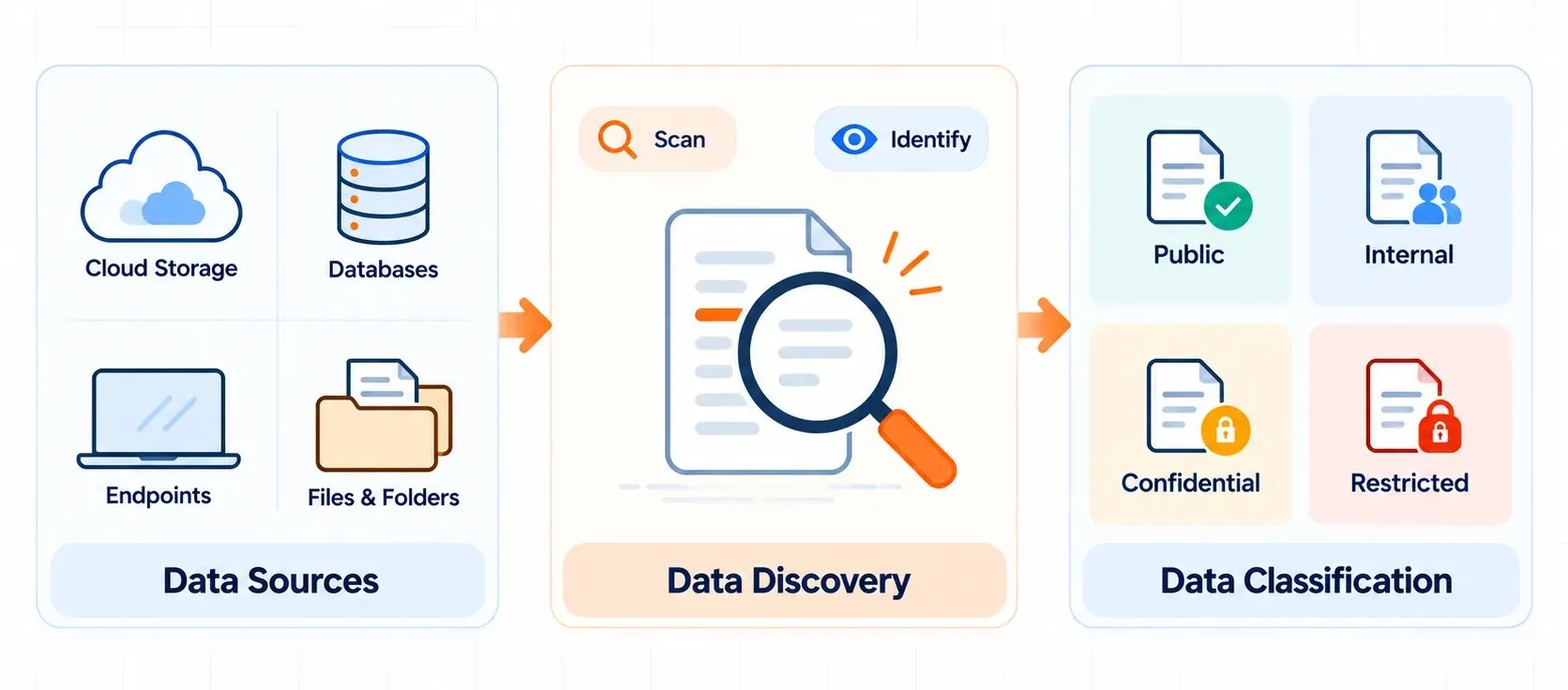
Data discovery and classification boil down to two questions:
- Where is the data?
- What should we do about it?
Data discovery answers the first question, while data classification answers the second. Organizations need both to strengthen data security.
Together, these processes help identify and categorize data spread across SaaS applications, cloud storage, endpoints, databases, AI workflows, and collaboration platforms. As organizations add applications, create files, and share information, their data landscape changes continuously.
Data Discovery
Data discovery is the process of identifying and inventorying data across your systems. It encompasses structured sources, such as databases, data warehouses, and CRM records, as well as unstructured sources, such as files, emails, chat exports, support tickets, PDFs, spreadsheets, and source code.
A strong data discovery capability answers questions such as:
- Which systems store sensitive data, including shadow IT repositories?
- Which data is exposed through public links, overly broad permissions, or risky third-party integrations?
- Who owns the data, who can access it, and how is it being shared?
- Where are copies and duplicates, including forgotten shared folders?
Discovery is not just about creating a list of data sources. It is about building a usable map of your data footprint that stays current as the organization adds new applications, cloud storage buckets, and collaboration spaces.
Data Classification
Data classification is the process of categorizing data by sensitivity, risk, regulatory scope, and business value.
Data classification can be:
- Content-based: Inspects the contents of data to identify sensitive information, such as Social Security numbers, payment card patterns, health record terms, or secrets and credentials.
- Context-based: Considers where the data is stored, who owns it, who can access it, how it is shared, and how it is used.
- Policy-based: Attaches handling requirements to data categories so IT and security teams can enforce them automatically.
Examples of data classification include:
- Sensitivity labels: Public, Internal, Confidential, Restricted.
- Data type labels: PII, PHI, PCI, credentials, IP, customer contracts.
- Handling tiers: Encrypt at rest, restrict sharing, retain for 7 years, delete after 90 days.
What makes classification effective? It should be consistent, explainable, and connected to clear handling rules. Otherwise, labels become noise instead of guardrails.
Data Discovery vs. Data Classification: Key Differences
Both capabilities are equally important, but they solve different problems. Data discovery focuses on coverage and visibility, whereas data classification focuses on understanding data and determining how it should be handled.
Treating them as interchangeable can lead to two common problems: a massive inventory with no clear priorities, or classification labels that cover only a fraction of the organization's systems.
| Differentiator | Data Discovery | Data Classification |
|---|---|---|
| Primary Question | Where is the data and how is it exposed? | What is the data and how should it be handled? |
| Main Output | Inventory of locations, assets, owners, access paths, and duplicates | Labels, categories, and handling rules tied to policy |
| Typical Starting Point | Connectors and scans across SaaS, cloud, endpoints, and databases | Classification schema, policy definitions, and detection logic |
| Unit of Work | Repositories, datasets, folders, file shares, buckets, and applications | Files, records, fields, messages, and sometimes specific data elements |
| Detection Approach | Metadata analysis, indexing, repository mapping, and API-based enumeration | Pattern matching, dictionaries, fingerprints, context analysis, and supervised review |
| Where It Can Break | Missed repositories, limited integrations, stale scans, and encrypted or inaccessible sources | False positives, false negatives, inconsistent labels, and “one rule fits all” schemes |
| Who Uses It Daily | Security, IT, cloud teams, data governance, and application owners | Security, privacy, legal, compliance, records management, and business owners |
| Best For | Reducing blind spots, finding shadow data, and scoping security work | Prioritizing controls, enabling DLP, and supporting retention and access decisions |
| Downstream Integrations | DSPM dashboards, ticketing, asset management, and access reviews | DLP, IAM, access control, encryption, retention, SIEM, and SOAR |
| How Success Is Measured | Coverage across repositories and freshness of inventory | Policy alignment, auditability, and reduction of high-risk exposure |
Put simply, data discovery and classification are complementary. Discovery gives you visibility into your data landscape. Classification tells you what that data means and where to focus first.
How Discovery and Classification Work Together in Real Security Workflows
Data discovery and classification operate in a continuous loop: identify data, classify it, apply controls, and reassess as access permissions and content change.
Here are four key ways these capabilities work together.
1. Offer Visibility for Data Context and Control
Security teams don't always need visibility into all data equally. They need to identify the data that creates risk.
Data discovery locates repositories containing sensitive information, while classification adds context by identifying PII, PHI, customer records, credentials, and other sensitive data types.
Together, these capabilities help security teams answer critical questions:
- Is restricted data stored in an engineering collaboration space?
- Which folders contain regulated data but are shared broadly?
- Are customer exports stored in personal cloud drives?
This approach also helps avoid the unnecessary effort of screening every piece of data with equal priority. Teams can focus first on the systems and repositories with the highest potential risk.
2. Connect Findings to DLP, Access Control, Encryption, and Retention
Discovery and classification become truly useful when their findings inform security controls. Classification labels can drive policies across data loss prevention (DLP), access control, encryption, and records retention tools.
For example:
- DLP: Block uploads of “Restricted: Customer PII” to unmanaged apps or personal email.
- Access control: Remove “Everyone” links from folders containing “Confidential: Contracts.”
- Encryption: Enforce encryption on “Restricted: Financial Reporting.”
- Retention: Apply retention rules to “Compliance: Tax Records” and dispose of records securely when permitted.
Without discovery, DLP policies can miss entire repositories. Without classification, DLP policies can become too broad and create unnecessary business friction.
3. Provide Support for DSPM
Data Security Posture Management (DSPM) relies on an up-to-date view of sensitive data. It combines discovery and classification with data exposure analysis, risk scoring, and remediation.
With DSPM, the question is not only “Where is sensitive data?” but also “Is that sensitive data appropriately protected right now?”
For example, a DSPM workflow may highlight restricted data that is:
- Publicly accessible through link sharing.
- Accessible to dormant accounts.
- Stored outside approved repositories or regions.
- Copied into new locations without appropriate controls.
For distributed businesses, this can make the difference between reactive cleanup and proactive risk reduction. Teams can prioritize high-risk exposures instead of chasing every low-risk finding.
4. Maintain Accuracy as Data Changes
Data is constantly moving. Teams copy files for analysis, export reports to partners or collaborators, and move documents into new project folders.
Discovery identifies new locations and exposures, while classification helps keep labels and handling rules consistent as data changes.
This is where operational discipline matters. If discovery runs once a month and classification runs once a year, the resulting view of the data landscape can quickly become outdated.
Schedule full scans alongside incremental rescans, and prioritize scanning frequency based on risk. This helps teams detect new data locations and exposures while maintaining accurate classifications over time.
Common Implementation Challenges of Data Classification and Discovery
The biggest implementation challenges usually involve coverage gaps, inconsistent labeling, and integration limitations.
Understanding these issues upfront helps organizations build a workflow that scales beyond a one-time assessment.
1. Data Complexity and Visibility Gaps
Modern data environments are complex, hybrid, and constantly changing. Confidential data can exist in approved systems as well as shadow IT tools. It can also move through downloads, APIs, and manual copy-and-paste workflows.
Without connectors for key SaaS applications or cloud repositories, discovery tools may miss sensitive information and potential exposures.
2. Data Accuracy and Classification Consistency
Classification becomes less reliable when different teams label similar data differently or when detection rules are too simplistic.
For example, a keyword rule for “SSN” might detect a policy document but miss an actual list of Social Security numbers stored as images or in unusual formats.
Maintaining consistency requires ongoing rule tuning, data governance, sampling reviews, and exception handling.
3. Privacy, Security, and Compliance Risks
Scanning and inspecting content can raise privacy and compliance concerns, particularly when data is processed across jurisdictions. Security teams should define the purpose of discovery activities, access boundaries, and audit trails.
Many organizations use NIST guidance to frame privacy as an enterprise risk management discipline, supporting a more defensible approach to data discovery and classification.
4. Integration and Technical Limitations
Discovery does not automatically translate into remediation. Organizations need integrations with identity systems, ticketing platforms, DLP, SIEM, and, in some cases, custom workflows.
API rate limits, insufficient permissions, and inconsistent metadata can also limit scan depth across SaaS platforms.
5. High Implementation Costs and Resource Requirements
Tools may be quick to deploy, but an effective program still requires time for policy design, classification schema definition, rule tuning, and stakeholder training.
Under-resourcing can lead to noisy results, inconsistent classifications, or stalled remediation efforts.
6. Continuous Monitoring and Data Changes
Point-in-time scans can create a false sense of control. Continuous monitoring requires a defined scanning cadence, clear ownership, and a process for handling data drift.
This includes identifying new repositories, changing sharing patterns, and new data types introduced by business activities. Organizations also need a clear response process so detected issues are addressed rather than accumulating as unresolved alerts.
7. Lack of Governance and Stakeholder Awareness
Even the best technology cannot replace decisions about what “Confidential” means within an organization.
Successful programs align security, privacy, legal, IT, and business owners on classification definitions, data ownership, and expected handling practices, particularly for high-risk data categories.
How to Evaluate Data Discovery and Classification Tools for Long-Term Use
Use this checklist to evaluate data discovery and classification tools in a way that reflects day-to-day operations.
1. Coverage and Integrations
Confirm that the tool supports the repositories you use today and those you plan to adopt in the future. Look for broad coverage across cloud storage, SaaS applications, databases, endpoints, and collaboration systems. Then validate integration quality, not just “logo coverage,” especially for IAM, SIEM, ticketing, and DLP enforcement.
Helpful questions to ask vendors include:
- Is scanning agentless, agent-based, or both?
- Can it handle multi-tenant SaaS environments and multiple cloud accounts effectively?
- How often does the platform rescan and detect changes?
2. Classification Flexibility and Explainability
Your classifications should match your business requirements. Look for flexible rules, support for custom categories, and explainable detections so analysts can understand why a file was labeled. If AI is used, its decisions should be reviewable and auditable rather than a black box.
Also confirm whether classification can operate at different levels of detail, such as labeling a folder broadly while applying more precise categories to individual files or records.
3. Remediation and Security Integrations
Tools should help you act on findings. Prioritize platforms that support automated remediation workflows or provide clear handoffs to systems that enforce policies, such as DLP software, access controls, encryption, and retention tools.
Look for the ability to route findings to the appropriate owner. In many organizations, security teams can flag an issue, but only the business owner can confirm whether the data should exist in that location.
4. Governance, Reporting, and Total Cost
Look for reporting that supports audits and operational metrics, including where restricted data resides, how exposure is trending, and what remediation has occurred.
Also account for the total cost, including connectors, agents, professional services, and the ongoing effort required to tune detections and policies.
Conduct a Full-Spectrum Data Discovery and Classification With miniOrange
If you want to connect visibility and enforcement more closely, a unified platform can reduce handoffs between tools that find data and tools that protect it. This matters when your team needs to move quickly from exposure detection to remediation.
miniOrange positions its offering around combining discovery, classification, monitoring, and DLP-style policy enforcement to help teams reduce data risk across common enterprise channels.
As with any vendor, validate coverage for your specific SaaS applications, cloud environments, and endpoints, along with how classifications translate into enforceable controls.
- Automated discovery: Identify where sensitive data exists across supported repositories so teams can reduce blind spots and prioritize high-risk locations.
- Context-aware classification: Classify data based on content and context so labels support security, privacy, and compliance decisions rather than serving as generic tags.
- Automatic tagging and labeling: Apply labels consistently at scale to support downstream controls, including DLP policies, access decisions, encryption requirements, and retention workflows.
Book a demo or start a free trial to see how miniOrange fits your environment and data risk priorities.
Frequently Asked Questions
1. How do data discovery and classification support DLP?
DLP tools enforce rules about where sensitive data can go and who can share it. Data discovery helps DLP controls identify which repositories and data flows to monitor. Data classification provides the labels and categories DLP policies rely on, such as “Restricted: PII” or “Confidential: Contracts.” Together, they reduce coverage gaps and overly broad blocking.
2. What is the difference between data classification and data labeling?
Classification is the decision-making process that determines a category based on data sensitivity and defined rules. Labeling is the practical output, such as a tag, header, metadata value, or policy marker applied to a file, record, or message.
3. Is data discovery capability required for GDPR or HIPAA compliance?
Regulations generally do not mandate a specific product feature, but they do expect organizations to understand where regulated data is stored and apply appropriate safeguards. Data discovery helps organizations maintain that understanding at scale.
4. What are the differences between DSPM, DLP, and data discovery and classification?
Data discovery locates data across an environment, while classification categorizes it by type and sensitivity. Data Security Posture Management (DSPM) builds on these capabilities to assess exposure, identify excessive access, and prioritize risks for remediation. Data Loss Prevention (DLP) monitors data use and movement, enforcing policies to prevent unauthorized sharing or data leakage.
About the Author

Content Writer
With a background in Journalism and extensive experience in SaaS and cybersecurity content writing, Chaitali Avadhani has contributed to creating various forms of impactful content pieces across multiple verticals. At miniOrange, her role is to craft SEO-friendly and lead-generating content around Identity and Access Management (IAM) products and cybersecurity as a whole.
Leave a Comment