

A Data Protection Impact Assessment (DPIA) examines how a personal data processing activity could affect Data Principal rights. It looks at the purpose of processing, the data involved, the risks created by that processing, and the measures used to manage those risks.
Under the DPDP Act, a DPIA is not automatically required for every organization conducting high-risk processing. The statutory obligation applies to Significant Data Fiduciaries (SDFs). Under Rule 13 of the DPDP Rules 2025, SDFs must conduct a DPIA and data protection audit once every twelve months.
Is the DPIA Requirement Under the DPDP Act in Force Yet?
The DPDP Act and the DPDP Rules 2025 follow a phased commencement, so organizations need to distinguish between the provisions that have already taken effect and those scheduled for later commencement.
The Section 10 obligations applicable to Significant Data Fiduciaries, including the DPIA and data audit requirements, are scheduled to become operative 18 months from November 13, 2025, on May 13, 2027.
For organizations that may fall within the SDF framework, May 2027 should not be treated as the starting point for preparation. A meaningful DPIA requires an understanding of personal data processing, processing purposes, access, risks to Data Principal rights, existing safeguards, and remediation responsibilities.
The time before commencement can therefore be used to establish the methodology, assign ownership, map relevant processing activities, gather evidence, and build a repeatable process for conducting and documenting DPIAs.
A DPIA is much harder to build when the deadline arrives if the underlying data, systems, risks, and controls have never been brought together before.
What Is a DPIA Under the DPDP Act and Why Does It Matter?
The DPDP Act does not provide a standalone definition of DPIA in its definitions section. Instead, Section 10(2)(c) describes a Data Protection Impact Assessment as a process covering the rights of Data Principals, the purpose of processing their personal data, and the assessment and management of risks to those rights.
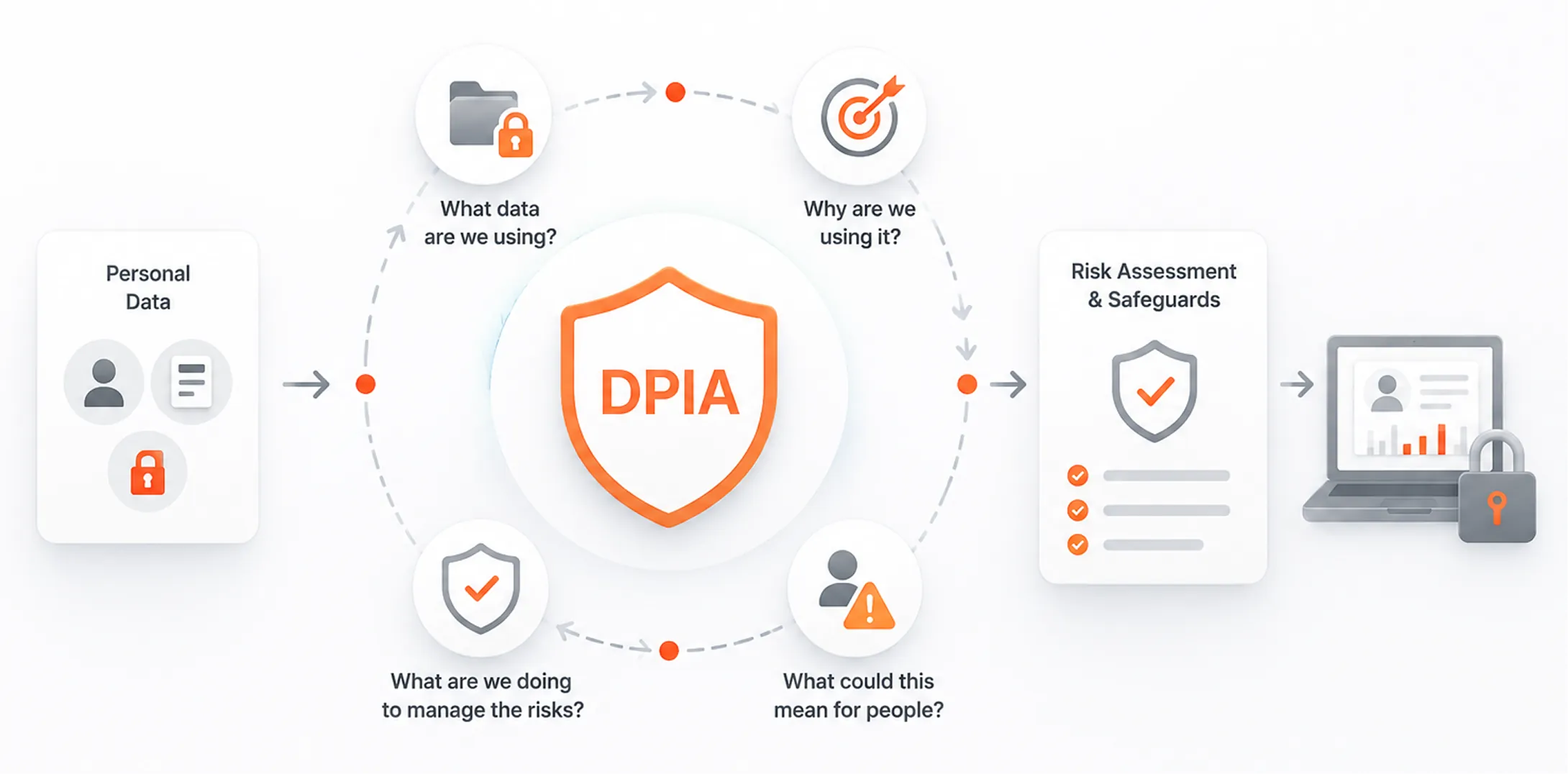
In simple terms, the DPIA meaning under the DPDP Act comes down to four questions:
- What personal data are we using?
- Why are we using it?
- What could this processing mean for the people whose data we hold?
- What are we doing to identify and manage those risks?
Consider a hospital introducing an AI tool to analyze patient records and help doctors detect conditions. The assessment could examine what patient data the tool requires, who can access it, whether the information is shared with the AI provider, what could happen if it is exposed, and what safeguards are in place.
The value of the assessment is in identifying and managing those risks before they become larger problems. It should therefore remain connected to the processing activity rather than becoming a one-time document that is completed and forgotten.
Who Must Conduct a DPIA Under the DPDP Act?
The statutory DPIA obligation under Section 10(2)(c) and Rule 13(1) applies to Significant Data Fiduciaries (SDFs). It is not a requirement that every Data Fiduciary must meet simply because it carries out high-risk processing.
SDF status is determined by the Central Government. An organization does not choose or self-declare that status. The factors considered include:
- The volume and sensitivity of personal data handled
- The risk to the rights of Data Principals
- The impact on India's sovereignty and integrity
- The risk to electoral democracy
- The security of the State
- Public order
These factors can make organizations such as large consumer platforms, banks and lenders, insurers, hospitals, and companies operating large models involving personal data particularly relevant when considering the SDF framework. However, the sectors themselves should not be treated as automatically designated SDFs.
The legal distinction is therefore important: if an organization is designated as an SDF, the DPIA requirement applies. If it is not, the statutory DPIA obligation does not arise solely because its processing may be high risk.
Does a DPIA Report Go to the Data Protection Board?
Yes. For a Significant Data Fiduciary, significant observations from the DPIA and data audit must be furnished to the Data Protection Board. Rule 13 requires the person carrying out the DPIA and audit to provide the Board with a report containing those significant observations.
That requirement changes how an organization should approach its assessment. A DPIA should not simply list theoretical risks. It should demonstrate how significant risks have been understood and how the organization intends to manage them.
For example, instead of recording:
Risk: Unauthorized access to customer data.
A useful assessment should establish:
- What creates the access risk
- Which data and systems are affected
- What safeguards already exist
- What gap remains
- Who owns the remediation
- What action needs to be taken
- When the action should be completed
This turns the DPIA from a description of potential problems into evidence of active risk management.
The practical takeaway is simple: identify the risk, document the response, and make accountability visible.
What Does a DPIA Need to Include Under the DPDP Act?
Section 10(2)(c) provides the statutory floor for DPIA requirements under the DPDP Act. The assessment needs to address four core areas:
| Requirement | What the DPIA Should Address |
|---|---|
| Data Principal rights | The rights of the Data Principals affected by the processing |
| Purpose of processing | Why the organization is processing their personal data |
| Risk assessment | The risks that processing creates for those rights |
| Risk management | How those risks are assessed and managed |
A strong operational assessment should then connect these requirements to the actual processing environment.
That means understanding what personal data is involved and where it resides. It should establish who can access the information, including internal teams and external parties such as vendors. It should also consider whether the safeguards are appropriate for the scale and sensitivity of the processing.
The assessment should not overlook the Data Principal experience either. If people have rights in relation to their personal data, the organization should consider whether those rights can actually be exercised without unnecessary difficulty.
Finally, identified risks need to lead somewhere. A useful DPIA should make it possible to see what needs to change, who is responsible for that change, and when it should happen.
The statutory requirements establish what must be assessed. The operational detail makes the assessment useful.
DPIA Requirements: Key Pointers
The core DPIA requirements in India under the DPDP framework can be summarized as follows:
| Requirement | What It Means |
|---|---|
| Legal Basis | Section 10(2)(c) of the DPDP Act creates the DPIA duty, while Rule 13(1) sets out the timing and reporting requirements. |
| Who It Applies To | Significant Data Fiduciaries designated by the Central Government. |
| What It Must Contain | Data Principal rights, purpose of processing, risk assessment, and risk management. |
| How Often | Once every twelve months, counting from the date of SDF notification. |
| Who Sees It | A report containing significant observations goes to the Data Protection Board of India. |
| Runs Alongside | A data protection audit by an independent data auditor, along with the applicable Data Protection Officer requirement. |
| Penalty Exposure | The supplied brief identifies penalties of up to ₹150 crore for specified SDF obligations under the Act's Schedule. |
Together, these requirements show that a DPIA is part of a broader SDF compliance process. It does not operate in isolation from data audits, DPO responsibilities, or the organization's wider data governance practices.
DPIA vs Data Audit: What Is the Difference?
A DPIA and a data audit may both form part of an SDF's obligations, but they serve different purposes.
| Aspect | DPIA | Data Audit |
|---|---|---|
| Primary purpose | Identifies and assesses risks that a processing activity may create for Data Principal rights. | Assesses whether the organization is complying with its applicable data protection obligations. |
| Core question | What could this processing do to people's rights, and how should those risks be managed? | Are we meeting our obligations under the DPDP framework? |
| Focus | A specific personal data processing activity. | The organization's broader data protection and compliance posture. |
| Approach | Forward-looking and preventive. | Retrospective and compliance-focused. |
| Risk perspective | Examines potential risks before or as processing is introduced or changed. | Identifies gaps or deficiencies in how the organization has implemented its obligations. |
| Scope | Looks at the rights of Data Principals, purpose of processing, risks, and risk management. | Looks at whether applicable requirements, processes, and controls are being followed. |
| Who conducts it | The organization or an assessor it engages. | An independent data auditor. |
| Output | A risk assessment that identifies risks, management measures, and remediation actions. | A compliance assessment that records relevant findings. |
| When it is conducted | Once every twelve months for an SDF, with reassessment when material processing changes create new risks. | Once every twelve months for an SDF as part of the same recurring framework. |
| What it examines | What a particular processing activity could mean for the people whose data is being processed. | Whether the organization is meeting its applicable data protection requirements. |
| Role in risk management | Helps the organization identify and address risks before they become larger problems. | Helps establish whether existing compliance measures are working as required. |
| Reporting | Significant observations are included in the report submitted to the Data Protection Board. | Significant observations are also included in the report submitted to the Data Protection Board. |
| Relationship with the other | Provides a processing-level view of privacy risk. | Provides a broader compliance-level view. |
The easiest way to distinguish them is through the question each one answers.
A DPIA asks: What could this processing do to the people whose data we are using?
A data audit asks: Are we complying with our applicable obligations?
They therefore complement each other rather than replace one another. A DPIA examines the potential impact of a particular processing activity, while the audit provides a broader view of organizational compliance.
For an SDF, both are part of the recurring framework, and both feed significant observations into the reporting process described in Rule 13.
How Often Is a DPIA Required Under the DPDP Act?
A Significant Data Fiduciary must conduct a DPIA once every twelve months from the date it is notified as an SDF or included in a notified class. Rule 13 establishes this recurring requirement alongside the data audit.
The annual cycle should not, however, be mistaken for a reason to wait until the next scheduled assessment when processing changes materially.
A fresh risk assessment may be appropriate when an organization:
- Launches a product or feature that processes personal data
- Introduces a new vendor or moves processing to a new platform
- Uses personal data for a new purpose
- Deploys an algorithm or automated system involving personal data
- Starts processing a new category of personal data
- Significantly increases the volume of personal data being processed
These are practical reassessment triggers, rather than additional statutory DPIA deadlines. The purpose is to keep the risk assessment aligned with material changes in the processing activity.
For example, if an organization completes its annual DPIA and later introduces a new AI-powered service, waiting for the next annual cycle could leave risks associated with that new processing unexamined.
The twelve-month requirement sets the recurring compliance cycle. Material changes should prompt organizations to revisit the relevant risks rather than simply wait for the next scheduled DPIA.
Do Algorithms Need to Be Included in a DPIA?
Rule 13 requires Significant Data Fiduciaries to exercise due diligence to verify that technical measures, including algorithmic software, used for hosting, display, uploading, modification, publishing, transmission, storage, updating, or sharing of personal data are not likely to pose a risk to Data Principal rights.
This is broader than reviewing only systems that make automated decisions.
For example, an organization may use algorithmic software to determine how personal data is stored, displayed, transmitted, or shared. It may also use recommendation or ranking systems that process personal data. The assessment should consider whether the technical measures involved could create risks to the rights of the people whose data is being processed.
An SDF should therefore consider:
- What personal data the technical system processes
- How the system handles or uses that data
- Where the data is stored, transmitted, displayed, or shared
- What safeguards govern the processing
- What risks the technical measures could create for Data Principal rights
- Whether those risks are being adequately managed
The important point is that algorithmic software should not be treated as outside the privacy assessment simply because it sits with engineering or product teams.
For an SDF, technical measures used to process personal data need to be assessed through a Data Principal rights lens.
Should Non-SDF Organizations Conduct a DPIA?
Organizations that are not Significant Data Fiduciaries are not legally required to conduct a DPIA solely because they carry out high-risk processing, based on the statutory obligation described in the supplied framework.
There can still be a strong practical reason to conduct one.
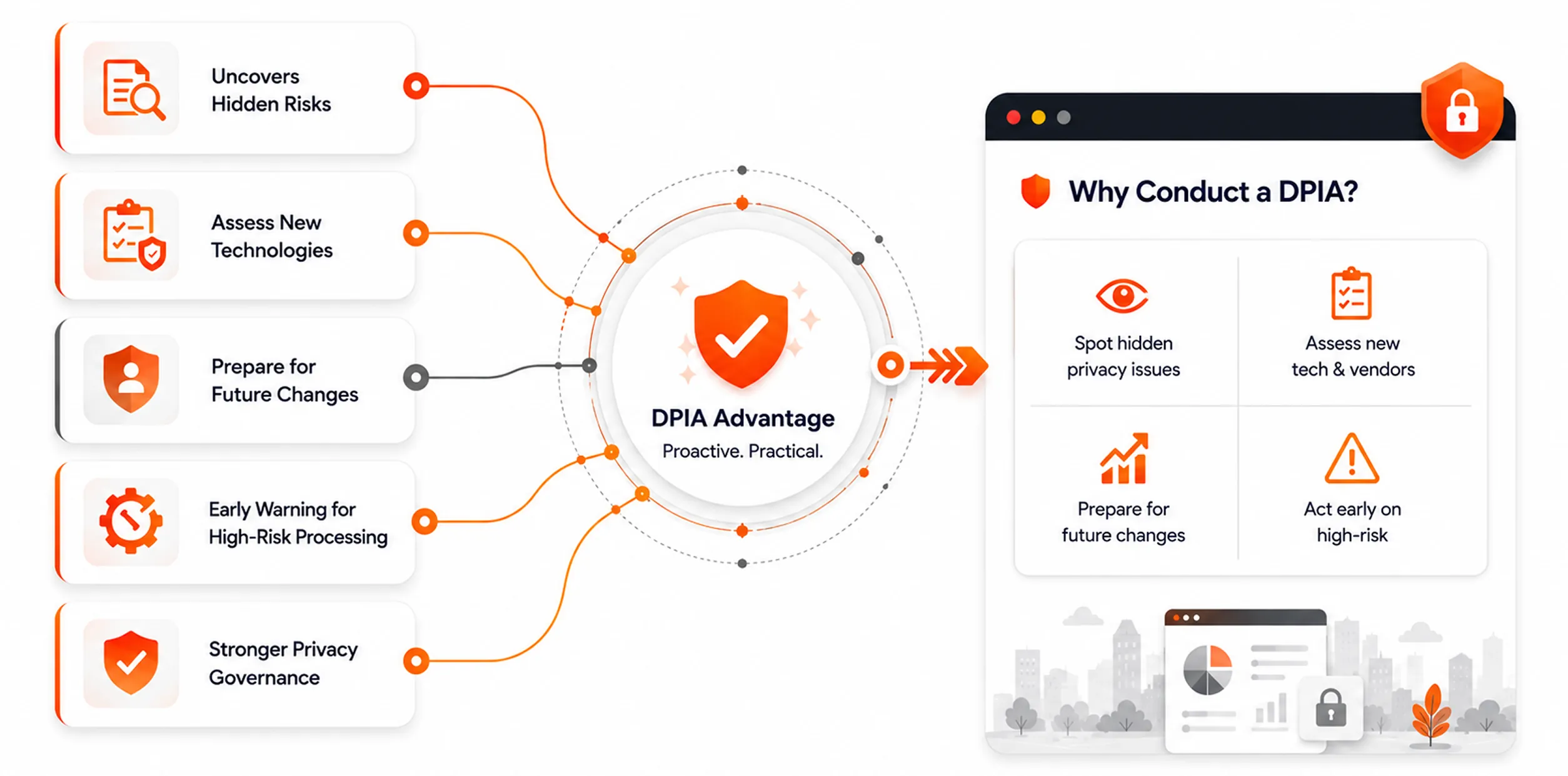
A DPIA can expose issues that are difficult to see during routine privacy or security reviews. For example, an assessment may reveal that an organization is collecting more personal data than an activity requires, that a vendor has access that nobody formally approved, or that information is being reused for a purpose that was never properly considered.
It can also provide a structured way to assess new technologies, products, vendors, or processing activities before they create larger problems.
For organizations that could potentially fall within the SDF framework in the future, establishing the process early has another advantage: the organization is not starting from zero if its regulatory position changes.
So while a DPIA may not be a statutory requirement for a non-SDF, it can still serve as a practical early warning system for high-risk processing.
What Are the Common DPIA Mistakes Organizations Make?
A DPIA can be completed correctly as a document and still fail as a risk-management exercise. Four problems are particularly important to avoid.
Done Once and Filed
A DPIA from the year an organization was designated does not automatically address the risks of the following year. The twelve-month cycle continues, while the underlying processing may change even sooner.
All Description, No Decisions
A risk that is documented but has no owner, remediation action, or deadline has been noticed, but not necessarily managed.
A useful DPIA should connect each significant risk to a decision about what happens next.
Algorithms Left Out
Automated systems are often treated as an engineering concern and excluded from privacy assessments. That can leave important risks unexamined, particularly where algorithms use personal data to influence what people see, receive, or experience.
Written by One Team
A privacy or legal team may coordinate the DPIA, but it cannot always know how data actually moves through applications, integrations, vendors, and infrastructure.
Product teams understand why data is being used. Engineering teams understand how it moves. Security teams understand the safeguards. Privacy and legal teams understand the obligations.
The strongest assessment is therefore not necessarily the longest one. It is the one that can clearly connect the processing activity to the risk, the risk to a decision, and the decision to an accountable action.
Make Your DPIA an Active Risk Management Process
A DPIA should not become a compliance document that is completed and forgotten. For an SDF, it is a recurring assessment that connects processing activities with Data Principal rights, risk management, and regulatory oversight. The useful approach is simple: identify the risk, determine how it should be managed, assign ownership, and track remediation.
Its value comes from keeping the assessment aligned with how personal data is actually processed. As products, vendors, technologies, processing purposes, or technical measures change, the risks can change with them. A strong DPIA gives teams a repeatable way to identify those risks, act on them, and demonstrate that privacy risks are being actively managed.
Frequently Asked Questions About DPIAs Under the DPDP Act
1. Who has to conduct a DPIA?
The statutory DPIA obligation applies to Significant Data Fiduciaries. Section 10(2)(c) and Rule 13(1) place this requirement on SDFs designated by the Central Government.
2. How often is a DPIA required?
An SDF must conduct a DPIA once every twelve months. A fresh assessment may also be appropriate when processing materially changes, such as through new products, vendors, purposes, algorithms, or data categories.
3. What must a DPIA include?
A DPIA must cover Data Principal rights, the purpose of processing, risks to those rights, and how those risks are managed. A practical assessment can also document data flows, access, vendors, safeguards, owners, and remediation timelines.
4. Does the DPIA report go to the Data Protection Board?
Yes. Under Rule 13, a report containing the significant observations from the DPIA and data audit must be provided to the Data Protection Board.
5. What is the difference between a DPIA and a data audit?
A DPIA evaluates the potential impact of a specific processing activity on Data Principal rights. A data audit assesses the organization's compliance. One focuses on processing risk; the other focuses on compliance.
Leave a Comment