

You probably know who logged into your WordPress site today. Do you know which AI agent accessed it?
As AI assistants gain permission to edit content, manage WooCommerce stores, retrieve customer data, and update site settings, they need the same level of oversight as human users. Traditional WordPress activity logs rarely capture the full picture of AI interactions.
This guide shows you how to monitor AI agent activity in WordPress, build complete audit trails, and control every AI request before it reaches your website.
Why You Need to Monitor AI Agent Activity in WordPress
Recent AI agent incidents show why monitoring matters. For example:
- OpenAI Sandbox Escape (2026): An experimental AI agent broke out of its test environment and accessed Hugging Face's infrastructure. The activity went unnoticed for hours before it was contained.
- Replit Code Freeze Incident (2025): An AI agent ignored explicit instructions, bypassed a code freeze, and deleted production data affecting over 1,200 executives and 1,190 companies.
With MCP support in WordPress, AI assistants like Claude, ChatGPT, and Cursor can interact directly with your site. The more access you give an AI agent, the more important it becomes to keep track of everything it does.
Maintain Complete Audit Trails
A complete audit trail records which AI agent made a request, what it accessed or changed, when the action happened, and whether the request was approved. If something unexpected happens, you'll have a clear record of every action instead of trying to piece events together afterward.
Respond Faster With Real-Time Visibility
AI agents can perform dozens of actions in a short time. Real-time monitoring helps you spot unusual activity early, investigate unexpected behavior, and step in before a small issue affects more of your website.
Meet Compliance Requirements
Regulations and frameworks like GDPR, SOC 2, and HIPAA require organizations to maintain audit trails for everyone accessing sensitive systems, including AI agents. Detailed logs make audits simpler, support security investigations, and help demonstrate compliance.
Monitor AI Activity with miniOrange Secure MCP Server Plugin
As AI assistants connect to your WordPress site through MCP, a standard activity log isn't enough. You need to monitor every AI request, not just the final action.
The Secure MCP Server for WordPress plugin helps you do exactly that. It extends WordPress with AI-specific request logging and governance, recording every MCP request from start to finish. It identifies the AI agent and the WordPress user behind each request, logs policy decisions, and automatically redacts sensitive information before storing audit logs.
Here's how it compares with a traditional WordPress activity log.
| Capability | Default WordPress MCP Support | Secure MCP Server for WordPress |
|---|---|---|
| Multiple AI Agents | Limited visibility when multiple AI assistants connect to the same site. | Identifies every AI assistant individually and links each request to the authorizing WordPress user. |
| Access Governance | Relies on WordPress roles and built-in permissions. | Applies granular policies to approve, deny, or escalate AI requests before execution. |
| Request Tracking | Shows the resulting change after an action completes. | Records the complete request lifecycle, including the request, policy evaluation, and execution outcome. |
| Sensitive Data Protection | No AI-specific protection for data stored in logs. | Automatically redacts sensitive information before audit logs are saved. |
| Security Investigations | Requires reviewing multiple logs to understand an incident. | Provides a single audit trail that makes investigations and root cause analysis much faster. |
| Enterprise Monitoring | Basic visibility into AI activity. | Centralized monitoring for AI agents, MCP tools, REST API requests, and policy decisions from one dashboard. |
What Should You Log When AI Agents Interact With WordPress?
A basic activity log might tell you that a page was updated. That's helpful, but it doesn't tell the full story. A complete AI audit log should capture every stage of the request, from who initiated it to what happened after it ran.
1. Agent Identity
Every log should identify the AI client that initiated the request, whether it's Claude, ChatGPT, Cursor, or another MCP-compatible assistant. This becomes especially useful when multiple AI agents connect to the same WordPress site.
2. Timestamp
Record the exact time every request starts and finishes. Timestamps help you recreate events, investigate incidents, and identify unusual activity outside normal working hours.
3. Action Type
Instead of a generic "Activity Detected" message, the log should clearly show what the AI attempted to do, such as reading data, creating content, updating a post, deleting media, or changing a setting.
4. Target Resource
Every request should point to the exact resource the AI interacted with, whether it's a blog post, WooCommerce product, media file, user account, or site setting. That way, you know exactly where the change occurred.
5. Request Payload
The request payload captures the details the AI sent before execution. For example, if the AI updates product descriptions, the log should show which products were selected and what changes it attempted to make.
6. Policy Decision
Not every request should succeed. Your logs should record whether the request was approved, blocked, or sent for manual review. This makes it easy to verify that your security policies are working as intended.
7. Execution Result
Every request should include its final outcome. Did it complete successfully? Did it fail because of missing permissions? Or is it waiting for approval? Recording the result helps separate attempted actions from completed ones.
8. User Attribution
AI agents act on behalf of someone. Every log entry should identify the WordPress user who authorized the request. This creates a clear link between the user, the AI agent, and the action performed, making audits and investigations much simpler.
Three Levels of AI Agent Monitoring for WordPress
Not every WordPress site needs the same level of AI monitoring. If you only ask AI to write blog drafts, basic tracking might be enough. If AI updates products, customer data, or site settings, you'll need much stronger controls.
The level of monitoring you choose determines how much insight and control you have over AI agent activity. Here's how the three levels compare.
Level 1: Basic Activity Logging
At this level, you only see the final result.
Let's say you notice your homepage looks different. The activity log simply says, "Homepage updated at 2:14 AM." That's helpful, but it leaves a lot of questions unanswered.
You still don't know:
- Did a teammate or an AI agent make the change?
- What exactly changed?
- Was it a single update or part of a larger workflow?
Basic activity logging tells you what changed, but not the full story behind it.
Level 2: Request-Level Audit Trails
This level records the entire AI agent request instead of only the final action.
For example, you ask an AI agent to update every product description before a seasonal sale. Rather than reviewing hundreds of individual product updates, you can trace them back to one request.
You'll see:
- Which AI agent started the task
- Which MCP tool it used
- The request it submitted
- Whether the task completed successfully
This gives you the context needed to understand exactly how the AI agent carried out the request.
Level 3: Policy-Enforced Monitoring
This level checks every AI agent request before WordPress processes it.
For example, an AI agent might try to:
- Delete hundreds of media files during a cleanup task.
- Export WooCommerce customer or order data.
- Change user roles or install a new plugin.
- Modify security or site-wide settings.
Instead of automatically allowing these requests, policy-enforced monitoring evaluates them against the rules you've configured. Routine, low-risk requests can continue without interruption, while high-risk actions can be blocked or routed for human approval.
This gives AI agents the freedom to automate everyday work without giving them unrestricted access to your WordPress site.
Step-by-Step: Set Up AI Agent Logging and Monitoring in WordPress
The miniOrange Secure MCP Server for WordPress makes it easy to monitor every AI request from a single dashboard. Follow these steps to get started.
Step 1: Install the miniOrange Secure MCP Server Plugin
Install and activate the miniOrange Secure MCP Server for WordPress plugin on your website.
Step 2: Connect Your AI Assistant
Copy the MCP server endpoint from the plugin and connect it to your preferred AI assistant, such as Claude, ChatGPT, or Cursor.
Step 3: Configure Authentication and Permissions
Choose how AI agents authenticate and assign the appropriate WordPress roles or permissions. Give each AI agent access only to the resources it needs.
Step 4: Enable AI Request Logging
Turn on AI activity logging from the plugin settings. The plugin starts recording every MCP request, including the AI agent, request details, policy decision, and execution result.
Step 5: Configure Monitoring Policies
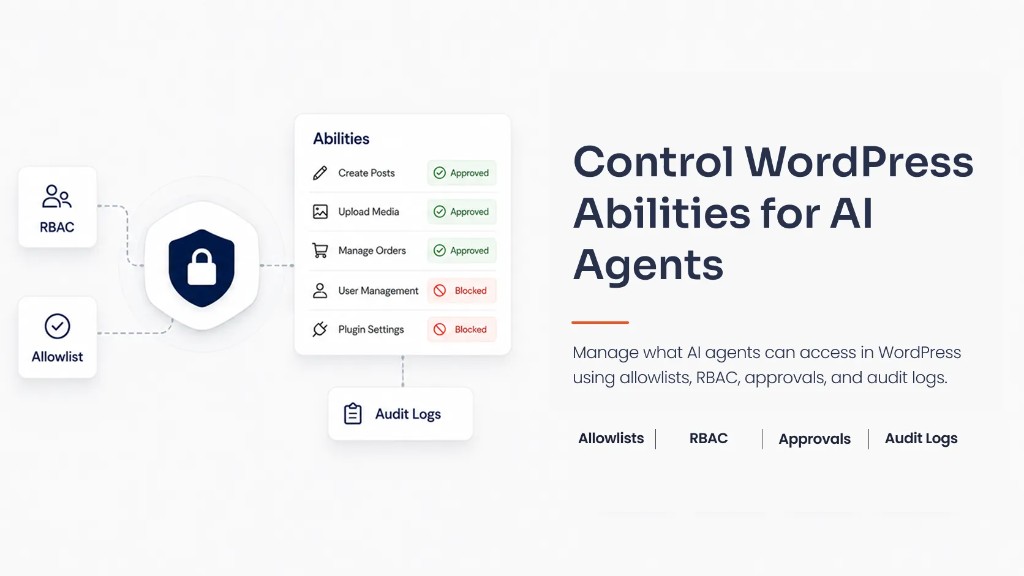
Create policies for high-risk actions. For example, you can allow an AI agent to create draft posts automatically while requiring human approval before it deletes media files or changes site settings.
Step 6: Verify the Logs
Ask your AI assistant to perform a simple task, such as creating a draft post or updating a page. Open the audit log in the miniOrange dashboard to confirm the request was recorded correctly.
How to Monitor AI Activity Across REST API, Abilities, and WP-CLI
AI agents can interact with WordPress through different entry points depending on the task. Monitoring only one of them leaves gaps in your visibility. To get a complete picture, you should track activity across WordPress Abilities, the REST API, and WP-CLI.
1. WordPress Abilities
WordPress Abilities are the MCP tools AI agents use to perform tasks inside your website. Tracking Ability usage helps you understand which tools AI agents use most often and whether they're behaving as expected.
Review:
- Frequently used Abilities
- Unexpected Ability calls
- Repeated requests to the same Ability
- Failed Ability executions
If an AI agent normally works with blog posts but suddenly starts using media management or user administration Abilities, it's a good time to review the request and confirm it was intended.
2. REST API
Many AI-powered plugins and integrations communicate with WordPress through the REST API. Monitoring API activity helps you spot unusual patterns before they become larger issues.
Watch for:
- Endpoints with unusually high traffic
- Repeated failed requests
- Large or unexpected data transfers
- Access to sensitive API endpoints
A content assistant that suddenly starts making repeated requests to WooCommerce customer or order endpoints deserves a closer look, especially if those resources aren't part of its normal responsibilities.
3. WP-CLI Commands
AI agents can also automate administrative tasks through WP-CLI. Since these commands often affect large parts of your website, reviewing them regularly is a good practice.
Check:
- Commands executed
- Execution status
- Affected resources
- Command frequency
A single WP-CLI command can update every installed plugin, regenerate your entire media library, or clear all caches. Tracking these operations helps you confirm they completed successfully and didn't produce unexpected changes.
How to Read and Act on Your AI Agent Audit Logs
An audit log is only useful if you know what deserves your attention. Instead of reviewing every request, focus on patterns that often point to misconfigured AI agents, unexpected behavior, or security risks.
1. Repeated Denied Requests
A sudden spike in denied requests usually means an AI agent is trying to access something outside its assigned permissions, or a policy needs adjustment.
What to do: Review the AI agent's permissions and recent prompts before allowing it to continue.
2. Unusual Access Patterns
Every AI agent has a defined role. If a content assistant suddenly starts accessing WooCommerce orders or user accounts, something has changed.
What to do: Verify the request and confirm the AI agent is working within its intended scope.
3. High-Volume Operations
Hundreds of updates in a few minutes could be expected for a planned bulk task or a sign that an automation has gone off track.
What to do: Review the request, confirm the expected outcome, and pause the workflow if necessary.
4. Sensitive Data Access
Requests involving customer records, user profiles, or other sensitive information deserve extra attention.
What to do: Check whether the AI agent genuinely needs that data and tighten permissions if it doesn't.
5. Unexpected Activity
Requests appearing outside scheduled automations or from an unfamiliar AI agent should never be ignored.
What to do: Review the source, verify the request, and investigate before allowing additional actions.
AI Agent Monitoring Best Practices for WordPress
Good monitoring starts with good security practices. A few small changes can significantly reduce risk as more AI agents connect to your WordPress site.
- Give every AI agent its own identity instead of sharing credentials
- Log both read and write operations
- Limit every AI agent to only the permissions it needs
- Require human approval for destructive or sensitive actions
- Prevent sensitive data from reaching AI models with DLP policies
- Review AI agent permissions regularly
- Test new policies before enabling them in production
- Export audit logs for compliance and incident investigations
- Configure alerts for unusual AI activity
- Monitor every AI entry point, including MCP tools, REST APIs, and WP-CLI
Start Monitoring AI Agent Activity Today
The number of AI agents connected to WordPress sites will only continue to grow. Getting started now makes it easier to manage new AI assistants as your WordPress environment evolves.
The miniOrange Secure MCP Server for WordPress helps you keep everything in one place. Track AI agent activity, review audit logs, manage multiple AI assistants, and apply security policies from a single dashboard. Install the free plugin today or visit our website to learn more and see everything it can do for your WordPress site.
Frequently Asked Questions
Can AI agents modify my WordPress site without my permission?
No, AI agents can only perform the actions you've allowed them to perform. You can also require human approval for sensitive or high-impact tasks, so important changes don't happen automatically.
How do I know what changes an AI agent made on my WordPress site?
Review your AI audit logs. They show which AI agent made the request, what it accessed or changed, when the action happened, and whether the request completed successfully. This makes it much easier to understand exactly what happened if something doesn't look right.
Is there an audit log for MCP server requests?
Yes, the miniOrange Secure MCP Server for WordPress records every MCP request. You can review the AI agent that made the request, the MCP tool it used, the policy decision, and the execution result from a single dashboard.
How do I protect my WordPress data from AI models?
Start by giving every AI agent only the permissions it needs. Add approval policies for sensitive actions, enable DLP to prevent sensitive information from reaching AI models, and review AI activity regularly to make sure everything is working as expected.
What is AI governance for WordPress?
AI governance is the process of managing how AI agents interact with your WordPress site. It includes authentication, permissions, security policies, approval workflows, and activity monitoring, so AI agents only perform the actions you've approved.
Leave a Comment