
Every organization processes personal data. But very few can instantly answer a simple question: What happens to that data after it's collected? From customer information and employee records to vendor details, personal data moves across teams, applications, and third parties every day.
Without a clear record of these activities, demonstrating compliance can quickly become a challenge. That's where a Record of Processing Activities (RoPA) comes in. It helps organizations document, understand, and govern how personal data is processed, making it a foundational element of modern privacy programs, including those aligned with the DPDP Act.
TL;DR
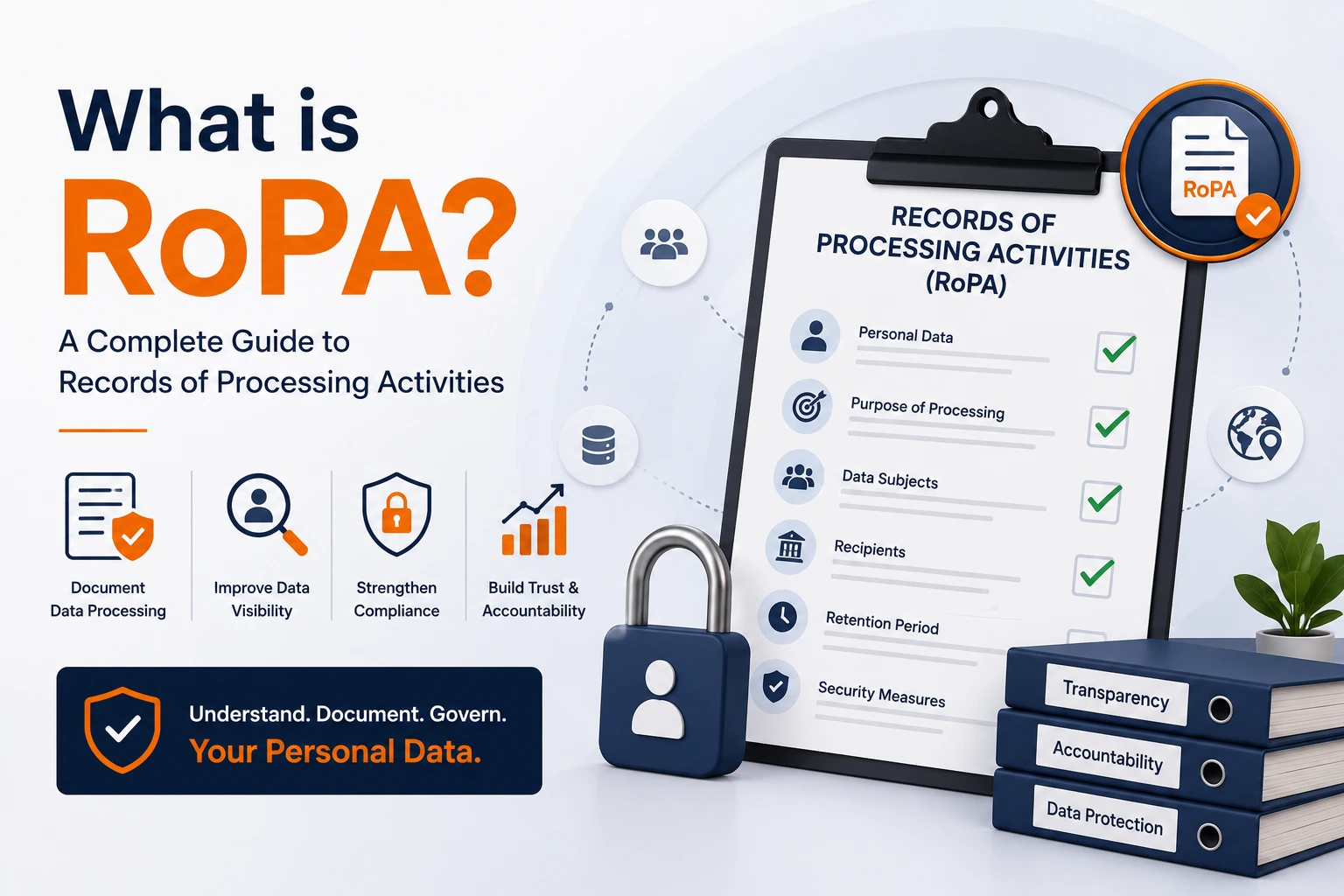
- RoPA (Records of Processing Activities) tracks how organizations collect, use, store, share, and delete personal data.
- Defined under GDPR Article 30, it supports privacy compliance and accountability.
- While not mandatory under the DPDP Act, RoPA helps demonstrate compliance, especially for Significant Data Fiduciaries.
- It includes data processing purposes, personal data categories, Data Principals, recipients, retention, security measures, and cross-border transfers.
- Maintaining a RoPA improves audit readiness, data governance, and breach response.
- Modern privacy tools automate RoPA using data discovery, consent management, and governance workflows.
What is a Record of Processing Activities (RoPA)?
Definition: A Record of Processing Activities (RoPA) is a centralized record that documents how an organization collects, uses, stores, shares, transfers, retains, and deletes personal data. It records each processing activity, its purpose, the categories of data involved, who can access it, where it is stored, and the safeguards used to protect it.
RoPA was introduced under Article 30 of the General Data Protection Regulation (GDPR) to help organizations maintain documented records of their personal data processing activities. It supports the GDPR's accountability principle by enabling organizations to demonstrate that personal data is processed responsibly and in accordance with applicable privacy requirements.
While its origins lie in the GDPR, RoPA has become a widely adopted privacy best practice. Many organizations maintain one even when local privacy laws don't explicitly require it because it strengthens governance, improves visibility into personal data, and simplifies compliance efforts.
A well-maintained RoPA typically provides visibility into:
- Processing activities across the organization
- Categories of personal data and Data Principals
- Processing purposes
- Internal teams and third parties accessing the data
- Data retention periods
- Cross-border data transfers
- Security measures protecting personal data
Instead of scattered spreadsheets and departmental records, a RoPA provides a centralized, up-to-date view of personal data processing across the organization.
Think of a RoPA as your organization's master register for personal data processing.
Benefits of Maintaining a RoPA
A well-maintained RoPA delivers value far beyond regulatory compliance. It helps organizations understand, manage, and improve how personal data is handled across the business.
Faster Compliance Audits
Maintain a centralized record of processing activities that can be quickly shared with auditors or regulators, reducing time spent gathering documentation.
Easier Breach Investigations
Quickly identify the systems, business processes, and personal data involved in an incident to support faster assessment and response.
Better Vendor Oversight
Track which vendors and third parties access personal data, making it easier to review contracts, monitor data sharing, and reduce third-party risk.
Supports Privacy Impact Assessments (DPIAs)
Use documented processing activities to identify high-risk processing operations and perform more accurate privacy assessments.
Enables Data Discovery
Create better visibility into where personal data resides across applications, databases, cloud services, and business functions.
Simplifies Data Principal Requests
Locate the relevant processing activity faster when responding to requests for access, correction, or erasure of personal data.
Improves Retention Management
Document retention schedules for each processing activity, helping ensure personal data is deleted or anonymized at the appropriate time.
Strengthens Privacy Governance
Give legal, privacy, IT, and security teams a shared view of personal data processing, making collaboration and ongoing governance significantly more effective.
What Does a RoPA Include?
While every organization can structure its RoPA differently, most follow a common set of fields that provide a complete picture of each personal data processing activity.
| RoPA Field | Purpose |
|---|---|
| Processing activity | Describes the business process involving personal data, such as employee onboarding or customer registration. |
| Business owner | Identifies the department or individual responsible for the processing activity. |
| Purpose of processing | Explains why the personal data is collected and used. |
| Categories of Data Principals | Specifies whose data is being processed, such as employees, customers, vendors, or job applicants. |
| Categories of personal data | Lists the types of personal data collected, such as names, email addresses, phone numbers, Aadhaar numbers, or financial details. |
| Sensitive personal data (where applicable) | Records sensitive information such as health records, biometric information, or financial data when processed under applicable regulations. |
| Legal basis | Documents the legal basis for processing, such as consent, contractual necessity, or legal obligations, where applicable. |
| Recipients | Identifies internal teams, service providers, or third parties that receive or access the data. |
| Cross-border data transfers | Records whether personal data is transferred internationally and any applicable safeguards. |
| Retention period | Defines how long the personal data is retained before deletion or anonymization. |
| Security controls | Documents the technical and organizational measures protecting the data, such as encryption, RBAC, MFA, logging, and monitoring. |
Together, these fields provide a comprehensive view of an organization's data processing activities. Maintaining this information in a centralized, regularly updated RoPA makes it easier to demonstrate compliance, improve governance, and respond confidently to audits or privacy requests.
RoPA Under the DPDP Act
The Digital Personal Data Protection (DPDP) Act, 2023, does not explicitly mention a Record of Processing Activities (RoPA) or require organizations to maintain one.
However, this doesn't mean a RoPA isn't relevant. The DPDP Act requires organizations to process personal data responsibly, comply with purpose limitation, maintain appropriate security safeguards, and demonstrate compliance when required. Maintaining a RoPA provides the documentation needed to support these obligations.
For Significant Data Fiduciaries (SDFs), maintaining detailed processing records becomes even more important. Their enhanced governance obligations under the DPDP framework make a centralized record of processing activities a practical way to manage compliance and prepare for audits or regulatory requests.
While a traditional GDPR RoPA focuses on documenting processing activities under Article 30, organizations preparing for DPDP compliance often expand their records to capture consent and privacy-specific information.
| Compliance Aspect | GDPR RoPA | DPDP-ready RoPA |
|---|---|---|
| Regulatory requirement | Required under Article 30 of the GDPR for applicable controllers and processors. | Not explicitly required under the DPDP Act, but maintained as a best practice to demonstrate accountability and support compliance. |
| Lawful basis for processing | Records the legal basis, such as consent, contract, legal obligation, legitimate interests, or vital interests. | Primarily documents consent and specified processing purposes, along with other applicable legal requirements under the DPDP framework. |
| Processing purposes | Documents the purpose of each processing activity. | Documents are processed for the purpose of supporting purpose limitation and preventing unauthorized use of personal data. |
| Privacy notices | References the privacy notice provided to data subjects. | Tracks version-controlled multilingual notices to demonstrate what information was presented to Data Principals. |
| Consent management | Consent is recorded only where it is the legal basis for processing. | Maintains consent artefacts, consent withdrawals, and the complete consent lifecycle for greater accountability. |
| Individual rights | Supports Data Subject rights, including access, rectification, erasure, and portability. | Supports Data Principal rights such as access, correction, erasure, grievance redressal, and consent withdrawal. |
| Retention management | Documents retention periods for each processing activity. | Defines retention schedules, deletion timelines, and evidence of data deletion where applicable. |
| Cross-border data transfers | Records transfers and applicable safeguards, such as Standard Contractual Clauses (SCCs) or adequacy decisions. | Documents international data transfers in accordance with government-notified restrictions or permitted jurisdictions under the DPDP framework. |
In practice, many organizations also maintain records of consent artefacts, consent withdrawals, notice versions, retention schedules, and cross-border data transfers as part of a DPDP-ready RoPA. Keeping this information together creates a stronger foundation for privacy operations and demonstrates a more mature approach to data governance.
Who Needs a RoPA?
Although every organization can benefit from maintaining a RoPA, the need becomes much greater as the volume and complexity of personal data processing increase.
Essential
Organizations notified as Significant Data Fiduciaries (SDFs) should maintain a comprehensive RoPA to support governance, audits, risk assessments, and regulatory compliance under the DPDP framework.
Recommended
Maintaining a RoPA is also considered a best practice for organizations that routinely process large volumes of personal data, including:
- Banks and financial institutions
- Healthcare providers and pharmaceutical companies
- SaaS and technology companies
- E-commerce and retail businesses
- Educational institutions
- HR and payroll platforms
- Enterprises processing employee, customer, or partner data across multiple systems
Even if your organization isn't legally required to maintain a RoPA today, creating one improves visibility into personal data processing and lays the foundation for a scalable privacy program as regulatory requirements continue to evolve.
How to Build a RoPA?
Building a RoPA doesn't have to be overwhelming. Breaking the process into clear, repeatable steps helps create a record that remains accurate as your organization grows.
- Discover personal data
Identify where personal data resides across applications, databases, cloud environments, endpoints, and business systems. - Identify processing activities
Document each business process that collects, uses, stores, shares, or deletes personal data. - Assign business owners
Identify the department or individual responsible for every processing activity to establish accountability. - Record processing purposes
Clearly document why personal data is processed and ensure every activity aligns with a legitimate business purpose. - Document recipients and data sharing
Record internal users, vendors, processors, and third parties that access or receive personal data. - Define retention periods
Specify how long personal data is retained and when it should be archived, anonymized, or deleted. - Review with privacy and legal teams
Validate the accuracy of the record and ensure it aligns with applicable privacy obligations and internal policies. - Keep the RoPA up to date
Update the register whenever new applications, vendors, processing activities, or regulatory requirements are introduced.
Best Practices for Maintaining a RoPA
Creating a RoPA is only the first step. To remain valuable, it should evolve alongside your organization's data processing activities.
- Automate updates whenever possible to reduce manual effort and keep records current.
- Review the RoPA at least quarterly or whenever significant business or regulatory changes occur.
- Integrate it with data discovery tools so newly identified personal data can automatically feed into the register.
- Involve IT, security, legal, privacy, and business teams to ensure every processing activity is accurately documented.
- Review vendors regularly to capture new processors, data-sharing arrangements, and cross-border transfers.
- Maintain version history so changes can be tracked over time and previous records can be referenced during audits.
- Move beyond spreadsheets as your organization grows. Centralized privacy management platforms improve collaboration, reduce inconsistencies, and make ongoing maintenance significantly easier.
Treat your RoPA as a living document rather than a one-time compliance exercise. The more accurately it reflects your organization's processing activities, the more valuable it becomes for governance and operational decision-making.
How miniOrange Helps Build and Maintain a DPDP-Ready RoPA
Many organizations begin their RoPA journey with spreadsheets, emails, and manual documentation. While this may work initially, keeping records accurate quickly becomes difficult as data sources, applications, and processing activities continue to grow.
The miniOrange Privacy-as-a-service simplifies this process by combining data discovery, governance, and compliance into a centralized privacy solution.
Here's how it works:
Automated Data Discovery
Automatically identify personal data across structured and unstructured data sources, including OCR-based discovery for documents containing identity proofs.
Centralized RoPA Register
Build a centralized RoPA register with standardized templates, clearly defined ownership, and role-based access controls (RBAC).
Consent & Notice Management
Link processing activities with consent records, notice versions, consent withdrawals, and the complete consent lifecycle.
Retention Management
Define retention schedules and automate retention or deletion workflows based on organizational policies.
Compliance Reporting
Export audit-ready reports for internal reviews, regulatory requests, and compliance assessments.
DPIA Support
Reuse RoPA records to streamline Privacy Impact Assessments (DPIAs), vendor assessments, and broader privacy operations.
With 30,000+ customers, 6,000+ integrations, and flexible deployment options including Cloud, On-Premises, and Private Cloud, miniOrange helps organizations maintain an accurate, continuously updated RoPA while reducing the operational burden of privacy compliance.
Making RoPA Work for Your Organization
A RoPA is more than a record of compliance activities; it's the operational foundation of an effective privacy program. By creating a clear, centralized view of how personal data is processed, organizations can improve governance, streamline compliance, and respond more confidently to audits, privacy requests, and regulatory changes.
Whether you're preparing for the DPDP Act, strengthening your privacy operations, or simply looking to gain better visibility into your data, investing in a well-maintained RoPA is a practical first step.
Frequently Asked Questions
1. What does RoPA stand for?
RoPA stands for Records of Processing Activities. It is a structured record that documents how an organization processes personal data, including what data is collected, why it is processed, who has access to it, where it is stored, and how long it is retained. It serves as a central record for privacy governance and compliance.
2. Is RoPA mandatory under the DPDP Act?
No. The Digital Personal Data Protection (DPDP) Act, 2023 does not explicitly require organizations to maintain a RoPA. However, maintaining one is considered a best practice because it helps demonstrate accountability, supports compliance efforts, and prepares organizations for audits.
3. Is a RoPA the same as a data inventory or data map?
No. While all three help organizations understand personal data, they serve different purposes. A data inventory identifies where personal data resides, a data map shows how it moves across systems and third parties, and a RoPA documents why and how that data is processed. Together, they provide a complete view of an organization's data ecosystem.
4. What's the difference between RoPA under GDPR and the DPDP Act?
Under the GDPR, Article 30 explicitly requires certain organizations to maintain a Record of Processing Activities. However, organizations preparing for DPDP compliance often maintain a DPDP-ready RoPA that includes processing purposes, consent records, notice versions, retention schedules, and other documentation needed to demonstrate accountability.
5. Who is responsible for maintaining the RoPA?
A RoPA is typically owned by the organization's Data Protection Officer (DPO), privacy team, or compliance function. However, maintaining an accurate RoPA requires collaboration between legal, IT, security, HR, business units, and data owners, as each department contributes information about its processing activities.
6. How often should a RoPA be updated?
A RoPA should be updated whenever new processing activities, applications, vendors, or business processes are introduced, or when existing activities change. As a best practice, organizations should also review their RoPA at least quarterly to ensure it remains accurate, complete, and aligned with current privacy requirements.
7. How can miniOrange help build a RoPA?
miniOrange simplifies RoPA management by combining automated data discovery, centralized processing registers, consent management, retention tracking, role-based access controls, and compliance reporting in a single privacy platform.
About the Author

Content Writer
Minal is an experienced B2B content writer. She has written over 250 articles across industries like UI/UX, real estate, automotive, digital marketing, SaaS, AI & ML, and cybersecurity. She brings her interest in cybersecurity to life by creating clear, engaging content tailored for technical, non-technical, and creative pieces. Her aim is to simplify complex topics, highlight product value, and connect with both technical and non-technical audiences.
Leave a Comment