

A data processor under the DPDP Act is any person who processes personal data on behalf of a Data Fiduciary, as defined under Section 2(k) of the Digital Personal Data Protection Act, 2023. Common examples include cloud providers, payroll vendors, payment gateways, and customer support platforms.
But who is responsible when a vendor mishandles personal data? The Data Fiduciary remains accountable, even when processing is outsourced. Section 8(2) requires a valid contract, while Rule 6(f) addresses contractual security safeguards. Understanding these requirements is essential for DPDP compliance for vendors too, ahead of May 2027.
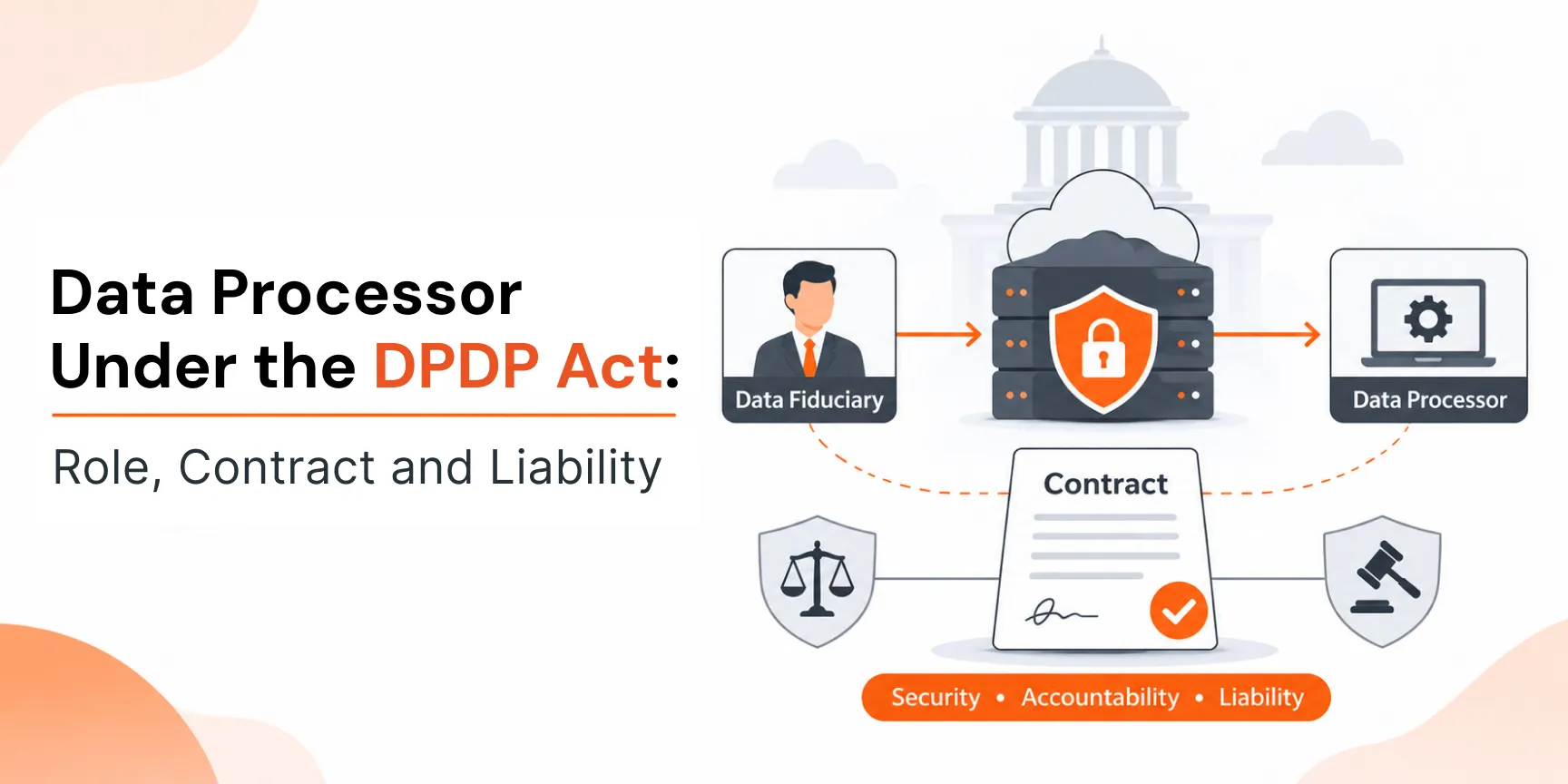
Data Processor vs Data Fiduciary: Who Controls the Processing?
Imagine a bank outsourcing its customer database management to a cloud provider. The provider maintains the infrastructure, but the bank decides why customer information is collected, which services require it, and how it will be used.
This difference in decision-making is central to data processor vs data fiduciary classification. Sections 2(i) and 2(k) establish these roles based on who determines the purpose and means of processing.
How Do Their Responsibilities Differ?
| Parameter | Data Fiduciary | Data Processor |
|---|---|---|
| Legal definition | Section 2(i) | Section 2(k) |
| Primary responsibility | Determines purpose and means | Processes data on behalf of a Fiduciary |
| Decision-making | Establishes processing objectives | Follows authorized instructions |
| Notice and consent | Responsible for applicable requirements | Supports processing as instructed |
| Accountability | Responsible for compliance under the Act | Governed primarily through contractual responsibilities |
| Example | Bank deciding how customer information is used | Cloud provider storing bank records |
For example, a vendor that uses client information to provide an agreed service remains a processor for that activity. If it independently determines another purpose for using the information, its classification must be assessed separately.
The actual processing activity, not the label in the agreement, determines the role.
For a detailed comparison, read Data Fiduciary vs Data Processor: Key Distinctions.
Upstream and Downstream Data Processors
Not every processor receives an existing customer database. Some vendors collect information directly from individuals, while others process records already held by the Data Fiduciary.
These arrangements are commonly described as upstream and downstream data processors.
Upstream Data Processors
An upstream Data Processor collects personal data directly from a Data Principal on behalf of a Data Fiduciary.
For example, a marketing agency conducting a registration campaign for a financial services company may collect customer names, contact details, and other required information before transferring the records to its client.
Since collection qualifies as processing under Section 2(x), the agency participates in the processing lifecycle even though it does not determine the campaign's purpose. The Data Fiduciary remains responsible for applicable notice and consent requirements under Sections 5 and 6.
Downstream Data Processors
A downstream processor receives information already collected by the Data Fiduciary and performs an assigned operation.
Common examples include:
- Payroll vendors processing employee salary records.
- Cloud platforms storing customer information.
- Email providers delivering authorized communications.
- KYC vendors verifying customer details.
The distinction becomes important when several vendors participate in one processing arrangement. A software provider may rely on another cloud infrastructure vendor, creating additional access points and processing dependencies.
Without a complete vendor inventory, organizations may struggle to identify where personal data is stored, accessed, or transferred.
Does the DPDP Act Place Obligations on Data Processors?
A company outsources customer support to an external vendor. The vendor mishandles customer records, resulting in unauthorized disclosure. Who is responsible under the DPDP Act?
Section 8(1) makes the Data Fiduciary responsible for compliance, including processing undertaken on its behalf by a Data Processor. Outsourcing the activity does not transfer statutory accountability.
Understanding Data Processor Liability Under DPDP
The data processor obligations under DPDP are different from those imposed on Data Fiduciaries.
The Act places most statutory accountability on Data Fiduciaries rather than establishing a comprehensive, separate set of operational duties for every processor. Processor responsibilities primarily arise through contractual arrangements and applicable legal provisions.
There are two important areas of exposure:
- Statutory accountability: The Data Fiduciary remains responsible for applicable security safeguards, breach notification, and erasure requirements.
- Contractual liability: A processor may face damages, indemnity claims, termination, or other remedies if it violates agreed processing instructions or security commitments.
The Schedule prescribes penalties for specified statutory contraventions. A processor's exposure must be assessed according to its actual role, conduct, and applicable legal provisions. See our guide on DPDP Act non-compliance penalties for more.
The practical implication is that Data Fiduciaries must verify that vendors can meet agreed requirements, while processors must understand the contractual consequences of failing to protect entrusted information.
Why the Obligations Arise Through the Contract
An organization may have comprehensive internal privacy policies, but those policies offer limited protection if external vendors follow different security practices.
This is where the Section 8(2) valid contract requirement becomes important. It requires a Data Fiduciary to engage a Data Processor under a valid contract for processing activities related to offering goods or services to Data Principals.
Rule 6(f) of the DPDP Rules further requires appropriate contractual provisions for reasonable security safeguards, wherever applicable. Together, these provisions establish the foundation for assigning vendor responsibilities.
How Does the Contract Support Compliance?
Consider a cloud provider storing customer records. The organization engaging it must establish how the provider protects information, controls access, reports incidents, and follows applicable erasure instructions.
The contract connects these operational responsibilities with other provisions of Section 8:
- Section 8(4): Requires appropriate technical and organizational measures to ensure effective observance of the Act.
- Section 8(5): Requires reasonable security safeguards to prevent personal data breaches.
- Section 8(6): Establishes personal data breach notification responsibilities.
- Section 8(7): Addresses erasure of personal data and requires the Fiduciary to cause its processor to erase the information where applicable.
Existing agreements should be reviewed for gaps in processing instructions, security commitments, incident escalation, and deletion procedures. General confidentiality clauses may not adequately address these responsibilities.
What a Data Processing Agreement Must Cover
A data processing agreement DPDP framework should establish more than the names of the parties and the services being delivered.
It should define what personal data the vendor handles, which activities it can perform, what safeguards it must implement, and how the organization can verify compliance.
Essential Clauses in a DPDP Data Processing Agreement
| Contract clause | What the agreement should establish |
|---|---|
| Roles and instructions | Processing purpose, scope, permitted activities, and documented instructions |
| Security safeguards | Encryption, masking, access controls, monitoring, and backups |
| Breach notification | Reporting timelines, escalation contacts, and investigation support |
| Data Principal requests | Assistance with applicable access, correction, erasure, and withdrawal instructions |
| Sub-processor arrangements | Authorization, disclosure, oversight, and downstream vendor responsibilities |
| Retention and deletion | Retention periods, erasure instructions, and deletion confirmation |
| Cross-border transfers | Processing locations and applicable transfer restrictions |
| Audit rights | Security evidence, assessments, and verification arrangements |
| Indemnity | Contractual allocation of responsibility for specified losses |
| Exit arrangements | Data return, deletion, and access revocation |
Not every clause is expressly prescribed as a separate statutory requirement. Rule 6(f) specifically addresses contractual security safeguards, while audit rights and indemnity provisions are additional contractual protections that help manage vendor risk.
Why Sub-Processor Oversight Matters
A primary vendor may depend on another service provider to complete part of the processing. For example, a customer support platform may use a separate cloud provider to store conversation records, creating another organization with potential access to personal information.
A sub-processor DPDP governance arrangement should establish which providers are authorized, what information they can access, which security requirements apply, and how changes are communicated.
This gives the Data Fiduciary visibility into the wider processing arrangement rather than limiting oversight to the vendor with which it signed the original agreement. Our guide on vendor risk management under the DPDP Act covers this in more depth.
When a Data Processor Becomes a Data Fiduciary
A software provider initially processes customer information only to deliver its contracted service. Months later, it introduces an AI feature that uses those records to train its own commercial model.
The service agreement may remain unchanged, but the vendor's role under the DPDP Act may not.
Understanding when a data processor becomes a data fiduciary requires examining whether it independently determines the purpose or means of processing for a particular activity.
Five Situations That Require Role Reassessment
- Independent data use: A vendor starts using customer information for its own commercial objectives rather than solely delivering the contracted service.
- Independent retention decisions: A vendor keeps personal data for additional purposes it determines independently of client instructions.
- Third-party data enrichment: A vendor combines client records with external datasets to develop independently defined customer profiles.
- Independent analytics: A vendor analyzes personal data to create its own products, services, or commercial insights.
- AI model development: A vendor uses client information to train or improve models for its independent benefit.
Not every operational decision changes the classification. Choosing an authorized sub-processor or using approved analytics tools within client instructions does not automatically make the vendor a Data Fiduciary.
However, when the vendor independently determines a processing purpose or means, it must assess the obligations applicable to that activity, including lawful grounds, notice, consent where required, and security safeguards.
Organizations should revisit these classifications whenever vendors introduce new products, analytics capabilities, or AI features. Additional obligations may apply if an organization is designated a Significant Data Fiduciary.
Breach, Retention and Deletion: Where Processor Contracts Fail
Vendor agreements are often tested during security incidents and deletion requests. These situations reveal whether a processor can actually support the Fiduciary's obligations.
Three areas deserve particular attention.
Personal Data Breach Notification
Suppose a cloud provider discovers unauthorized access to customer records on Monday but informs its client on Thursday. The delay leaves the Data Fiduciary with less time to investigate, assess the impact, and prepare the required notifications.
Under Rule 7, the Data Fiduciary must:
- Notify affected Data Principals without delay.
- Inform the Data Protection Board of India without delay.
- Submit updated, detailed information within 72 hours of becoming aware of the breach, unless the Board permits a longer period.
The Rules do not prescribe a universal processor-to-Fiduciary reporting window in hours. The DPA should establish a short breach intimation period, clear escalation contacts, and investigation responsibilities.
A processor should not wait for its investigation to conclude before alerting the organization to a suspected breach.
One-Year Data and Log Retention
Retention requirements can complicate vendor agreements, particularly when an organization promises to delete all customer information within a short period.
Rule 8(3) one-year log retention requires retention of personal data, associated traffic data, and processing logs for at least one year from processing for the purposes specified in the Seventh Schedule.
The requirement also covers relevant processing undertaken by a Data Processor on the Fiduciary's behalf. Organizations should account for these requirements when setting vendor retention schedules. A general deletion commitment must not override an applicable statutory retention obligation. Refer to our guide on data retention policy under the DPDP Act.
Erasure and Deletion Requirements
A customer withdraws consent, but their information remains in a vendor's operational database, backups, and processing logs. Deleting the primary customer record may not complete the applicable erasure process.
Sections 6(6) and 8(7) address cessation and erasure following consent withdrawal or when the specified purpose is no longer being served, subject to applicable legal requirements.
A workable deletion arrangement should establish:
- Which records must be erased.
- Which records are subject to lawful retention.
- How deletion instructions reach processors.
- How completion is verified and documented.
Separating operational data from records subject to statutory retention helps organizations avoid conflicting contractual commitments.
Data Processors Outside India
Using an overseas vendor does not automatically place personal data outside the DPDP framework. Section 3(b) extends the Act to processing outside India when it is connected with offering goods or services to Data Principals within India.
For example, an Indian business may use an overseas cloud platform or engage an international customer support provider. The vendor's location alone does not determine whether the processing falls outside the Act.
What Organizations Should Assess
Before approving overseas processing arrangements, organizations should examine:
- Processing locations: Where personal data is stored, accessed, and processed.
- Vendor access: Whether overseas personnel or sub-processors can access the information.
- Cross-border data transfer: Applicable restrictions under Section 16 and Rule 15.
- Sector requirements: Additional obligations, such as RBI payment-data localization rules, where applicable.
Rule 15 addresses requirements the Central Government may specify concerning making personal data available to a foreign State or an entity under its control or agency.
It should not be interpreted as a blanket prohibition on overseas processing. Organizations must assess applicable government restrictions and sector-specific obligations before approving cross-border arrangements. Our guide on cross-border data transfers under the DPDP Act explains this further.
How Data Fiduciaries Should Govern Data Processors
A signed DPA establishes responsibilities, but it does not prove that a vendor follows them.
Effective DPDP compliance for vendors requires visibility into processing activities, access permissions, security controls, and evidence of compliance.
Build a Complete Processor Inventory
Start by identifying every vendor that collects, stores, accesses, or processes personal data.
Record the processing purpose, data categories, storage locations, access permissions, and sub-processors involved. A centralized inventory helps teams identify vendors requiring additional assessments or contractual updates.
Strengthen Vendor Due Diligence
Before onboarding a vendor, examine its security credentials, audit reports, breach history, access controls, and documented data flows.
Vendor due diligence should evaluate whether the vendor's actual controls match the risks of the processing arrangement. ISO 27001 and SOC 2 reports can provide supporting evidence but should not replace a focused security assessment.
Control Access and Minimize Data Exposure
Vendors should receive only the information necessary to perform their assigned functions.
Encryption, masking, tokenization, and role-based access controls can reduce unnecessary exposure. Organizations should also review permissions periodically and revoke vendor access when engagements end, or responsibilities change.
Monitor Processing and Enforce Instructions
Consent withdrawal, correction, and erasure requests must reach the relevant vendors when they affect outsourced processing.
Establish workflows for communicating instructions, obtaining acknowledgments, and maintaining audit trails. Periodic assessments and breach response exercises can reveal operational gaps before they affect the organization's ability to meet its obligations.
Assign Clear Governance Ownership
Vendor governance requires coordination across procurement, legal, security, and privacy teams.
Procurement and vendor risk teams can maintain inventories and due diligence records. Legal teams can review DPAs, security teams can validate technical safeguards, and the DPO, where applicable, can oversee relevant data protection responsibilities. See the role of the Data Protection Officer under the DPDP Act.
New integrations, acquisitions, and AI features should trigger a fresh review of vendor roles and controls.
Data Processor Readiness Checklist
Both Data Fiduciaries and Data Processors need evidence that their arrangements are ready for the DPDP framework. The following checklist supports preparation for the DPDP compliance deadline of May 2027.
For Data Fiduciaries
- Maintain an approved inventory of all Data Processors.
- Record processing roles and purposes for each activity.
- Review contracts against Section 8(2) and Rule 6(f).
- Test processor-to-Fiduciary breach reporting timelines.
- Obtain deletion and erasure confirmations.
- Maintain updated sub-processor records.
- Verify vendor security and retention controls.
For Data Processors
- Prepare DPDP-specific contractual addenda.
- Map security measures to Rule 6 requirements.
- Maintain ISO 27001 or SOC 2 evidence, where available.
- Establish documented breach escalation procedures.
- Separate deletion commitments from applicable retention requirements.
- Document sub-processors and processing locations.
- Reassess roles whenever services or data usage change.
Both parties should maintain an evidence pack containing signed agreements, security assessments, retention schedules, incident procedures, and audit documentation.
These records support compliance reviews and help demonstrate that agreed safeguards can be verified.
How miniOrange Supports DPDP Data Protection and Vendor Governance
Managing external vendors requires more than reviewing contracts. Organizations also need to control access to personal data, monitor privileged activities, and reduce unauthorized information exposure.
miniOrange provides identity security and data protection capabilities that support these operational requirements.
Control Employee and Vendor Access
Identity and Access Management (IAM), including Single Sign-On (SSO), Multi-Factor Authentication (MFA), and role-based access controls, helps organizations govern access to applications and sensitive information.
These controls support consistent access policies for employees, contractors, and external vendors.
Govern Privileged Vendor Activities
Privileged Access Management (PAM) helps organizations manage elevated permissions granted to external service providers and administrators.
Controlled access, permission management, and session monitoring provide greater oversight of privileged activities involving critical systems. Read more about vendor privileged access best practices.
Strengthen Data Protection and Privacy Operations
Data Loss Prevention (DLP) solution helps reduce unauthorized exposure and movement of sensitive information, while Data Discovery and Classification helps identify personal data across organizational environments.
Consent Management and the Data Principal Portal support privacy workflows and individual data protection requests.
For Data Fiduciaries, these capabilities strengthen access governance and visibility across vendor relationships. For Data Processors, they can help implement and demonstrate the reasonable security safeguards agreed upon with clients.
Strengthen Your Data Processor Governance Before May 2027
Your DPDP compliance position depends on more than internal privacy policies. Every vendor that collects, stores, accesses, or processes personal data can affect your organization's ability to meet statutory responsibilities.
Contracts that do not reflect actual data flows, security controls, and retention requirements can leave gaps that remain hidden until an incident occurs.
Talk to a miniOrange DPDP expert to assess your data protection requirements, review vendor-related risks, and identify the safeguards needed across your processing ecosystem.
Frequently Asked Questions
1. What is a Data Processor under the DPDP Act?
Section 2(k) defines a Data Processor as any person who processes personal data on behalf of a Data Fiduciary. Common examples include cloud providers, payroll vendors, payment gateways, and customer support platforms.
2. What is the difference between a Data Fiduciary and a Data Processor?
A Data Fiduciary determines the purpose and means of processing personal data, while a Data Processor performs processing activities on its behalf. The distinction depends on actual decision-making authority.
3. Does the DPDP Act place any direct obligations on Data Processors?
The Act places primary statutory accountability on Data Fiduciaries under Section 8(1). Processors perform their assigned activities under contractual instructions and applicable legal requirements.
4. Is a contract mandatory before engaging a Data Processor?
Yes. Section 8(2) requires a valid contract when engaging a Data Processor for activities related to offering goods or services to Data Principals. Rule 6(f) addresses contractual security safeguards.
5. Can a Data Processor be penalized by the Data Protection Board?
A processor is not automatically subject to the same statutory accountability as the Fiduciary merely because it processes data. Its exposure depends on its actual role, conduct, applicable provisions, and contractual responsibilities.
6. When does a Data Processor become a Data Fiduciary?
A processor may become a Fiduciary for an activity when it independently determines the purpose or means of processing, such as using client data for its own commercial analytics or AI model development.
7. How quickly must a Data Processor report a breach to the Data Fiduciary?
The DPDP Rules do not prescribe a universal processor-to-Fiduciary reporting window. The parties should establish a contractual timeline that enables the Fiduciary to meet Rule 7 requirements.
8. Does the DPDP Act apply to Data Processors located outside India?
Yes, when processing falls within the territorial scope established under Section 3(b), including processing connected with offering goods or services to Data Principals in India.
Leave a Comment