
The Digital Personal Data Protection (DPDP) Act, 2023, has shifted data privacy from a regulatory obligation into a critical business risk. With the DPDP Rules, 2025 providing operational clarity, businesses are expected to implement reasonable security safeguards, manage consent, protect children's data, and respond promptly to personal data breaches.
Failure to meet these obligations can lead to significant DPDP Act non-compliance penalties, with the maximum fine reaching ₹250 crore. In many cases, a single incident can trigger multiple violations, increasing both financial and reputational exposure. This guide explains the DPDP Act penalty schedule, how the Data Protection Board of India determines penalties, and the practical measures organizations can take to reduce their regulatory risk.
DPDP Act Penalties Explained
The Digital Personal Data Protection (DPDP) Act, 2023 establishes a monetary penalty framework to encourage responsible handling of digital personal data and ensure organizations comply with the obligations defined under the Act and the DPDP Rules, 2025. Penalties are imposed by the Data Protection Board of India (DPBI) after reviewing the facts and circumstances of each case through an adjudication process.
Some key aspects of the DPDP penalty framework include:
- Monetary penalties only: The DPDP Act focuses on financial penalties for non-compliance and does not prescribe imprisonment or criminal sanctions.
- Enforced by the Data Protection Board of India: The DPBI investigates complaints, conducts inquiries, and determines the appropriate penalty based on the nature of the violation.
- Maximum penalties are defined in the Act: The Schedule specifies the highest penalty applicable for different categories of non-compliance, with the maximum reaching ₹250 crore.
- Penalties are determined case by case: The Board considers factors such as the severity of the violation, the type and volume of personal data affected, mitigation efforts, and whether the violation is repetitive before deciding the final amount.
- Organizations can appeal: Any organization aggrieved by the Board's decision may appeal before the Telecom Disputes Settlement and Appellate Tribunal (TDSAT) within the prescribed timeline.
Understanding how DPDP Act penalties are imposed helps businesses assess their compliance posture, prioritize high-risk obligations, and reduce the likelihood of regulatory action before violations occur.
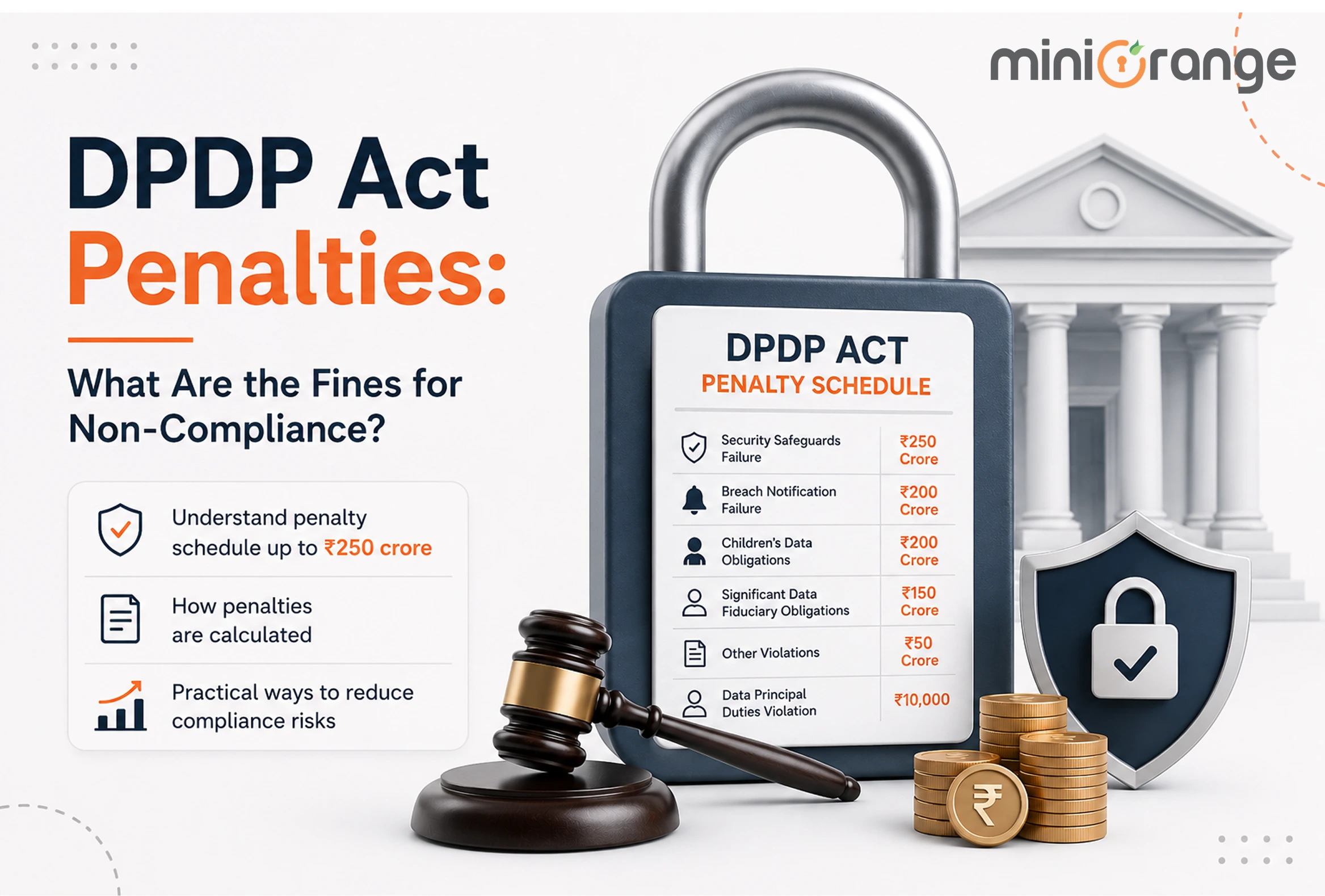
The DPDP Act Penalty Schedule
The Schedule to the DPDP Act, 2023 specifies the maximum penalty amount for each category of non-compliance. While these figures represent the statutory limits, the Data Protection Board of India determines the final penalty after evaluating the facts of each case. Understanding the DPDP penalty schedule helps organizations prioritize compliance efforts and prepare for potential regulatory scrutiny.
Failure to Implement Reasonable Security Safeguards (Section 8(5))
Maximum Penalty: Up to ₹250 Crore
Organizations are required to implement reasonable technical and organizational security safeguards to protect personal data from unauthorized access, disclosure, alteration, or loss. Weak access controls, inadequate security monitoring, poor encryption practices, or other security failures that contribute to a personal data breach can attract the highest monetary penalty under the DPDP Act.
Failure to Notify a Personal Data Breach (Section 8(6))
Maximum Penalty: Up to ₹200 Crore
When a personal data breach occurs, Data Fiduciaries must notify the Data Protection Board of India and affected Data Principals in accordance with the Act and the applicable Rules. Delayed, incomplete, or omitted breach notifications may lead to significant financial penalties.
Non-Compliance with Children's Data Obligations (Section 9)
Maximum Penalty: Up to ₹200 Crore
Organizations processing children's personal data must comply with additional obligations, including obtaining verifiable parental consent where required and implementing appropriate safeguards to protect children's privacy. Failure to meet these requirements may attract penalties of up to ₹200 crore.
Failure to Fulfil Significant Data Fiduciary Obligations (Section 10)
Maximum Penalty: Up to ₹150 Crore
Organizations classified as Significant Data Fiduciaries (SDFs) must comply with additional governance requirements, including conducting Data Protection Impact Assessments (DPIAs), appointing a Data Protection Officer (DPO), implementing risk management measures, and undergoing periodic audits. Non-compliance with these obligations can result in penalties of up to ₹150 crore.
Breach of Other Provisions of the DPDP Act or Rules (Statutory Schedule)
Maximum Penalty: Up to ₹50 Crore
Any violation of the DPDP Act or the Rules that is not specifically covered under another penalty category may attract a penalty of up to ₹50 crore. Examples include failures relating to consent management, grievance redressal, privacy notices, Data Principal rights, or other compliance obligations.
Violation of the Duties of a Data Principal (Section 15)
Maximum Penalty: Up to ₹10,000
The DPDP Act also places certain responsibilities on Data Principals. Knowingly providing false information, suppressing material facts, impersonating another individual, or filing frivolous complaints may result in a penalty of up to ₹10,000.
| Note: If the Data Protection Board accepts a voluntary undertaking under Section 32, failure to comply with that undertaking may result in penalties up to the amount applicable to the original violation. This reinforces the importance of implementing and maintaining corrective actions once committed to the Board. |
|---|
Can Multiple DPDP Penalties Apply to One Incident?
A common misconception is that one incident results in one regulatory penalty. Under the DPDP Act, however, the Data Protection Board of India may examine every compliance failure arising from the same event. If multiple statutory obligations are violated, each may attract a separate monetary penalty during the adjudication process.
For example, consider an organization that experiences a ransomware attack due to inadequate security safeguards. If it also delays notifying the Board and affected Data Principals, and is classified as a Significant Data Fiduciary that failed to meet its additional governance obligations, the Board may evaluate each violation independently during adjudication.
A single incident could therefore involve:
- ₹250 crore for failure to implement reasonable security safeguards (Section 8(5))
- ₹200 crore for failure to notify the Board and affected Data Principals (Section 8(6))
- ₹150 crore for failure to fulfil Significant Data Fiduciary obligations (Section 10)
Depending on the facts of the case, the cumulative financial exposure could exceed ₹600 crore. While the Board determines the final penalty based on statutory factors and the circumstances of each violation, organizations should treat every compliance obligation as equally important rather than focusing only on the highest penalty.
How Does the Data Protection Board Determine the Penalty Amount?
Although the DPDP Act penalties can be substantial, timely breach reporting, effective remediation, cooperation during investigations, and demonstrable compliance efforts may influence the Board's decision when determining the final penalty amount.
When determining the penalty, the Board may consider factors such as:
- Nature, gravity, and duration of the breach to understand its overall impact.
- Type and volume of personal data affected, particularly if sensitive or large-scale datasets are involved.
- Whether the violation is repetitive or reflects a pattern of non-compliance.
- Any gain obtained or loss avoided because of the violation.
- Measures taken to mitigate harm, including containment, remediation, and support provided to affected individuals.
- The organization's cooperation during the investigation and adjudication process.
- The effectiveness of corrective actions implemented after the incident to prevent recurrence.
Common DPDP Penalty Triggers Organizations Should Watch For
Most DPDP Act penalties arise from preventable gaps in governance, security, and privacy operations. Identifying these common compliance failures helps businesses strengthen their controls, reduce regulatory exposure, and avoid costly enforcement actions.
1. Failure to Implement Reasonable Security Safeguards
Weak access controls, inadequate encryption, insufficient monitoring, outdated security practices, and ineffective risk management can all increase the likelihood of a personal data breach, making this the most significant DPDP Act penalty.
2. Failure to Notify a Personal Data Breach
Delaying or failing to notify the Data Protection Board of India and affected Data Principals after a personal data breach can lead to significant regulatory action. Organizations should have a well-defined breach response process to ensure timely assessment, documentation, and notification in accordance with the DPDP Rules.
3. Non-Compliance with Children's Data Obligations
Organizations processing children's personal data must obtain verifiable parental consent where required and implement additional safeguards to protect minors. Failure to comply with these obligations can increase regulatory scrutiny and expose organizations to substantial penalties.
4. Failure to Fulfil Significant Data Fiduciary Obligations
Significant Data Fiduciaries must comply with additional governance requirements, including conducting Data Protection Impact Assessments (DPIAs), appointing a Data Protection Officer (DPO), maintaining appropriate records, and completing periodic audits. Failure to meet these responsibilities can result in regulatory penalties.
5. Consent and Data Principal Rights Management Gaps
Incomplete consent records, unclear privacy notices, ineffective grievance redressal mechanisms, or failure to respond to Data Principal rights requests may constitute violations under the Act. Organizations should ensure individuals can easily provide, withdraw, and manage consent while exercising their statutory rights.
6. Violation of Data Principal Duties
The DPDP Act also places responsibilities on Data Principals. Knowingly providing false information, impersonating another individual, suppressing material facts, or filing frivolous complaints may result in monetary penalties for the individual.
How to Avoid DPDP Act Penalties
Preventing DPDP Act penalties requires a proactive approach that combines security controls, privacy governance, documented processes, and continuous monitoring. Focusing on the highest-risk obligations enables organizations to reduce regulatory exposure while strengthening customer trust.
1. Strengthen Security Safeguards
Implement layered security controls such as Data Loss Prevention (DLP), encryption, continuous monitoring, role-based access controls, and regular risk assessments. These controls reduce the likelihood of personal data breaches while supporting the reasonable security safeguards required under Section 8(5).
2. Build a 72-Hour Breach Response Process
Develop a structured incident response framework that includes breach detection, internal escalation, impact assessment, notification workflows, and documentation. A documented incident response plan helps organizations detect, assess, and report breaches within statutory timelines while reducing regulatory risk.
3. Protect Children's Personal Data
Establish processes for age verification, obtain verifiable parental consent where applicable, and implement additional safeguards for processing children's personal data. These practices strengthen compliance with Section 9 and reduce risks associated with processing children's personal data.
4. Meet Significant Data Fiduciary Obligations
Organizations designated as Significant Data Fiduciaries should conduct Data Protection Impact Assessments (DPIAs), maintain Records of Processing Activities (RoPA), appoint a Data Protection Officer (DPO) where required, and perform periodic privacy audits to strengthen governance and regulatory readiness.
5. Improve Consent and Rights Management
Maintain accurate consent records, provide simple consent withdrawal mechanisms, establish an effective grievance redressal process, and ensure timely responses to Data Principal rights requests. Clear consent records and efficient rights management improve transparency while reducing the likelihood of avoidable compliance violations.
6. Maintain Evidence of Compliance
Maintain comprehensive audit logs, policy documents, compliance reports, incident records, and governance documentation. Having clear evidence of compliance activities helps organizations demonstrate accountability during regulatory inquiries and supports ongoing compliance with the DPDP Act.
Being Prepared Costs Less Than Being Penalized
The financial penalties under the DPDP Act are significant, but the greater challenge often lies in the operational disruption, reputational damage, and loss of customer trust that follow a compliance failure.
Organizations that invest in strong security safeguards, effective consent management, documented governance processes, and timely breach response are better equipped to meet regulatory expectations and respond confidently when incidents occur.
Assessing your privacy program today, addressing compliance gaps, and strengthening security controls can significantly reduce the risk of DPDP Act penalties while improving long-term operational resilience and customer trust.
FAQs
1. What is the maximum penalty under the DPDP Act?
The maximum penalty under the DPDP Act is ₹250 crore for failing to implement reasonable security safeguards that result in a personal data breach. Other violations, such as failing to report breaches or meet Significant Data Fiduciary obligations, carry different maximum penalty limits specified in the Act.
2. Who has the authority to impose DPDP Act penalties?
The Data Protection Board of India (DPBI) is responsible for investigating complaints, conducting adjudication proceedings, and imposing monetary penalties for violations of the DPDP Act. Organizations may appeal the Board's decisions before the Telecom Disputes Settlement and Appellate Tribunal (TDSAT) within the prescribed timeline.
3. Can multiple DPDP Act penalties apply to a single incident?
Yes. A single data breach can result in multiple violations if it involves inadequate security safeguards, delayed breach notification, failures relating to children's data, or other compliance gaps. The Data Protection Board evaluates each violation separately before determining the applicable monetary penalties.
4. Are there criminal penalties or imprisonment under the DPDP Act?
No. The DPDP Act provides for civil monetary penalties and does not prescribe criminal punishment or imprisonment for non-compliance. Regulatory action primarily focuses on financial penalties, corrective measures, and ensuring organizations address the compliance failures that led to the violation.
5. How does the Data Protection Board determine the penalty amount?
The Board considers several factors, including the nature and seriousness of the violation, the duration of non-compliance, the volume and sensitivity of personal data affected, repeated violations, mitigation efforts, and the organization's cooperation during the investigation before deciding the final penalty amount.
6. How can organizations reduce the risk of DPDP Act penalties?
Organizations can lower their compliance risk by implementing strong security safeguards, maintaining breach response procedures, protecting children's data, managing consent effectively, enabling Data Principal rights, conducting regular compliance assessments, and maintaining documentation that demonstrates adherence to the DPDP Act and its Rules.
About the Author

Content Writer
Minal is an experienced B2B content writer. She has written over 250 articles across industries like UI/UX, real estate, automotive, digital marketing, SaaS, AI & ML, and cybersecurity. She brings her interest in cybersecurity to life by creating clear, engaging content tailored for technical, non-technical, and creative pieces. Her aim is to simplify complex topics, highlight product value, and connect with both technical and non-technical audiences.
Leave a Comment