

The Digital Personal Data Protection (DPDP) Act, 2023, has established a new privacy framework for organizations handling digital personal data, while the DPDP Rules, 2025, provide greater clarity on how businesses should implement these obligations in practice. For many organizations, however, translating legal requirements into day-to-day operational processes remains a significant challenge.
Through our conversations with customers across industries, we've consistently seen teams struggle with questions like: Where do we begin? What documents should we maintain? Which controls are mandatory? How do we measure compliance readiness? That's exactly why we created this DPDP compliance checklist.
Instead of presenting legal provisions in isolation, this guide organizes the key DPDP compliance requirements into eight practical domains mapped to the relevant provisions of the Act.
TL;DR
The DPDP Act, 2023, and the DPDP Rules, 2025 require organizations handling digital personal data to establish governance, obtain valid consent where applicable, protect personal data, enable Data Principal rights, and maintain accountability throughout the data lifecycle.
This guide simplifies those requirements into an 8-domain DPDP compliance checklist to help you:
- Determine whether the DPDP Act applies to your organization.
- Assess your compliance readiness against key legal obligations.
- Identify operational and technical gaps that require attention.
- Understand the documents and evidence needed for audit readiness.
- Prioritize remediation efforts with a practical implementation roadmap. Whether you're a Data Fiduciary, Data Processor, or Significant Data Fiduciary, use this checklist as a practical starting point to evaluate your current privacy program and strengthen your organization's DPDP compliance posture.
The DPDP Compliance Checklist: 8 Domains Every Organization Should Assess
The DPDP Act and rules establish a comprehensive framework for protecting digital personal data throughout its lifecycle. Rather than viewing compliance as a collection of isolated legal requirements, organizations should approach it through a structured framework that covers governance, lawful processing, security, and continuous accountability.
The following eight compliance domains are mapped to the key obligations under the DPDP Act and serve as a practical checklist to help assess your organization's privacy readiness, identify compliance gaps, and prioritize implementation efforts.
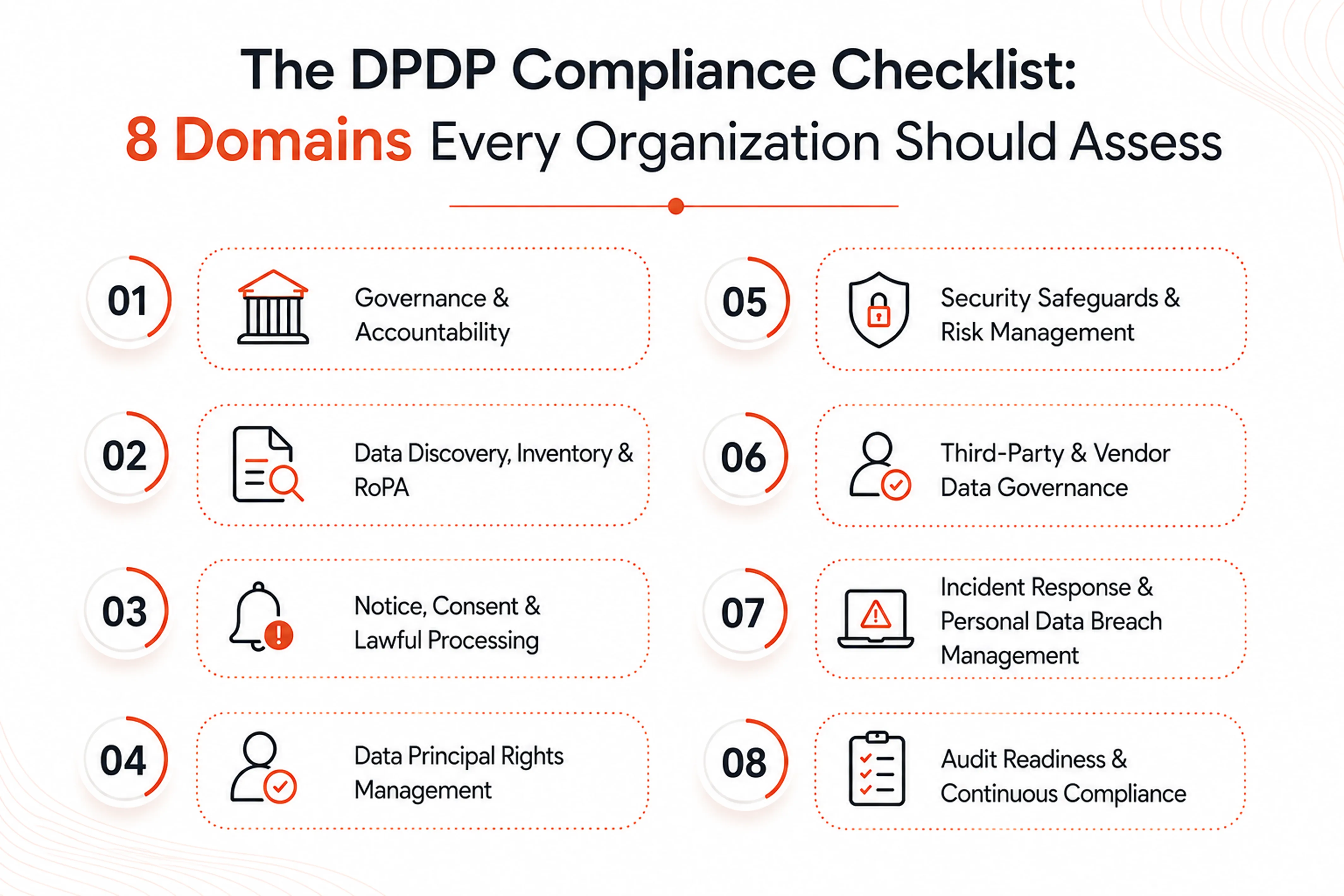
The 8 Compliance Domains
- Governance & Accountability
- Data Discovery, Inventory & RoPA
- Notice, Consent & Lawful Processing
- Data Principal Rights Management
- Security Safeguards & Risk Management
- Third-Party & Vendor Data Governance
- Incident Response & Personal Data Breach Management
- Audit Readiness & Continuous Compliance
Pro Tip: Treat these domains as interconnected pillars rather than independent tasks. A strong governance foundation, for example, directly influences how effectively your organization manages consent, protects personal data, responds to incidents, and demonstrates compliance during audits.
1. Governance & Accountability
Effective DPDP compliance starts with clear ownership and accountability. Before implementing privacy controls, organizations should define who is responsible for managing compliance, overseeing data protection practices, and responding to regulatory obligations.
What the Act Requires
Under the DPDP Act, Data Fiduciaries are responsible for protecting personal data and ensuring compliance with the Act. Organizations notified as Significant Data Fiduciaries (SDFs) have additional obligations, including appointing a Data Protection Officer (DPO), conducting periodic Data Protection Impact Assessments (DPIAs), and undergoing periodic independent data audits.
Governance Checklist
☐ Identify the Data Fiduciary responsible for DPDP compliance.
☐ Assess whether your organization qualifies as a Significant Data Fiduciary (SDF).
☐ Appoint a Data Protection Officer (DPO), where applicable.
☐ Appoint or designate a Grievance Officer.
☐ Define roles and responsibilities across Legal, IT, Security, HR, and Compliance.
☐ Establish documented privacy governance policies and procedures.
☐ Conduct periodic Data Protection Impact Assessments (DPIAs), where applicable.
☐ Undergo periodic independent data audits, where applicable.
☐ Conduct regular employee privacy awareness and role-based training.
Evidence to Maintain
- Privacy governance policy
- DPO appointment records (where applicable)
- DPIA reports (where applicable)
- Independent audit reports (where applicable)
- Roles and responsibilities matrix
- Employee training records
- Records of Processing Activities (RoPA)
Common Compliance Gap
Many organizations treat DPDP compliance as a legal initiative rather than a business-wide responsibility. Without clearly assigned ownership, documented governance processes, and executive oversight, privacy initiatives often become fragmented, making it difficult to demonstrate accountability and sustain compliance over time.
2. Data Discovery, Inventory & RoPA
You can't protect or govern personal data if you don't know where it exists. Before implementing consent, security, or retention controls, organizations should identify all repositories containing personal data, understand how it flows across systems, and document why it is being processed.
What the Act Requires
The DPDP Act expects organizations to process personal data only for lawful purposes and remain accountable for how it is collected, used, shared, and stored. Maintaining an accurate data inventory and Records of Processing Activities (RoPA) helps demonstrate this accountability.
Data Discovery Checklist
☐ Discover personal data across databases, cloud storage, endpoints, SaaS applications, and shared drives.
☐ Build and maintain a centralized data inventory.
☐ Classify personal data according to business and regulatory requirements.
☐ Identify sensitive and high-risk personal data.
☐ Map personal data flows across systems and third parties.
☐ Assign business owners for critical datasets.
☐ Maintain Records of Processing Activities (RoPA).
☐ Document the purpose for every processing activity.
Evidence to Maintain
- Data inventory
- Data flow diagrams
- RoPA register
- Data classification reports
- Processing purpose documentation
Common Compliance Gap
Organizations often maintain incomplete data inventories, leaving shadow IT, archived files, and cloud applications outside the scope of their privacy program.
3. Notice, Consent & Lawful Processing
Every instance of personal data processing should have a lawful basis. Whether processing relies on consent or another permitted ground under the DPDP Act, organizations must clearly communicate how personal data will be used and maintain records to demonstrate compliance.
What the Act Requires
The DPDP Act requires organizations to provide clear privacy notices, obtain valid consent where required, allow individuals to withdraw consent easily, and document processing activities that rely on legitimate uses permitted under the Act.
DPDP Act, 2023 Mapping
Privacy Notice: Provide a clear, easy-to-understand notice before or at the time of data collection.
Consent: Obtain free, informed, specific, and unambiguous consent.
Consent Withdrawal: Allow individuals to withdraw consent as easily as it was given.
Legitimate Uses: Document processing activities that rely on legally permitted uses instead of consent.
Lawful Processing Checklist
☐ Publish clear and accessible privacy notices.
☐ Provide notices before or at the time of data collection.
☐ Obtain valid consent where required.
☐ Maintain auditable consent records.
☐ Allow Data Principals to withdraw consent easily.
☐ Record and process consent withdrawals.
☐ Identify processing activities that rely on legitimate uses.
☐ Document the lawful basis for every processing activity.
☐ Implement additional controls for processing children's personal data.
☐ Periodically review notices, consent mechanisms, and lawful processing practices.
Evidence to Maintain
- Privacy notices
- Consent records
- Consent withdrawal logs
- Legitimate use documentation
- Notice version history
Common Compliance Gap
Organizations frequently collect consent but fail to maintain auditable records or update privacy notices when processing activities change.
4. Data Principal Rights Management
The DPDP Act empowers individuals by giving them greater control over how their personal data is managed. Organizations should establish standardized processes to receive, verify, respond to, and document Data Principal requests while ensuring every interaction is handled within defined timelines.
What the Act Requires
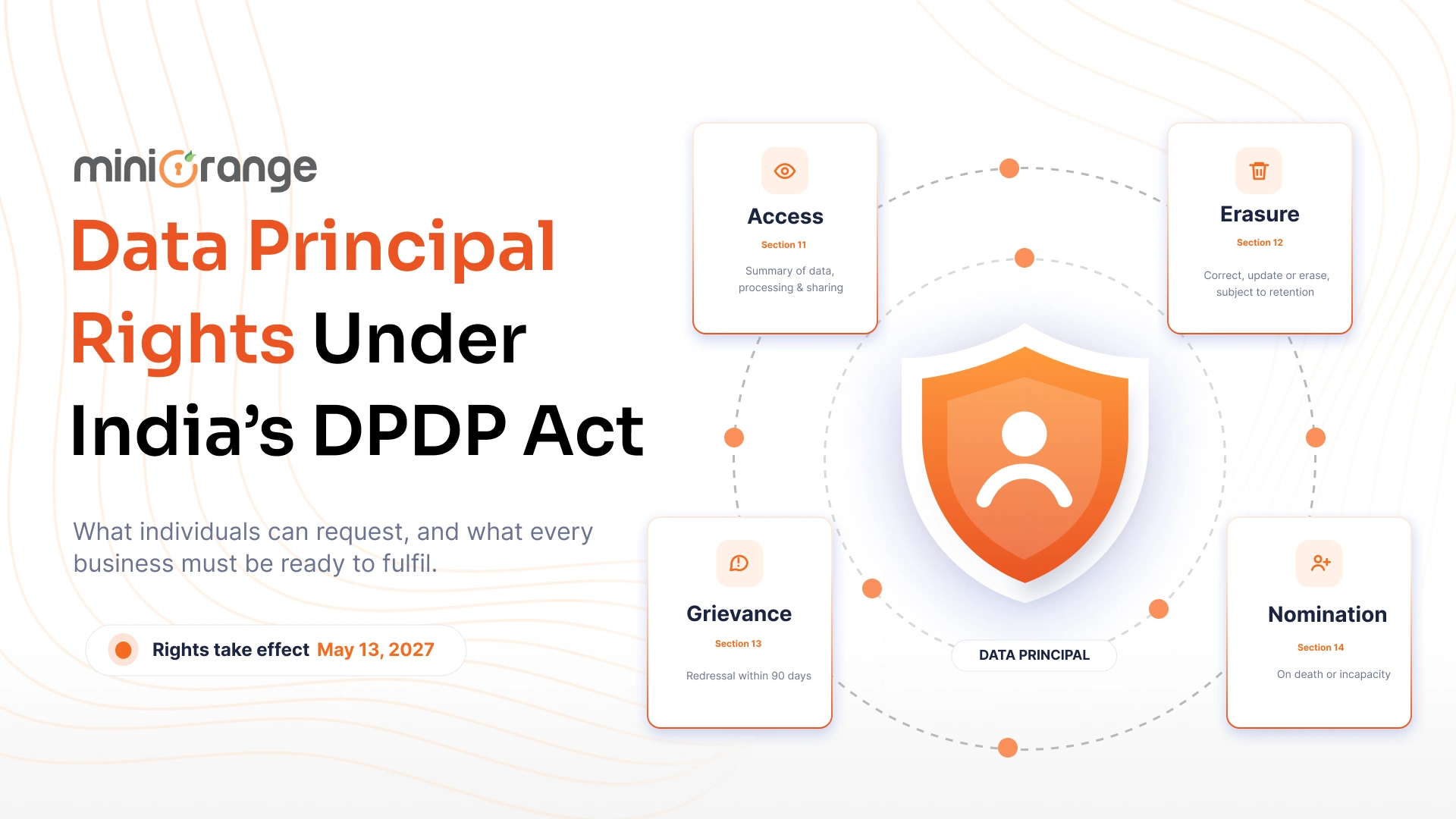
The DPDP Act requires organizations to provide mechanisms for Data Principals to exercise their rights, including requesting access to information, correcting or erasing personal data, raising grievances, and nominating another individual where applicable.
Data Principal Rights Checklist
☐ Establish a process to receive Data Principal requests.
☐ Verify the identity of every requester.
☐ Enable requests for access to personal data.
☐ Enable correction of inaccurate or incomplete personal data.
☐ Enable erasure requests where applicable.
☐ Implement a grievance redressal process.
☐ Support nomination requests where applicable.
☐ Track request timelines and maintain a complete audit trail.
Evidence to Maintain
- Data Principal request logs
- Identity verification records
- Grievance records
- Request resolution reports
- Audit trail of completed requests
Common Compliance Gap
Many organizations rely on manual processes to manage Data Principal requests, resulting in inconsistent verification, missed response timelines, incomplete audit trails, and difficulty demonstrating compliance. Standardized workflows and centralized tracking are essential for handling requests efficiently and consistently.
5. Security Safeguards & Risk Management
Protecting personal data requires a combination of technical and organizational measures that reduce the risk of unauthorized access, disclosure, alteration, or loss. A risk-based security approach helps organizations safeguard personal data while supporting ongoing compliance with the DPDP Act.
What the Act Requires
The DPDP Act requires Data Fiduciaries to implement reasonable security safeguards to protect personal data and take appropriate measures to prevent and manage personal data breaches.
Security Checklist
☐ Implement role-based access controls (RBAC).
☐ Enforce the principle of least privilege.
☐ Enable multi-factor authentication (MFA).
☐ Encrypt personal data at rest.
☐ Encrypt personal data in transit.
☐ Deploy Data Loss Prevention (DLP) controls.
☐ Maintain audit logs and continuous monitoring.
☐ Conduct periodic security risk assessments.
☐ Perform privileged access reviews regularly.
☐ Test backup and recovery processes for systems storing personal data.
Evidence to Maintain
- Information security policies
- Access review reports
- Encryption standards
- Audit logs
- Risk assessment reports
- Security monitoring records
Common Compliance Gap
Implementing security tools alone does not ensure compliance. Organizations often overlook periodic access reviews, security testing, vendor assessments, and audit logging, making it difficult to prove that reasonable security safeguards are consistently implemented and operating effectively.
6. Third-Party & Vendor Data Governance
Organizations remain accountable for personal data even when it is processed by vendors, service providers, or other third parties. Effective vendor governance reduces compliance risks by ensuring external partners follow the same privacy and security standards expected within the organization.
What the Act Requires
The DPDP Act places accountability on Data Fiduciaries for personal data processed on their behalf. Organizations should assess third-party risks, establish appropriate contractual safeguards, and review cross-border data processing arrangements where applicable.
Vendor Governance Checklist
☐ Identify all vendors and processors handling personal data.
☐ Perform vendor due diligence before onboarding.
☐ Execute Data Processing Agreements (DPAs).
☐ Review contracts for privacy and security obligations.
☐ Assess cross-border data processing arrangements.
☐ Conduct periodic vendor compliance reviews.
Evidence to Maintain
- Vendor risk assessment reports
- Signed Data Processing Agreements (DPAs)
- Third-party inventory
- Contract review records
- Vendor compliance reports
Common Compliance Gap
Organizations frequently assess vendors during onboarding but fail to perform ongoing reviews as services evolve. Outdated processor agreements, undocumented subprocessors, and limited visibility into third-party security practices can introduce significant compliance and operational risks over time.
7. Incident Response & Personal Data Breach Management
Even with strong preventive controls, security incidents can still occur. A well-defined incident response plan enables organizations to detect, contain, investigate, and respond to personal data breaches quickly while minimizing business disruption and meeting regulatory obligations.
What the Act Requires
The DPDP Act requires Data Fiduciaries to take appropriate measures in the event of a personal data breach. Organizations should establish documented response procedures, assess the impact of incidents, and comply with applicable breach notification requirements under the DPDP Rules.
Incident Response Checklist
☐ Maintain a documented incident response plan.
☐ Define incident response roles and responsibilities.
☐ Establish breach detection and reporting procedures.
☐ Create an internal escalation process.
☐ Maintain procedures for regulatory and stakeholder notifications.
☐ Conduct post-incident reviews and corrective actions.
☐ Perform periodic incident response drills or tabletop exercises.
Evidence to Maintain
- Incident response plan
- Incident register
- Investigation reports
- Breach notification records
- Post-incident review reports
Common Compliance Gap
Many organizations focus on responding to technical incidents but lack documented procedures for assessing privacy impact, coordinating internal stakeholders, preserving evidence, and maintaining records of decisions taken during a personal data breach, making regulatory reporting significantly more challenging.
8. Audit Readiness & Continuous Compliance
DPDP compliance is an ongoing process that requires regular reviews, documented evidence, and continuous improvement. Periodic assessments help organizations identify emerging risks, validate existing controls, and demonstrate accountability as business processes and regulatory expectations evolve.
What the Act Requires
The DPDP Act emphasizes accountability and requires organizations to demonstrate compliance through appropriate governance, documentation, and ongoing oversight. Significant Data Fiduciaries may also be subject to additional audit and compliance obligations.
Continuous Compliance Checklist
☐ Conduct periodic DPDP compliance assessments.
☐ Perform internal compliance audits.
☐ Review and update privacy policies regularly.
☐ Monitor compliance KPIs and remediation activities.
☐ Maintain centralized compliance documentation.
☐ Preserve audit trails and supporting evidence.
☐ Conduct periodic employee privacy refresher training.
☐ Review the privacy program after regulatory or business changes.
Evidence to Maintain
- Internal audit reports
- Compliance assessment reports
- Policy review records
- Employee training records
- Compliance dashboard
- Audit trail and supporting documentation
Common Compliance Gap
Organizations often treat DPDP compliance as a one-time implementation project instead of an ongoing governance program. Without regular audits, policy reviews, employee training, and continuous monitoring, compliance controls gradually become outdated and less effective in addressing evolving privacy risks.
Score Your DPDP Compliance Readiness
Use the checklist to evaluate your organization's current privacy maturity. The assessment includes 66 implementation checkpoints across eight DPDP compliance domains. For every requirement that has been fully implemented and is supported by documented evidence, award 1.5 points.
Scoring Method
- Implemented = 1.5 points
- Not Implemented = 0 points
Maximum Score: 99 Points (≈ 100% DPDP Readiness)
Pro Tip: Only award points if the control is operational and supported by evidence, such as policies, audit logs, consent records, training records, or other compliance documentation.
| Readiness Score | Readiness Level | What It Means | Recommended Next Step |
|---|---|---|---|
| 0–25.5 | Not Started | Your organization has significant compliance gaps and lacks the foundational governance, privacy, and security controls required under the DPDP Act. | Conduct a DPDP gap assessment, assign ownership, and establish governance before implementing operational controls. |
| 27–49.5 | Foundational | Basic privacy practices exist, but several core compliance requirements remain incomplete or undocumented. | Prioritize data discovery, consent management, security safeguards, and supporting documentation. |
| 51–73.5 | Developing | Most compliance controls are in place, but operational consistency and audit readiness require improvement. | Strengthen Data Principal rights management, vendor governance, incident response, and evidence collection. |
| 75–90 | Operational | Your organization has implemented most DPDP requirements with defined processes and documented controls. | Focus on continuous monitoring, internal audits, policy reviews, and ongoing compliance improvements. |
| 91.5–99 | Audit Ready | Your privacy program demonstrates mature governance, effective operational controls, and comprehensive audit-ready documentation across all compliance domains. | Continue monitoring regulatory updates, review controls periodically, and continuously improve your privacy program to maintain long-term compliance. |
DPDP Act Penalties for Non-Compliance
Non-compliance with the DPDP Act, 2023 can result in significant financial penalties depending on the nature and severity of the violation. Beyond monetary fines, organizations may also face regulatory scrutiny, operational disruptions, and reputational damage. Understanding these penalties highlights the importance of implementing a proactive DPDP compliance program rather than reacting after an incident occurs.
| Violation | Maximum Penalty |
|---|---|
| Failure to implement reasonable security safeguards | Up to ₹250 crore |
| Failure to notify a personal data breach (as required) | Up to ₹200 crore |
| Non-compliance relating to children's personal data | Up to ₹200 crore |
| Failure to fulfill additional obligations of Significant Data Fiduciaries | Up to ₹150 crore |
| Violation of any other provision of the DPDP Act or the DPDP Rules | Up to ₹50 crore |
Note: The Data Protection Board of India determines penalties based on factors such as the nature and gravity of the breach, duration, mitigation efforts, and previous instances of non-compliance. Always refer to the latest penalty schedule under the DPDP Act, 2023, and the notified DPDP Rules, 2025, before making compliance decisions.
How miniOrange Helps Adhere to DPDP Compliance
Meeting the requirements of the DPDP Act, 2023 involves more than implementing individual controls. miniOrange supports every stage of your DPDP compliance journey by aligning its privacy solutions with the eight key compliance domains.
Build a Strong Privacy Governance Framework
Establish clear ownership with Privacy-as-a-Service, DPO advisory, governance dashboards, policy management, and compliance tracking to strengthen accountability and support ongoing privacy operations.
Discover, Classify, and Map Personal Data
Automatically identify personal data across cloud environments, databases, endpoints, and SaaS applications. Maintain a centralized data inventory, classify sensitive information, and generate AI-assisted Records of Processing Activities (RoPA).
Automate Consent and Privacy Workflows
Manage multilingual privacy notices, capture and maintain auditable consent records, process consent withdrawals, and support lawful processing requirements through automated consent and cookie management.
Streamline Data Principal Requests
Enable individuals to submit access, correction, erasure, and grievance requests through a self-service portal while automating request routing, SLA tracking, and audit trail generation.
Strengthen Security and Reduce Privacy Risks
Protect personal data with Data Loss Prevention (DLP), encryption, data masking, Identity and Access Management (IAM), and continuous monitoring to reduce the risk of unauthorized access and data breaches.
Manage Third-Party Compliance with Confidence
Assess vendor risks, manage Data Processing Agreements (DPAs), monitor processor compliance, and maintain visibility into third-party data processing activities from a centralized platform.
Respond to Breaches Faster
Coordinate incident response through structured breach workflows, investigation tracking, notification support, and comprehensive audit logs to improve regulatory readiness.
Stay Audit-Ready Year Round
Monitor compliance progress through centralized dashboards, automate reporting, maintain audit evidence, and continuously review policies and controls to support long-term DPDP compliance Solution.
Turn Your DPDP Compliance Checklist into an Action Plan
Completing the DPDP compliance checklist is only the first step toward compliance. The real value lies in turning your assessment into measurable actions that strengthen privacy governance over time. As your organization grows, new systems, vendors, and processing activities can introduce additional compliance risks.
Regular reviews, continuous monitoring, and periodic updates to your privacy program will help you stay aligned with evolving regulatory expectations. Use this DPDP Act compliance checklist as a benchmark to track progress, prioritize improvements, and build a privacy-first culture that supports both compliance and customer trust. If you need help identifying gaps or implementing the right controls, our experts can help you create a tailored roadmap for your organization.
Frequently Asked Questions
1. How often should a DPDP compliance assessment be conducted?
Organizations should review their compliance posture at least annually and whenever there are significant changes to business processes, technology, data processing activities, or regulatory requirements.
2. Does the DPDP Act apply to employee and HR data?
Yes. If an organization processes employees' digital personal data, those activities may fall within the scope of the DPDP Act and should be governed according to its applicable provisions.
3. Can small and medium-sized businesses use a DPDP compliance checklist?
Yes. Regardless of organization size, a structured checklist helps identify compliance gaps, prioritize remediation efforts, and establish consistent privacy practices as the business grows.
4. How should organizations prepare for a DPDP compliance audit?
Maintain accurate documentation, preserve evidence of implemented controls, conduct periodic internal reviews, and ensure privacy policies, procedures, and records remain current and readily accessible.
5. Can DPDP compliance be integrated with existing security and privacy programs?
Yes. Many organizations align DPDP compliance with existing governance, risk, cybersecurity, and privacy initiatives to reduce duplication and improve operational efficiency.
6. What should organizations do after completing a DPDP compliance checklist?
Prioritize identified gaps based on risk, assign ownership, establish implementation timelines, and continuously monitor progress to maintain long-term compliance and improve overall privacy maturity.
Leave a Comment