

Why Authentication Matters on Shopify Plus
On Shopify Plus, every part of the customer journey needs to feel effortless — and the login experience sits right at the front.
When you’re running multiple Shopify Plus stores, catering to global shoppers, or managing a growing network of B2B customers, even small login roadblocks can escalate into bigger issues: customer drop-offs, abandoned carts, and frustrated buyers.
Shopify's built-in login options work for simple stores, but Plus merchants often face more complex identity challenges. Whether it's recurring Shopify Plus login issues, struggles with B2B authentication, or the need for a consistent experience across regions, the default setup isn’t always enough.
Understanding Shopify Plus’ Built-In Authentication Options
Shopify gives two straightforward login methods out of the box:
Email OTP login: Default method for Shopify Customer Accounts (Plus and non-Plus). Passwordless but inconvenient for repeated logins.
Login via Single Sign-On: Exclusive to Shopify Plus, allows connecting one external identity provider. Useful, but limited (one IDP at a time, no advanced attribute mapping, only OIDC-compliant identity providers).
These authentication flows work—but only at a basic level: email OTP login is easy for occasional buyers, and OIDC-based Single Sign-On (SSO) lets a Plus merchant centralize logins to a single IdP.
For merchants managing multi-brand or regional storefronts, large B2B catalogs, or partner networks, these login defaults quickly lead to Shopify Plus login issues, customer friction, and unnecessary operational overhead.
Use Case: Why Shopify Plus Brands Need Unified Login
Picture a brand that operates dedicated Shopify Plus storefronts for the US, EU, and APAC markets. A single customer who shops on all three quickly notices that they need to log in again each time, even if they just authenticated moments ago.
The native Shopify Plus SSO flow essentially gives brands a limited choice: enable login via Single Sign-On (SSO) using a single OIDC-based identity provider, or use the default email OTP flow for Customer Accounts – but not both. This leads to customer login limitations and can frustrate both retail and B2B users on Shopify Plus.
This fragmented experience is one of the biggest login roadblocks for global and enterprise merchants on Shopify Plus. When users repeatedly authenticate or can’t access the right storefront without re-verifying themselves, session interruptions become a direct cause of churn.
Where Native Features of Shopify Plus SSO Fall Short
As businesses scale, some challenges begin to surface: login problems in Shopify Plus, session inconsistencies, and fragmented B2B experiences.
- One of the important pain points is issues with integrating multiple IDPs on Plus. Shopify SSO supports only one active identity provider at a time, which works well for straightforward setups but becomes restrictive when a brand needs different login experiences for different users or storefronts. Compatibility can add another challenge: Shopify Plus SSO works with OIDC only, meaning logging via legacy or non-standard identity providers (IdPs) often requires time-consuming workarounds.
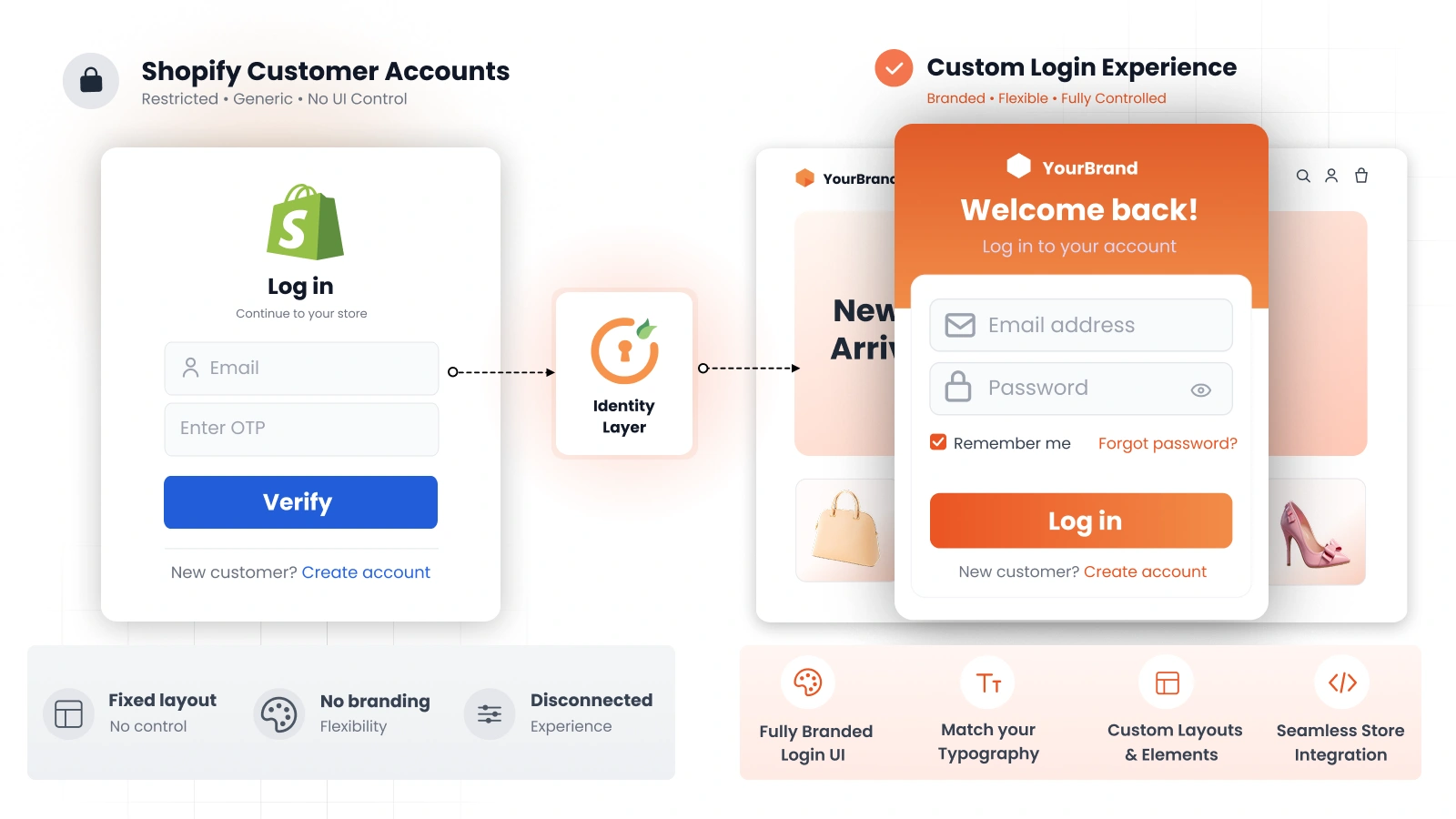
- Another common problem for Shopify Plus customer accounts is the lack of flexibility in login methods. While customers can log in to Customer Accounts using the email OTP, and enterprise users have the option to log in via their existing IdP credentials, the default SSO flow does not allow for both these methods to be combined, creating friction for companies that cater to both B2C and B2B users. Customers with legacy accounts also face challenges, as they are more accustomed to the traditional username-password login flow, which is not supported in the default login process.
- As merchants expand, these constraints become more noticeable. Multi-store provisioning isn’t available, user sessions are limited, and there is no built-in way to enforce advanced login restrictions or customize login behavior. The standard 24-hour limit is another session timeout issue that Shopify Plus merchants often face; while suitable for basic use cases, it can feel restrictive for businesses that need longer or more flexible user session lifecycles.
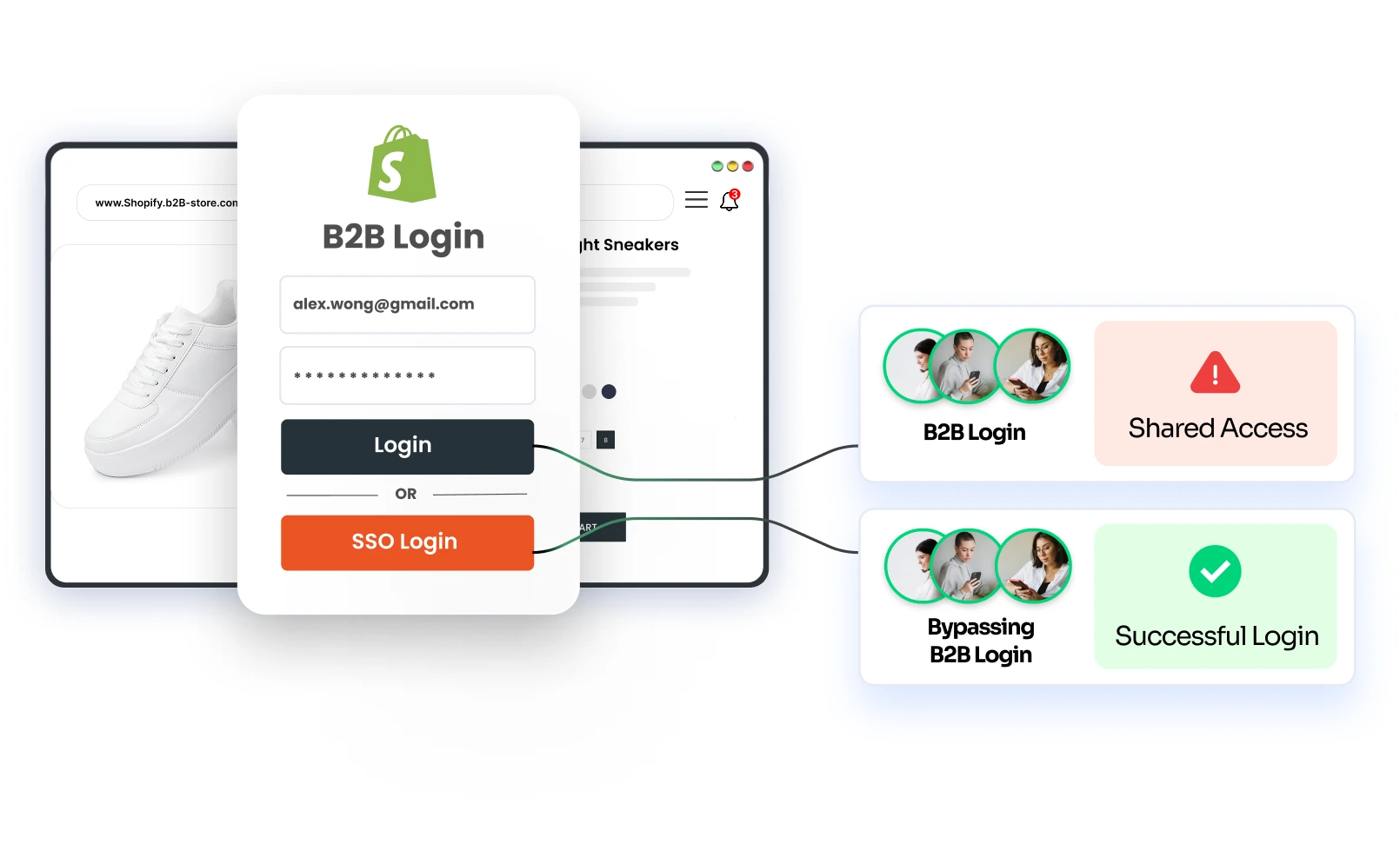
- B2B login issues are also a common concern for Shopify Plus merchants. Shopify’s default SSO solution does not include the option to create company account requests from the storefront. There is also no support for domain-based assignment of company contacts, role-based permissions for B2B users, or support for custom authentication for B2B customers. This leaves merchants without the foundational identity and access management tools needed for scalable B2B storefronts.
- Lastly, Shopify’s native SSO setup maps only the email attribute. This provides no support for names, roles, metafields, tags, addresses, or other user attributes required for restricted content, pricing rules, or personalized B2B experiences. And for brands that prioritize fully branded login and registration experiences, the limited customization options around overall design (logos, layouts, colors, etc.) may feel restrictive.
Taken together, these constraints can contribute to some of the most common pain points merchants report—Shopify Plus login problems, session inconsistencies across stores, and B2B login issues, making it difficult to manage or cater enterprise-level requirements.
miniOrange SSO: Enhancing Storefront Login on Shopify Plus
miniOrange’s Single Sign-On (SSO) solution is designed specifically to bridge these gaps and eliminate the customer login limitations that Shopify Plus merchants struggle with.
| Capability | Shopify Plus SSO | miniOrange SSO |
|---|---|---|
| Authentication Support | Single active identity provider (IdP) | Connect multiple identity providers (Okta, Microsoft Entra ID, Keycloak) |
| Protocol Support | Support for OIDC protocol only | Support for multiple protocols (SAML, OAuth, OpenID) |
| User Profile Mapping | Limited to email address | Maps first name, last name, tags, addresses, and custom attributes for complete profile mapping |
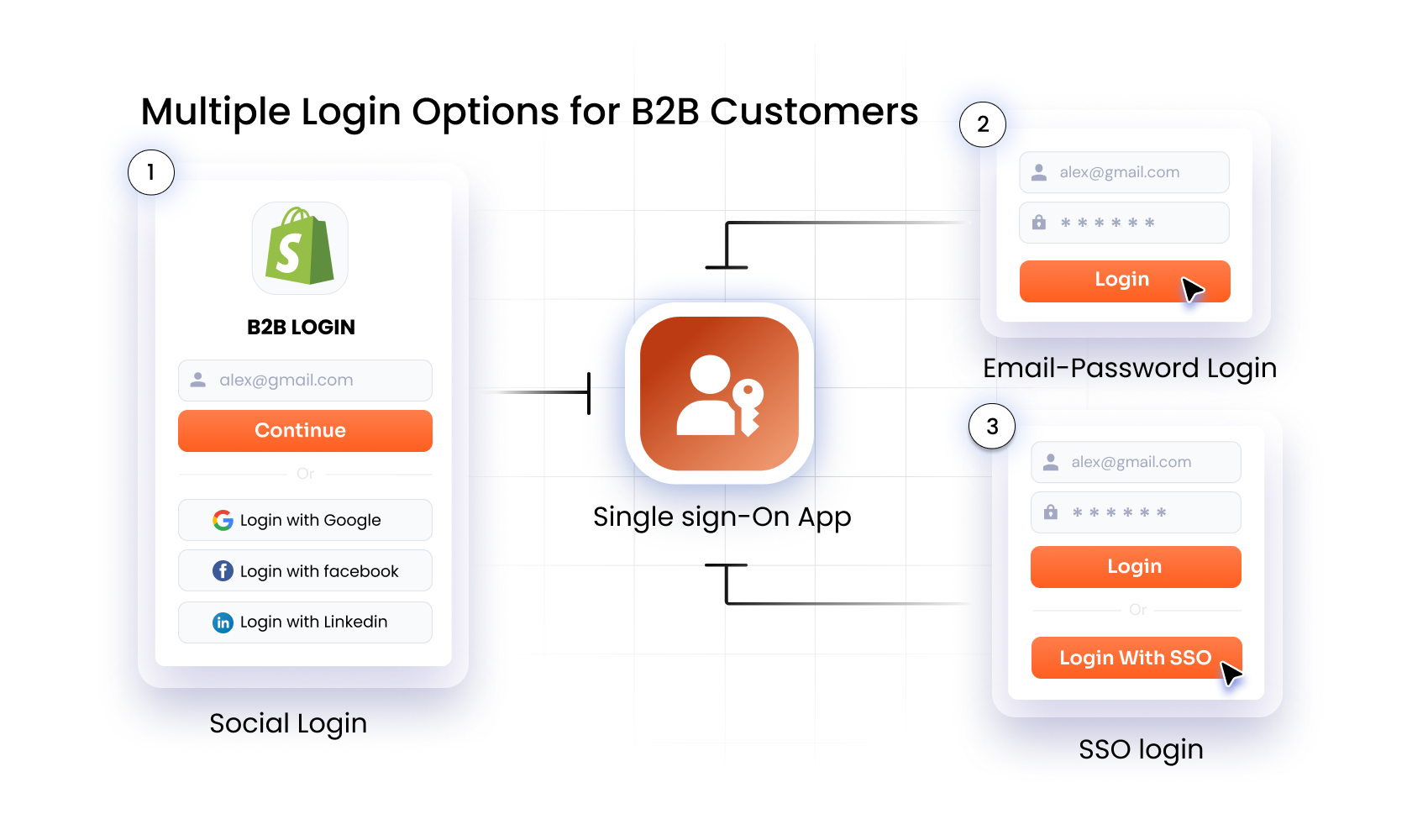
| Login Flexibility | Rigid login flows for B2C/B2B customers (either email OTP or SSO, not both) | Supports custom authentication flows for customer logins and B2B users (email-password, email/phone OTP, corporate SSO, social login) |
| User provisioning & Session Management | No multi-store user provisioning; 24-hour session timeout limit, no single logout support | Automatic user provisioning/deprovisioning across stores, flexible user sessions, custom login flows. Full logout across Shopify and connected platforms |
| B2B Features | Limited B2B functionalities | Full B2B support: company account creation, automated contact assignment, role-based permissions, B2B-specific content restrictions, integrated storefront login |
| Branding & Customization | Limited options for branding or customization of login experience | Full control over login/registration UI, layout, colors, logos |
For Shopify Plus merchants who need more flexibility than native login allows, miniOrange SSO extends storefront authentication in practical ways without disrupting the customer journey. It supports major authentication protocols such as SAML, OAuth, and OpenID Connect (OIDC), making it possible to connect Shopify Plus with different identity systems. User profile mapping also goes beyond basic email matching, allowing attributes like first name, last name, tags, and addresses to stay consistent across logins. This makes it easier to support flexible login flows, such as username-password, email/phone OTP, and Single Sign-On (SSO) through corporate or social identity providers, without forcing all users into a single experience.
Beyond login flexibility, the solution also simplifies B2B company assignment and onboarding on Shopify Plus. B2B contacts can request company registration directly from the Shopify storefront, with those requests routed to admins for review and approval. Once approved, B2B contacts are automatically assigned to their respective company based on their verified email domain, reducing manual setup. Merchants can also keep selected pages accessible for general users while restricting B2B-specific products, pages, or collections to verified company contacts only, ensuring a structured B2B experience.
As store setups become more complex, identity management and session control start to matter just as much as the login method itself. miniOrange SSO allows merchants to integrate with multiple identity providers, which helps avoid the single-IdP limitation that many Shopify Plus stores run into. It also supports seamless user provisioning across Shopify multiple storefronts, eliminates the default 24-hour session timeout limit, and ensures unified logout across all connected platforms, reducing user session-related issues.
In summary, while Shopify’s native SSO is suitable for basic customer login use cases, the miniOrange SSO solution provides a comprehensive, scalable, and enterprise-ready approach to guide merchants in making their Shopify Plus login process more efficient.
Conclusion
Shopify Plus gives merchants a strong foundation, but its default login system wasn’t built for large-scale identity needs. As brands grow, the gaps become clearer: issues with setting up multiple IDPs, limited B2B functionality, user session issues, and repetitive login flows that frustrate customers.
miniOrange solves these problems with a single sign-on (SSO) solution tailored for the complexity of Shopify Plus storefronts. It modernizes authentication, unifies multi-store access, strengthens security, and improves customer experience, all while reducing support workload.
If you’re ready to overcome the limitations of Shopify Plus SSO and give your customers a seamless login experience, miniOrange offers a clear path forward with the Single Sign-On (SSO) solution.
Connect with our team to find the best-fit approach for your business.
Leave a Comment