
Shopify’s introduction of Customer Accounts marks a significant step toward modernizing the customer experience across ecommerce. These updates aim to provide a more scalable and self-service-friendly experience for buyers. But while this is a promising start, there are also limitations around authentication, login methods, and access control that Shopify merchants cannot ignore. These challenges highlight the need for a robust and flexible login solution for Shopify Customer Accounts.
Note: Shopify has recently deprecated Legacy Accounts. To retain your existing email-password login or create flexible login experiences while transitioning to Shopify Customer Accounts, follow our step-by-step migration guide.
Why Merchants Are Seeking Login Flexibility From Shopify Customer Accounts
One of the ways the new updates from Shopify are benefiting merchants is by making the login experience simpler. The default login flow for Customer Accounts includes a simplified, email OTP-based login, i.e. passwordless access; ideal for merchants that are just getting started.
However, like any other emerging technology, there are some bottlenecks. As businesses scale and their operations become more complex, merchants have started to identify certain limitations in the Shopify customer accounts login experience. What starts as a streamlined login flow becomes a point of friction when complex use cases such as shared-user access, role-based authorizations, auto-login from third party services, etc., emerge.
In this blog, we will explore the key challenges with email OTP-based login in Shopify Customer Accounts based on our observations and real-world feedback from our customers. We'll highlight the specific issues that B2B stores face and learn how to move beyond them by replacing the Shopify customer accounts login with flexible Shopify B2B login solutions.
What Are the Limitations & Problems Faced by Merchants During Shopify Customer Accounts Login?
1. Accessing Shopify Store With Shared Email Account Access
One of the most common concerns raised by Shopify merchants is having to manage OTP login for shared user logins in Shopify Customer Accounts. In its current setup, Shopify requires every login to be verified via a one-time passcode sent to the registered email ID. But, what if in an organization, one email account is used by many users?
This may be manageable for smaller teams or businesses with limited access requirements. However, for merchants with larger internal teams or shared business emails, the default login flow for Shopify Customer Accounts becomes problematic.
In this setup, every login attempt requires coordination with the inbox owner, presenting a limitation of shared logins in Shopify environments.
To address this, merchants in this situation are actively seeking ways to avoid default email OTP login in Shopify Customer Accounts, in order to manage access for multiple internal stakeholders without unnecessary bottlenecks.
2. Login Redundancy Due To Email OTP-Based Login
Imagine a scenario where employees are required to have access to multiple internal systems in their company, including Shopify stores. While they can log in to internal connected platforms using their corporate credentials, for Shopify, they are forced to log in via email OTP to access their stores, instead of getting auto-logged-in. This repetitive step can cause delays and inconvenience for customers, causing disruptions to the workflow.
Also, the lack of fine-grained access control has led merchants to seek more secure alternatives for auto-login. These include ways to restrict access to specific user groups, based on customer tags, additional profile details, domains, or internal policies that are defined in their corporate Identity and Access Management services.
This highlights a critical concern for Shopify merchants, especially in industries that demand high security, such as healthcare, legal, or finance.
3. Lack of 2FA Options For Secure Authentication in Default Customer Accounts Login
Some merchants have expressed concerns about the limited support for advanced authentication options like 2FA in the default Shopify login flow.
For many Shopify businesses, especially in high-security industries, enforcing two-factor authentication and similar options is necessary for securing access and store management. However, since Shopify’s default login flow relies on a single-step email OTP login, merchants are worried about the limited options for authentication, highlighting a limitation of Shopify customer accounts login.
Shopify users have therefore expressed their intention to replace email OTP login for Customer Accounts and implement more robust authentication flows that are better aligned with their specific security needs.
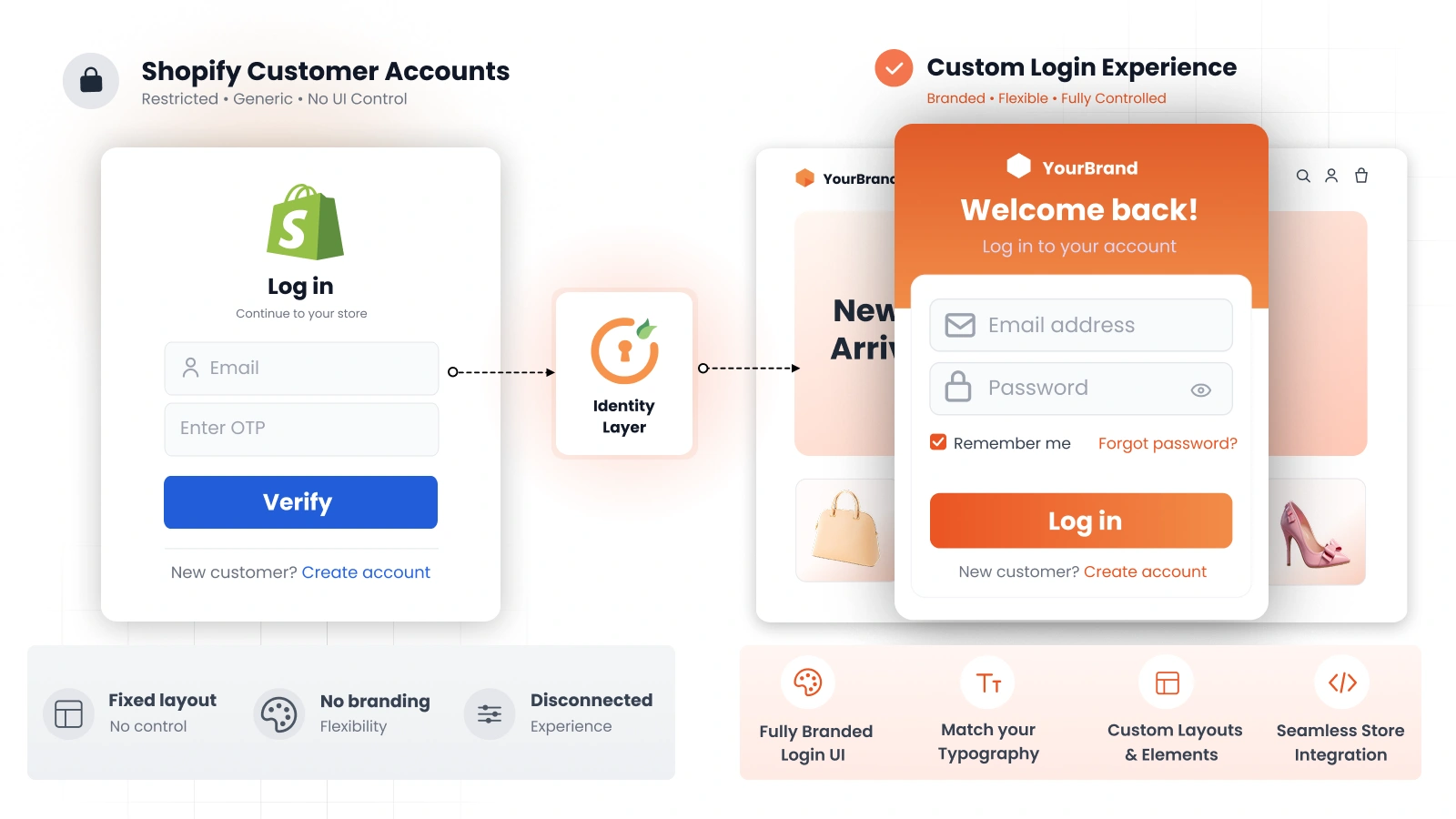
4. No Customization Options for Shopify Email OTP Login Page
Recently, merchants switching to Shopify Customer Accounts have reported an important issue — the inability to customize Shopify’s default email OTP login page. In the current setup, there are no options to alter the branding, language, or additional input fields on the login page, making it difficult for merchants to align their login experience with their brand’s needs.
This issue is creating disruptions in the customer journeys, particularly for Shopify customers who expect a tailored and consistent login process that aligns with their experience with the brand.
This has made Customer Accounts login a major consideration for Shopify merchants looking to deliver a more customized and streamlined login flow for their customers.
5. Lack of Phone-Based OTP Login for Shopify Customer Accounts
The absence of phone-based OTP options has also been brought up as a notable limitation in Shopify customer accounts login. Currently, Shopify has made it mandatory for users to log in using email-based OTPs, with no options to verify users via their phone numbers.
This has become a challenge for Shopify merchants whose customers either don’t have access to email, or who prefer to use SMS or other delivery methods that need phone numbers for authentication.
Due to this issue, many merchants are now exploring more flexible and accessible login solutions that allow them to replace default email OTP login in Shopify and give customers the option to log in using their phone numbers instead.
6. No Post-Login Redirect Control
Another common issue reported by Shopify merchants is the inability to control where users end up after they log in. In the current flow, users are redirected to a default page on the Customer Accounts login portal, even if they want to navigate to a different page.
This is a major concern for Shopify merchants who wish to offer smooth and tailored experiences. They are actively looking for an alternative that would help them avoid email OTP in Shopify B2B login altogether and route users to specific pages (product pages, orders page, etc.) automatically once they are logged in.
How miniOrange Helps to Overcome the Limitations of Shopify Customer Accounts Login?
Based on these observations and the queries from several Shopify merchants, it has become clear that there are some distinct limitations associated with the standard login flow for Shopify Customer Accounts. Our Shopify B2B Customer Login solution is built to address these specific challenges and help replace OTP login in Shopify Customer Accounts to make the process more flexible, secure, and better suited for real-world workflows.
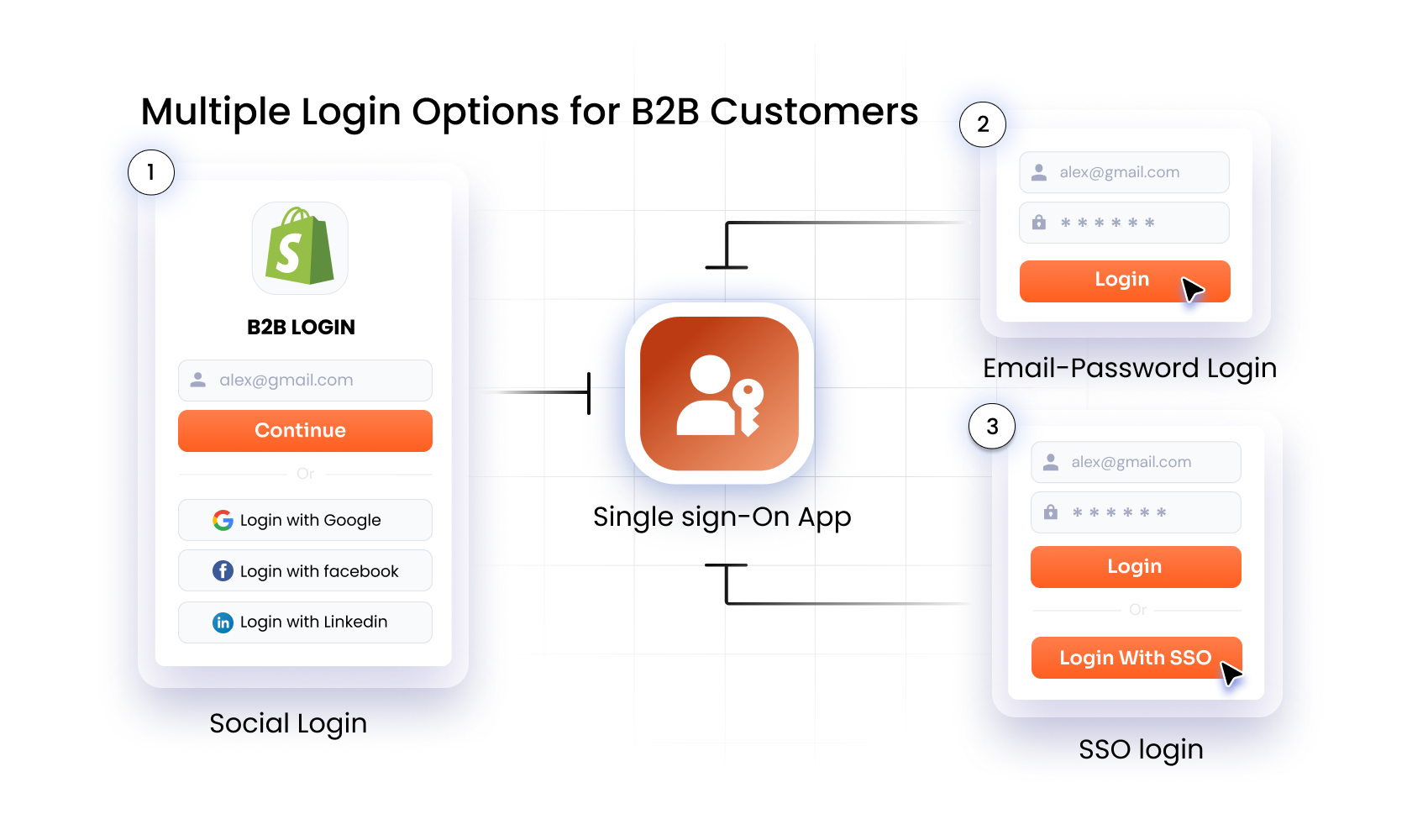
The Shopify Customer Accounts Login application provides a login flow that works using the users’ existing credentials, eliminating the dependency on email-based OTPs. Merchants can offer flexible authentication methods such as email-password login, phone OTP, or Single Sign-On (SSO) using existing corporate credentials. These methods can also be offered alongside Shop app login, providing greater flexibility in how users access their accounts. This is a crucial step for merchants that are looking for alternatives to OTP verification, especially in shared-access environments or among larger teams where bottlenecks like OTP are likely to occur.
The solution also offers support for custom user login forms, hosted on Shopify or other third-party platforms. By allowing merchants to onboard new users through a custom registration form in Shopify, the app provides greater control over which users are allowed to access the store.
miniOrange also offers an alternative solution to Shopify Plus stores looking to avoid the default email OTP login for Customer Accounts. Our passwordless login solutions are especially useful for users who prefer not to use email-based credentials to log into the store, allowing them to authenticate using an OTP sent to their mobile phone number instead. Passwordless login is a secure and convenient alternative to OTP login for Shopify customers who need flexible access options beyond email.
Ultimately, by enabling merchants to replace OTP login, the Shopify Customer Accounts Login solution delivers a scalable, real-world answer to the accessibility challenges faced by merchants.
Frequently Asked Questions (FAQs)
Can you replace email OTP login in Shopify Customer Accounts?
Yes, while Shopify’s default settings do not support disabling OTP login for Customer Accounts, merchants looking to avoid email verification bottlenecks can implement alternative login methods. These include username-password, phone OTP, SSO using existing corporate credentials, or a combination of these alongside Shop app login.
Can I log into Shopify Customer Accounts using existing Shopify credentials instead of OTP?
Yes, solutions like Customer Accounts Login let customers avoid Shopify’s standard email OTP login entirely and sign in using their existing Shopify credentials. This can help businesses overcome the limitations of Shopify’s standard login flow and create a smoother, more scalable customer accounts login experience.
Are there any Shopify apps that improve the Customer Accounts login flow?
Yes, miniOrange offers the Customer Accounts Login application that helps merchants provide multiple authentication methods, support login and registration through custom forms, and create a more flexible login experience tailored to their customer needs.
Conclusion
While Shopify Customer Accounts is a strong starting point for delivering a modern customer login experience, real-world feedback suggests that there are still certain limitations of Shopify Customer Accounts Login that need to be addressed.
As ecommerce customer journeys continue to evolve, merchants need the flexibility to support different authentication preferences and access requirements. In this scenario, solutions like Customer Accounts Login from miniOrange can help address pain points ranging from shared account access and authentication flexibility to customized login experiences and post-login journeys, so merchants can deliver a smoother customer experience without being restricted by a single login method.
Any of these issues resonate with you? Connect with us to explore how you can simplify your Shopify Customer Accounts login experience.
About the Technical Expert

Sr. Software Engineer
Manish Chhabra is a Senior Software Engineer at miniOrange with extensive experience in cybersecurity, Identity and Access Management (IAM), and e-commerce platforms. He has worked on building products for Shopify, WordPress, and other platforms, with a strong focus on authentication, authorization, MFA, and provisioning systems. His work includes designing system architecture, managing cloud and on-premise deployments and CI/CD pipelines, and contributing to secure and scalable product development. He also works in direct collaboration with enterprise customers to understand and implement technical requirements.
About the Author

Content Writer
As a seasoned content specialist, Saloni Walimbe specializes in bridging the gap between intricate cybersecurity frameworks and the end-user. With extensive professional experience and a postgraduate degree in Marketing, she has a proven track record of navigating highly technical industries like IT and market research. At miniOrange, she focuses on creating streamlined, strategic narratives that simplify the complexities of the cybersecurity landscape, ensuring mission-critical information is both professional and easy to digest for a global audience.
Leave a Comment