
Search Engine Optimization (SEO) helps websites rank higher on search engines and perform better. Users tend to check the sites present on the first page of the search engines, rather than the subsequent pages. So, in order to rank on the first page, businesses must have a solid SEO tactic and strategy.
In the blog, we will cover the basics of SEO, why it matters in today’s world, and how search engines work, so you can prepare an effective strategy for your organization.
What is Search Engine Optimization (SEO)?
Search Engine Optimization (SEO) is the process of improving a website’s visibility and position on search engines like Google, Bing, Yandex, Baidu, and DuckDuckGo.
The objective is to attract a higher quantity of organic (non-paid) traffic and ensure that such visitors are also of high quality, meaning they’re genuinely interested in the website’s content, products, or services.
Why SEO is Critical for Every Business Website?
The importance of SEO is growing globally, with its market share expected to reach $143.9 billion by 2030.
With people moving extensively to e-commerce, content marketing, AI tools, digital advertising, social media platforms, and popular forums like Quora and Reddit, the need for efficient SEO is expected to escalate rapidly in the coming years.
1. Increased Visibility and Organic Traffic
SEO helps business websites to rank higher on search engines, so they’re visible to people who are actively looking for relevant services, products, news, or any specific type of information.
This increased visibility drives organic traffic to the website, resulting in a steady stream of potential clients or users who may show a keen interest in the site’s offerings.
2. Cost-Effective
SEO is a cost-effective and sustainable strategy in multiple ways. As compared to paid advertising (PPC costs between $1 to $100,000 per month on average), the cost for SEO ranges anywhere between $1000 - $2,500 per month, depending on the scope, enterprise level, and project.
Unlike paid advertising, SEO isn’t about continuous spending; it’s a long-term, sustainable strategy. Once your website is properly optimized, it can continue to attract traffic and generate results over time without the need for constant investment. This long-lasting impact often translates into a higher Return on Investment (ROI) compared to short-term marketing campaigns.
The SEO’s cost-effective nature makes it a go-to solution for small and medium-sized businesses, startups, or solopreneurs.
3. Builds Credibility and Trust
Business websites that appear on the first page of SERPs are often perceived as trustworthy and credible by users. Search engines prioritize authoritative sites through ranking algorithms, enhancing brand reputation and user confidence.
4. User Experience and Engagement
User experience and engagement go hand-in-hand for bringing better leads for businesses. So, an organization must have a good search engine optimization strategy that promotes faster load times, intuitive navigation, relevant content, and mobile responsiveness, which contribute to lower bounce rates and increased user engagement.
5. Higher Conversion Rates
SEO leads close at 14.6% compared to 1.7% for outbound leads. Meaning, traffic driven via SEO tactics is well-targeted and includes users with a clear intent.
This translates to higher conversion rates, as visitors are more likely to complete the desired action, such as sign-ups, purchases, or consultations.
6. Competitive Advantage
SEO enables businesses to outrank competitors in search results, thereby capturing a larger share of the market. Staying ahead in organic rankings establishes a vital competitive edge.
7. Brand Awareness and Long-Term Equity
SEO is a continuous process, and consistent efforts help to build brand awareness, brand recognition, and long-term digital equity. Visibility across multiple search queries amplifies trust and familiarity amongst potential customers, resulting in business growth.
8. Analytics and Insights
Another benefit of SEO is leveraging tools for gaining analytical reports and insights on the published website, pages, or blogs.
The analytical reports include insights into keyword rankings, clicks, impressions, traffic sources, page rankings as per location, and more. Based on these insights, you can find ways to improve your website, refine marketing strategies, and improve content.
9. Helps in Multi-Channel Marketing
A powerful SEO strategy supports and amplifies other marketing channels, including social media, email marketing, and paid advertising, ensuring a cohesive and comprehensive digital marketing strategy. This helps in the overall visibility of your business on multiple platforms and to reach your target audience.
How Do Search Engines Work?
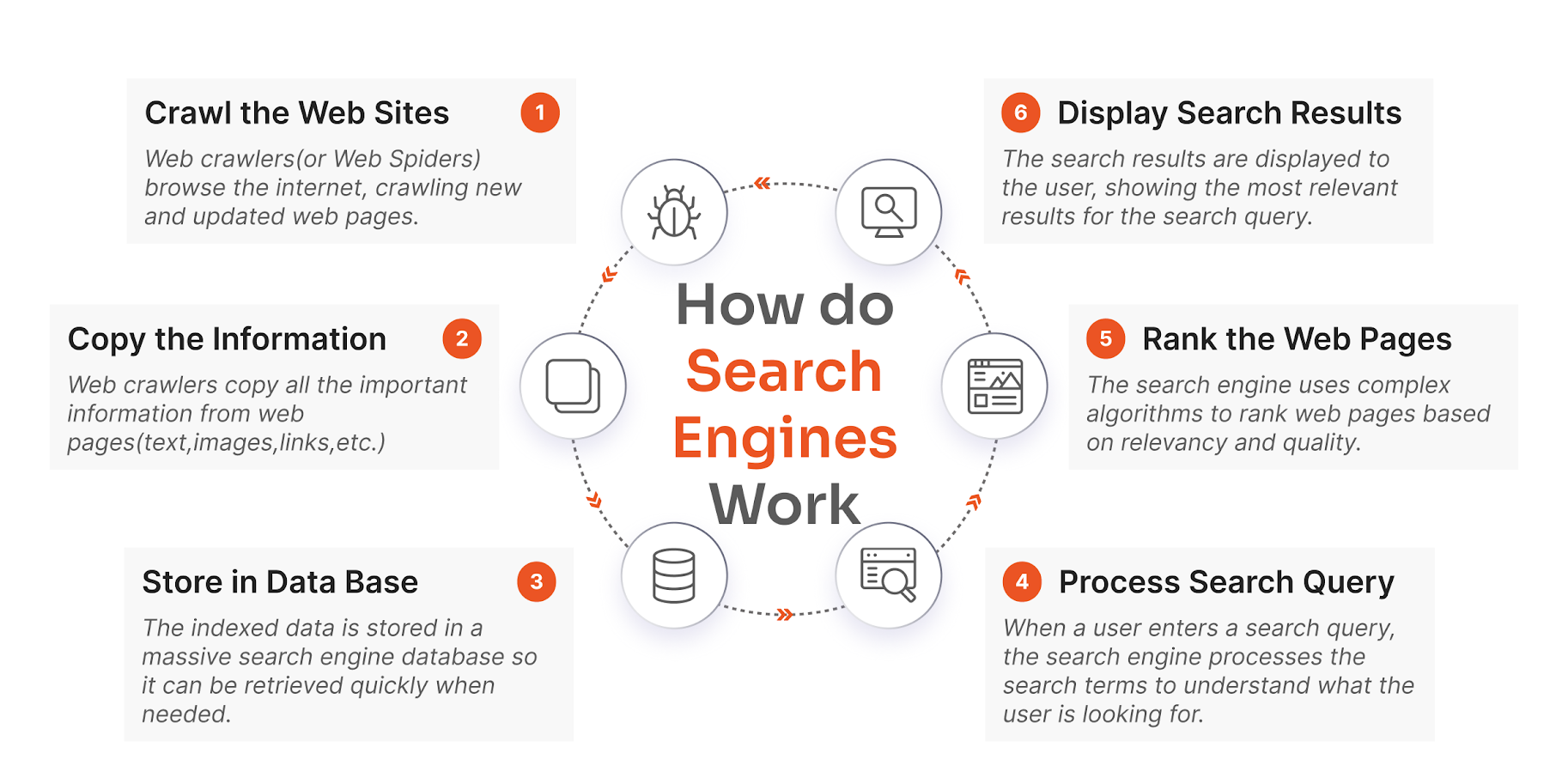
Before going into the depths of SEO, it is important to understand how search engines work, because they determine the rankings of the pages and blogs. The SEO works in three stages: crawling, indexing, and ranking.
1. Crawling
Crawling is the first step, and it is the process by which search engines discover new or updated web pages on the internet using automated software called web crawlers, spiders, or Googlebots.
These crawlers follow links from known pages to find additional pages. For example, if Googlebot finds a new blog post linked on your homepage, it will crawl to that post and collect information.
2. Indexing
The next step is indexing, and it involves organizing and storing the information gathered from web pages in a large database called the search engine index.
This process includes analyzing the content, keywords, images, and metadata to understand what the page is about.
3. Ranking
Ranking is the stage where the search engines decide the order in which the indexed web pages or websites appear on the search engines. This order depends on the user’s search intent, search query, and content relevancy.
Moreover, the ranking relies on aspects such as keyword relevance, page quality, user engagement, content structure, and User Interface/User Experience (UI/UX).
4. Role of Google’s Algorithm
Google’s algorithms are highly complex mathematical formulas and rules that guide crawling, indexing, and ranking. They are responsible for determining how pages are scrutinized for relevance, quality, and authority.
Google constantly revamps its algorithms or changes them, so only relevant information based on the user queries is displayed.
For instance, in June 2025, Google rolled out the Core Update, where the focus was on rewarding sites with topical authority and strong E-E-A-T (Experience, Expertise, Authoritativeness, and Trust), along with well-sourced information, and penalizing stale or thin content.
What are the Key Ranking Metrics for SEO?
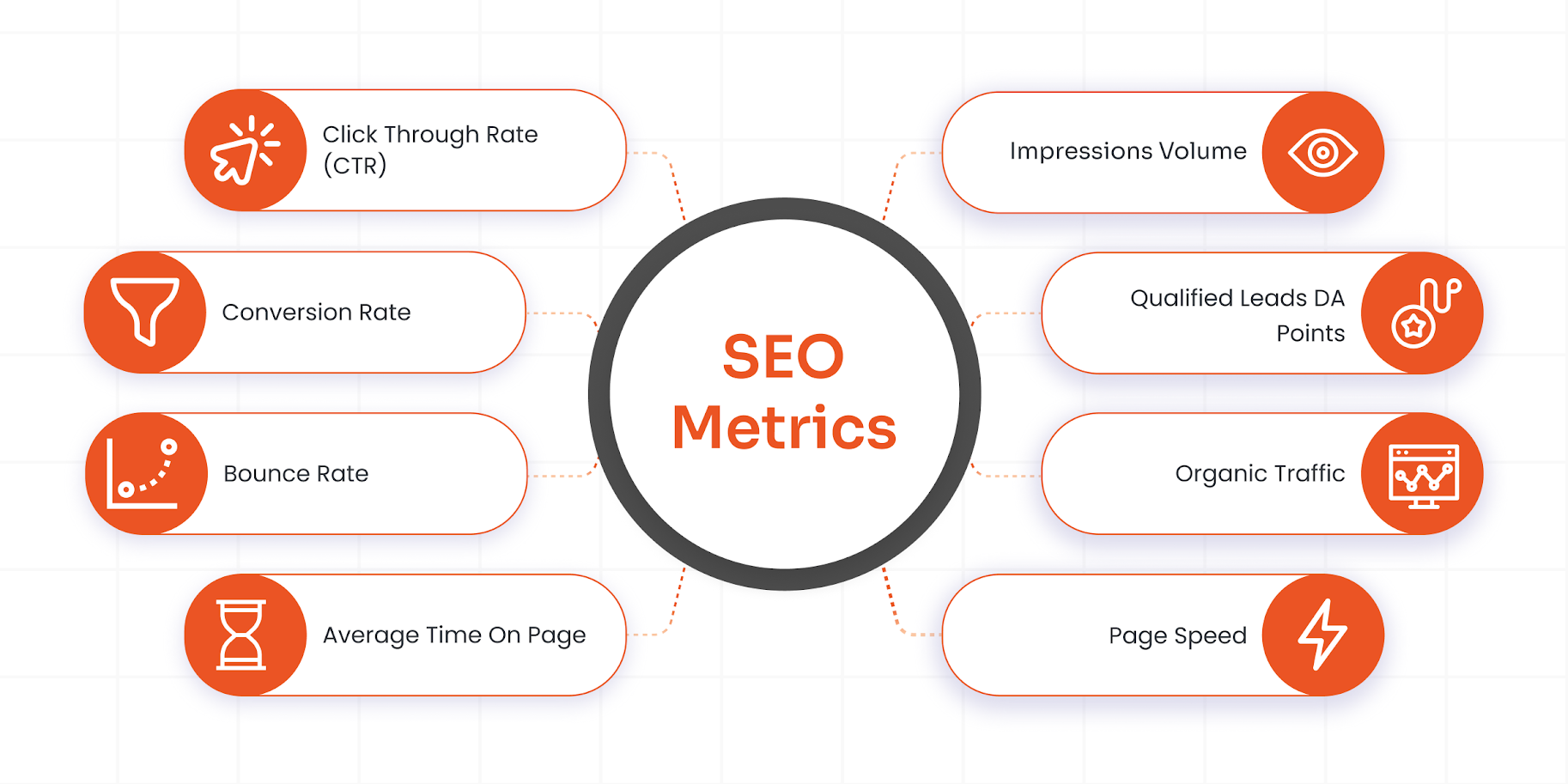
SERPs rely on several factors to determine page rankings. Here is a non-exhaustive list of metrics that will help you boost your chances of ranking higher on search engines.
1. Content Quality and Relevance
Content quality and relevance top the list because SERPs prioritize in-depth materials over thin pages. For example, web pages with comprehensive coverage of topics with consistent publishing are more likely to rank compared to pages that don’t.
2. Backlinks and Authority
Backlinks from credible and reputable sites signal trustworthiness, and they act as a vote of confidence. Quality always prevails over quantity. So, you can have a definitive outreach program for building credible backlinks on sites that accept them and aren’t spammy.
3. Keywords
Keywords are nothing but search queries that people type into the search bar of Google or Bing. If you incorporate the query into the webpage or blog, then you can easily rank it, provided that the content quality, its usefulness, and intent are relevant and valuable.
Keywords can be implemented in meta tags, H1 tags, the introduction, the hero section, and the content. However, avoid stuffing keywords and maintain the keyword density between 1-2%.
Furthermore, semantic terms and keyword variations, including long-tailed keywords, now drive better results, with topical authority being a single-keyword focus.
4. E-E-A-T
Experience, Expertise, Authoritativeness, and Trustworthiness (E-E-A-T) is a set of guidelines created by Google to analyze the content quality.
It evaluates the first-hand experience of the content writer or creator, their knowledge, and reputation. Websites with cited sources, real-world experiences, and author bios tend to rank higher.
5. Time Spent on Page
Stronger user engagement signals that content truly resonates and delivers on user expectations. When visitors spend more time and interact deeply, through clicks, scrolls, or form submissions, it shows the page masterfully matches search intent.
Though dwell time isn't a direct ranking factor, such engagement boosts pages' overall quality signals, helping them climb search results over time.
6. User Experience and Engagement Rate
Integrate user experience aspects such as mobile-friendliness, site speed, and site architecture for improved results. A good user experience encourages engagement, makes websites discoverable, and decreases bounce rates.
An engagement rate in terms of SEO refers to how well your website keeps its visitors engaged through compelling content pieces.
7. Click-Through Rate
Click-through Rate (CTR) determines the percentage of people who have clicked on your website after seeing it on SERPs. A higher CTR means that your website’s meta title and meta description are relevant to the search queries.
8. Brand Awareness
Brand awareness involves making people aware of your product or service, so they arrive at your doorstep to either purchase, sign up, or read your content.
Positive reviews on credible sites like G2, Gartner, Glassdoor, or Google Reviews help to create brand awareness, leading to better rankings.
9. Domain Authority
Domain Authority (DA) is a score that predicts a website’s ability to rank on SERPs. DA is influenced by aspects like quantity and quality of backlinks, content relevancy, and overall online presence. A higher domain authority relates to better SEO results.
10. Bounce Rate
Bounce rate measures the percentage of visitors who leave a website after viewing only one page, without interacting further or navigating elsewhere. In SEO contexts, a high bounce rate often signals issues like mismatched content, slow loading times, or poor user experience, potentially impacting search rankings indirectly through user engagement signals.
11. Conversion Rate
Conversion rate tracks the number of visitors who’ve taken a desired action after visiting your site. For example, they’ve purchased your product or service, signed up for a webinar, or downloaded an asset.
A high conversion rate signals that the content is valuable, trustworthy, and relevant. It also helps to increase sales and eventually ROI.
12. Organic Traffic
Organic traffic refers to the number of people who’ve visited your website via SERPs (without paid advertising). Organic traffic reflects directly on how your SEO is driving results.
Rising organic visits validate your strategy, creating a virtuous cycle with better rankings. Track this metric in Google Analytics or Google Search Console (GSC).
The Three Pillars of SEO
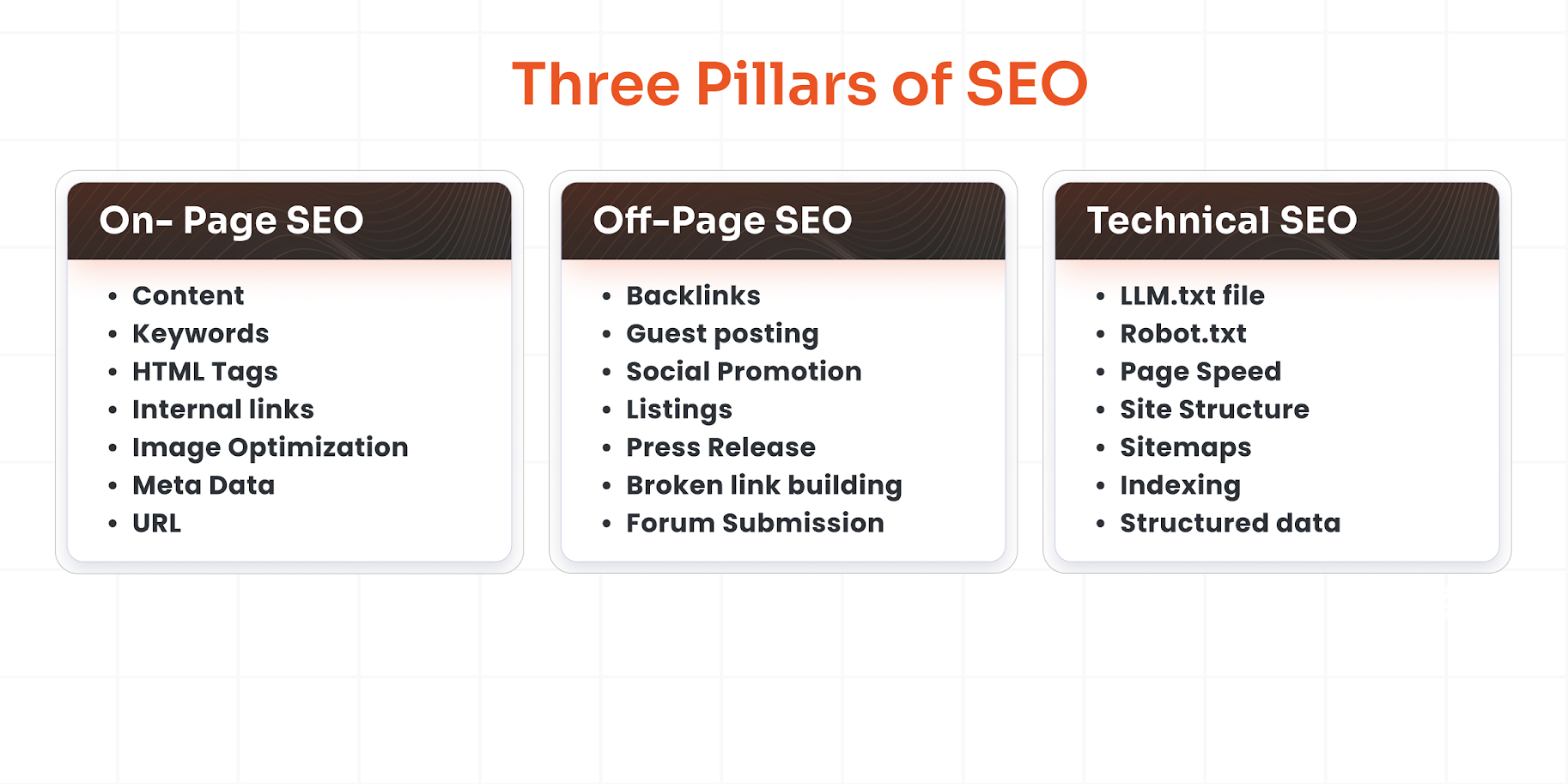
Search engine optimization highly depends on how you leverage on-page, off-page, and technical SEO foundations. Each of these pillars leaves a maximum impact on your website’s performance.
1. On-Page SEO
On-page SEO optimizes individual pages for better rankings and user experience. Key elements and best practices:
- Content Optimization: Create readable, engaging content with primary/related keywords in the first 100 words, titles, and headers (H1-H3). Prioritize semantic relevance over stuffing.
- Title Tags and Meta Descriptions: Limit titles to 50-60 characters; metas to 150-160 with summaries and CTAs to boost clicks.
- URL Structure Use clean, keyword-rich slugs with hyphens—no special characters or numbers.
- Internal Linking: Link pages strategically to build clusters, distribute authority, and aid navigation with relevant anchor text.
- Image Optimization: Add descriptive, keyword-relevant alt text for SEO and accessibility.
- Schema Markup: Implement JSON-LD structured data for rich SERP features like FAQs or reviews.
- Content Quality and User Intent: Deliver original, researched content matching search intent, structured with headers, bullets, images, tables, and CTAs.
These tactics make pages search-friendly and user-focused, driving traffic and growth.
2. Off-Page SEO
Off-page SEO boosts your site's credibility via third-party mentions, reviews, social tags, and more for long-term gains.
- Link Building: Earn backlinks through outreach from authoritative sites.
- Quality Over Quantity: Prioritize a few high-DA, relevant links over spammy ones.
- Social Media: Build profiles on Instagram, Facebook, X, and LinkedIn; share engaging content like infographics to drive traffic and signals.
- Brand Mentions: Use Google Alerts to track and convert mentions into backlinks on reputable sites.
- Guest Posting: Contribute niche articles to other sites; promote ebooks and blogs for links.
- Reputation Management: Monitor and respond to reviews on Yelp, Google, and social platforms.
Mastering off-page SEO requires patience and relationship-building, but it creates a powerful foundation that elevates your entire site in search results.
3. Technical SEO
Technical SEO ensures search engines can crawl, index, and rank your site efficiently. It prioritizes fast loading, mobile-first design, and smooth user experience.
Website Architecture: Keep key pages 2-3 clicks from the homepage with logical URLs and internal links.
- Crawlability: Audit for errors via Google Search Console or Screaming Frog; fix broken links and blocks.
- Site Speed: Optimize for quick loads to boost UX and rankings.
- Mobile Responsiveness: Use responsive CSS; test with Google's Mobile-Friendly Tool for large, tappable buttons.
- XML Sitemaps: Submit updated sitemaps to Google Search Console for faster indexing.
- Robots.txt: Block irrelevant pages from crawling.
- Structured Data: Add JSON-LD schema for events, FAQs, or reviews to improve CTR and rich snippets.
- Core Web Vitals: Optimize LCP (loading), FID (interactivity), and CLS (stability) to meet Google's standards.
- HTTPS and Security: Secure your site with HTTPS.
- Fix Broken Links/Redirects: Scan for 404s; use 301 redirects and avoid chains.
By mastering these technical SEO essentials, you provide a solid foundation for search engines to crawl, index, and rank your site, while simultaneously offering a superior user experience that drives engagement and conversions.
Wrapping Up
Mastering SEO fundamentals, from understanding search engines to nailing the key pillars, sets your business website up for long-term success. But theory alone won't cut it; you need tools that make implementation effortless, especially on WordPress.
Enter the miniOrange SEO Plus plugin: it simplifies technical audits, sitemap generation, schema markup, and Core Web Vitals optimization in one dashboard, perfect for turning these basics into rankings.
To know more about the SEO plugin, connect with us; you can also download the plugin, and if you want to try it out, don’t hesitate to sign up for a free trial today!
FAQs
1. How to learn SEO and get started?
Start with free resources like Google's SEO Starter Guide and YouTube channels that offer SEO tutorials. Also, practice on a test site using Search Console. You can implement an SEO plugin to optimize your website.
2. Is the miniOrange SEO Plus plugin free?
Yes, a free version offers essential SEO features like site audits and sitemap management, along with Webmaster tools, llms.txt, and many more.
3. What makes miniOrange SEO Plus different from other WordPress SEO plugins?
It stands out with a lightweight design, AI-driven suggestions, broken link detection, and an intuitive interface suitable for all skill levels, without slowing site performance.
Leave a Comment