

According to a recent study by Deloitte, 96% of organizations are running AI agents in production and only 21% have a mature governance model for them.
This gap is not a roadmap problem. It is a live compliance exposure. 53% of organizations have already experienced AI agents exceeding their intended permissions, and 47% have faced a security incident involving an AI agent in the past 12 months. According to a recent report, in 2025 alone, financial losses linked to AI compliance failures across large enterprises reached $4.4 billion.
The root cause is structural.
Enterprise compliance frameworks such as GDPR, HIPAA, SOC 2, the EU AI Act, and India’s DPDPA were designed for human users, service accounts, and traditional systems. AI agents do not fit into any of these categories. They are autonomous systems that access data, execute workflows, call APIs, and make decisions without a human approving every action.
This creates a fundamental gap between how systems are governed and how they actually operate.
This article is a practical guide for compliance leaders. It breaks down the exact compliance challenges AI agents introduce, maps them to major regulatory frameworks, and explains the controls required to close these gaps.
The governance gap, deploying at speed, governing at standstill
AI adoption inside enterprises has moved at a pace that governance frameworks were never designed to match. Organizations are deploying AI agents rapidly to automate workflows, improve efficiency, and reduce operational overhead. Governance, however, has not evolved at the same speed.
The result is a widening structural gap.
- Only 21% of organizations maintain a real-time agent registry, meaning most do not have a complete inventory of the agents operating inside their environment (CSA/Strata, 2026).
- Confidence in existing identity systems is equally low. Only 18% of security leaders believe their IAM infrastructure can effectively handle AI agent identities, and just 23% have a formal strategy for managing non-human identities at scale (Cloud Security Alliance/Strata, February 2026).
- Monitoring is another weak point. Only 38% of organizations track AI activity end-to-end, including prompts, tool calls, and outputs. Even fewer, just 17%, monitor agent-to-agent interactions (EY/AIUC-1 Consortium, March 2026).
- The financial impact is already visible. 64% of companies with revenue above $1 billion reported AI-related losses exceeding $1 million in 2025 (EY/AIUC-1 Consortium, March 2026). Gartner predicts that over 40% of agentic AI projects will be canceled by 2027, with poor governance cited as the primary reason.
This is not due to negligence. It is a mismatch in architecture.
Traditional governance models were built around human-speed interactions. Even shadow IT could be discovered, reviewed, and controlled through periodic audits. AI agents operate at machine speed. They can access thousands of records, trigger workflows across systems, and generate outputs continuously, all within seconds.
A quarterly audit cycle cannot keep up with a system that operates in real time.
This is why the governance gap is not just a maturity issue. It is a structural compliance risk. Organizations that address this gap early will have a measurable advantage in audit readiness and regulatory resilience.
Why do AI agents create compliance problems that traditional frameworks were not built to handle?
Most compliance frameworks are built around a simple idea: every action in a system can be traced back to a known entity. GDPR assumes contracted data processors. HIPAA assumes identifiable workforce members. SOC 2 relies on access controls tied to specific users. Even the EU AI Act assumes that automated systems operate under human supervision.
AI agents don’t fit into this model.
What makes them different is not just how they are used, but how they behave. The following characteristics explain why they create compliance challenges that traditional frameworks were not designed to handle.
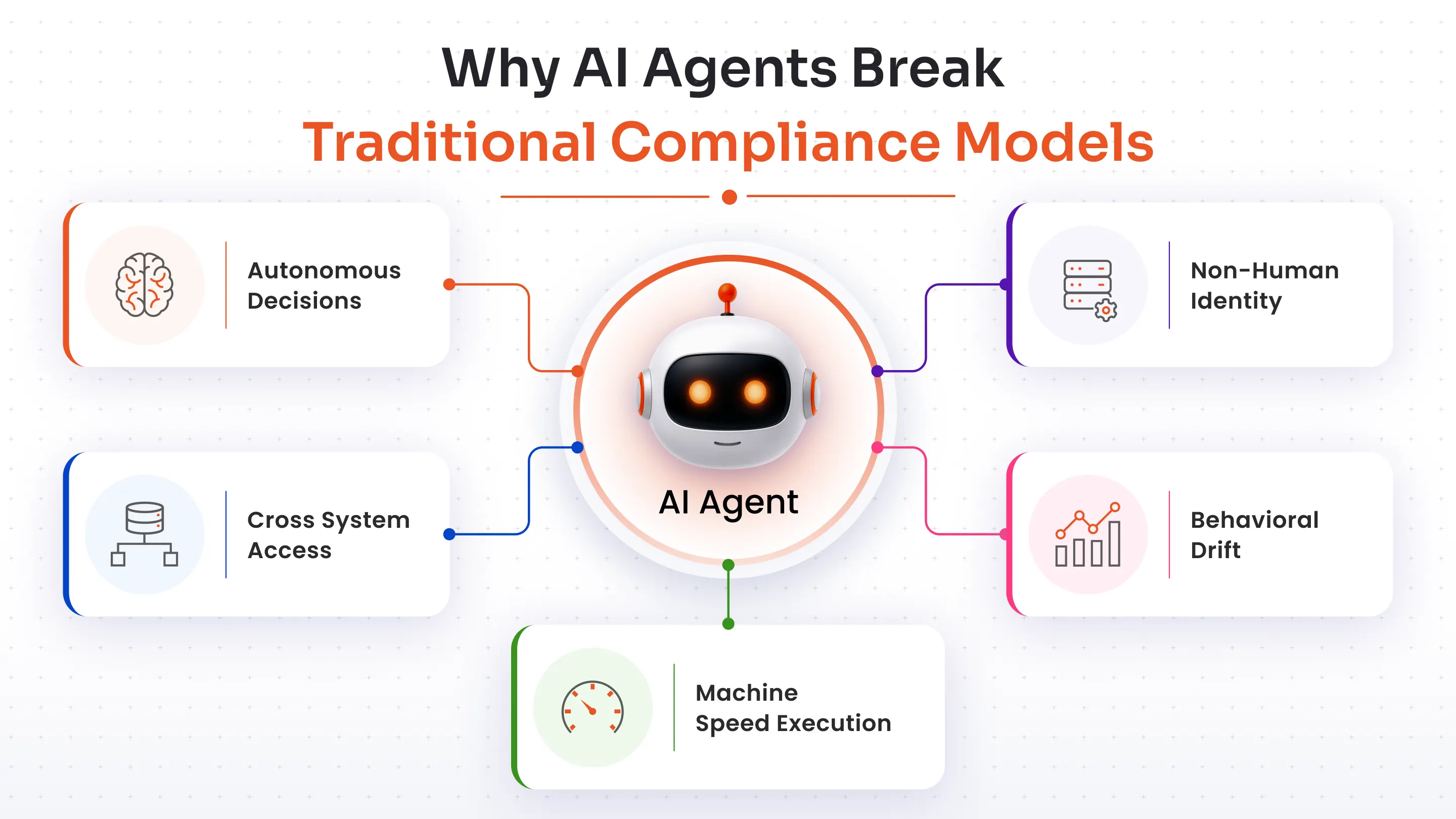
1. Autonomy without clear ownership
AI agents can perform actions independently, but they are not legal or accountable entities. When something goes wrong, like unauthorized data access or unintended communication, there is no direct mapping to responsibility, which creates ambiguity during audits and investigations.
2. Non-human identity without enterprise control
In most environments, agents run using borrowed access such as shared credentials, API keys, or user-granted tokens. Only a small portion of organizations maintain a real-time inventory of such agents (CSA/Strata, 2026). Without a defined non-human identity, these agents cannot be properly governed or lifecycle-managed.
3. Cross-system access with overlapping regulations
AI agents are designed to connect systems. A single agent might pull customer data, update financial records, and interact with healthcare information in one workflow. This blends multiple regulatory scopes into a single execution path, increasing the impact of any failure.
4. Behavior that evolves over time
Unlike static systems, AI agents adapt based on inputs and usage patterns. This can lead to outcomes that were never explicitly designed or tested. From a compliance perspective, such shifts may require re-evaluation, especially under regulations that account for system changes.
5. Execution at machine scale
AI agents operate continuously and at high speed. They can process large volumes of sensitive data without pause, which makes traditional review mechanisms ineffective. By the time an issue is detected, the exposure may already be significant.
AI agents don’t just introduce new risks. They challenge the basic assumptions that compliance frameworks rely on.
The five core compliance challenges of AI agents in enterprise environments
AI agents introduce compliance challenges that go beyond isolated risks. These issues are interconnected and often amplify each other across systems and workflows.
Over-permissioned access can lead to unauthorized data exposure. Lack of identity makes audit trails incomplete. Behavioral drift introduces gaps over time. Together, these challenges create an environment where compliance cannot be consistently enforced.
1. Uncontrolled and over-permissioned access
AI agents are often granted broad permissions because they need to interact across systems. In practice, users approve OAuth scopes or API access without fully evaluating the impact. This results in agents having access to more data than required. According to CSA/Zenity (2026), 53% of organizations reported AI agents exceeding their intended permissions, highlighting how common this issue has already become. From a compliance standpoint, this directly violates principles like least privilege under SOC 2 and data minimization under GDPR.
2. Lack of audit trails and traceability
Most compliance frameworks require clear visibility into who accessed what data and when. AI agents break this model when they operate without a defined identity or structured logging. This gap is already visible at scale. According to the EY/AIUC-1 Consortium (2026), only 38% of organizations monitor AI activity end-to-end, and just 17% track agent-to-agent interactions. This means a large portion of AI-driven actions, especially those happening between agents, remain outside visibility, making traceability and auditability difficult.
3. Unauthorized data processing and transfer
AI agents frequently move data across systems as part of their workflows, often without explicit approval or visibility. This is not a theoretical concern. According to the IBM Cost of Data Breach Report, unauthorized or poorly governed data flows are contributing to a growing share of enterprise data breaches. This creates direct compliance risk under frameworks like GDPR, HIPAA, and DPDPA, where data processing must be controlled, documented, and purpose-driven.
4. Compliance drift due to evolving behavior
AI agents are dynamic systems. Their behavior can evolve over time based on new inputs, integrations, or usage patterns. The challenge is that most organizations are not equipped to detect this shift. According to CSA/Strata (2026), only 21% of organizations maintain a real-time inventory of AI agents. This lack of visibility makes it difficult to track how agents evolve after deployment and increases the risk of undetected compliance drift. Under regulations like the EU AI Act, such drift may require reassessment, even if no explicit changes were made by the organization.
5. No clear ownership or accountability
When an AI agent performs an action, responsibility is often unclear. The agent is not a legal entity, and the user who enabled it may not be directly involved in its actions. This challenge is compounded by weak identity governance. According to CSA/Strata (2026), only 23% of organizations have a formal strategy for managing non-human identities, and just 18% of security leaders trust their IAM systems to handle them. Without clear ownership and identity, organizations struggle to assign accountability during audits, incidents, or regulatory reviews.
Framework-by-framework: what each regulation requires from AI agent deployments
AI agents don’t bypass regulations. They expose the gaps in how those regulations are enforced.
Most frameworks assume you know who is accessing data, why, and under what control. With AI agents, that clarity starts to break down. Here’s how this shows up across major compliance frameworks and what needs to change to stay compliant.
1. GDPR: Accountability, data minimization, and processor obligations
GDPR requires organizations to control how personal data is processed, ensure it is used only for defined purposes, and maintain records of every system involved in that processing. It also mandates the ability to delete data on request and requires impact assessments for high-risk processing.
AI agents complicate all of this.
They don’t operate within a single, fixed workflow. Instead, they move data across systems dynamically, often without being formally recorded as part of processing activities. In many cases, organizations have not mapped AI agents into their Article 30 records or completed impact assessments for agent-driven workflows. This creates a blind spot in compliance.
According to Fini Labs/DLA Piper (2026), the average GDPR fine reached €2.8 million per breach, while enterprises continue to spend heavily on compliance efforts.
To close this gap, organizations need to treat each agent as a processing entity. This includes registering agents in processing records, completing Data Protection Impact Assessments for high-risk use cases, ensuring data processor agreements cover all AI sub-processors, and extending data subject rights handling to include agent-processed data.
2. HIPAA: Unique identification, PHI access control, and accountability
HIPAA governs access to protected health information, regardless of whether that access is performed by a human or a system. It requires unique identification, strong authentication, and audit controls for every entity accessing PHI.
AI agents often violate these assumptions.
Most agents operate using shared credentials or API keys, which means access cannot be attributed to a specific entity. Audit logs may show that a service account accessed thousands of records, but not which agent performed the action or why. This breaks both traceability and accountability.
According to Censinet (2026), HIPAA penalties can exceed $2 million annually in many cases, making this a real and immediate compliance risk rather than a theoretical concern.
To meet HIPAA requirements, each agent must have a unique identity, enforced authentication, and agent-level audit logging. In addition, any AI system interacting with PHI must be covered under a Business Associate Agreement, and sensitive actions such as data export or modification should include human approval checkpoints.
3. SOC 2: Logical access control, monitoring, and change management
SOC 2 focuses on how access is controlled, how systems are monitored, and how changes are managed. It assumes that all access can be tied to authorized entities and that activity can be monitored for anomalies.
AI agents introduce gaps across all three areas.
Agents are often granted broad access through OAuth or shared credentials, which conflicts with least privilege requirements. Their behavior is rarely monitored at a granular level, making anomaly detection difficult. In some cases, agents can trigger changes in systems without being included in formal change management processes.
This is becoming a real audit issue. According to Comp AI (2025), 66% of B2B buyers now require SOC 2 reports, and auditors are increasingly evaluating AI agent access to customer data.
To stay compliant, organizations need to bring agents into their access control systems as managed identities, include them in access reviews, log their activity into centralized monitoring systems, and ensure any system changes triggered by agents are documented and approved.
4. EU AI Act: Oversight, risk classification, and lifecycle control
The EU AI Act introduces the most comprehensive requirements for AI systems, especially those classified as high-risk. It requires risk management, documentation, logging, transparency, and human oversight throughout the system lifecycle.
AI agents, particularly those used in enterprise workflows, often fall into high-risk categories.
The challenge is that most deployments lack built-in oversight mechanisms. Agents operate independently, and their decision-making process is not always logged in a way that supports audit or post-incident analysis. In addition, their behavior can evolve over time, which may trigger reclassification or reassessment requirements.
The gap is most visible in oversight and logging.
To meet EU AI Act requirements, organizations need structured risk management processes for agents, continuous logging of agent decisions and actions, clear documentation of system behavior, and enforceable human oversight controls. Without this, compliance becomes difficult to demonstrate.
5. DPDPA (India): Purpose limitation, consent, and cross-border data flow
India’s Digital Personal Data Protection Act focuses on consent, purpose limitation, and control over how personal data is processed and transferred.
AI agents challenge these requirements in practical ways.
They often reuse data across workflows, which can violate purpose limitation. They may process data through external AI providers without explicit consent coverage. Most critically, they frequently send data outside India through LLM APIs, creating untracked cross-border transfers.
For many Indian enterprises, this is the biggest compliance blind spot.
To address this, organizations need clear mapping of agent data flows, enforcement of purpose-specific access controls, and visibility into where data is processed. Cross-border transfers must be explicitly reviewed and governed.
This is where DPDPA-native controls become critical. Platforms like miniOrange are positioned to address these requirements by providing built-in governance for identity, access, and data flow across AI-driven systems.
The non-human identity problem at the heart of every compliance failure
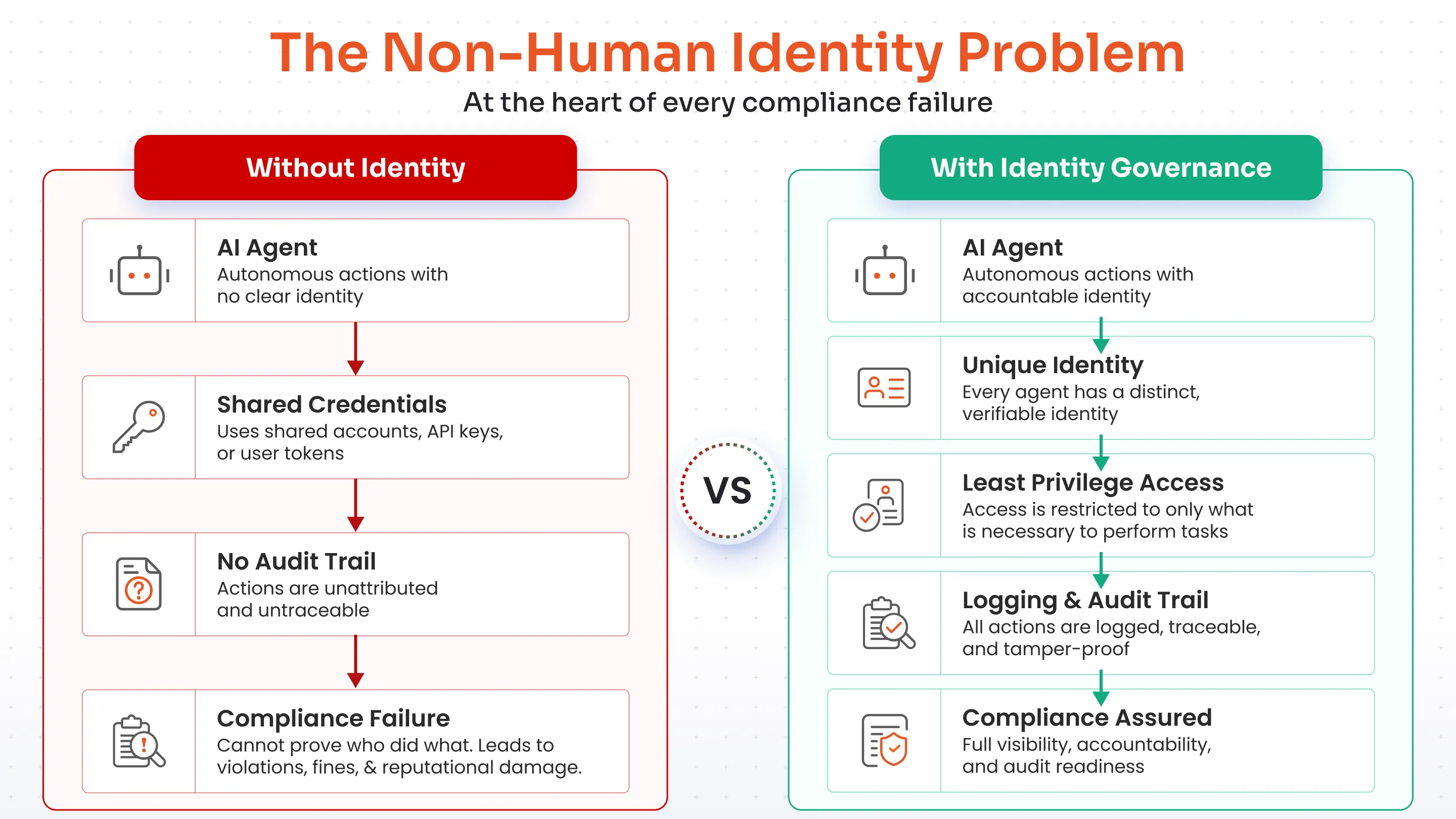
If you look at the compliance challenges discussed earlier, a clear pattern emerges. Each issue traces back to the same root cause: AI agents operating without verified enterprise identities.
No audit trail exists because there is no identity to attribute actions to. Data minimization fails because permissions are not scoped to a defined entity. Third-party processing risks increase because data flows cannot be tracked at an identity level. Even human oversight breaks down, because you cannot enforce controls on a system that is not formally identified.
This is the non-human identity problem.
According to the Cloud Security Alliance, only 18% of security leaders are confident their identity systems can handle AI agents, and just 23% of organizations have a formal strategy for managing non-human identities. At the same time, AI governance failures are increasingly driven by identity and access sprawl rather than model misuse alone, according to Security Boulevard (2026).
The implication is clear. This is not primarily a policy problem. It is an identity architecture problem.
To operate in a regulated environment, every AI agent must be treated as a first-class identity within the enterprise. That means:
- A unique enterprise identity provisioned through the IAM system, not borrowed from user credentials
- A defined permission scope aligned to the agent’s function
- A clearly assigned owner responsible for its behavior and lifecycle
- An expiration policy to prevent long-lived, unmanaged access
- An immutable audit trail, with every action attributed and logged centrally
This is not an advanced control set. It is the baseline required for compliance.
Three compliance failure scenarios that are happening right now
These are not edge cases. They are patterns already showing up in audits, investigations, and compliance reviews. The common thread is not malicious intent, but lack of visibility, identity, and control over how AI agents operate.
The scenarios below show exactly how these failures unfold.
Scenario 1. The HIPAA breach that was not a breach until the audit
A hospital network rolls out an AI care coordination agent to help nurses quickly access patient history. To simplify deployment, the agent is connected to the EHR system using a shared service account with broad read access. Procurement is not involved, so no Business Associate Agreement is signed with the LLM provider powering the agent.
For months, everything appears to work as expected.
During a routine HHS OCR audit, the hospital is asked to provide access logs for a specific period. The logs show over 100,000 record accesses tied to the shared service account. The problem is not the volume. It is the lack of clarity. The hospital cannot separate which requests came from the AI agent, which came from staff, and which came from other integrations using the same credentials.
According to Censinet (2026), HIPAA penalties can exceed $2 million annually, making gaps like this financially significant.
Compliance lesson: HIPAA requires unique identification and audit controls for every entity accessing ePHI. Shared credentials and missing BAAs remove both.
Scenario 2. The GDPR Article 22 violation inside a recruiting workflow
A financial services firm deploys an AI screening agent to handle high volumes of job applications. The agent assigns each candidate a score based on resume content and automatically filters out those below a set threshold. Recruiters only review shortlisted candidates.
The system improves efficiency, but it also removes human involvement from a critical decision point.
A rejected candidate challenges the decision under GDPR Article 22. During the internal review, the firm realizes that no human reviewed the rejected application, candidates were not informed about automated decision-making, and there is no clear explanation of how the score was generated.
What looked like a productivity gain turns into a compliance issue.
The investigation highlights multiple failures at once: lack of disclosure, no opt-out mechanism, and no prior risk assessment for an automated decision system.
Compliance lesson: When AI agents make decisions that affect individuals, GDPR requires transparency, human review options, and documented risk assessment. Without these, automation becomes a compliance liability.
Scenario 3. The SOC 2 audit finding that was not on the agenda
A SaaS company is undergoing its annual SOC 2 Type II audit. As part of the review, the auditor requests evidence that access is removed promptly when employees leave the organization.
During this process, an issue surfaces.
An employee who left months earlier had authorized an AI agent using an OAuth connection to access the company’s data warehouse. While the employee’s SSO account was deprovisioned, the OAuth token remained active. The agent continued to run in the background, accessing customer data and sending processed outputs externally.
No alerts were triggered because the activity appeared as valid API usage.
The auditor flags this as a failure in logical access removal and unauthorized data handling. The finding delays the audit and requires formal remediation, which must be disclosed to enterprise customers.
Compliance lesson: OAuth-based access granted to AI agents does not automatically expire with user offboarding. Without explicit control over agent identities and tokens, access persists beyond employee lifecycle events.
The AI agent compliance readiness checklist
Compliance gaps don’t usually come from lack of intent. They come from lack of structure. Most organizations don’t have a clear process to identify, assess, and control AI agents across their environment.
This checklist gives you a practical way to move from visibility to governance, step by step.
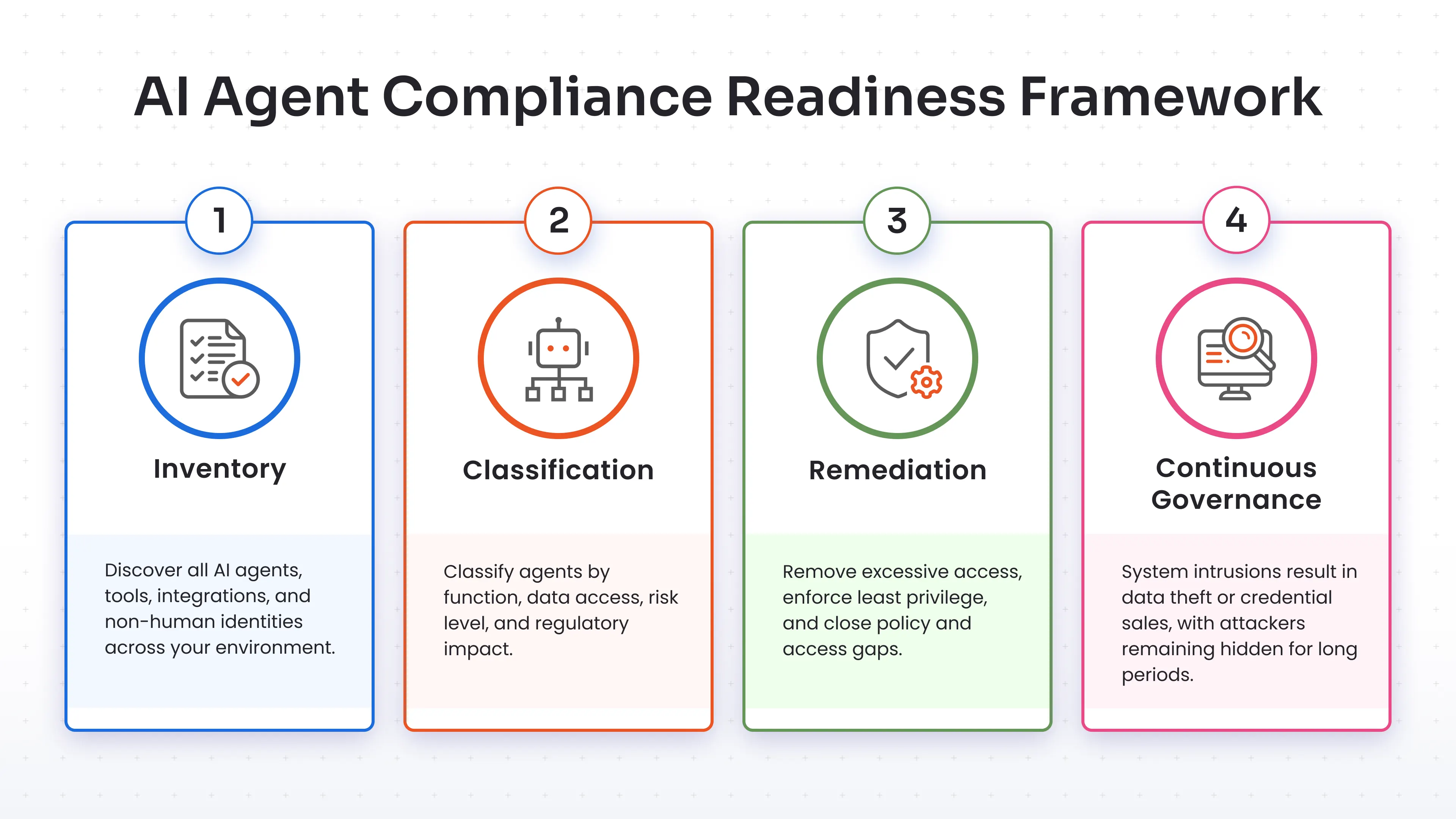
Phase 1: Inventory (start here)
Before you assess compliance, you need a complete and accurate view of what exists across your environment.
- Identify every AI agent currently in use, including those embedded within approved SaaS platforms that may not be centrally tracked.
- Document key details for each agent, including its purpose, the type of data it accesses, the systems it connects to, how it authenticates, and who is responsible for it.
- Review all access mechanisms used by agents, such as OAuth tokens, API keys, and shared service accounts, to understand how they interact with enterprise systems.
- Map all external AI or LLM providers receiving data from these agents, and verify that appropriate agreements such as DPAs and BAAs are in place.
Phase 2: Classification (prioritize by risk)
Once you have visibility, the next step is to understand which agents carry the highest regulatory exposure.
- Classify each agent against EU AI Act high-risk categories, especially those involving employment, healthcare, finance, or critical infrastructure use cases.
- Identify which agents process regulated data, including EU personal data (GDPR), health data (HIPAA), Indian personal data (DPDPA), or payment data (PCI-DSS).
- Where an agent falls under multiple frameworks, align it with the strictest applicable requirement, since a failure in one area often impacts others.
Phase 3: Remediation (fix what matters first)
Focus on bringing high-risk and high-impact agents under control before expanding governance across the environment.
- Assign each approved agent a unique enterprise identity through your IAM system, and eliminate reliance on shared credentials or user-linked OAuth access.
- Restrict permissions to the minimum required for the agent’s function, and formally document this scope to support audits and reviews.
- Assign a clear owner for every agent who is accountable for its behavior, access, and lifecycle management.
- Implement agent-level logging so every action, data access, and system interaction can be traced back to a specific identity.
- Introduce approval workflows for sensitive or irreversible actions, such as data exports, system changes, or external communications.
- For EU AI Act high-risk agents, complete required documentation, risk classification, and oversight controls before enforcement deadlines.
- Conduct Data Protection Impact Assessments for agents performing high-risk processing under GDPR requirements.
- Update all DPAs and BAAs to explicitly include AI agent data processing and any external model providers involved.
Phase 4: Continuous governance
Compliance is not a one-time effort. It requires ongoing monitoring, review, and control.
- Include AI agents in regular access review cycles alongside human users to ensure permissions remain appropriate over time.
- Automate deprovisioning when an agent is no longer needed or when ownership changes, preventing long-lived unmanaged access.
- Continuously monitor agent behavior for anomalies, such as unusual data access patterns, unexpected API calls, or activity outside defined scopes.
- Maintain a real-time agent registry to track all active agents. This becomes the foundation for visibility, audit readiness, and ongoing governance.
Why is identity governance the compliance foundation for every AI agent framework?
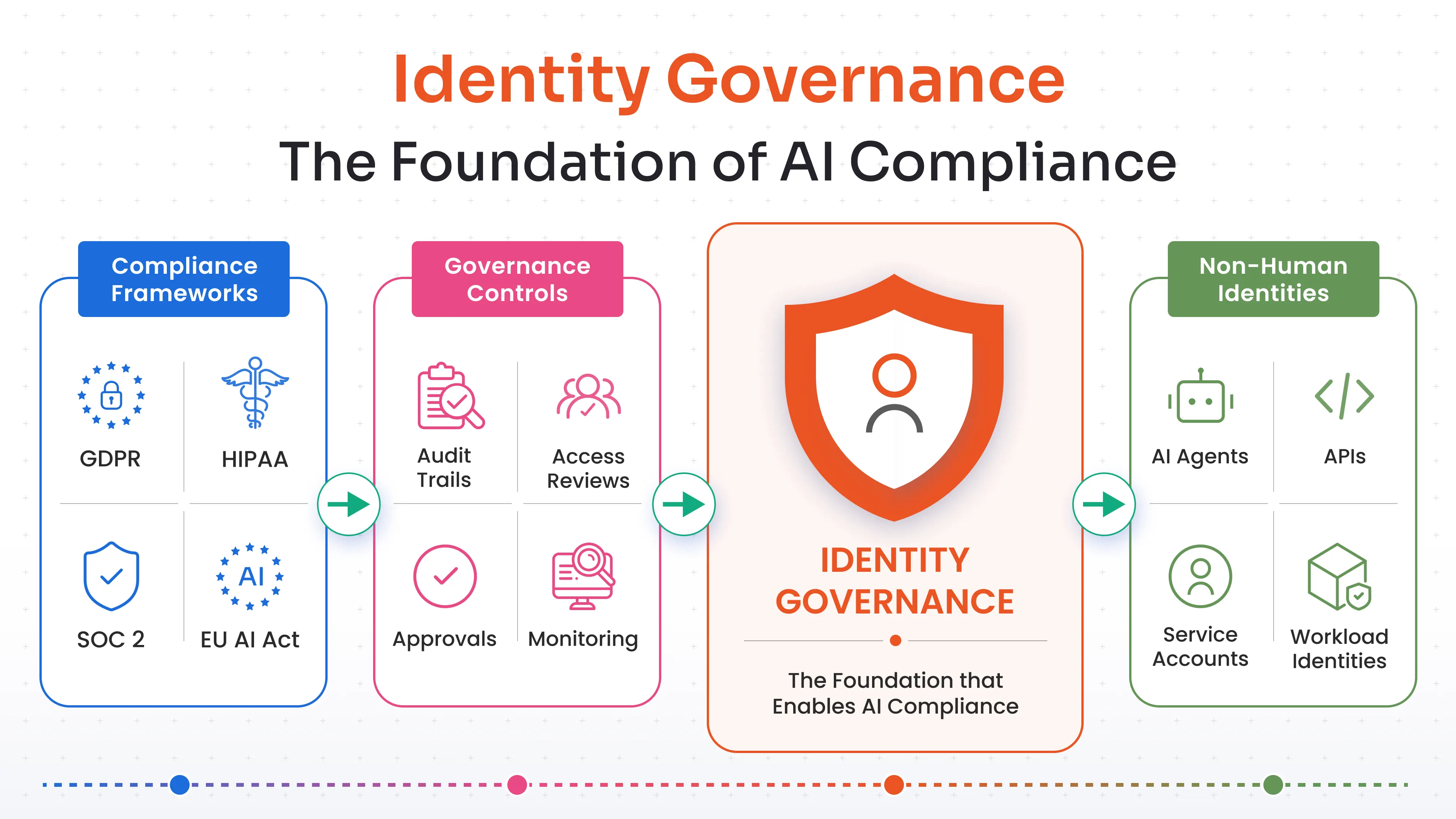
If you look at the checklist in the previous section, most of the work does not sit in policy. It sits in execution.
From provisioning identities to enforcing access, logging activity, and removing access when no longer needed, these are identity problems. Without a system that can manage non-human identities at scale, compliance frameworks remain theoretical.
The connection between compliance requirements and identity capabilities is direct.
- GDPR Article 30 requires records of processing activities, which maps to maintaining an agent identity registry with data access records per agent.
- HIPAA requires unique user identification and audit controls, which translates to assigning every agent a unique identity and maintaining immutable audit logs.
- SOC 2 requires timely access removal, which depends on automated deprovisioning tied to agent ownership.
- The EU AI Act requires record-keeping and human oversight, which means logging agent decisions and enforcing approval workflows for high-risk actions.
- DPDPA requires purpose limitation, which can only be enforced through tightly scoped permissions assigned to each agent identity.
This is where identity governance becomes the foundation.
miniOrange extends enterprise IAM to AI agents by treating each agent as a first-class identity. With miniOrange AI agent governance every agent is provisioned with a unique identity, scoped to the minimum permissions required, and tied to a defined owner. Actions are logged centrally, access is continuously monitored, and approvals can be enforced for sensitive operations through human-in-the-loop controls.
The result is a system where AI agents are not operating outside governance, but within it.
FAQs
Do existing compliance frameworks like GDPR and HIPAA apply to AI agents?
Yes. Compliance frameworks apply to how data is accessed and processed, not who or what is doing it. If an AI agent handles personal data or PHI, it must follow the same rules as any other system, including access control, auditability, and data protection requirements.
What is the EU AI Act deadline for AI agents, and what are the penalties?
The deadline for high-risk AI systems is August 2, 2026. Organizations must meet requirements around risk management, documentation, oversight, and monitoring. Non-compliance can result in penalties of up to €15 million or 3% of global annual turnover.
What is a DPIA and when is one required for an AI agent?
A DPIA is a risk assessment required under GDPR for high-risk data processing. It is needed when AI agents profile individuals, process sensitive data, or make decisions that significantly impact people. It must be completed before deployment.
Can AI agents use the same service accounts as human users?
No. Shared accounts break audit trails and make it impossible to attribute actions. Each AI agent should have its own identity to ensure traceability, controlled access, and compliance with frameworks like HIPAA, SOC 2, and GDPR.
What happens to AI agent OAuth tokens when an employee leaves?
They often remain active. OAuth tokens are issued to applications, not users, so they do not automatically expire when an employee is offboarded. Without explicit revocation, AI agents can continue accessing systems, creating compliance risks.
What does the EU AI Act require for human oversight of AI agents?
It requires organizations to maintain control over high-risk actions. In practice, this means allowing routine actions to run automatically, while requiring human approval for sensitive activities like financial transactions, data access, or external communication.

Leave a Comment