

Modern businesses depend on constant communication between systems. Applications exchange data, automation workflows trigger actions, and AI-driven processes execute tasks without human involvement.
Behind every one of these interactions is a digital identity verifying access and permissions. These are known as Non-Human Identities (NHIs).
As organizations expand their digital infrastructure, the number of machine identities continues to grow rapidly. Service accounts, API credentials, workload identities, and autonomous systems now support a large portion of enterprise operations.
However, unlike employee accounts that follow structured access policies, many NHIs operate in the background with limited tracking and accountability. Unmanaged credentials, inactive identities, and excessive permissions can create serious security gaps if left unchecked.
TL;DR
- Non-Human Identities (NHIs) are digital identities used by applications, workloads, APIs, bots, and AI systems to authenticate automatically.
- Common examples include service accounts, API keys, OAuth tokens, cloud IAM roles, Kubernetes identities, and AI agents.
- Non-human identities often outnumber human users, increasing the identity attack surface significantly.
- Long-lived credentials and unmanaged access make NHIs a growing cybersecurity risk.
- Effective non-human identity security requires visibility, credential rotation, least privilege access, and continuous monitoring.
What Is a Non-Human Identity?
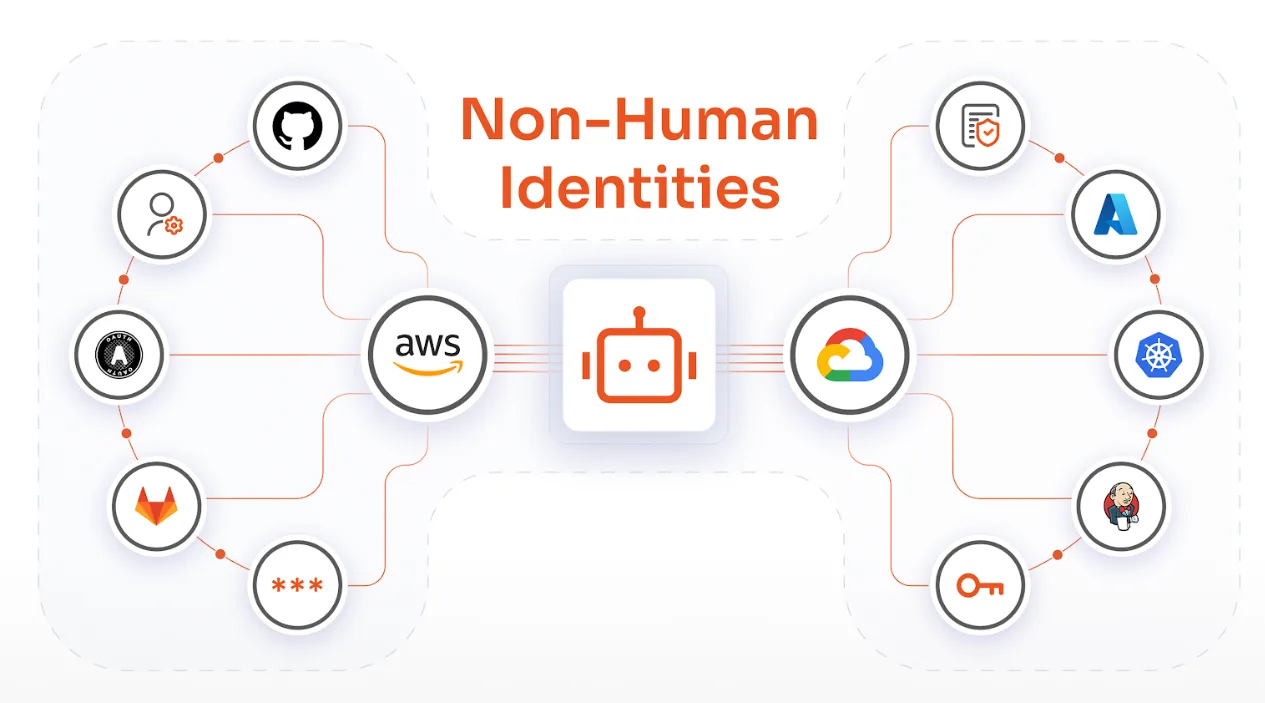
A Non-Human Identity (NHI) is a digital identity assigned to applications, workloads, services, or automated processes so they can authenticate and access resources securely without direct human involvement.
Just as employees use credentials to access enterprise systems, machines also require authentication mechanisms to communicate with databases, applications, APIs, and infrastructure resources. Unlike human users, non-human identities rely on programmatic authentication methods rather than interactive logins.
Common access authentication methods used by NHIs include:
- API keys
- OAuth tokens
- Certificates
- Secrets
- IAM roles
- SSH keys
- Service accounts
These credentials help systems validate requests, establish trusted connections, and authorize automated operations across enterprise environments.
In simple terms, a non-human identity is any identity associated with a machine, application, or automated workflow instead of an individual user.
Examples of non-human identities include:
- Service accounts running background operations
- Kubernetes workloads communicating across containers
- AWS IAM roles assigned to cloud resources
- CI/CD bots deploying applications
- API integrations transferring data between platforms
- AI agents executing automated workflows
As organizations continue adopting cloud-native infrastructure, automation, and AI technologies, machine identities have become essential for maintaining scalability, operational efficiency, and system connectivity.
Why Non-Human Identities Matter in Modern Cybersecurity
They Operate at Massive Scale
Modern enterprises manage large volumes of machine identities across infrastructure, applications, integrations, and automation workflows. Unlike workforce identities that grow gradually, non-human identities scale rapidly as organizations deploy new technologies and services.
They Often Bypass Traditional IAM Processes
Most identity and access management (IAM) frameworks were designed around employee access management. Non-human identities, however, are frequently created dynamically through scripts, deployments, integrations, and automated workflows, making centralized management more difficult.
They Support Critical Business Operations
Many essential enterprise processes rely on machine identities to function continuously. A compromised token, expired certificate, or broken authentication relationship can interrupt services, impact operations, or expose sensitive resources to unauthorized access.
They Increase Operational Complexity
Modern environments constantly introduce new authentication relationships between applications, workloads, and automated systems. As infrastructure becomes more distributed, organizations face increasing challenges around credential management, lifecycle tracking, access policies, and identity accountability.
How Non-Human Identities Work
Non-human identities authenticate through automated authentication flows. Instead of manually entering usernames and passwords, systems exchange cryptographic credentials programmatically to verify identity and gain authorized access to resources.
This process happens continuously behind the scenes across enterprise applications and infrastructure environments.
Step 1: A System Requests Access
The authentication process begins when an application, workload, API, or automated process attempts to connect to another resource. This may involve retrieving data, initiating a workflow, or communicating with another service.
Step 2: The Identity Presents Credentials
The non-human identity authenticates automatically using credentials such as:
- API tokens
- OAuth tokens
- Certificates
- Secrets
- IAM roles
These credentials help establish trusted communication between systems without requiring human interaction.
Step 3: The Target System Validates the Request
The receiving system verifies whether the provided token, certificate, or assigned role is trusted and authorized. It checks the identity against predefined security policies before granting access.
Step 4: Access Is Granted Based on Assigned Permissions
Once validated, the system grants access according to configured permissions and policies. The non-human identity can then perform approved actions such as transferring data, triggering workflows, or accessing connected resources.
Common Types of Non-Human Identities
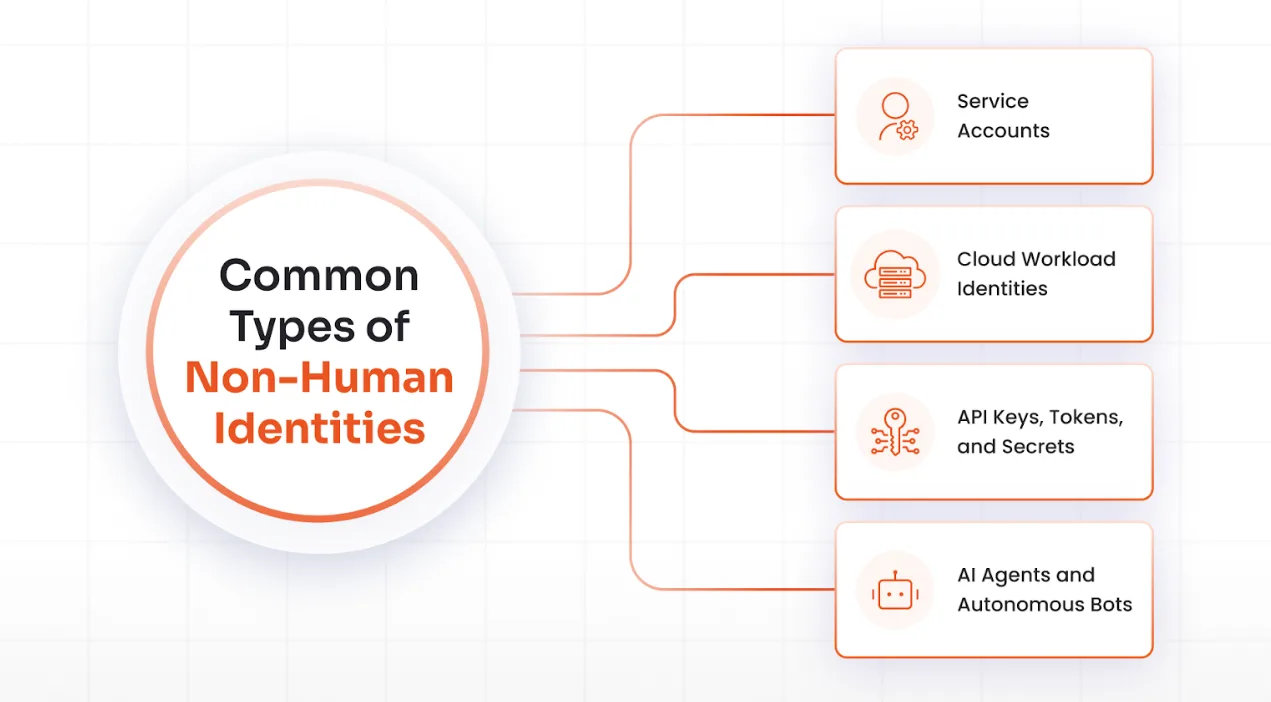
Organizations manage multiple categories of non-human identities across enterprise environments. These identities support automation, application connectivity, and operational processes throughout modern IT infrastructure.
Service Accounts
Service accounts are one of the most common types of non-human identities. They are typically created for applications, operating systems, or background services that require persistent access to resources and enterprise systems.
Common examples include Windows service accounts, Linux daemon accounts, database service users, and scheduled automation jobs. Because these accounts often remain active for extended periods, weak ownership tracking and inconsistent credential management can create long-term security risks.
API Keys, Tokens, and Secrets
Applications rely heavily on API keys, OAuth tokens, access tokens, SSH keys, and other secrets to authenticate requests and exchange data securely. These credentials support integrations between enterprise applications, APIs, automation tools, and external services.
However, organizations frequently struggle with secrets sprawl, where credentials become distributed across repositories, scripts, configuration files, and CI/CD pipelines. Exposed credentials can create direct entry points into enterprise environments.
Cloud Workload Identities
Cloud-native environments increasingly use workload identities instead of static usernames and passwords. Services such as AWS IAM Roles, Azure Managed Identities, Google Cloud Service Accounts, and Kubernetes Service Accounts allow workloads to authenticate dynamically without storing credentials directly inside applications.
While workload identities improve scalability and operational flexibility, inactive identities, misconfigured permissions, and weak access policies can increase security exposure across cloud environments.
AI Agents and Autonomous Bots
AI agents and autonomous systems are emerging as a rapidly growing category of non-human identities. These systems retrieve data, interact with applications, execute workflows, and perform automated decision-making with minimal human involvement.
As organizations adopt AI-driven operations, these identities often receive broad access across multiple systems and services. Without proper controls, autonomous systems can introduce challenges related to unmanaged permissions, uncontrolled automation, and expanding identity ecosystems.
Non-Human Identities vs Human Identities
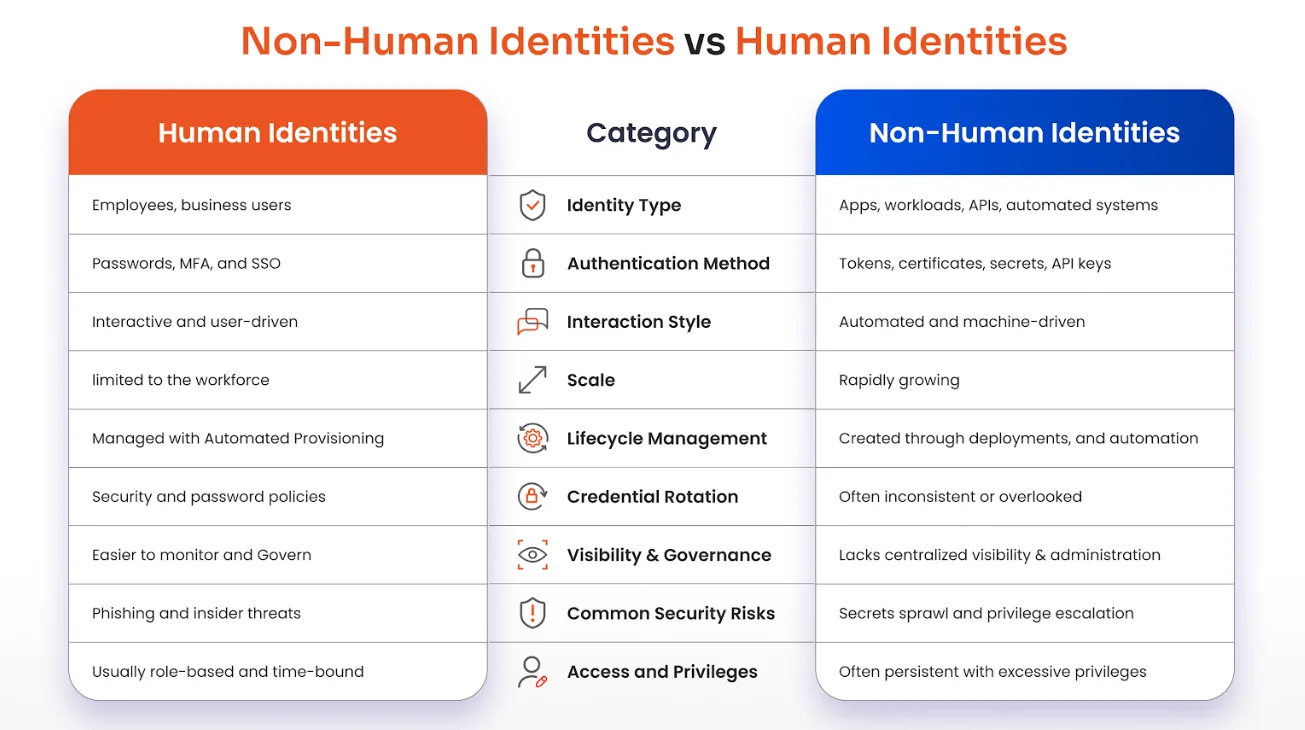
Why Non-Human Identities Are Harder to Secure
Traditional IAM and security frameworks were primarily built around human users. Employees log in interactively, follow password policies, complete MFA challenges, and are typically managed through structured onboarding and offboarding workflows.
Non-human identities operate very differently.
Machine identities authenticate automatically in the background, often across multiple systems, cloud environments, and APIs simultaneously. Because these identities are created dynamically through automation, DevOps pipelines, cloud workloads, and AI systems, they are significantly harder to track and govern at scale.
Several factors make NHIs particularly challenging to secure:
- Traditional MFA cannot be applied easily to automated systems
- Credentials often remain active continuously for uninterrupted operations
- Ownership and accountability are frequently unclear
- Cloud workloads and containers scale dynamically and create identities rapidly
- Secrets, tokens, and API keys become scattered across environments
Unlike employee accounts, many non-human identities also operate with persistent access and elevated permissions. Over time, this creates governance blind spots, excessive privilege risks, and hidden attack paths that security teams may not easily detect through traditional IAM controls.
The Biggest Non-Human Identity Security Risks
Secrets Sprawl
Modern applications and automation workflows depend heavily on secrets such as API keys, access tokens, certificates, and SSH keys. Over time, these credentials often become scattered across Git repositories, scripts, CI/CD pipelines, configuration files, and cloud environments.
Without centralized secrets management, organizations lose visibility into where credentials are stored and who can access them, significantly increasing the risk of accidental exposure and credential leakage.
Excessive Privileges
Many non-human identities are granted broad permissions to avoid operational disruptions and simplify automation. However, overprivileged service accounts, workload identities, and API integrations can create serious security risks.
If attackers compromise these identities, they may gain access to sensitive systems, move laterally across environments, escalate privileges, and bypass segmentation controls without triggering traditional user-focused security alerts.
Shadow Identities
Non-human identities are often created dynamically through temporary projects, cloud deployments, automation workflows, and DevOps tooling. As environments evolve, organizations frequently lose track of old service accounts, inactive API integrations, unused workload identities, and expired projects. These unmanaged or “shadow” identities expand the attack surface and create hidden access paths that attackers can exploit.
Long-Lived Credentials
Unlike employee credentials that are rotated regularly, many machine identities rely on static secrets and long-lived tokens for uninterrupted operations. These credentials may remain active for months or even years without updates.
If compromised, attackers can maintain persistent access to systems and data for extended periods, making detection and remediation significantly more difficult.
AI-Driven Identity Expansion
AI agents and autonomous systems are rapidly increasing the number of machine identities inside enterprise environments. Every AI workflow may introduce new API connections, tokens, permissions, and trust relationships across systems.
Without proper governance and visibility, AI-driven automation can accelerate identity sprawl and introduce complex security risks that traditional IAM models were not designed to manage.
Real-World Examples of Non-Human Identity Attacks
CircleCI Supply Chain Breach
In 2023, CircleCI disclosed a major breach after attackers compromised production credentials and OAuth tokens used within CI/CD environments. The attackers gained access to customer secrets stored across development pipelines, forcing organizations to rotate credentials and review machine identity exposure across cloud systems.
Codecov Supply Chain Attack
The Codecov breach involved attackers modifying the company’s Bash Uploader script to steal environment variables, API keys, and credentials from customer CI/CD workflows. Because these machine credentials were used across automated development pipelines, the attack demonstrated how exposed non-human identities can compromise large software ecosystems.
Toyota GitHub Credential Exposure
Toyota disclosed a data exposure incident after a hardcoded access key was left publicly accessible inside a GitHub repository for several years. The exposed credential allowed unauthorized access to customer-related cloud data, highlighting the risks associated with unmanaged secrets and long-lived machine credentials.
Microsoft OAuth Token Abuse Attacks
Microsoft has reported multiple incidents involving stolen or abused OAuth tokens used to gain unauthorized access to enterprise cloud applications. Unlike passwords, compromised OAuth tokens can sometimes bypass traditional authentication checks and maintain persistent access across connected services if not revoked quickly.
Non-Human Identity Security Best Practices
Effective NHI security requires continuous visibility, governance, and lifecycle management.
Continuous Discovery and Inventory
Organizations should continuously identify and inventory service accounts, API tokens, workload identities, and secrets across environments. Centralized visibility helps eliminate shadow identities, reduce unmanaged access risks, and improve identity governance.
Implement Least Privilege Access
Every non-human identity should only receive the minimum permissions required to function. Applying least privilege reduces lateral movement, privilege escalation, and the overall impact of compromised machine credentials across systems.
Automate Credential Rotation
Organizations should replace static credentials with short-lived tokens, dynamic secrets, and automated rotation policies. Regular credential rotation minimizes exposure windows and reduces risks associated with leaked or compromised machine identities.
Implement ITDR
Identity Threat Detection and Response helps organizations detect suspicious authentication behavior, token misuse, and unauthorized machine access in real time. Continuous monitoring improves visibility into identity-based threats beyond traditional IAM security controls.
Secure AI and Autonomous Systems
AI agents and autonomous systems require strict identity governance and access controls. Organizations should continuously monitor AI-driven identities, limit permissions, and audit automated workflows to reduce emerging security risks.
How miniOrange Helps Secure Non-Human Identities
miniOrange helps organizations secure and manage non-human identities across cloud, hybrid, and on-prem environments. By improving visibility, governance, authentication security, and lifecycle management, organizations can reduce identity risks associated with machine accounts, workloads, APIs, and automated systems.
Centralized Identity Visibility
miniOrange helps organizations discover and monitor non-human identities across applications, cloud workloads, APIs, and infrastructure environments. Centralized visibility reduces shadow identities and improves governance across rapidly growing machine ecosystems.
Service Account Governance
Organizations can strengthen control over service accounts through better ownership tracking, access governance, and lifecycle management. This helps reduce excessive privileges, orphaned accounts, and unmanaged machine access risks.
Stronger Authentication and Access Controls
miniOrange enables organizations to enforce stronger authentication policies, least privilege access, and secure credential management for machine identities operating across cloud, DevOps, and enterprise environments.
Continuous Monitoring and Lifecycle Management
Continuous monitoring helps detect suspicious machine identity activity, unauthorized access, and credential misuse. Automated lifecycle management improves visibility into identity creation, usage, rotation, and deprovisioning across environments.
Securing the Future of Non-Human Identities
Non-human identities are becoming a critical part of modern enterprise environments, powering cloud workloads, APIs, automation workflows, DevOps pipelines, and AI-driven systems. As organizations continue expanding their digital infrastructure, the number of machine identities is increasing rapidly, making identity visibility, governance, and access control far more complex than traditional IAM models were designed to handle.
miniOrange Identity Governance and Administration (IGA) helps organizations gain centralized visibility into non-human identities, govern service accounts and machine access, enforce least privilege policies, automate lifecycle management, and strengthen access governance across hybrid and cloud environments. By improving oversight and reducing unmanaged identity risks, miniOrange helps organizations build a stronger and more resilient identity security posture.
FAQs
What is a non-human identity?
A non-human identity is a digital identity assigned to applications, workloads, APIs, services, bots, or automated systems to authenticate and access resources without human involvement.
What is the difference between machine identities and non-human identities?
Machine identity typically refers to cryptographic credentials such as certificates and keys, while non-human identity is a broader category that includes all automated digital identities and workload authentication mechanisms.
Why are non-human identities a security risk?
NHIs are difficult to secure because they often lack MFA, have excessive privileges, use long-lived credentials, operate continuously, and remain hidden from the security team. This makes them attractive targets for attackers.
What is secrets sprawl?
Secret sprawl occurs when API keys, tokens, passwords, and credentials become scattered across repositories, scripts, applications, and cloud environments without centralized management.
What is ITDR for non-human identities?
Identity Threat Detection and Response (ITDR) helps organizations detect suspicious identity activity involving machine identities, including credential theft, token abuse, privilege escalation, and unauthorized authentication behavior.
Leave a Comment