

Every access decision comes down to one question:
Can this request be trusted?
Traditional authorization systems answer that question once. If the user belongs to the right role, access is granted, and that decision often remains unchanged until an administrator updates permissions manually.
The problem is that trust isn't permanent.
Devices become compromised. Employees change responsibilities. Contractors finish projects. Sessions become risky long after a user has signed in. Yet many organizations continue relying on authorization models that assume yesterday's access decisions remain valid today.
Dynamic Authorization checks identity, device, location, and behavior every time access is requested, not just once at the login. And this article is therefore about why and where traditional authorization falls short, how Dynamic Authorization management works in the AI-driven environment, and best practices to implement it in your environment.
What is Dynamic Authorization?
Dynamic Authorization is an access control model that makes decisions in real time. It replaces static trust with continuous evaluation. To do that, it uses the context around a request instead of a permission set assigned months/years ago.
But first, let’s define the two terms that people usually mix up.
- Authentication: it confirms who someone is
- Authorization: it decides what they’re allowed to do.
Dynamic Authorization therefore lives in the second layer; it keeps re-asking the “what can they do right now” question throughout a session. It weighs the signals like:
- User identity
- Role
- Device trust
- Location
- Session
- Risk level
Put those together, and you get access control that responds to what’s happening in real time.
Why Traditional Authorization Falls Short
Traditional authorization models were built for environments where users worked from corporate offices, applications ran inside on-prem networks, and access requirements changed infrequently.
Static Roles Cannot Respond to Dynamic Risks
RBAC (Role-Based Access Control) hands every user in a role the same access, no matter what's happening around any individual request. That works fine when risk barely moves. It breaks down the moment a device falls out of compliance mid-session, or a login shows up from a country nobody expected on that account.
Access Decisions Ignore Context
Most legacy systems check identity and role, then stop. Location, device posture, behavior, the things that often matter more than the role itself, never enter the decision. Ignoring contextual information makes it easier for compromised credentials or insider threats to bypass traditional authorization controls.
Modern IT Environments are Constantly Changing
- Organizations today support,
- Hybrid and remote workforce
- SaaS and multi-cloud environments
- Third-party vendors and contractors
- APIs and machine identities
- AI agents performing autonomous tasks
Each of these introduces new variables that influence whether an access request should be trusted.
How Does Dynamic Authorization Management Work?
A typical Dynamic Authorization management runs as a loop, not a one-time check, and the workflow consists of five stages.
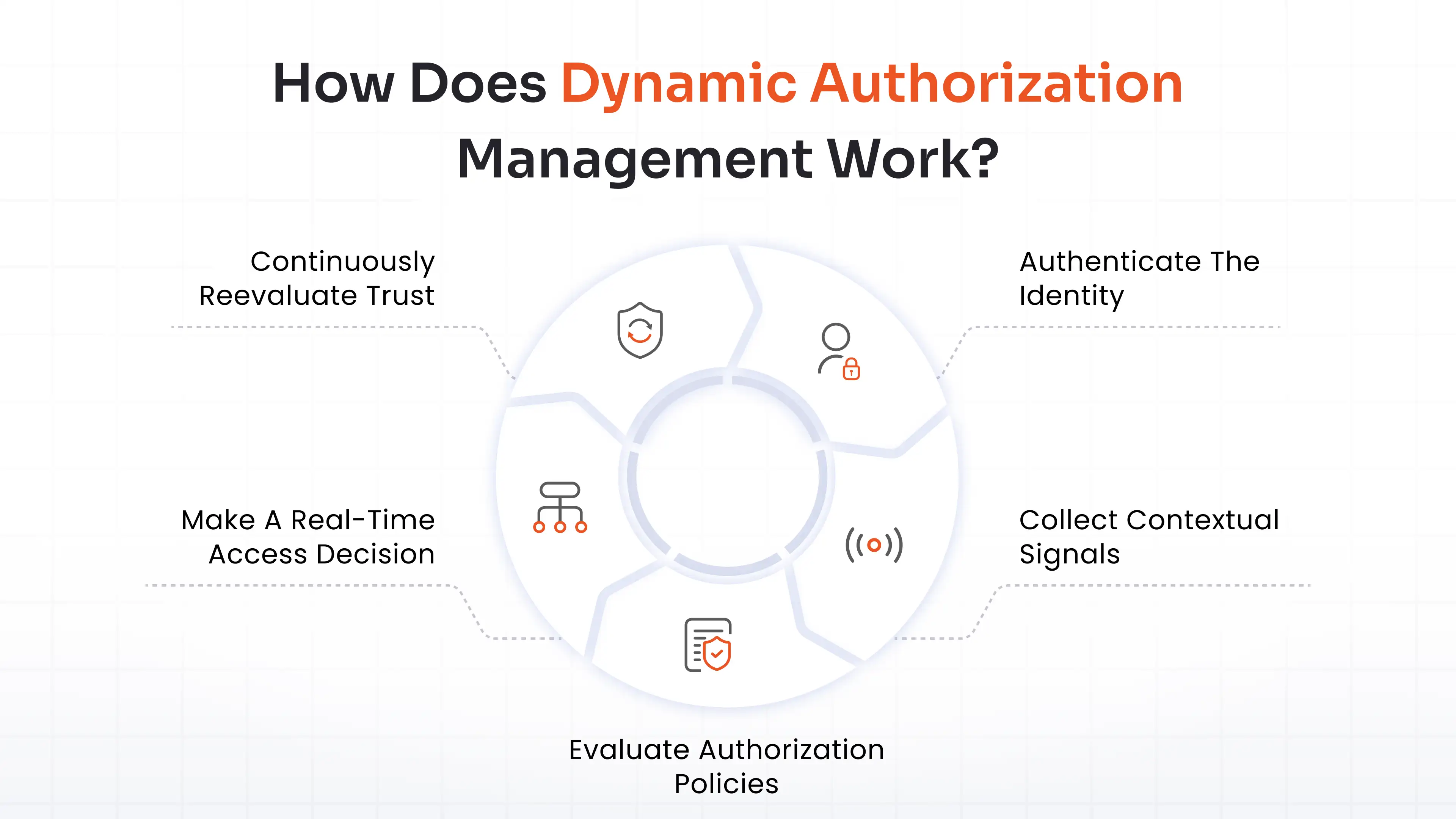
Step 1: Authenticate the Identity
This step typically involves Identity and Access Management (IAM) services, Single-Sign-On (SSO), and Multi-Factor Authentication (MFA), often using protocols such as SAML, OAuth 2.0, and OpenID Connect (OIDC).
Authentication checks who’s making the request before authorization determines what they should be allowed to do.
Step 2: Collect Contextual Signals
Common contextual signals include:
- Device compliance and posture
- Geological location and network information
- time of access request
- behavioral signals during the session
- Recent login history
- Threat intelligence and calculated risk scores
Rather than relying on a single factor, the system combines these signals to build a complete picture of the current access request.
Step 3: Evaluate Authorization Policies
Compare the request and its context against defined authorization rules. These policies may incorporate RBAC, risk-based policies, or other business rules.
Step 4: Make a Real-Time Access Decision
Based on the policy evaluation, the system grants, denies, restricts, or challenges the request. For example, prompting for step-up authentication rather than an outright denial.
Step 5: Continuously Reevaluate Trust
Authorization doesn't end once access is granted. Risk is reassessed throughout the session, and access can be revoked or restricted if conditions change.
The fact, though, is that this loop is quite different from how most companies actually run access control today, usually through RBAC. Here's how the two actually compare.
RBAC vs. Dynamic Authorization
| RBAC Authorization | Dynamic Authorization |
|---|---|
| Fixed rules | Rules that adjust to context |
| Role only | Role plus context |
| Limited flexibility | Real-time decisions |
| Periodic review | Continuous evaluation |
But this doesn’t mean that RBAC is outdated. It works as the foundation for structuring entitlements. Dynamic Authorization just adds the context layer on top, which is the piece RBAC alone was never designed to handle.
Key Benefits and Use Cases of Dynamic Authorization
None of our discussion matters unless it actually improves the day-to-day process and threats, correct? Here’s what shifts once access decisions run on real-time context instead of a fixed role.
Improved Security
Evaluating context at the point of access helps reduce unauthorized access that static, role-only checks would otherwise approve.
Sharper Access Control
Real-time signals produce more specific and granular decisions than a single fixed permission list ever could.
Fewer Insider Threats
Continuous evaluation means a stolen credential still has to pass a context check. This makes it harder for legitimate credentials to be used for privilege misuse, since unusual behavior would trigger restrictions even after access was initially granted.
Stronger Zero Trust
Zero Trust depends on continuous verification. Dynamic Authorization delivers that by rechecking risk throughout the session, not only at the moment someone logs in.
Better User Experience
With Dynamic Authorizations, low-risk requests move through without extra prompts, and risky ones get stopped for a step-up check. Users don't get re-authenticated 5 times a day just because the system can't tell trusted access from risky access.
Common Use Cases of Dynamic Authorization
- Workforce access management: secure employee access to internal apps using real-time identity and device context
- Privileged access management: evaluate session risk before and during privileged activity
- SaaS security: secure cloud app access regardless of where or how someone connects
- API security: secure machine-to-machine access, where user-centric checks don't apply
- AI agent security: control access requests from AI systems acting on someone's behalf, or on their own
All the benefits and different use cases underline the same question. Does this request still make sense right now?
That question is what ties Dynamic Authorization to the zero trust principle. Let’s understand this in more detail.
Why Dynamic Authorization Matters for Zero Trust
Zero Trust runs on one simple but powerful premise: never trust, always verify. Rather than assuming that users/devices/applications are trustworthy just because they are already inside the network, zero trust requires every access request to be evaluated based on its current level of risk.
That only means something if verification is earned continuously and not granted indefinitely. Dynamic Authorization makes "always verify" actually happen in practice. It rechecks trust throughout a session instead of assuming a decision made an hour ago still holds.
In other words, zero trust defines the security philosophy, while dynamic authorization management provides one of the core mechanisms for enforcing it.
And this doesn’t stop at human logins. An AI agent firing off a hundred API calls a minute needs the same real-time check as someone logging in from a new laptop, which is exactly where Zero Trust gets tested hardest right now.
Dynamic Authorization in AI-Driven Environments
AI agents and machine identities/NHIs now make up a real share of the entities requesting access inside most enterprises. They act on their own, fire off requests fast, and don't behave as humans do.
That creates access patterns that static rules were never built to read. Governing what an AI agent can touch and verifying its machine-to-machine authentication takes the same real-time evaluation that Dynamic Authorization applies to people.
None of that happens by accident. Teams that pull off the shift from static rules to real-time decisions tend to follow a handful of similar practices.
Best Practices for Implementing Dynamic Authorization
- Grant only what's needed for the task, nothing more
- Build policies around device, location, and behavior, not role alone
- Treat authorization as ongoing, not a one-time gate
- Pair it with strong IAM and MFA.
- Audit access decisions regularly for frameworks like SOC 2 Type II, ISO 27001, and NIST CSF
None of this runs on its own, though. Every practice on that list depends on an identity platform that can actually pull device, location, and behavior signals together in real time, which comes down to the IAM foundation underneath it.
IAM: The Foundation That Dynamic Authorization Management Runs On
Dynamic Authorization solution is not something you buy off a shelf. Getting there takes IAM, SSO, MFA, and access governance already working together, since real-time decisions are only as good as the signals feeding them.
miniOrange's identity and access management suite covers that foundation:
- SSO: one-click access with consistent verification
- MFA: risk-based authentication that adjusts to context
- PAM: just-in-time privileged access with session monitoring
- Access governance: visibility into who has access to what, and why
It works with your existing stack, so moving from static roles to context-aware access doesn't mean ripping out what you already run.
Want to move past static access rules?
Talk to a miniOrange identity security expert about strengthening your access control strategy.
FAQs
What are the key components of the Dynamic Authorization solutions?
Dynamic Authorization relies on identity verification, contextual signal collection (device, location, behavior), policy evaluation, real-time decisioning, and continuous session monitoring.
What factors are considered in Dynamic Authorization?
Common factors include user identity, role, device trust, location, session behavior, and an overall calculated risk level.
Can Dynamic Authorization management improve AI security?
Yes. Dynamic Authorization helps govern access for AI agents and machine identities, which require continuous, context-based evaluation rather than static, role-only permissions.
What industries benefit from Dynamic Authorization solutions?
Healthcare, BFSI, education, government, and technology organizations all benefit, particularly those managing hybrid workforces, cloud infrastructure, and regulatory compliance requirements.
How does Dynamic Authorization management improve access control?
It replaces one-time, role-based decisions with continuous, real-time evaluation of identity and context, reducing unauthorized access and enabling smarter, more granular controls.
Is Dynamic Authorization better than RBAC?
Dynamic Authorization isn't a replacement for RBAC so much as an evolution of it; it builds on role-based foundations by adding real-time context, making access decisions adaptive rather than fixed.

Leave a Comment