

Choosing the right deployment model for your Identity Governance and Administration (IGA) system is a high-stakes decision that affects many aspects of your organization. It determines how you manage access across your entire enterprise. It also dictates your audit readiness and integration capabilities.
Now you might assume that the cloud is the only modern option. However, many organizations are changing their infrastructure strategies. According to Gartner, 90% of organizations will adopt hybrid or multi-cloud infrastructures by 2027.
That's because in the era of AI, digital sovereignty has become a major board-level concern. Organizations are placing greater emphasis on data sovereignty and strict data residency requirements.
In this guide, we'll provide you with a practical on-premise IGA vs. cloud IGA comparison to help you evaluate the strengths, trade-offs, and ideal use cases for each deployment model so you can choose the one that fits your business.
What Is On-Premise IGA and What Is Cloud IGA?
Let's see how these deployment models work in practice.
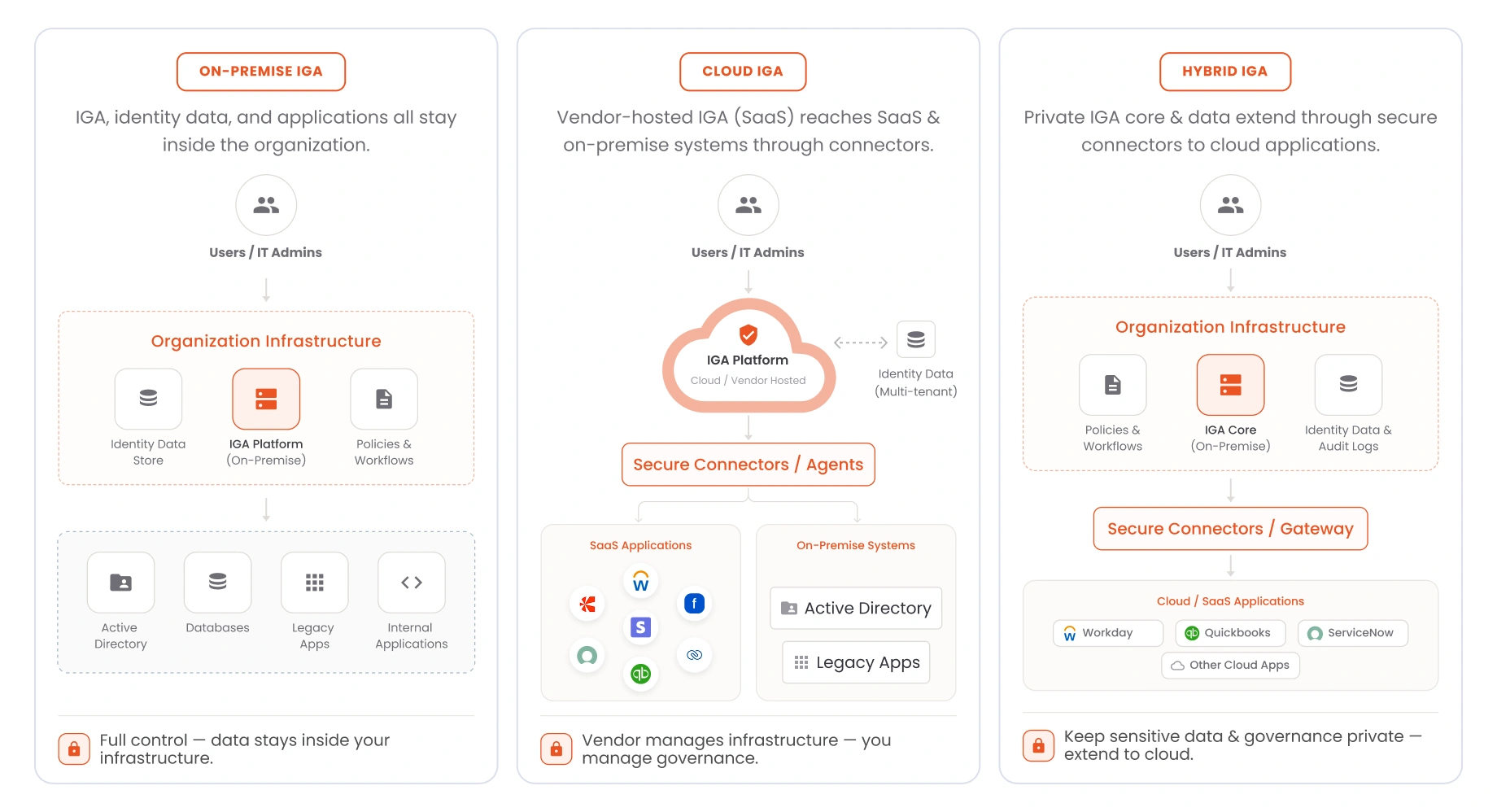
On-Premise IGA
An on-premise identity governance solution is installed and managed inside your own infrastructure. It could be a corporate data center or a private cloud that your organization controls. It's up to your IT team to manage the servers, databases, upgrades, backups, and security of the platform.
A common misconception is that an on-premise governance platform can't connect to cloud tools. In reality, an on-premise system can manage identities across both your local assets and external Software-as-a-Service (SaaS) applications.
Cloud IGA
Cloud IGA, often delivered as Identity-as-a-Service (IDaaS), runs entirely on vendor-managed infrastructure. The vendor handles server provisioning, upgrades, high availability, and security patches. But configuring the policies, building the rules, and managing daily alerts are on you.
Another misconception is that cloud platforms can't manage legacy on-premise systems. Cloud governance engines use local gateway agents to bridge the gap and interact with internal directories.
If neither model fits your environment, there's also a third option.
Hybrid IGA
A hybrid model positions the core engine and highly sensitive identity storage inside a private environment while using cloud connectors to manage web apps.
The core distinction between these three lies in where the governance platform itself resides, not in the boundaries of what it can govern.
Control and Data Residency
While convenience matters, the biggest deciding factor for organizations evaluating IGA deployment models is control over data.
An IGA platform stores some of your organization's most sensitive information, including user identities, audit logs, and access policies. When you deploy an on-premise system, you retain direct ownership over it. Your identity footprint remains isolated from external system dependencies.
Your security team gets to decide:
- Where identity data is stored
- How backups are handled
- Which administrators have infrastructure access
- How long audit records are retained
- Which security controls protect the platform
Cloud deployments alter this relationship.
When you use a cloud engine, you usually store your sensitive directory data on a multi-tenant architecture, which is managed by a third party. You don't control the architecture that runs the platform, but defining governance policies, approval workflows, and access rules is still in your hands.
That doesn't mean cloud IGA is insecure. Reputable cloud providers invest heavily in infrastructure security and maintain certifications such as ISO 27001 and SOC 2.
It's just that the responsibility is shared.
The vendor secures the platform, while you remain responsible for correctly configuring governance policies, access controls, and user permissions.
When evaluating IGA deployment models, ask yourself questions like:
- Where must identity data remain?
- Are there contractual data residency obligations?
- Does your organization require direct control over infrastructure?
- How much operational responsibility is your team willing to own?
The answers often narrow the deployment options significantly.
Compliance and Regulatory Fit
Compliance requirements often influence IGA deployment decisions as much as technical considerations. While most privacy regulations don't explicitly require cloud or on-premise deployments, they do require you to demonstrate effective governance, strong access controls, complete audit trails, and appropriate protection of sensitive information.
For example:
| Regulation | Identity Governance Requirements |
|---|---|
| HIPAA | Protect electronic protected health information (ePHI), restrict access, maintain audit logs |
| GDPR | Apply least-privilege access, maintain accountability, support auditability, protect personal data |
| PCI DSS | Restrict access to cardholder data, review privileged access regularly, maintain logging |
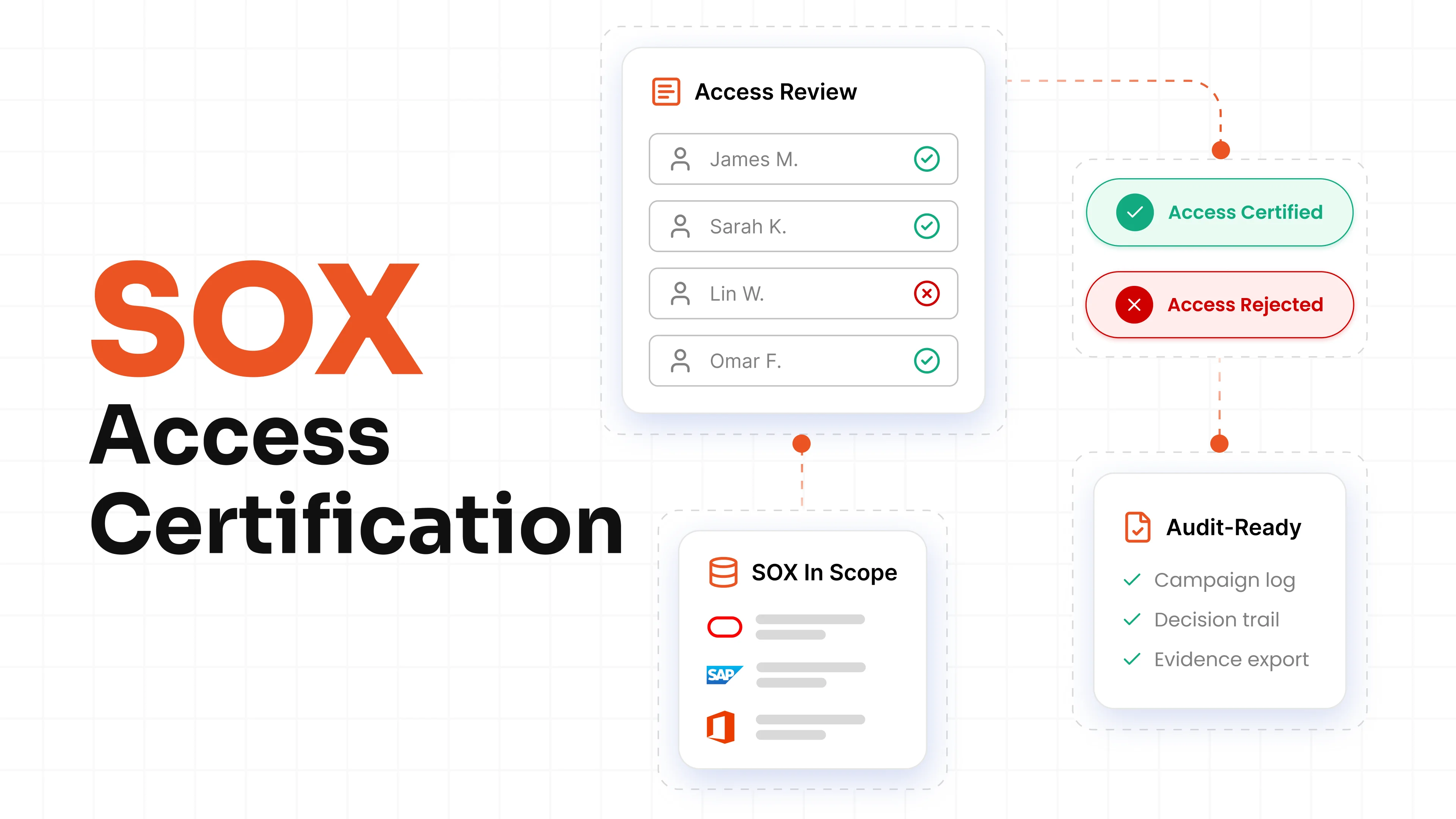
| SOX | Demonstrate effective internal controls, access governance, and approval processes |
| NIS2 | Strengthen cybersecurity governance, identity management, and access control across critical services |
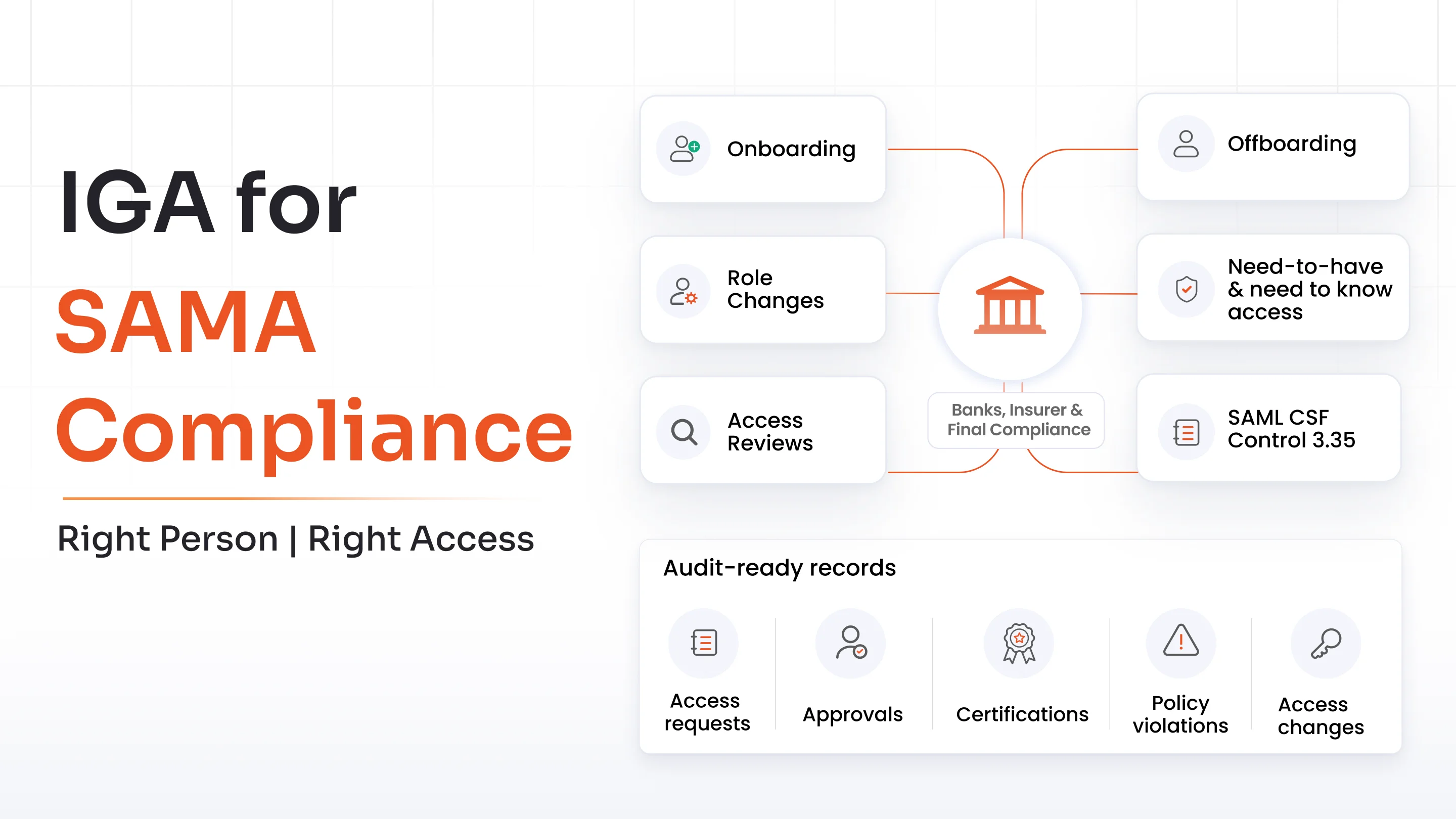
| SAMA CSF | Enforce strict logical access controls, manage identity lifecycles, and ensure data localization. |
On-premise deployments simplify these assessments because your internal teams can directly show auditors your data storage setups and network paths. Your team controls the audit pipeline end to end.
This doesn't mean cloud IGA can't support compliance.
Cloud governance vendors typically hold certifications like ISO 27001, SOC 2, or FedRAMP, which satisfy requirements for most organizations. However, they force you to rely heavily on third-party compliance attestations. In highly regulated sectors like defense, financial services, healthcare, and critical infrastructure, this indirect reliance can complicate your audits.
Another thing you have to consider is evidence. Compliance is also about proving that those policies are consistently applied.
Your IGA platform should help you produce evidence such as:
- Access review reports
- Approval histories
- Policy violation reports
- User lifecycle records
- Privileged access changes
- Audit logs
Regardless of deployment model, these reports become essential during audits.
Customization and Integration Complexity
Your existing infrastructure also plays a major role in determining your choice of cloud IGA or on-premise deployment.
On-premise models offer greater flexibility for configuration. If you have a lot of legacy systems or proprietary tools, you can build custom connectors and tailor approval flows to match your needs.
You can design complex Joiner-Mover-Leaver (JML) processes and strict segregation of duties (SoD) policies without vendor-imposed limitations.
Customization is often easier as everything is in your control.
Cloud IGA platforms take a different approach. They prioritize standardization. You get pre-built connector libraries optimized for mainstream SaaS applications like Workday, Microsoft 365, Salesforce, and ServiceNow. This is incredibly valuable if your application ecosystem lives primarily in the cloud.
However, you can only customize options that the vendor explicitly exposes through their configuration consoles or APIs. If you must connect to a highly customized, homegrown database, it'll be a challenge without expensive custom development.
Before selecting among different IGA deployment models, take inventory of your environment. See what percentage of your systems run on-premise versus in the cloud. This step ensures your platform can smoothly execute your identity lifecycle management goals without running into costly redesigns.
Total Cost of Ownership Over Five Years
Cost is often one of the first factors organizations evaluate when comparing deployment options. But only looking at the initial purchase price isn't enough.
For a clear on-premise IGA vs. cloud IGA comparison, you should consider the Total Cost of Ownership (TCO) over several years. This includes infrastructure costs, licensing models, implementation effort, operational overhead, and future growth.
An on-premise deployment typically requires a larger upfront investment. You'll need to invest in hardware, perpetual software licenses or subscriptions, and specialized engineering setups.
In return, once you establish the system, your multi-year costs remain highly predictable. Post-deployment, expenses depend on how you expand the platform and support and maintenance.
Cloud deployment models generally have lower entry costs. You don't have to invest in servers or hardware, as the vendor manages the infrastructure. This means you can get started quickly.
You get faster time-to-value, but costs can scale quickly over time. Per-user fees, tiered features, and API transaction charges compound as your organization grows. If you have a growing user base, your long-term cloud costs can outpace what you estimated initially.
Scalability and Deployment Speed
If time to value can't wait, then Cloud IGA stands out as a clear choice. Cloud-hosted platforms are very fast when you need to spin up a new instance. You can get started in days, as the vendor handles server provisioning and the platform is already hosted.
When you scale up over the years by onboarding new employees or completing mergers and acquisitions, you can expand your system through configuration changes instead of procurement cycles. You don't have to invest in extra hardware or servers.
On-premise deployments involve additional preparation.
If your user base expands dramatically, your internal infrastructure team must verify that your local database and application servers can handle the load. This setup process does not inherently slow down your daily administrative tasks. However, it means your expansion timelines depend on internal hardware availability and provisioning queues.
Security Risk, Connectivity, and Air-Gapped Environments
Cloud platforms require continuous internet connectivity to deliver their services. This can be risky for certain industries. Critical governance operations such as certifications, approvals, or policy management will be affected if connectivity is broken. The vendor's hosted infrastructure also matters.
This might not be a concern if you have reliable internet connectivity or haven't faced any issues with cloud services.
That isn't true for every organization. Especially government agencies, defense organizations, energy providers, research facilities, and certain critical infrastructure operators who maintain isolated or air-gapped identity governance environments that are intentionally disconnected from public networks.
Cloud-only products can't meet their operational needs.
An on-premise deployment works well here, as it can operate completely offline. It functions perfectly inside isolated environments because it does not need to connect to a vendor's data center to process an access request.
Furthermore, it avoids multi-tenant risks, such as shared-infrastructure data exposure or widespread vendor outages.
Cloud-only tools like Okta and Microsoft Entra ID can't support fully offline or air-gapped deployments.
If your operations require standalone resilience, hosting your own engine ensures your access controls stay up even during a total internet outage.
Hybrid IGA: Combining Both Models
What if you don't fit neatly into an "all cloud" or "all on-premise" strategy? Most organizations don't. They usually have a mix of legacy apps and SaaS platforms. In such scenarios, a hybrid IGA deployment often provides the best balance.
A hybrid deployment combines the security of an on-premise platform with the flexibility of cloud connectors. Your core engine, master directories, and audit logs are in your private infrastructure. You then use secure connectors or gateway services to extend governance to SaaS applications.
With this approach, you get to maintain strict control over your primary directories while continuing to onboard modern SaaS applications quickly. You also don't have to deal with vendor lock-in.
Hybrid deployment is becoming an increasingly common option because it offers flexibility without requiring you to commit entirely to one infrastructure strategy.
Decision Framework: Questions to Ask Before You Choose
As you evaluate different IGA deployment models, use the following questions to guide your decision.
- Do data residency laws or internal compliance policies require you to keep identity logs inside a specific geographic boundary or private database?
- Do your target systems use highly customized configurations, legacy mainframes, or specialized approval paths that require direct database adjustments?
- Where are your identity administrators located, and do they have the technical bandwidth to manage database patching and server configurations?
- What exact percentage of your business applications live on-premise versus multi-tenant cloud architectures?
- Can your organization tolerate an operational freeze on access requests if your internet connection fails or your vendor suffers an outage?
- Does your IT department have the budget and personnel to manage infrastructure health, data backups, and high availability systems internally?
- What will your total cost of ownership look like over the next five years if your organization doubles its headcount or adds new subsidiaries?
- What is your organization's risk tolerance regarding multi-tenant platforms, shared infrastructure data breaches, and third-party software updates?
On-Premise vs Cloud vs Hybrid IGA: Comparison Table
Each IGA deployment model offers distinct advantages. The table below summarizes the major differences to help you compare the three approaches at a glance.
| Criteria | On-Premise IGA | Cloud IGA | Hybrid IGA |
|---|---|---|---|
| Data control | Full, direct control | Vendor-managed, multi-tenant | Sensitive data on-premise, rest in cloud |
| Compliance evidence | Direct, audit-friendly | Relies on vendor attestations | Direct for regulated core systems |
| Customization | High | Limited to vendor features | High for core, standard for SaaS |
| Deployment speed | Slower (infra setup) | Fast | Moderate |
| Air-gapped support | Yes | No | Yes, for on-premise layer |
| Cost over 5 years | Predictable, higher upfront | Lower upfront, scales with users | Blended |
| Best fit | Regulated, air-gapped, complex orgs | Cloud-native, fast-scaling orgs | Orgs with mixed on-premise and SaaS |
Why miniOrange IGA Supports Every Deployment Model
At miniOrange, we have worked with hundreds of enterprises for over a decade. We understand that every organization has different requirements. Some want flexibility while others can't compromise on control.
That's why we have developed the miniOrange IGA platform to give you full deployment flexibility. You can host the platform on-premise, deploy it in a private cloud, or implement a hybrid architecture.
This flexibility allows organizations to:
- Meet data residency requirements without changing governance processes.
- Govern both on-premise and SaaS applications from a unified platform.
- Support modernization initiatives while continuing to manage legacy systems.
- Adapt deployment strategies as business and regulatory requirements evolve.
We are continuing to expand our platform capabilities to handle modern enterprise challenges. This includes new governance capabilities designed for non-human identities (NHIs) and automated AI workloads.
These additions allow you to run automated access request workflows and manage your access certification process smoothly across all environments, regardless of where you host the core engine. You can also evaluate IGA pricing across different deployment options to determine the model that best fits your technical and business requirements.
Conclusion
There's no single correct choice when comparing on-premise and cloud identity governance systems. The right choice depends on your specific regulatory demands, integration requirements, and budget strategy. You'll need to balance the speed of a cloud platform against the control and resilience of an on-premise deployment. The miniOrange platform supports cloud, on-premise, hybrid, and air-gapped configurations, ensuring you can deploy your identity governance infrastructure exactly where you need it.
Request a personalized IGA deployment demo to see how miniOrange fits into your current architecture.
FAQs
Is on-premise IGA more secure than cloud IGA?
Not necessarily. Both deployment models can be highly secure when implemented correctly. On-premise IGA provides greater control over infrastructure and data, while cloud IGA benefits from vendor-managed infrastructure and security operations. The better choice depends on your organization's security requirements, operational capabilities, and compliance obligations.
Can on-premise IGA govern cloud and SaaS applications?
Yes. An on-premise IGA platform is not limited to on-premise systems. Modern identity governance platforms can manage access across cloud applications, SaaS services, legacy systems, and custom applications regardless of where the platform itself is deployed.
Which industries typically prefer on-premise identity governance?
Organizations in government, defense, healthcare, banking, energy, and other highly regulated industries often choose on-premise identity governance because they require greater control over infrastructure, data residency, audit evidence, or support for isolated environments.
Is cloud IGA faster to deploy than on-premise IGA?
In most cases, yes. Since the infrastructure is already managed by the vendor, cloud IGA deployments generally begin with platform configuration instead of server provisioning. Actual deployment timelines still depend on factors such as application integrations, governance policies, and implementation complexity.
Can identity governance be deployed in air-gapped environments?
Yes, provided the platform supports on-premise deployment. Organizations operating classified or isolated environments can deploy an IGA platform entirely within their own infrastructure without requiring internet connectivity. Cloud-only services cannot operate in fully air-gapped environments.
What is a hybrid IGA deployment?
A hybrid IGA deployment combines on-premise and cloud components. Organizations can keep sensitive governance data and core policies within infrastructure they control while extending governance to cloud and SaaS applications through secure integrations. This approach is well suited to organizations operating mixed IT environments.
Leave a Comment