Hello there!
Need Help? We are right here!

Need Help? We are right here!
Search Results:
×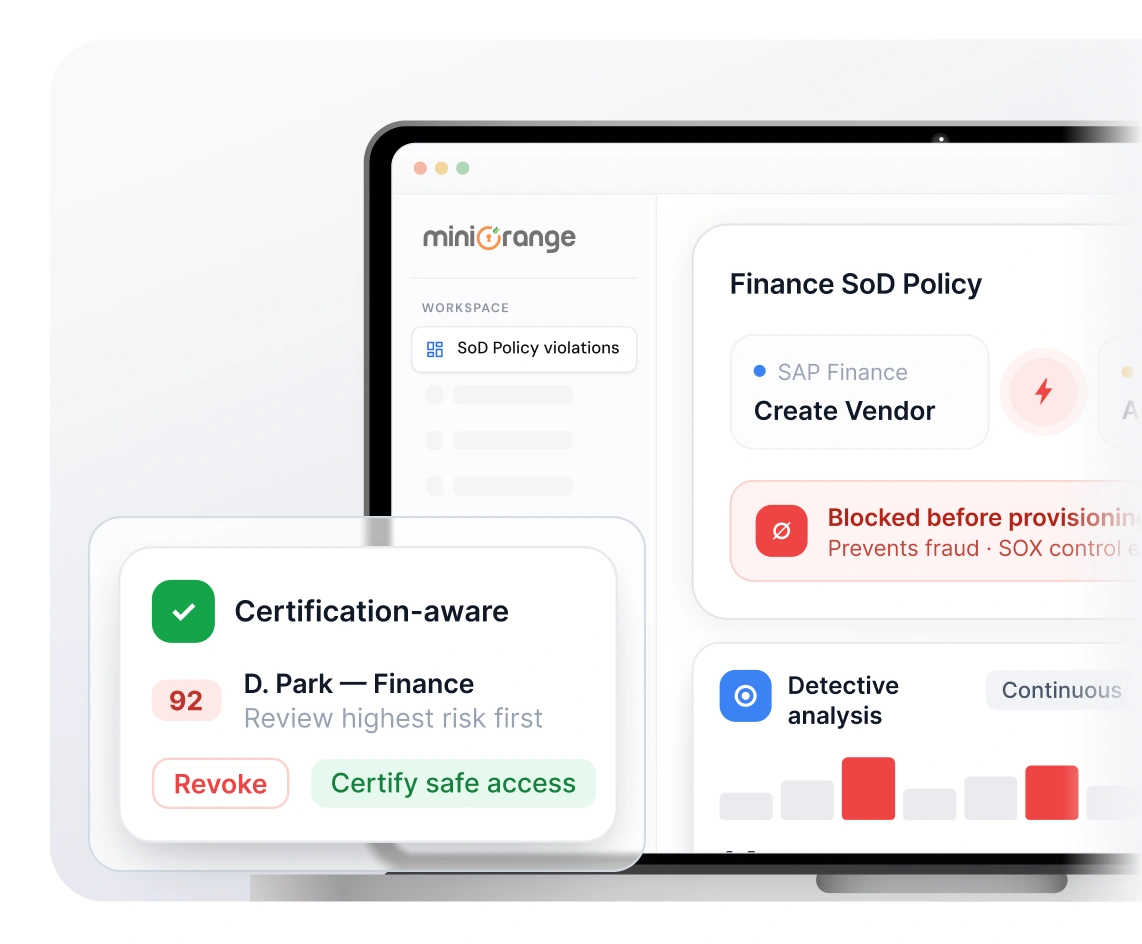
Segregation of Duties (SoD) is an internal control principle that ensures no single user holds enough access to initiate, approve, or complete a sensitive business transaction without oversight.
When one person holds control over many critical processes, it leads to fraud, compliance violations, and errors. SoD also prevents toxic access combinations through detection, prevention, and certificate-aware risk evaluation. Common SoD examples include: Process payroll + approve payroll; Create vendor + approve vendor payments.
Spot and solve multi-application blind spots in your SAP, Oracle, Workday, or Dynamics environments.

Each application only checks its own roles. A user can look “clean” in every app but still have a dangerous combination of permissions when you add everything together.

Traditional SoD tools are complex, consultant-driven, and hard to change. Rules and SoD matrices lag behind reality, leaving coverage gaps exactly where risk is growing fastest.

Detective-only SoD checks run on a schedule. By the time a conflict appears in a report, that access has already been granted, and may have been in use for weeks or months before anyone notices.

The spreadsheet SoD matrix can’t keep pace with new roles, entitlement changes, and process updates. The design on paper stops matching the access users actually have.

Weak risk controls lead to SOX failures and eventually recurring audit findings. Undetected or unremediated conflicts show up as repeat findings, showing internal controls aren’t effective.

A stack of roles creates hidden SoD conflicts that nobody approved, designed, or documented. NHIs hold permissions that rarely go through structured SoD checks. This has become a major risk.
An effective Segregation of Duties (SoD) and risk management is a part of a continuous process that is built into every access decision.
Define which permissions must never sit with the same identity. These rules are codified into a SoD matrix that maps incompatible roles, entitlements, and processes.
Map roles and permissions from all the connected systems and link them to identities. This gives a complete view of what each user and NHI can actually do.
User access is continuously evaluated against your SoD matrix. Any SoD violation or toxic access combination is flagged, including conflicts that span multiple applications.
Each conflict is scored based on business impact, likelihood, and regulatory relevance. High-risk conflicts rise to the top, so teams focus on what truly matters.
Conflicts are resolved by removing or changing access, applying documented controls, or accepting the risk. Workflows track who did what, when, and why for audit-ready evidence.
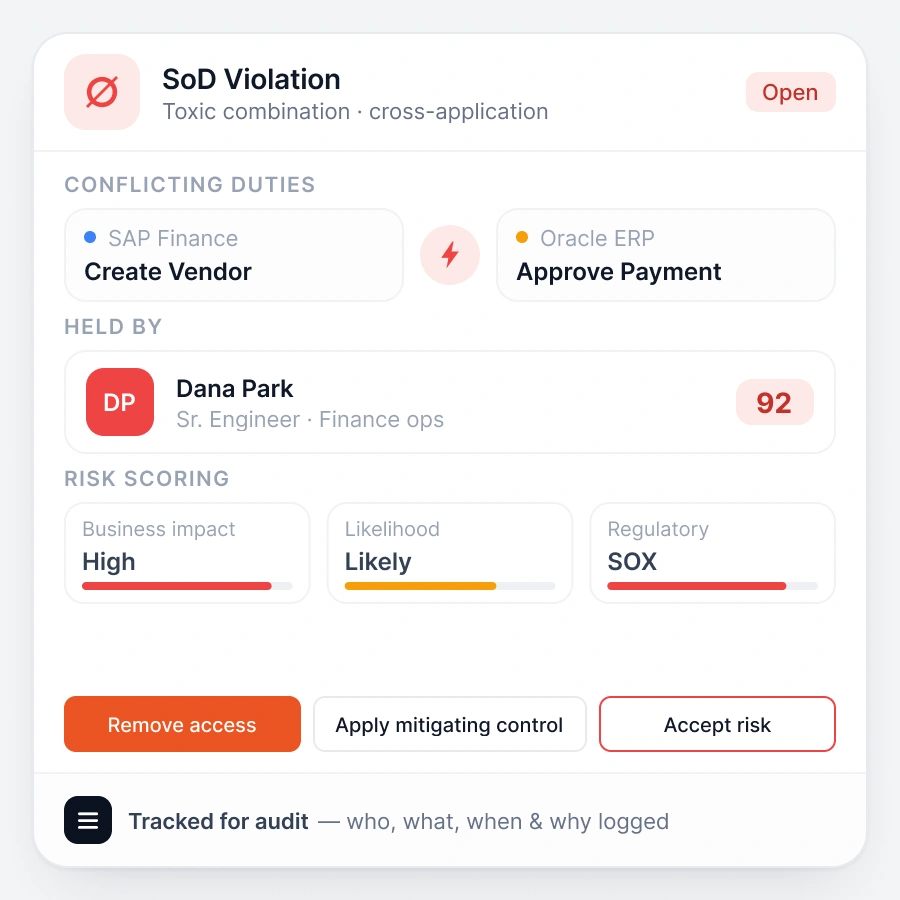
miniOrange delivers end-to-end SoD and risk management across ERP systems and cloud platforms.
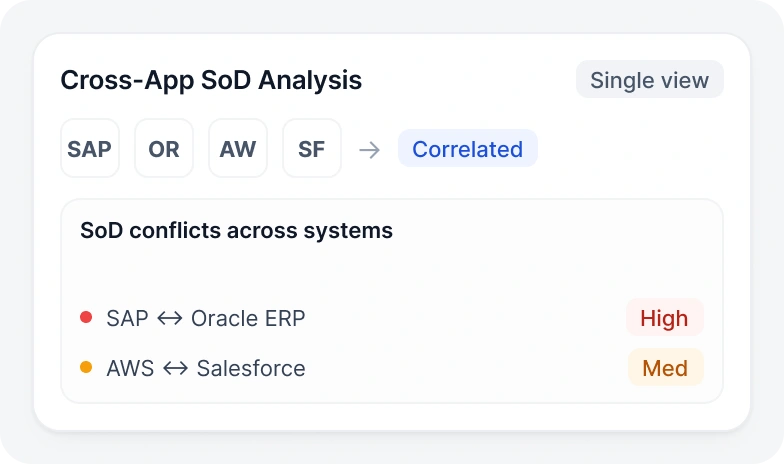
Get a single view of SoD conflicts across applications, ERP, and cloud by correlating identities and entitlements, so you can analyze access risk and manage SoD centrally.
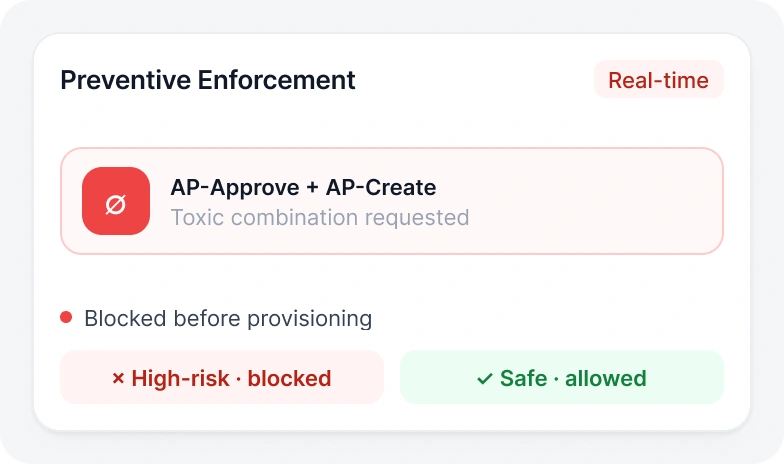
Stop toxic access combinations at the point of request with real-time risk controls that block high-risk access before it’s provisioned.
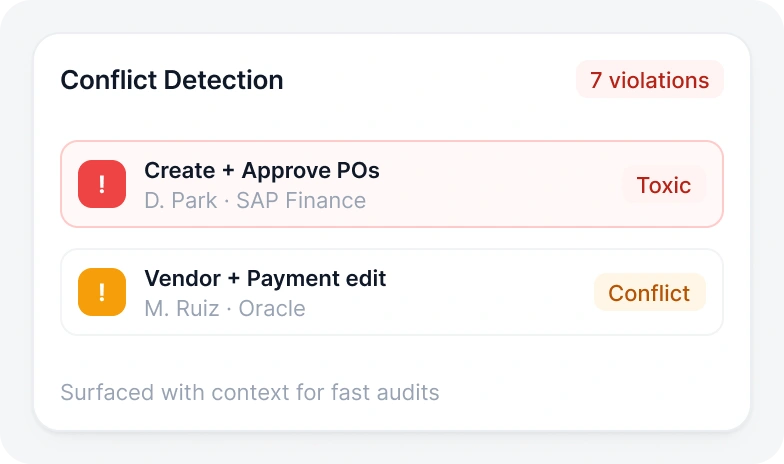
Scan existing access to uncover SoD violations and other toxic combinations, and surface them with the context needed for fast SoD audits and remediation.
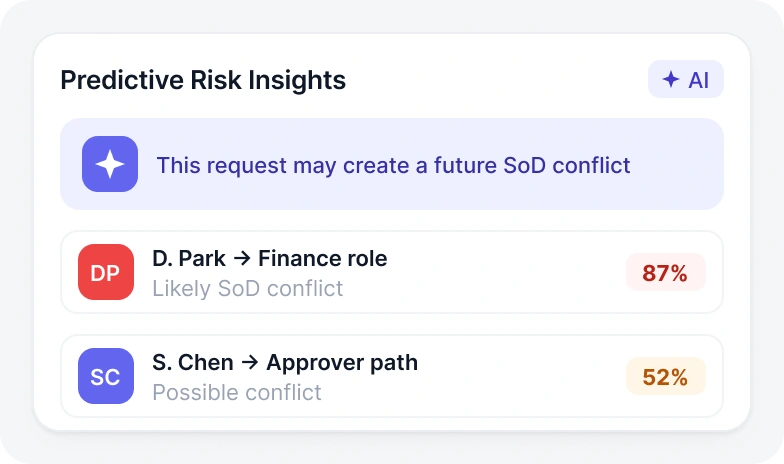
Use AI to flag access requests that could introduce future SoD conflicts. Utilize risk scoring to see which users, roles, and access paths are most likely to create SoD issues, so teams focus on the riskiest conflicts first.
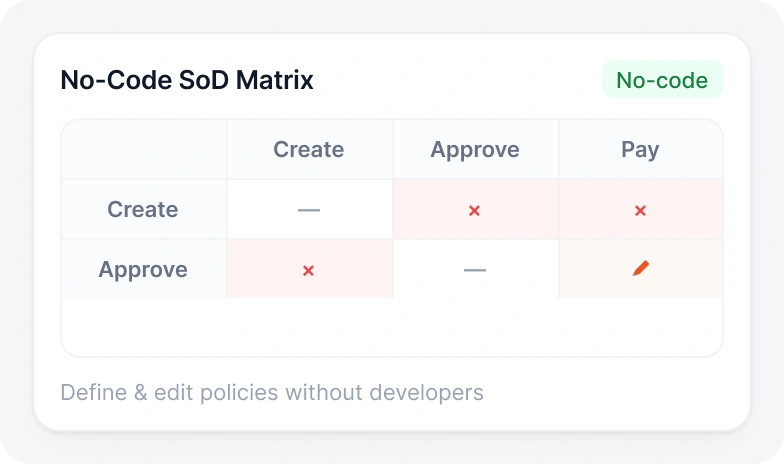
Define, update, and maintain your SoD matrix in a no-code interface, so risk and compliance teams can manage SoD policies without dependencies on developers or consultants.
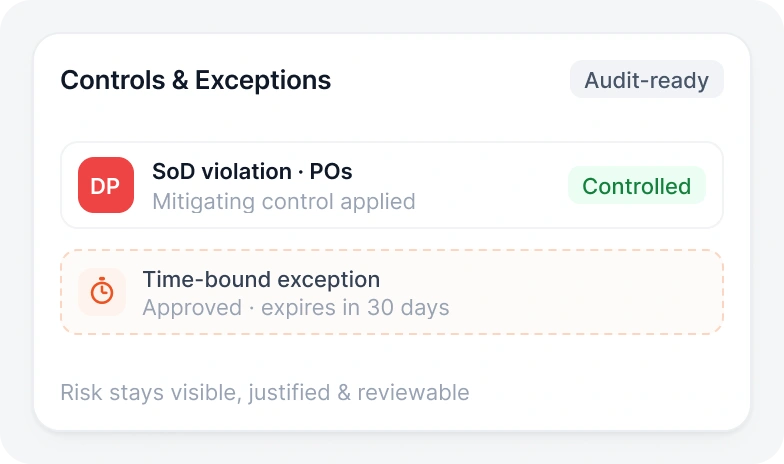
Determine mitigating controls and time-bound exceptions to specific SoD violations, keeping SoD risk visible, justified, and ready for audit review.
Segregation of Duties is designed and deployed for the exact use cases auditors are likely to flag first.
The miniOrange IGA platform supports major regulatory frameworks, helping organizations stay audit-ready at all times.
Ensure continuous compliance with automated controls, reporting, and access certification workflows.
View Compliance Frameworks
Access Control

Healthcare

ISMS

Type II

Privacy

Payments

Cybersecurity

India

Privacy

Payments

Cybersecurity

India
Evaluate every access request against the SoD ruleset in real-time. Intercept conflicting combinations at the time of request, not after provisioning or during the next quarterly review.
Use predictive analysis to identify which pending access requests would result in high-risk toxic combinations if approved.
Re-evaluate user access profiles against the current SoD ruleset, so conflicts that emerge from role changes are caught immediately, and not at the next annual audit.
Have a clear, structured explanation for every flagged conflict, approved exceptions, and applied controls. The auditors get full documentation of who reviewed it, when, what the risk was, and how it was handled.
miniOrange combines the depth of an enterprise SoD solution with the speed and economics that legacy platforms can’t match.

Enforce SoD at the point of request, predict emerging conflicts before they’re provisioned, and provide no-code rule management that eliminates dependency on external consultants.

miniOrange delivers SoD coverage across ERP systems, cloud platforms, SaaS applications, and non-human identities, all within a single, unified identity and access management platform.

Traditional SoD solutions require months of implementation, multi-year contracts, and a significant service expense. miniOrange deploys faster and costs less than the legacy SoD solutions.
Common questions about segregation of duties, SoD matrices, toxic access combinations, and risk management.