

As per a report by Identity Theft Resource Center (ITRC), the number of data compromises in 2025 (3,322) increased by 5% compared to 2024 (3,152). Separately, 71% of organizations suffered at least one identity-linked data breach last year.
These numbers have turned identity into a leading breach vector and pushed identity risk squarely onto the board agenda, and not just the help desk's to-do list.
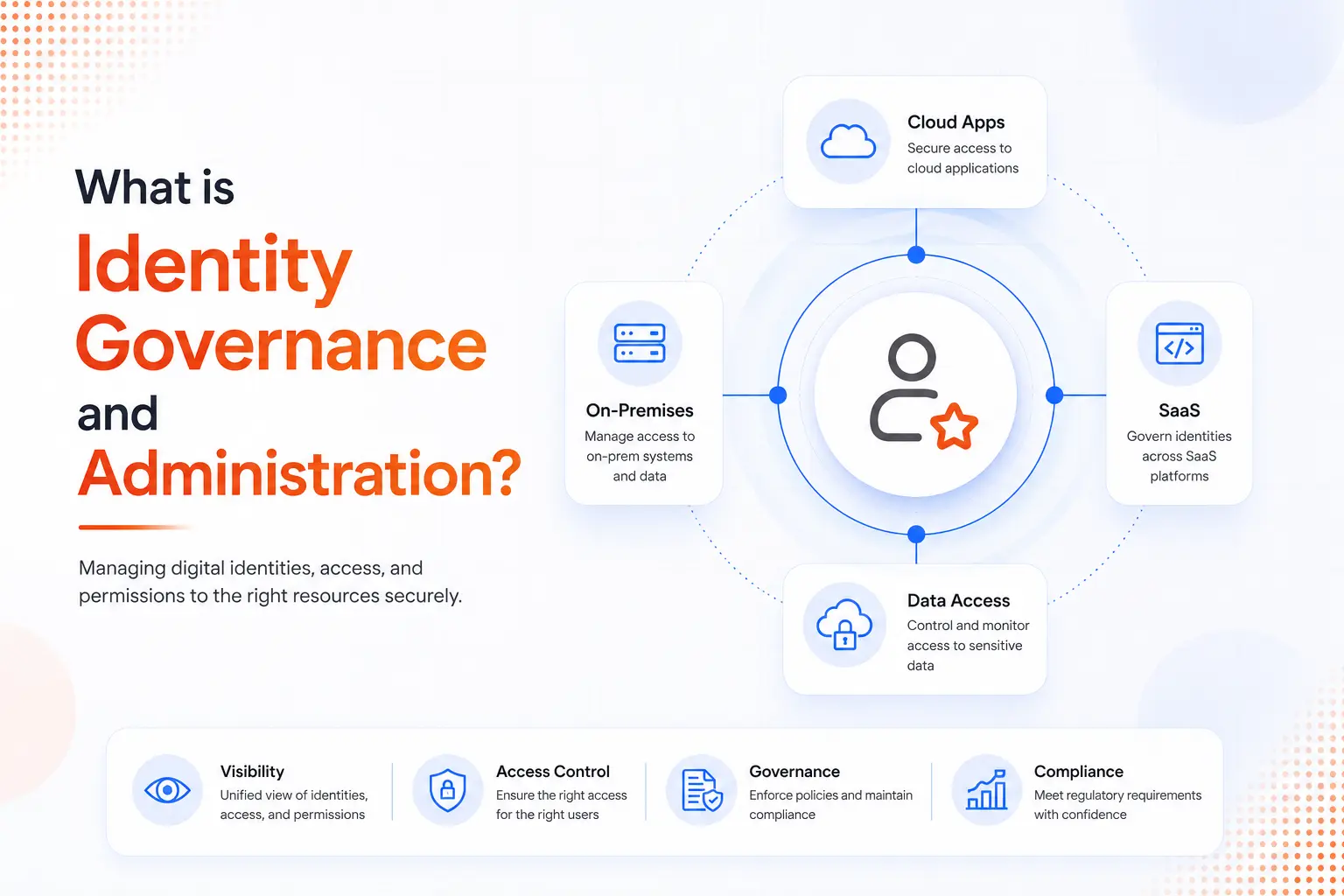
If you're a security or IT executive evaluating an Identity Governance and Administration (IGA) platform, then this guide is for you. Let's dive right in.
What Is Identity Risk Management?
Identity Risk Management (IRM) is the part of identity governance that focuses on identifying the users and accounts carrying the highest access risk. This helps security and IT teams to prioritize remediation instead of chasing every alert equally.
In practice, IRM takes the raw data — entitlements, roles, activity logs, and account status, and turns it into a ranked list of where the real risk sits.
A quick note before moving on: some vendors and analysts use "identity risk management" more broadly to cover fraud prevention, customer identity verification, or general cybersecurity risk scoring.
That is a valid usage in other contexts, but for this blog, and for most B2B buyers evaluating an IGA solution, we're defining IRM the way it functions inside identity governance: the risk-identification and risk-scoring layer that tells you which identities need attention first.
Why Is Identity Risk a Board-Level Problem
Identity compromise now drives the majority of material cyber incidents. And it has moved from an operational IT concern to a matter of enterprise resilience. So, when credentials or excess permissions are the entry point, the fallout touches revenue, regulatory standing, and customer trust, and not just system uptime.
Keeping this in mind, let's look at the core reasons why identity risk is a board-level issue.
1. Expanding Attack Surface
Cloud adoption, SaaS sprawl, and Non-Human Identity (NHI) growth are outpacing the oversight that teams can realistically provide.
Further, AI agents in particular are being folded into core business workflows and treated as infrastructure rather than identities. This means they rarely go through the same access reviews or behavioral monitoring as human users.
Additionally, every unmanaged service account, API key, or bot represents another entry point for attackers that traditional access reviews rarely capture.
All of the above reasons expand the attack surface.
2. Governance Blind Spots
Many executives simply lack visibility into who holds privileged access and whether it gets revoked when it should. Also, they lack full insight into identity vulnerabilities across their organization. The gap between what leadership assumes is governed and what's actually governed is where most identity risk hides.
3. Rising Cost of Compromised Credentials
As per an IBM report, compromised credentials continue to be the primary vehicle for identity-based threats, accounting for 10% of breaches. They are responsible for huge financial losses.
Speed of detection, not just prevention, is where identity risk scoring earns its budget.
Core Components of an Identity Risk Program
These six components are the building blocks that any IGA platform needs to deliver, if it's going to function as a real identity risk program rather than a checklist tool.
1. Access Certification
Periodic, manager-driven reviews confirm that each identity's access entitlements still match its job function. If done well, then certification catches access creep before it becomes an access violation waiting to be exploited.
2. SoD Analysis
Segregation of Duties (SoD) analysis flags when a single identity holds two conflicting permissions, for instance the ability to create a vendor and approve payment to that same vendor. Holding two permissions together enables fraud.
SoD is one of the clearest, most auditable forms of access compliance, and regulators expect to see it documented.
3. Orphaned and Dormant Accounts Management
Orphaned accounts (left behind after an employee departs) and dormant accounts (unused but still active) are quiet liabilities that rarely trigger alerts on their own, which is exactly why attackers favor them.
Effective management goes beyond one-time cleanup: it means continuously comparing account lists against HR and ownership data, tracking dormancy by activity and age, and automating deprovisioning the moment ownership is lost or access goes unused for a defined period.
4. Risk Scoring
Identity risk scoring assigns a quantifiable value to each account based on factors like privilege creep, access scope, activity patterns, and authentication strength. This converts a vague sense of "this looks risky" into a number leadership can track and benchmark over time.
5. Predictive Analytics
Predictive risk management uses historical access and behavior patterns to flag identities that are likely to become risky before they cause an incident, rather than waiting for a violation to surface in a review cycle. This shifts identity governance from reactive cleanup to proactive risk reduction.
6. Non-Human Or Machine Identity Monitoring
Given how quickly machine identities are growing across the average enterprise, no identity risk program is complete without dedicated monitoring for service accounts, bots, and AI agents.
This means discovering them in the first place, attributing each one to a human owner, and applying the same certification and scoring discipline used for employee accounts.
Identity Risk vs. Access Management vs. Governance
Buyers evaluating an IGA solution often conflate three related but distinct disciplines. Here's how they differ in practice:
| Dimension | Identity Risk Management | Access Management | Identity Governance |
|---|---|---|---|
| Core Question | Which identities pose the highest risk? | Can this identity get in right now? | Is access appropriate and compliant? |
| Nature | Continuous scoring and monitoring | Real-time authentication/authorization | Periodic review and policy enforcement |
| Primary Output | Prioritized risk list, remediation actions | Login/session decisions | Certification records, audit trail |
| Time Orientation | Ongoing and predictive | Instantaneous, per-request | Cyclical (quarterly, annual) |
| Data Inputs | Entitlements, activity logs, breach exposure, and privilege level | Credentials, MFA signals, and session context | Roles, policies, and entitlement catalogs |
| Typical Owner | Security/GRC team | IT operations | Identity governance team |
| Executive Relevance | Board-level risk visibility | Operational continuity | Regulatory/compliance assurance |
| Failure Mode if Absent | Excess permissions go undetected until exploited | Legitimate users get locked out, or attackers walk in | Audit findings, uncontrolled access sprawl |
How to Implement Identity Risk Management
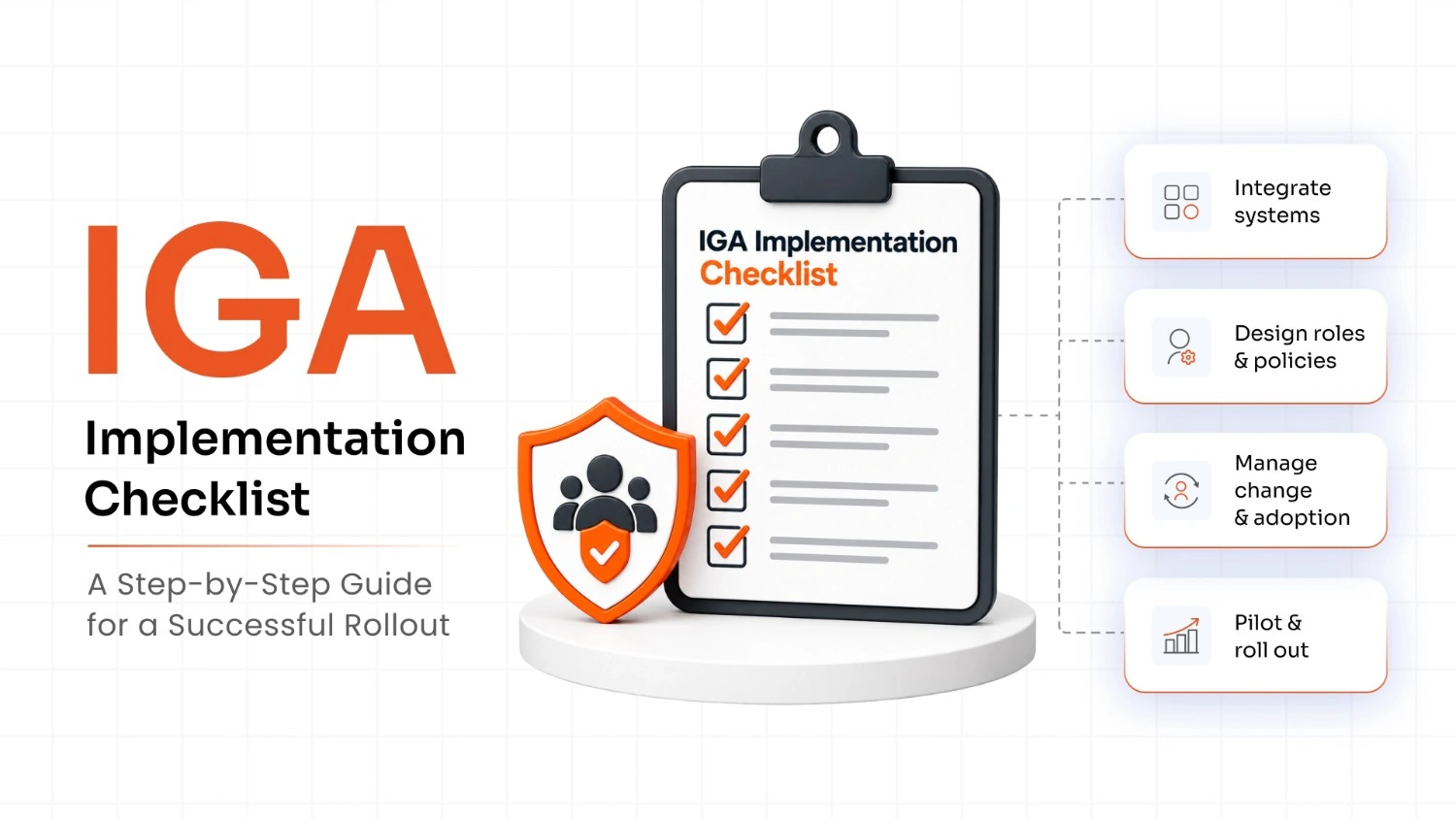
Implementation is iterative, not a one-time project; identities, permissions, and applications change constantly, so the process has to loop rather than end.
1. Discover
Start with a complete inventory of every human and non-human identity and account across cloud, on-prem, and SaaS environments. You can't score or remediate risk in accounts you don't know exist.
2. Assess
Evaluate each identity's access against defined risk criteria: privilege level, sensitivity of systems reached, and whether the access still matches business needs.
3. Score
Apply a standardized identity risk scoring methodology so every account, human or machine, gets a comparable, weighted risk value rather than a subjective label.
4. Remediate
Act on the highest-scoring risks first: revoke unused access, adjust over-privileged users down to least privilege, or formally certify justified access.
5. Audit
Document every decision and action taken. This record is what turns remediation into demonstrable compliance risk reduction during regulatory reviews.
6. Repeat
Feed the results back into continuous monitoring. New hires, offboarded employees, and freshly spun-up service accounts mean the discovery-to-remediation loop never really closes; it just keeps running.
Business Benefits of Identity Risk Management
Framed in terms executives care about, the payoff isn't abstract security hygiene; it's measurable risk reduction, cost control, and operational resilience.
1. Reduced Attack Surface
Fewer standing privileges and fewer orphaned accounts mean fewer paths an attacker can exploit in the first place. It is different from general posture improvements because it shrinks the actual number of exploitable entry points.
2. Stronger Security Posture
Continuous scoring means risky access gets flagged and addressed before it turns into an incident, rather than being discovered during a post-breach investigation.
3. Compliance Readiness
SoD analysis, certification records, and audit trails map directly to requirements under frameworks like SOX, HIPAA, and GDPR, cutting the scramble that usually precedes an audit.
4. Faster Breach Response
Risk-scored identities give incident responders a prioritized starting point instead of a flat list of every account, shortening the mean time to contain an incident.
5. Cost Reduction
Fewer breaches, shorter containment windows, and reduced manual review overhead add up to real budget impact over time.
6. Audit Efficiency
Automated certification and documented remediation replace manual spreadsheet reviews, cutting the hours teams spend preparing for regulatory or internal audits.
What Are the Notable Use Cases?
Let's look at a few hypothetical use cases to understand the risks associated with identity leakage better.
1. A Departed Contractor Kept Access for 90 Days
A fast-growing tech company, an offboarded contractor retained privileged access to customer data systems for three months after their contract ended. This is an oversight that nearly triggered a serious breach and significant compliance exposure before it was caught.
2. A Healthcare Firm Found 500 Dormant Privileged Accounts Hiding in Plain Sight
An identity risk assessment at a healthcare technology company uncovered more than 500 dormant privileged accounts with access to sensitive patient data. It also found dozens of toxic access combinations creating compliance violations. None of this was visible to the organization's existing security controls.
3. AI Agents Are Quietly Becoming an Unmanaged Identity Category
Organizations are integrating AI agents into core systems without treating them like identities. This means over-permissioned service accounts and agents accessing sensitive information go unmonitored because behavioral reviews rarely extend to automated actors.
The above-mentioned gap is one of the fastest-growing identity risks security teams are now dealing with.
Each case traces back to the same root cause: accounts and permissions that existed outside the visibility of a continuous risk-scoring process. That's precisely the blind spot identity risk management is built to close.
Identity Risk Management With miniOrange
Once you know what to look for in an IGA solution, the next question is which platform actually delivers it without forcing a rebuild of your existing environment. miniOrange's IGA platform is built specifically around the gaps most identity risk programs still have:
- Unified visibility across all identity types: Get a single view of employees, contractors, service accounts, bots, and AI agents instead of chasing information across disconnected tools.
- Automated identity discovery: Eliminate shadow access by automatically discovering identities across systems, closing the gap where orphaned and dormant accounts usually hide.
- Built-in SoD enforcement: Detect and block risky access combinations in real time, at the point of request, rather than finding violations during a review cycle months later.
- Continuous access certification: Run review campaigns that improve decision accuracy and reduce the manual burden on managers.
- Audit-ready compliance reporting: Generate detailed reports for SOX, GDPR, HIPAA, and other frameworks, with complete timelines auditors can act on directly.
FAQs
What is the fundamental architectural distinction between identity risk and access risk?
Identity risk evaluates the identity itself, whereas access risk is focused on whether a specific access grant is appropriate for a specific resource at a specific time.
How can an organization establish a standardized methodology to measure and score identity risk?
Apply a unified scoring formula across all human and non-human identities, weighting five core factors: access scope, privilege level, activity status, authentication strength, and credential exposure.
What compliance frameworks require identity risk management?
SOX, HIPAA, GDPR, and PCI DSS all require some form of access control, segregation of duties, or audit trail documentation that identity risk management directly supports.
How often should you review identity risk?
Continuously. Identity risk scoring must update in real time as access and behaviors change, with quarterly or annual formal certifications layered on top for compliance.
Leave a Comment