

Enterprises today manage thousands of identities across employees, contractors, applications, APIs, and machine-driven systems. In most environments, identities have become the primary security boundary, yet access remains fragmented, overprovisioned, and difficult to track. According to IBM's X-Force Threat Intelligence Index, identity-based attacks now account for nearly one-third of all intrusions, highlighting how identity has become one of the most targeted layers in modern cybersecurity.
The challenge is not just authentication. It is knowing who has access, why they have it, and whether that access should exist at all. According to CyberArk's 2025 Identity Security Landscape Report, machine identities now outnumber human identities by 82:1 in many enterprise environments, while 50% of organizations have already experienced security incidents tied to compromised machine identities.
Identity Governance and Administration (IGA) addresses this by bringing visibility, control, and policy enforcement to the entire identity lifecycle. It acts as the governance layer that ensures access is continuously aligned with business roles, security policies, and regulatory requirements.
- An identity governance solution controls who has access to what across users, systems, and applications.
- It automates provisioning, deprovisioning, and access reviews to reduce manual effort and errors.
- Enforces least privilege and policy-based access to strengthen security and compliance.
- Provides visibility into access entitlements, audit trails, and risk exposure.
- Extends governance to machine identities and AI-driven environments, not just human users.
What Is Identity Governance and Administration?
Identity Governance and Administration (IGA) is a framework of policies, processes, and technologies that ensures the right individuals and systems have the right access to the right resources at the right time, for the right reasons.
At its core, an identity governance solution provides:
- Visibility into identities and access entitlements
- Control over provisioning and deprovisioning
- Governance through access reviews, policies, and audit trails
Unlike traditional identity systems, IGA security focuses on access governance, not just access enablement.
It answers critical questions like:
- Who has access to this system?
- Why do they have it?
- Is that access still required?
- Does it violate any policies or compliance rules?
Modern IGA solutions integrate across:
- SaaS applications
- On-prem systems
- Cloud infrastructure
- APIs and machine identities
This makes Identity Governance and Administration (IGA) a central authority for identity lifecycle management and policy enforcement across the enterprise.
Common Identity Governance Challenges
Traditional identity and access management approaches were designed for centralized environments with predictable user roles and a limited set of applications. Today's enterprise identities are dynamic and constantly changing. Without governance, access becomes difficult to track, control, and validate.
Access Sprawl
Organizations today rely on a growing number of SaaS applications, cloud platforms, and internal systems. As employees move across roles and projects, access permissions accumulate without proper oversight.
This results in users holding far more access than required for their responsibilities. Over time, unmanaged access entitlements increase the attack surface, making it easier for malicious actors to exploit excessive permissions and move laterally within systems.
Orphaned Accounts
When employees leave the organization or transition to new roles, their access is often not fully revoked. These orphaned accounts remain active without clear ownership or monitoring. Attackers frequently target such accounts because they are less likely to trigger alerts.
Without structured deprovisioning and identity lifecycle controls, organizations struggle to detect and eliminate these hidden risks, leaving critical systems exposed to unauthorized access.
Manual Provisioning Delays
Manual access provisioning processes slow onboarding and introduce inconsistencies in access assignment. IT teams often rely on tickets, emails, or spreadsheets to grant permissions, which increases the likelihood of errors and delays.
This not only impacts employee productivity but also leads to overprovisioning as shortcuts are taken. Without automation, maintaining consistent and policy-driven access across systems becomes nearly impossible.
Shadow IT and AI Agents
The adoption of unsanctioned tools, automation scripts, and AI-driven workflows has introduced identities that operate outside traditional governance frameworks. Service accounts, bots, and AI agents interact with systems and APIs without clear ownership or visibility.
These non-human identities often persist with long-lived credentials and excessive permissions. As their numbers grow, they create significant blind spots that traditional identity systems are not equipped to manage.
Compliance Complexity
Regulatory requirements demand strict control over who has access to sensitive systems and data. Organizations must demonstrate access certification, maintain audit trails, and enforce segregation of duties.
Without centralized governance, these processes become fragmented and manual, increasing the risk of audit failures. Compliance reporting takes longer, errors become more frequent, and security teams lack confidence in the accuracy of access-related data.
What Happens Without Identity Governance and Administration?
Without Identity Governance and Administration, access control becomes fragmented and reactive. Over time, users accumulate permissions across systems without proper validation, leading to excessive access and increased security risk. IT teams lose visibility into who has access to critical resources, making it difficult to enforce least privilege or detect misuse.
Orphan accounts remain active after employees leave, creating silent entry points for attackers. Access reviews, if conducted, are manual and inconsistent, often reduced to checkbox exercises rather than meaningful validation. This weakens compliance posture and increases the likelihood of audit findings.
Operationally, the absence of Identity Governance and Administration slows down onboarding and offboarding processes. Employees may wait days for access, while revoked users may retain access longer than necessary. Compliance reporting becomes time-consuming, requiring data from multiple disconnected systems.
In this environment, identity becomes the weakest link. Security teams are forced to react to incidents rather than prevent them, while organizations struggle to maintain control over an ever-expanding access landscape.
How Does an Identity Governance Solution Work?
Identity Governance and Administration functions as a continuous control layer that governs access across the entire identity lifecycle as it connects identities, applications, and policies into a unified framework.
Identity Discovery
IGA security begins by aggregating identity data from directories, HR systems, cloud platforms, and applications. This creates a centralized view of all identities, including employees, contractors, and machine identities. By consolidating this information, organizations eliminate visibility gaps and establish a reliable foundation for governance.
Access Request Workflows
Users request access through structured workflows that are routed based on predefined policies. Approvals are tied to roles, business context, and risk levels, ensuring that access request decisions are consistent and justified. This replaces informal methods such as emails or tickets with controlled and auditable processes.
Provisioning and Deprovisioning
Once access is approved, IGA automates provisioning across connected systems. When users change roles or leave the organization, access is updated or revoked automatically. This reduces delays, prevents orphan accounts, and ensures that access remains aligned with current responsibilities.
Access Certification
Identity Governance and Administration enables periodic access reviews where managers and application owners validate whether users still require their access. These reviews are guided by policies and supported by clear visibility into entitlements. Unnecessary or risky access can be revoked during the certification process, strengthening compliance and reducing exposure.
Policy Enforcement
Policies such as least privilege, role-based access control, and segregation of duties are enforced continuously. IGA systems detect violations, such as conflicting access rights, and either flag them for review or automatically remediate them. This ensures that access remains compliant with internal and regulatory requirements.
Risk Analytics
Modern IGA platforms incorporate analytics to identify unusual access patterns and high-risk entitlements. By analyzing user behavior and access data, organizations can detect anomalies early and prioritize remediation. This shifts identity security from a static control model to a more adaptive and risk-aware approach.
Steps to IGA Implementation for Your Organization
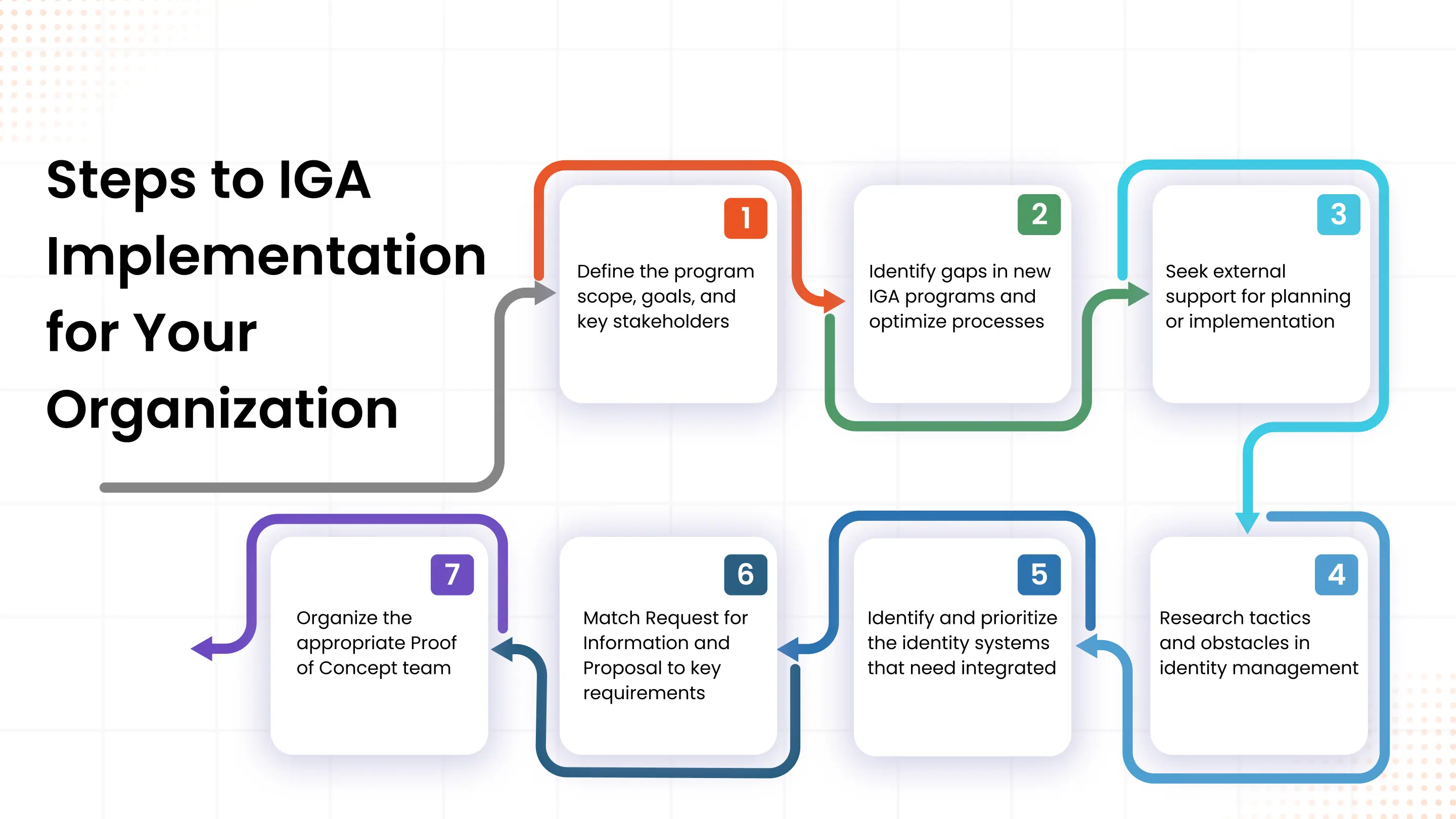
Implementing an IGA solution requires a structured and phased approach. A well-planned set-up ensures both security and operational efficiency.
Identity Inventory
The first step is to identify and catalog all identities from IdP, HRMS, or AD from the organization's digital ecosystem. This includes workforce identities, third-party access, applications, and machine identities. Establishing a complete inventory provides the visibility needed to understand existing access patterns and risks.
Role Modeling
Define roles based on job functions and responsibilities. Role-based access control helps standardize access assignment and reduces complexity. Instead of assigning permissions individually, organizations can map access to roles, ensuring consistency and easier management.
Policy Definition
Establish governance policies that enforce least privilege and segregation of duties. These policies should reflect business requirements as well as regulatory obligations. Clear policy definition ensures that access decisions are aligned with both security and compliance needs.
System Integration
Integrate the IGA solution with enterprise applications such as Microsoft 365, Google Workspace, Salesforce, ServiceNow, Slack, AWS, Zoom, Atlassian, Workday, SAP, Dropbox, or more for seamless provisioning and centralized governance.
Automation and Workflows
Configure automated workflows for access requests, approvals, provisioning, and deprovisioning. Implement Joiner-Mover-Leaver (JML) lifecycle automation and birthright access provisioning to ensure users receive appropriate access based on roles, departments, and organizational policies.
Continuous Governance
IGA is not a one-time setup. Organizations must continuously monitor access, conduct periodic reviews, and update policies as the environment evolves. Ongoing governance ensures that access remains aligned with business needs while adapting to new risks and technologies.
Core Features of Modern IGA Solutions
Modern Identity Governance and Administration solutions go beyond basic access control and provide a comprehensive framework for managing identity lifecycle, enforcing policies, and maintaining compliance across complex environments.
Identity Lifecycle Management
Identity or user lifecycle management ensures that access is automatically aligned with a user's status and role within the organization. From onboarding to role changes and offboarding, access is dynamically updated based on predefined rules. This reduces manual intervention and ensures that users always have the appropriate level of access, minimizing both delays and security risks.
Entitlement Management
Entitlement management provides detailed visibility into the specific permissions assigned to each identity. It allows organizations to track access at a granular level, including application-level and system-level privileges. This helps security teams identify excessive or unused access and ensures that permissions are aligned with business requirements.
Role-Based Access Control (RBAC)
RBAC simplifies access management by assigning permissions based on roles rather than individual users. Roles are defined according to job functions, making it easier to manage access at scale. This approach improves consistency, reduces administrative overhead, and supports policy enforcement across departments and systems.
Segregation of Duties (SoD)
Segregation of duties ensures that no single user has conflicting access that could lead to fraud or misuse. For example, a user should not be able to both initiate and approve financial transactions. IGA systems detect and prevent such conflicts, helping organizations maintain strong internal controls and meet regulatory requirements.
Compliance Reporting
IGA solutions generate detailed reports on access, policy enforcement, and user activity. These reports support audits by providing clear evidence of access controls, certifications, and remediation actions. Automated reporting reduces the time and effort required to demonstrate compliance with industry regulations.
AI-Driven Anomaly Detection
Advanced IGA platforms use analytics and machine learning to detect unusual access patterns and high-risk behavior. This includes identifying users with excessive permissions or anomaly detection in access usage. These insights enable security teams to take proactive action and reduce the likelihood of identity-related risks.
Benefits of Identity Governance and Administration
Implementing IGA delivers measurable improvements in both security and operational efficiency. It enables organizations to move from conditional access management to a more controlled and policy-driven approach.
Reduced Operational Overhead
Automation of access requests, provisioning, and reviews significantly reduces the workload on IT teams. Tasks that previously required manual effort are streamlined, allowing teams to focus on higher-value activities while maintaining consistent access control across systems.
Faster Onboarding
New employees can be provisioned with the right access from day one based on their role. This eliminates delays and improves productivity, ensuring that users can start working without waiting for manual approvals or system access.
Reduced Insider Risk
By enforcing least-privilege policies and continuously reviewing access, Identity Governance and Administration minimizes the risk of misuse or unauthorized actions. Excessive permissions are identified and removed, reducing the potential impact of compromised accounts or insider threats.
Better Audit Readiness
IGA provides centralized visibility and automated reporting, making it easier to demonstrate compliance during audits. Access certifications, audit trails, and policy enforcement records are readily available, reducing the time and effort required for audit preparation.
Zero Trust Enablement
IGA plays a key role in supporting zero-trust security by ensuring that access is continuously verified and aligned with policies. It enables organizations to move away from implicit trust and enforce strict access controls across all identities and systems.
IGA vs IAM vs PAM
Understanding the differences between IGA, IAM, and PAM is essential for building a complete identity security strategy. While these solutions are closely related, they serve distinct purposes.
| Aspect | IGA | IAM | PAM |
|---|---|---|---|
| Primary Focus | Access governance and compliance | Authentication and access enablement | Protection of sensitive and critical access |
| Core Function | Visibility, lifecycle management, and access reviews | User authentication and session management | Control and monitoring of privileged accounts |
| Key Capability | Access certification, policy enforcement | Login, SSO, authentication workflows | Credential vaulting, session recording |
| Risk Addressed | Excessive and inappropriate access | Unauthorized access attempts | Misuse of high-level privileges |
| Access Scope | All identities and entitlements across systems | User access to applications and resources | Privileged and admin-level accounts |
| Lifecycle Coverage | End-to-end identity lifecycle governance | Limited lifecycle support | Focused on privileged account lifecycle |
| Compliance Role | Central to audits, reporting, and governance | Supports authentication-related controls | Supports privileged access compliance |
| Visibility Level | Deep visibility into who has access and why | Limited visibility beyond authentication | Visibility into privileged sessions only |
Real-time IGA Use Cases
IGA-Driven Onboarding
When a new employee joins the organization, their details are created in the HR system. IGA automatically detects this event and assigns access based on predefined roles mapped to the employee's job function.
For example, a finance analyst is granted access to financial systems, reporting tools, and relevant datasets without manual intervention. If the employee changes roles, their access is updated automatically. When they leave, all access is revoked immediately, eliminating orphan accounts and reducing security risk.
This ensures faster onboarding, consistent access control, and alignment with least privilege policies.
IGA Access Certification
Organizations must regularly validate whether users still need access to critical systems. IGA automates this through access certification campaigns.
For example, a manager receives a periodic review of their team's access to financial applications. The system highlights what access each user has and flags any high-risk or unused permissions. The manager can approve or revoke access directly within the workflow.
All decisions are logged, creating a clear audit trail. This reduces excessive access, improves compliance readiness, and ensures continuous governance of access entitlements.
IGA for AI Agents and Non-Human Identities
Organizations now rely on machine identities such as service accounts, APIs, automation scripts, and AI agents that interact with systems autonomously.
In many environments, these non-human identities significantly outnumber human users. Despite their scale and critical role, they often lack proper governance. They are created without clear ownership, assigned excessive permissions, and rarely reviewed or deprovisioned.
This creates several risks:
- Persistent credentials that are never rotated
- Excessive access to sensitive systems
- Lack of visibility into how these identities are used
IGA extends governance to these identities by applying the same principles used for human users. It enables organizations to define ownership, enforce policies, and manage lifecycle events such as joiner, mover, and leaver.
By governing machine identities and AI agents, IGA helps organizations:
- Reduce security blind spots in access control
- Enforce least privilege across automated systems
- Improve visibility into API and service-level access
- Align identity security with modern, AI-driven environments
As organizations adopt AI at scale, Identity Governance and Administration becomes essential for ensuring that these systems operate within controlled and secure boundaries.
How to Choose the Right IGA Solution
Selecting the right Identity Governance and Administration solution requires evaluating both current needs and future scalability. Organizations should focus on the following capabilities:
Deployment Model
Choose between cloud-based, on-premises, or hybrid deployment depending on your environment. Cloud-based solutions offer faster deployment and scalability, while hybrid models provide flexibility for organizations with legacy systems.
Integration Capabilities
A strong IGA solution must integrate seamlessly with directories, HR systems, SaaS applications, and cloud platforms. Broad integration suite ensures accurate identity data, enables automation, and allows the solution to function as a centralized governance layer.
Compliance Support
Evaluate whether the solution supports regulatory requirements relevant to your industry. This includes features such as access certification, audit trails, segregation of duties, and compliance reporting. Strong compliance capabilities reduce audit effort and improve accuracy.
Scalability
The solution should handle growth in users, applications, and identities without performance issues. This includes the ability to manage both workforce identities and machine identities across distributed environments.
AI Readiness
Modern environments require governance beyond traditional users. Look for solutions that support machine identities, API access, and AI-driven workflows. Advanced analytics and risk detection capabilities can further enhance security and provide deeper insights into access patterns.
Why Enterprises Choose miniOrange for IGA
With miniOrange, organizations can automate the entire identity lifecycle, from onboarding to deprovisioning, while maintaining strict control over access. Role-based access control, access certification, and policy enforcement are built into unified workflows, reducing manual effort and improving consistency across systems.
What sets miniOrange apart is its ability to simplify governance across SaaS, cloud, and on-prem environments without requiring heavy customization. Teams gain centralized visibility into access entitlements, making it easier to detect risks, enforce least privilege, and maintain audit readiness.
The platform is designed to scale with modern identity challenges, including machine identities and API-driven access. This ensures organizations are not just solving today's access problems, but are prepared for evolving environments where identity is the primary security layer.
FAQs
What is Identity Governance and Administration (IGA)?
Identity Governance and Administration is a framework that controls and manages user access across systems, ensuring the right users have the right access at the right time while supporting compliance and security policies.
What is the difference between IGA and IAM?
IGA focuses on access governance, visibility, and compliance, while IAM manages authentication and user access. IGA ensures access is appropriate, whereas IAM ensures users can log in securely.
Why is IGA important for organizations?
IGA helps reduce security risks by enforcing least privilege, removing unnecessary access, and providing visibility into access entitlements. It also simplifies compliance by automating access reviews and maintaining audit trails.
How does IGA improve compliance and audits?
IGA enables automated access certification, tracks access decisions, and generates audit-ready reports. This makes it easier to demonstrate compliance with regulatory requirements and reduces manual audit effort.
Does IGA support cloud and SaaS applications?
Yes, modern IGA solutions integrate with cloud platforms and SaaS applications, allowing organizations to manage access consistently across hybrid and distributed environments.
Leave a Comment