

Most Magento security articles read like a vendor brochure: enable 2FA, install an SSL certificate, change your admin URL, and you're done. The trouble is that none of that describes what is actually happening to Magento stores in 2026. Real attacks look nothing like a tidy checklist. They look like SessionReaper — a single REST API flaw that compromised the majority of unpatched Magento stores within hours of disclosure. Or PolyShell — an unauthenticated file upload bug that fed a defacement campaign hitting Asus, FedEx, Toyota, Yamaha, and roughly 15,000 hostnames before anyone outside the security community had heard the name. Or the quiet Magecart skimmer that sat undetected on a mid-sized retailer's checkout for nine months, harvesting every card number that crossed it.
This guide is different. Instead of walking through generic security categories, it walks through the eight attack scenarios that actually compromise Magento stores in 2026 — what the attacker does step by step, why the standard advice often misses the point, and what to do about each one. If you have ten minutes, jump to the scenario that worries you most. If you have an hour, work through all eight in order: they build on each other.
A note on the lens: this is written for store owners and engineers who already know the basics (Magento exists, 2FA is a thing, you should use HTTPS). The goal is to bridge from "I know what 2FA is" to "I know why my store will or will not survive the next CosmicSting."
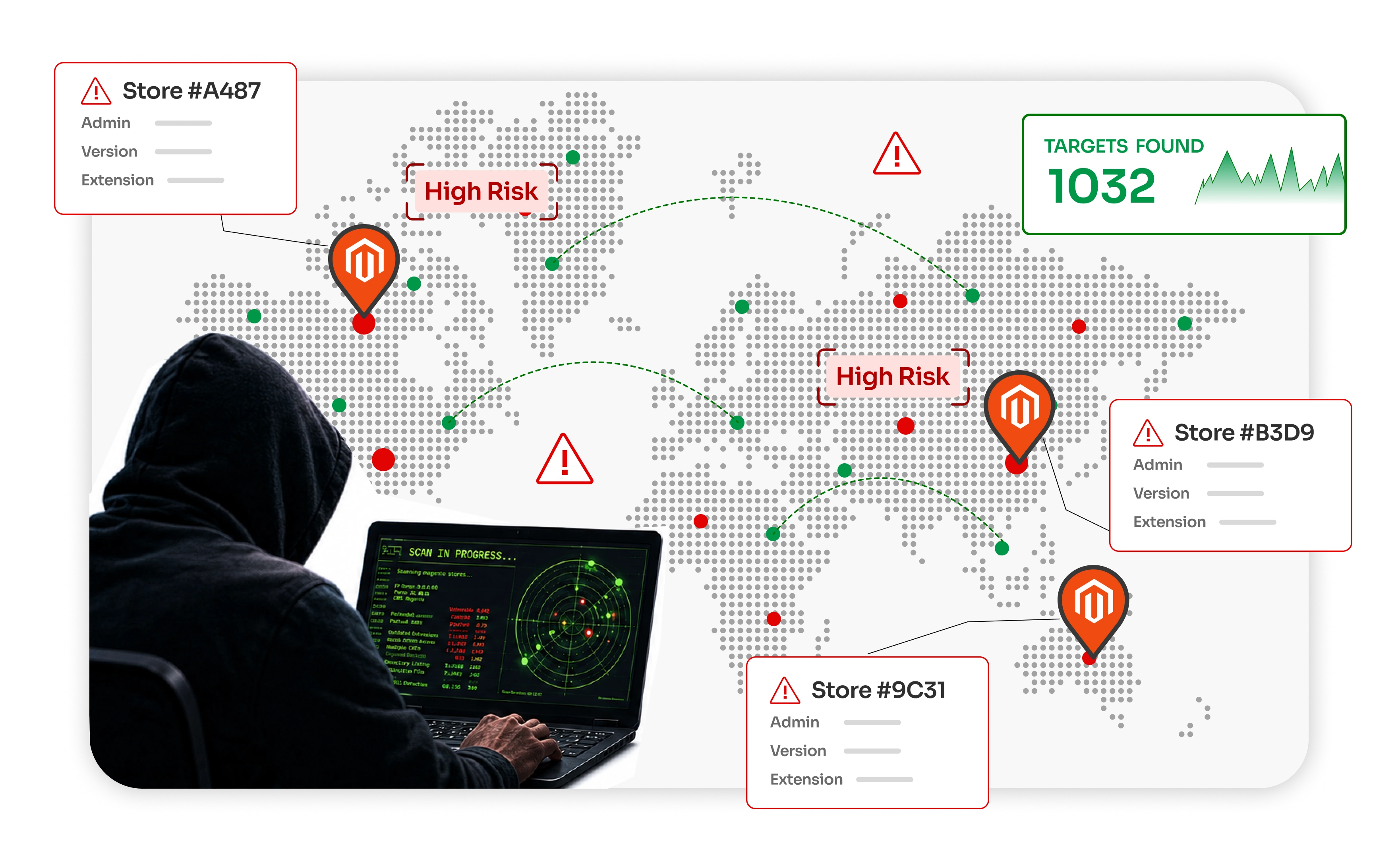
Why "Standard" Magento Security Advice Has Aged Badly
Three shifts between 2023 and 2026 broke a lot of older Magento security advice. Patch velocity collapsed: SessionReaper (CVE-2025-54236) drew 250+ exploitation attempts within 24 hours of disclosure, and 62% of stores were still unpatched six weeks later; PolyShell went from public disclosure to mass exploitation in two days. Client-side threats are now a compliance issue, not just a security one — PCI DSS 4.0.1 requirements 6.4.3 (payment-page script inventory and integrity) and 11.6.1 (tamper detection on payment pages and HTTP headers) became mandatory March 31, 2025. And the supply chain is now part of your attack surface: the FishPig compromise reached 200,000+ stores through one trusted vendor, and CosmicSting hit 5% of all Magento stores in 2024.
Against that backdrop, here are the eight attack scenarios that actually compromise Magento stores in 2026 — and what to do about each.
Scenario 1: The Race-the-Patch Attack
Adobe publishes a CVE. Within hours, an attacker diffs the patch, reverse-engineers the exploit, and feeds it into automated scanners sweeping every Magento IP range. They are not targeting you — they are targeting every store still running the unpatched version. SessionReaper followed exactly this pattern, and most stores lose because patching is operationally hard: a "quick patch" turns into a multi-week project the moment an extension breaks or staging drifts from production.
Defenses: Subscribe to Adobe PSIRT bulletins. Set a written SLA (Critical ≤72h, High ≤7d, Medium ≤30d). Keep staging functionally identical to production. Automate the deploy to one command. If you're on 2.4.4/2.4.5/2.4.6, the upgrade is already overdue — support ends in 2026.
Scenario 2: The Magecart Skimmer on Checkout
A sliver of JavaScript lands on your checkout — via a compromised extension, a hijacked third-party tag, a stored XSS, or a compromised admin. It reads card data as the customer types, before tokenization, and exfiltrates to an attacker-controlled domain disguised as analytics. Most skimmers run for months undetected. The dangerous half-truth: hosted payment fields (Stripe Elements, Adyen Drop-in) reduce risk but do not satisfy PCI DSS 4.0.1's new client-side requirements, which apply to the whole payment page.
Defenses: Inventory and authorize every script on the payment page (PCI 6.4.3). Deploy tamper detection — Jscrambler, Feroot, cside, Reflectiz, or self-built (PCI 11.6.1). Enforce a strict CSP with script-src allowlisted, plus SRI on external scripts. Treat tag manager additions like code changes. Use hosted fields anyway. Any one of these alone is bypassable; real defense is layered.
Scenario 3: The Brute-Force Bot on /admin
Attackers scan for default /admin URLs and stream leaked credential pairs from 10B+ password corpora against admin emails. They aren't guessing passwords — they're trying known ones. If 0.01% of your admins reused a breached password, they're in. Password strength advice misses the point because the attacker already has the password.
Defenses: Change the admin URL to something random (php bin/magento setup:config:set --backend-frontname="ops_9f3k2m"). Mandate 2FA platform-wide — native Magento 2FA covers admins (Google Authenticator, Duo, Authy, U2F) but stops there; if you need customer-side 2FA, SMS or email OTP, or role-based and IP-based bypass rules, Magento Two Factor Authentication by miniOrange extends the native module without replacing it. Restrict admin network access via IP allowlist or zero-trust proxy (Cloudflare Access, Tailscale, or Magento IP Restriction, which moves the rules inside the Magento admin instead of the infrastructure console). Set lockout to 5 failures / 30 minutes and session lifetime to 900 seconds. Audit admin users quarterly — forgotten contractor accounts are the most common foothold.
Scenario 4: The Supply-Chain Compromise
Instead of attacking your store, attackers attack an extension vendor whose code runs on thousands of stores. They push a malicious update via the vendor's release pipeline, or buy an abandoned extension and backdoor it. Every store that auto-updates inherits the compromise. FishPig reached 200,000+ stores this way. The defense problem: the malicious code arrives over a channel you trust.
Defenses: Vet vendors before installing — reputation, last update date, support model, published advisories. Prefer Adobe Commerce Marketplace over forks and forum repackages. Pin versions and review the changelog diff before updating. Remove unused extensions (composer remove vendor/module). Raise the bar for payment, checkout, and JavaScript-injecting extensions. Run file integrity monitoring (OSSEC, Wazuh, Sucuri).
Scenario 5: The Long-Lived API Token Leak
A token leaks somewhere it shouldn't — public GitHub repo, over-shared Postman collection, CI log, ex-employee's laptop. It's valid, broadly scoped, and never expires. The attacker now has authenticated API access and quietly exfiltrates customer data for weeks. This is one of the quietest and most expensive breach vectors in e-commerce, and rarely makes the news because victims don't notice until card brands flag fraud months later.
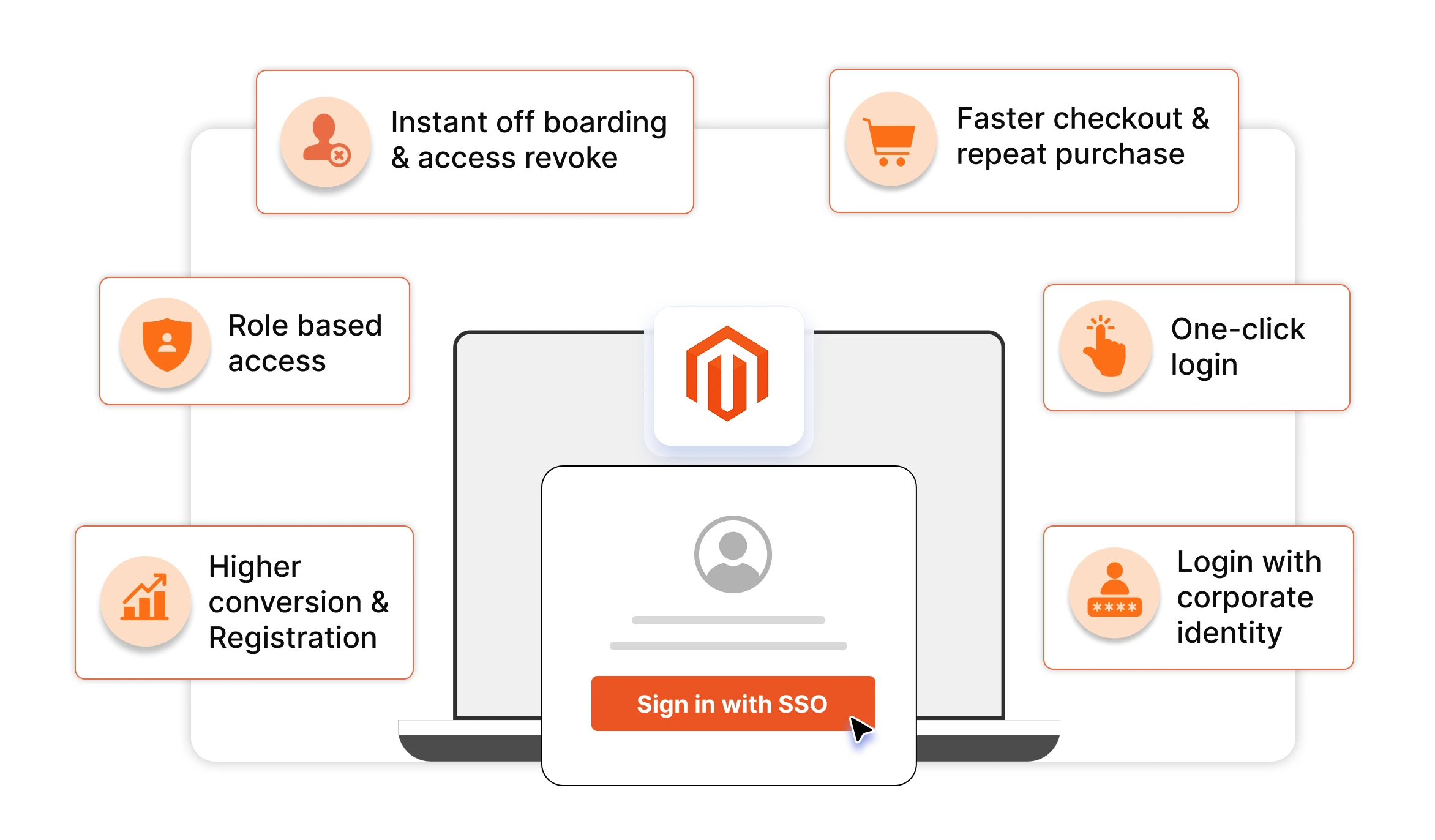
Defenses: Shorten token lifetimes to hours, not weeks (Stores → Settings → Configuration → Services → OAuth). Scope every integration narrowly when creating it in Stores → Settings → Integrations — never check "All." Rotate quarterly, and immediately when developers leave. Where possible, push the problem upstream: routing admin and integration auth through your corporate IdP via the Magento 2 SSO extension means token issuance, scope, and revocation are governed by IdP policy rather than by manual quarterly rotations that always slip. Baseline API metrics (request rate, error rate, response size) and alert on anomalies. Audit and disable unused anonymous endpoints.
Scenario 6: The PolyShell-Style Unauthenticated File Upload
A vulnerability lets attackers upload files without authenticating. PolyShell exploited Magento's anonymous guest cart functionality — it accepted base64-encoded file options without validating whether uploads were required, checking option IDs, or restricting extensions. Attackers dropped PHP webshells (json-shell.php, bypass.phtml, Unicode-obfuscated filenames) and got full code execution. PolyShell, CosmicSting, and SessionReaper all worked by chaining small primitives into RCE.
Defenses: Patch fast (Scenario 1). Configure your web server to refuse PHP execution from pub/media, pub/static, and any user-writable directory — the highest-leverage server change for limiting webshell impact. Run file integrity monitoring. Alert on suspicious filenames, unexpected files under pub/, and MD5 hashes from CVE advisories. Disable anonymous endpoints you don't use.
Scenario 7: The Quiet XSS-to-Admin Pivot
Attackers plant a stored XSS payload somewhere admins eventually view — a product review, CMS block, custom form. When an admin opens the page, the payload runs in their browser with their session, creating new admin users, modifying configuration, or injecting a Magecart skimmer. The boundary between "data shown to customers" and "data shown to admins" is thinner than it looks.
Defenses: Use Magento's escaping helpers (escapeHtml, escapeUrl, escapeJs, escapeHtmlAttr) everywhere — including admin views. Use the ORM, never raw SQL. Validate on input and escape on output. Set CSP headers blocking inline script execution. Run PHPStan/Psalm and Magento Coding Standard in CI. Hold custom modules to the same rigor as core — "it's just a small module" is the origin story of most stored XSS.
Scenario 8: The Insider Mistake
No attacker required — the store breaches itself. A developer commits a database dump to a public repo. An ex-employee keeps admin access for six months. A contractor installs a "free" extension from a forum. A staging environment with real data gets indexed by Google. It doesn't feel like a security incident in the moment; it feels like a process failure. The data still leaks.
Defenses: Offboarding checklists with no exceptions — disable account, rotate tokens, revoke VPN/SSH, audit recent activity. Use RBAC properly: 2-3 people max in "Administrators," everyone else in narrower roles (Content Editor, Catalog Manager, Customer Service, Developer, Finance). Enable admin action logging and forward centrally. Treat staging like production — same authentication, same secrets handling, same robots.txt rules. Run quarterly 20-minute training sessions on phishing patterns aimed at Magento admins.
Closing Thought
The defining feature of Magento security in 2026 is asymmetry. The attacker scans the entire internet in hours; the defender patches one store at a time. The attacker reuses the same exploit across thousands of victims; the defender has to think about their own store, their own extensions, their own integrations. The attacker only has to be right once; the defender has to be right continuously.
The way to win this is not to outspend the attacker. It is to make your store stop being worth the attacker's effort. Patch faster than the average store. Lock down the admin tighter than the average store. Govern your scripts more strictly than the average store. Monitor more continuously than the average store. Magento attackers in 2026 are running a numbers game, not a targeted hunt — and a store that is in the top 10% of patched, hardened, monitored stores rarely shows up on their list at all.
Work through the eight scenarios above before the next SessionReaper lands; what matters is whether your store is on the 62% that gets hit or the 38% that does not.
Leave a Comment