

A new website launches with none of the signals search engines use to rank pages. There is no crawl history, no links pointing to the domain, and no record of whether visitors found anything useful. Every ranking factor that matters is one built over time, and on launch day you have none of them.
That is why most new sites sit invisible for months, and why advice promising fast results usually disappoints. Authority cannot be shortcut. What can be controlled is everything else: how quickly pages get indexed, whether they target queries a new site can realistically win, and whether avoidable technical mistakes are keeping content out of search results entirely.
This guide covers what actually helps rank a new WordPress website in 2026, from website setup and indexing through keyword research, technical SEO, internal linking, backlinks, and the growing question of visibility inside AI-generated search results.
Why New WordPress Websites Take Time to Rank
New websites rank slowly because search engines have no history to evaluate, not because something is broken.
Google states this directly in its crawling and indexing documentation: the most common reason a site is not indexed is that it is simply too new. That single fact should reset expectations for anyone watching an empty dashboard weeks after launch.
Five factors work against a new domain at the same time:
- Low authority. Search engines weigh the accumulated trust signals a domain has earned. A new domain has none, so it competes at a structural disadvantage against established sites.
- Limited content. Ten published pages give search engines very little basis for understanding a site's subject matter. Topic coverage is how a search engine decides what a website is genuinely about.
- Indexing delays. Crawling and indexing are separate events. A page can be visited and still not added to the index, which appears in reporting as "Crawled, currently not indexed."
- No backlinks. External links remain the clearest way authority transfers between websites. A site nobody links to has no borrowed credibility to draw on.
- Established competition. Pages already ranking for a target term have years of accumulated signals behind them. Matching them on content quality alone rarely closes that gap quickly.
The practical implication for website ranking is that the first several months should be spent building the conditions for rankings rather than chasing competitive terms too early.
Set Up Your Website Correctly From Day One
Correct website setup prevents the problems that become expensive to fix once a site has published hundreds of pages.
Restructuring a live site means redirects, lost link value, and re-crawling. Getting the foundations right before launch costs nothing.
- Site structure. Keep every important page within three clicks of the homepage. Group content into logical parent sections rather than a flat collection of posts. A shallow, organized hierarchy helps both search engines and readers understand which pages matter most.
- SEO-friendly URLs. Configure permalinks to use the post name structure before publishing anything. URLs should be short, lowercase, hyphenated, and descriptive, with stop words and dates removed. Any URL changed later becomes a redirect that must be maintained permanently.
- HTTPS. Serve the entire site over TLS with a single canonical version. Choose either the www or non-www form and permanently redirect the other. Mixed content warnings and duplicate protocol versions split ranking signals and undermine visitor trust.
- Mobile responsiveness. Search engines index the mobile version of a page. If a theme renders differently or hides content on smaller screens, that hidden content is effectively what gets evaluated.
- Navigation. Menus should be crawlable HTML links. Navigation built entirely in JavaScript, or hidden behind interactive elements, can leave entire sections undiscovered.
Connect Google Search Console and Submit Your Sitemap
Google Search Console is the only place to see how Google actually treats a website, and it should be connected before the first page goes live.
- Verify the property. Domain verification through a DNS TXT record is the stronger option because it covers every subdomain and both protocol versions at once. Verifying by URL prefix instead requires verifying each variant separately, including www and non-www
- Submit the sitemap. Under Indexing, then Sitemaps, submit the sitemap URL generated by the site's SEO plugin. One caution is worth internalizing: Google states that a sitemap helps it learn about a site's pages but does not guarantee indexing and does not improve ranking. It is a discovery aid and nothing more.
- Use URL Inspection. Entering any URL shows whether it is indexed, when it was last crawled, which canonical version Google selected, and whether the rendered page matches expectations. This is the fastest way to diagnose a single page that is not appearing in search.
- Read the indexing reports. The Pages report groups URLs by status and gives a reason for every exclusion. Three statuses matter most on a new site. Discovered, currently not indexed, means Google knows the URL exists but has not crawled it yet, usually a sign that internal linking to that page is weak. Crawled, currently not indexed, means the page was visited and not kept, typically a content quality or duplication signal. "Duplicate, Google chose a different canonical" means another URL is being treated as the original, which points to canonical tags, URL parameters, or near-identical pages.
Reviewing these reports weekly during the first three months teaches more about a website than any automated audit.
Get Your Pages Indexed Faster
Faster website indexing comes from making pages easy to discover and worth keeping, not from repeatedly requesting indexing.
- Request indexing selectively. The URL Inspection tool includes a Request Indexing action. Use it for genuinely new or substantially updated pages. Applying it to every URL does not increase priority, and Google offers no guarantee on timing.
- Keep sitemap timestamps accurate. Google specifically advises updating the last modification date when content changes. Plugins that rewrite that date on every page load train search engines to ignore it.
- Link new pages internally on publication. A new page linked from an existing indexed page is discovered during the next crawl of that page. A page linked from nowhere waits for the sitemap to be processed.
- Eliminate orphan pages. An orphan page has no internal links pointing to it. These should be audited regularly, because they are the most common reason a published page is never discovered.
- Reduce crawl waste. Tag archives, paginated author pages, attachment pages, and internal search results consume crawl attention that should be going to real content. Apply noindex to anything with no search value.
- Create external discovery paths. A link from any already-crawled website, including business listings and social profiles, gives search engines a second route to new content.
Perform Keyword Research Before Creating Content
Keyword research for a new website means identifying queries that can be won now, not queries the site hopes to win eventually.
Ranking difficulty scales with the authority of the pages already ranking, so the winnable set for a new domain is narrower and more specific than most teams expect.
- Prioritize long-tail keywords. Four and five word phrases with clear intent carry less competition and convert better. A specific phrase is a far more realistic target than a broad head term.
- Read the search results before committing. Search the term and examine what actually ranks. If the first page consists entirely of major publishers and long-established domains, that term is not a first-year target regardless of what a difficulty score suggests.
- Confirm intent alignment. If the ranking results are product pages and the plan is to publish a guide, the query has been misread. Match the format that is already winning.
- Analyze realistic competitors. Study what smaller sites in the same space rank for rather than the market leaders. Sites at a comparable authority level show the achievable ceiling.
- Cluster before writing. Group related keywords into one comprehensive article rather than publishing a thin page for each variation. A single thorough page usually outranks several shallow ones targeting near-identical terms.
A workable rule for the first year is to target terms where at least one first-page result comes from a site of similar size.
Build Topical Authority From the Start
Topical authority is the accumulated evidence that a website covers a subject comprehensively, and it is one of the few advantages a small site can build deliberately.
Search engines evaluate websites at the topic level, not only page by page. A site with fifteen connected articles on one subject demonstrates a depth that fifteen unconnected articles across fifteen subjects cannot.
- Choose one narrow territory first. Select a subject that can be covered exhaustively rather than three that can only be covered partially. Breadth comes later.
- Build pillar and cluster structures. A pillar page covers the broad topic. Cluster pages cover individual subtopics in depth. Every cluster page links up to the pillar, and the pillar links down to each cluster.
- Cover the full question set. For any topic, readers ask definitional questions, comparison questions, cost questions, and troubleshooting questions. Comprehensive coverage means answering all four categories.
- Interlink the cluster tightly. The links between related articles are what make the group readable as a group rather than as isolated pages.
- Expand only when complete. Move to an adjacent topic once the first cluster is finished and has started earning impressions.
Create High-Quality Content That Matches Search Intent
Content optimization means satisfying the query completely, in the format the searcher expected, more clearly than the pages currently ranking.
Search intent falls into four categories, and mismatching it is the most common reason a well-written page fails to rank:
| Intent type | The query looks like | What the page must be |
|---|---|---|
| Informational | "what is," "how to," "why" | An explanation or guide |
| Commercial | "best," "top," "vs," "review" | A comparison with real evaluation criteria |
| Transactional | "buy," "pricing," "download" | A product, pricing, or signup page |
| Navigational | A brand or product name | The specific page being sought |
Beyond intent, four qualities separate content that ranks from content that merely exists.
- Answer first. Place the direct answer in the first sentence beneath each heading, then expand. Readers and search features both take the opening line.
- Contribute something original. A synthesis of the top five existing results gives search engines no reason to rank it above them. Original data, a worked example, a documented process, or a clear point of view is the differentiator.
- Match depth to the query. Some questions deserve four hundred words. Padding a simple answer to two thousand words is a liability in 2026, not an advantage.
- Show who wrote it. A named author with real credentials, a publication date, and cited external sources are the trust signals that both ranking systems and AI answer engines evaluate.
Improve Technical SEO
Technical SEO removes the obstacles between content and the search index. It rarely creates rankings by itself, but it can prevent them entirely.
The technical SEO checklist below is ordered by severity. Each item either blocks indexing or wastes the crawl attention a new site can least afford to lose.
Fix Crawlability Issues
Crawlability issues are the highest-priority technical problems because they stop everything downstream from working.
Check the robots.txt file first and confirm it is not disallowing directories containing content, CSS, or JavaScript, since search engines need to render pages the way a browser does. Verify that no site-wide noindex directive is active, including the discourage search engines setting and any plugin applying noindex globally, which is the single most common cause of a website that never appears at all. Fix internal broken links, which waste crawl budget and break the paths crawlers follow between pages. Resolve redirect chains by pointing every redirect directly at its final destination rather than through intermediate URLs. Then work the crawl errors report down to zero and keep it there.
Configure XML Sitemaps
An XML sitemap is a machine-readable list of the URLs a site wants indexed, and it speeds discovery on a website with few inbound links.
Include only canonical, indexable URLs that return a 200 status code. Exclude anything marked noindex, anything redirected, and low-value archive pages. Keep last modification dates accurate so they remain a usable signal. Submit the sitemap in Google Search Console and reference it in robots.txt so other search engines find it as well. A single sitemap file is sufficient for sites under a few hundred pages, while larger sites benefit from splitting by content type so indexing reports can be diagnosed section by section.
Add Schema Markup
Schema markup is structured data that tells search engines what content is, rather than leaving them to infer it.
Four types cover most new websites: Organization on the homepage, Article on blog posts, BreadcrumbList for navigation paths, and FAQPage wherever a genuine question and answer block exists. Structured data can qualify pages for rich results in search, and it makes content easier for AI systems to parse and attribute correctly. Validate every implementation with Google's Rich Results Test, and never mark up content that is not visible on the page itself.
Build a Strong Internal Linking Structure
Internal linking is the most cost-effective ranking lever available to a new website because it is entirely within the site owner's control.
Internal links perform two jobs. They give crawlers paths to follow, which drives discovery and indexing, and they distribute authority, so a page that earns an external link can pass part of that value to the pages it links to.
An effective internal linking strategy for a new site follows five rules. Link every new page to at least three existing pages, and add links from at least two existing pages back to it, on the day of publication rather than during a quarterly audit. Use descriptive anchor text that describes the destination, since a keyword-bearing anchor communicates what the target page covers while generic anchors communicate nothing. Link the first natural occurrence of a concept rather than every mention. Direct more internal links toward the pages that matter most commercially. Finally, audit for orphan pages monthly, because any page with zero inbound internal links is a page search engines are being asked to find by accident.
Improve Website Speed and Core Web Vitals
Website speed optimization affects rankings as a tie-breaker between comparable pages and affects conversions directly, and new sites tend to fail on the same small set of issues.
Google measures three Core Web Vitals, each assessed against real visitor data at the 75th percentile over a rolling 28-day window:
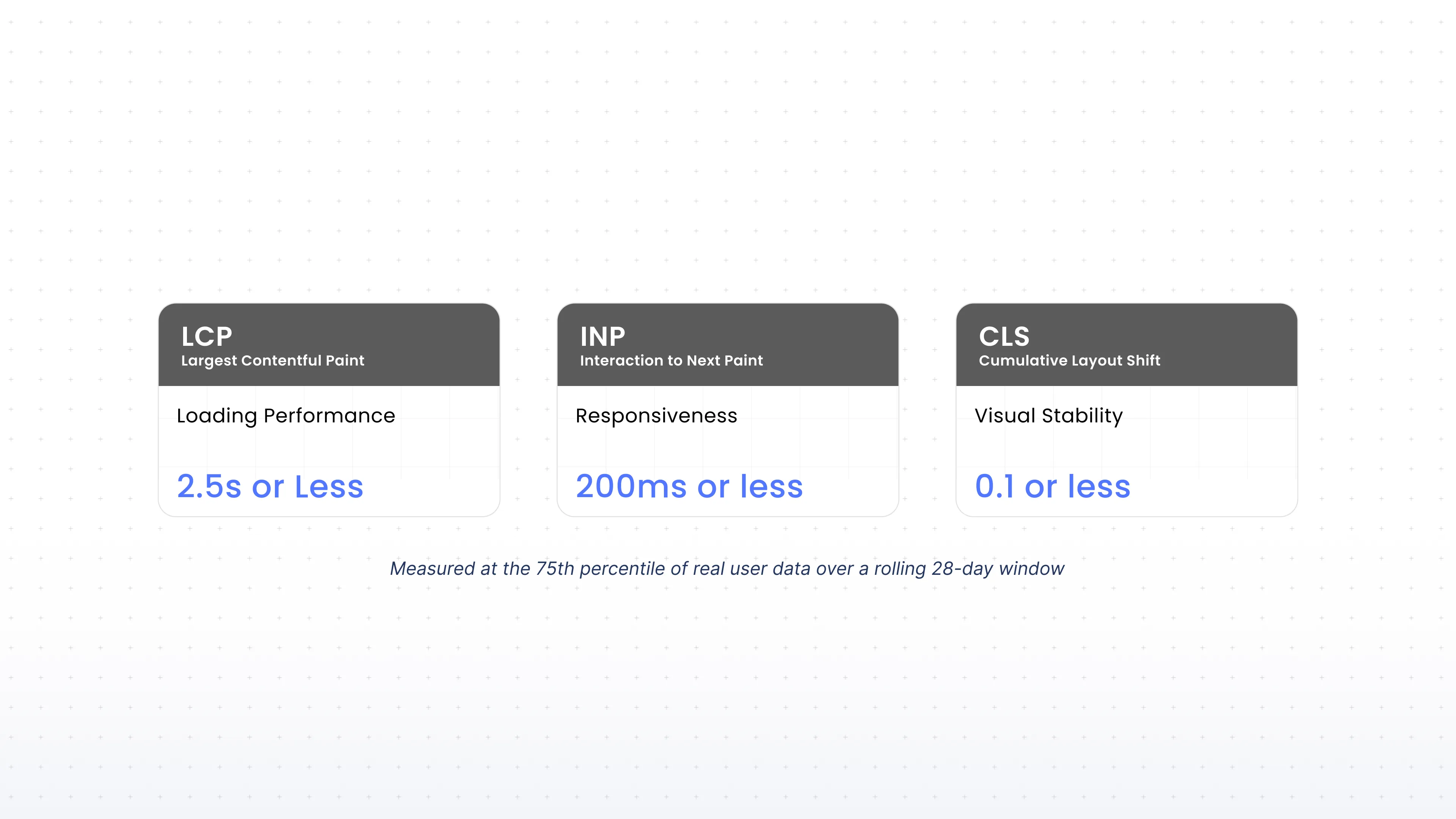
Interaction to Next Paint replaced First Input Delay as the responsiveness metric in March 2024, and it is harder to pass because it accounts for every interaction during a visit rather than only the first one.
Five fixes address most website speed problems. Optimize images by serving modern formats, sizing them correctly rather than scaling them in the browser, lazy-loading anything below the fold, and setting explicit width and height attributes, since missing dimensions are the leading cause of layout shift. Enable page caching alongside a content delivery network, which resolves most loading problems on shared hosting. Audit JavaScript, because responsiveness failures are almost always caused by long-running scripts, and remove any plugin not actively in use. Preload the fonts used above the fold. Test on mobile first, since the thresholds are identical across devices but mobile conditions are considerably harder to pass.
Use real-world field data to determine whether a site passes, and lab tools to diagnose why it does not. Allow several weeks after any fix before judging the result, because the measurement window covers 28 days.
Build Quality Backlinks to Increase Authority
Backlinks remain the clearest external signal of trust, and a new website needs a small number of genuinely relevant links far more than a large number of weak ones.
Several link building methods are realistic for a site with no established reputation. Contributing expert commentary through journalist request platforms earns attribution in published articles and is the most reliable early source that does not require an existing audience. Guest contributions to publications the target audience already reads work well when selected for relevance and genuine readership rather than domain metrics. Original research, even a modest survey or an analysis of internal data, gives other writers a reason to cite the site. Curated industry directories and professional communities provide legitimate listings. Unlinked brand mentions can often be converted into links with a simple request. Partners, suppliers, and customers are the easiest links available and the ones most frequently overlooked.
Certain practices should be avoided entirely: purchased links, private blog networks, mass directory submissions, and reciprocal link exchanges. These violate Google's spam policies, and the consequences fall hardest on new domains with no established trust to offset them.
Create Link-Worthy Content
Link-worthy content gives another writer a specific reason to cite it, which is a narrower requirement than simply being useful.
Four formats reliably attract backlinks: original research and survey data, definitive resources that become the standard reference for a subtopic, free tools and calculators, and clearly presented statistics pages that others can quote with attribution. What these share is that each gives someone else something concrete to point at. A well-written explainer that duplicates twenty existing explainers serves readers but attracts no links.
Optimize for AI Search and Google AI Overviews
AI search optimization is about being retrievable and quotable, and the underlying work is largely the SEO work already described above.
Google added dedicated generative AI performance reports to Search Console on June 3, 2026, giving site owners a separate view of impressions from AI Overviews, AI Mode, and generative features in Discover. The reports rolled out to a subset of websites and show impressions rather than clicks, so they measure visibility rather than traffic value.
Six practices improve the chances of being cited in AI-generated answers. Write self-contained passages, because AI systems extract discrete claims and a section that states its answer fully within the first few sentences can be lifted and attributed, while one that builds toward a conclusion over several paragraphs cannot. Use question-shaped headings that match how people actually phrase queries. Maintain an FAQ block, since direct question and answer pairs are among the most extractable formats on any page. Implement structured data so content is machine-parsable and the publishing entity is identifiable. Display sources clearly through named authors, publication dates, and cited external references. Keep entity details consistent, using the same organization name and description across the website, business profiles, and directory listings.
The honest summary is that there is no separate AI channel to optimize for. Crawlable, well-structured, clearly sourced content that ranks in traditional search is the content that gets cited in AI results.
Search Visibility Best Practices for 2026
These SEO best practices are the ones that survived the shift toward AI-assisted search, and they are what a new website should organize around.
- Content freshness where it matters. Update pages when the underlying facts change, and record the update honestly. Rewriting dates on unchanged content is not a freshness strategy.
- Depth over volume. Fifteen thorough articles within one topic will outperform sixty shallow ones spread across six topics.
- Visible expertise. Named authors with real credentials, specific examples, and cited sources. Anonymous, generic content is the profile most affected by recent search quality systems.
- User experience as a genuine signal. Fast, stable, readable pages that are not interrupted by intrusive interstitials.
- Measure visibility, not only clicks. With AI-generated summaries answering some queries directly, impressions and citations matter alongside sessions. Track both.
- Consistency over campaigns. Search performance compounds. A site publishing steadily across twelve months will outperform one that published forty pages in a single month and then stopped.
Conclusion
Knowing how to rank a new website comes down to sequence. Get the technical foundation right before publishing, because retrofitting site structure, URLs, and HTTPS is far more expensive than configuring them correctly at the start. Connect Google Search Console immediately, since the data only begins accumulating after verification. Choose one narrow topic and cover it completely, targeting long-tail queries where comparable sites already rank. Link every new page into the existing structure on the day it is published. Keep the website fast, secure, and fully crawlable. Earn a small number of relevant backlinks through original work and genuine contribution rather than volume.
None of this delivers rankings in the first week. Google itself confirms that the most common reason a new site is not indexed is that it is new. What this sequence achieves is ensuring that when authority does begin to accumulate, nothing on the website's side is standing in its way.
FAQs
1. How can I rank a new WordPress website faster?
Focus on removing delays rather than looking for shortcuts. Connect Google Search Console and submit a sitemap before launch, resolve crawlability issues, target long-tail keywords with realistic competition, build a strong internal linking structure, and publish consistently within a single topic. These steps compress the time to first rankings, but they do not remove the initial waiting period entirely.
2. Why is my new WordPress website not ranking on Google?
The most likely reason is that the website is too new for Google to have evaluated it, which Google states directly in its crawling and indexing documentation. Beyond that, check for a site-wide noindex directive, a blocking rule in robots.txt, orphan pages with no internal links, and content targeting keywords well above the site's current authority level.
3. How long does it take for a new website to rank on Google?
Indexing usually occurs within days to a few weeks after submission, while meaningful rankings for competitive terms typically take several months. Google does not publish timelines and explicitly declines to guarantee when or whether a URL will be crawled or indexed. Long-tail terms tend to move first, competitive terms considerably later.
4. How do I get my new website indexed by Google faster?
Verify the property in Google Search Console, submit an accurate XML sitemap, and use URL Inspection to request indexing for genuinely new pages. Then make discovery straightforward: link every page internally, eliminate orphan pages, remove crawl waste from tag and archive pages, and earn at least one external link so search engines have a second route to the content.
5. What are the most important ranking factors for a new website in 2026?
Crawlability and indexability come first, because nothing else matters if pages are not in the index. After that: content matching search intent and answering completely, topical depth within a focused subject area, a strong internal linking structure, Core Web Vitals within Google's thresholds, and a small number of relevant backlinks. Visible expertise signals such as named authors and cited sources have grown in importance as AI-generated answers depend on source credibility.

Leave a Comment