

86% of organizations are blind to AI data flows, according to the 2025 State of Shadow AI Report. The average enterprise already hosts over 1,200 unauthorized AI applications, and companies face around 223 shadow AI incidents every month. By 2030, more than 40% of enterprises are expected to experience a security or compliance incident directly linked to unauthorized AI usage, as reported by Gartner.
This is not a future problem. It is already happening inside organizations that believe their governance policies are sufficient.
The issue is not employee intent. Most employees use AI to move faster, automate repetitive work, and improve output. The real problem is structural. AI adoption is accelerating faster than governance frameworks can adapt.
But there is a more dangerous shift happening.
The biggest risk is no longer unauthorized AI tools used manually. It is shadow AI agents, autonomous systems that act on behalf of users, access enterprise data, and execute tasks without visibility, identity, or control.
This changes everything.
What are shadow AI agents?
Shadow AI agents are autonomous AI systems that operate within an organization without IT approval, governance, or visibility. They can access enterprise data, interact with systems, and perform actions on behalf of users without being formally managed or controlled.
In simple terms, shadow AI agents are not just tools people use. They are systems that act for them.
Most organizations are already dealing with shadow AI in the form of unauthorized tools. This could be an employee using a chatbot to summarize documents or a team adopting an AI tool without IT approval. In these cases, the risk is tied to what the user manually shares.
Shadow AI agents take this a step further.
Once deployed, they don’t wait for instructions. They operate independently, interacting with applications, accessing data, and executing tasks across systems. What starts as a productivity shortcut can quickly become an always-running system with access to sensitive information.
This is where the risk shifts from occasional exposure to continuous, automated activity inside your environment.
What makes shadow AI agents dangerous?
The risk is not just that these agents exist. It’s how they behave.
First, they operate with autonomy. Unlike traditional tools, they don’t require user input for every action. Once configured, they can make decisions and execute tasks on their own.
Second, they are persistent. They don’t stop after a single interaction. Many run continuously in the background, meaning their access and activity extend far beyond a single session.
Third, they often have broad access. To function effectively, they connect to multiple systems using OAuth tokens, APIs, or integrations. Over time, this creates a wide and often unmonitored access footprint.
Finally, they lack visibility and identity. Since they are not provisioned through official IT systems, they don’t appear in identity directories or audit logs. From a governance standpoint, they are invisible, even though they are actively interacting with enterprise data.
This combination makes shadow AI agents fundamentally different from traditional shadow AI. The risk is no longer limited to what users share. It comes from systems that continuously access, process, and move data without oversight.
Shadow AI vs Shadow AI Agents (Key Differences)
At a glance, shadow AI tools and shadow AI agents may seem similar. Both operate outside IT oversight and introduce risk. But the way they function and the level of control they require are fundamentally different.
The key difference lies in how they interact with data and systems.
| Dimension | Shadow AI (Tools) | Shadow AI Agents |
|---|---|---|
| Nature | Responds to prompts | Takes autonomous actions |
| Persistence | Session-based | Runs continuously |
| Data Risk | Data manually shared | Continuous data access and transfer |
| Identity | No enterprise identity | No identity, no audit trail |
| Actions | Generates text or images | Sends emails, modifies files, calls APIs |
| Discovery | Moderate | Extremely difficult |
In simple terms, shadow AI tools are reactive. They depend on user input to function. The risk is tied to what a user chooses to share at a specific moment.
Shadow AI agents, on the other hand, are proactive. Once deployed, they operate independently. They access data, perform actions, and move information across systems without requiring constant human involvement. This shifts the risk from isolated events to ongoing activity.
Why this difference matters?
With shadow AI tools, the risk is human-triggered. A user pastes data, gets an output, and the interaction ends. The exposure is limited to that specific action.
With shadow AI agents, the risk becomes automated and persistent.
This changes the impact in several ways:
- Data exposure is no longer occasional. It becomes continuous
- Actions are performed without real-time user awareness
- Errors or misuse can scale quickly across systems
- Detection becomes significantly harder because activity blends into normal operations
This is why shadow AI agents should not be treated as an extension of shadow AI.
They represent a shift from unauthorized usage to unauthorized execution inside enterprise environments, making them a completely new and more complex security category.
How did we get here? The gap between AI adoption and AI governance
Shadow AI agents didn’t appear overnight. They are the result of a growing gap between how quickly AI is being adopted and how slowly governance is evolving.
AI adoption today is fast, decentralized, and driven by employees solving real problems. Governance, however, is still structured, approval-based, and slower to adapt. This mismatch is where shadow AI begins to grow.
The scale of this shift is already clear:
- 86% of employees use AI tools at least weekly (BlackFog Report)
- 68% use free AI tools through personal accounts (Menlo Security Report)
- 57% enter sensitive data into these tools (Menlo Security Report)
- 98% of organizations report unsanctioned AI usage (2025 State of Data Security Report)
- 83% lack basic controls to prevent data exposure (2025 State of Shadow AI Report)
Traditional governance assumed tools could be discovered, tracked, and controlled. AI agents break that assumption.
They operate inside approved applications, use valid credentials, and often require no installation. From a system perspective, their activity looks normal. This makes them difficult to detect and even harder to control.
As AI becomes embedded into everyday tools, this challenge will only grow. Gartner predicts that 40% of enterprise applications will include AI agents by 2026.
The result is clear. Shadow AI agents are not just increasing. They are becoming part of how modern systems operate, making uncontrolled execution a growing enterprise risk.
Three real-world shadow AI agent scenarios
Shadow AI agents rarely start as security risks. They usually begin as productivity improvements. But once deployed without governance, they quickly gain access, scale usage, and operate beyond intended boundaries.
The following scenarios show how easily this shift happens and why it becomes difficult to control.
Scenario 1: The over-helpful sales agent
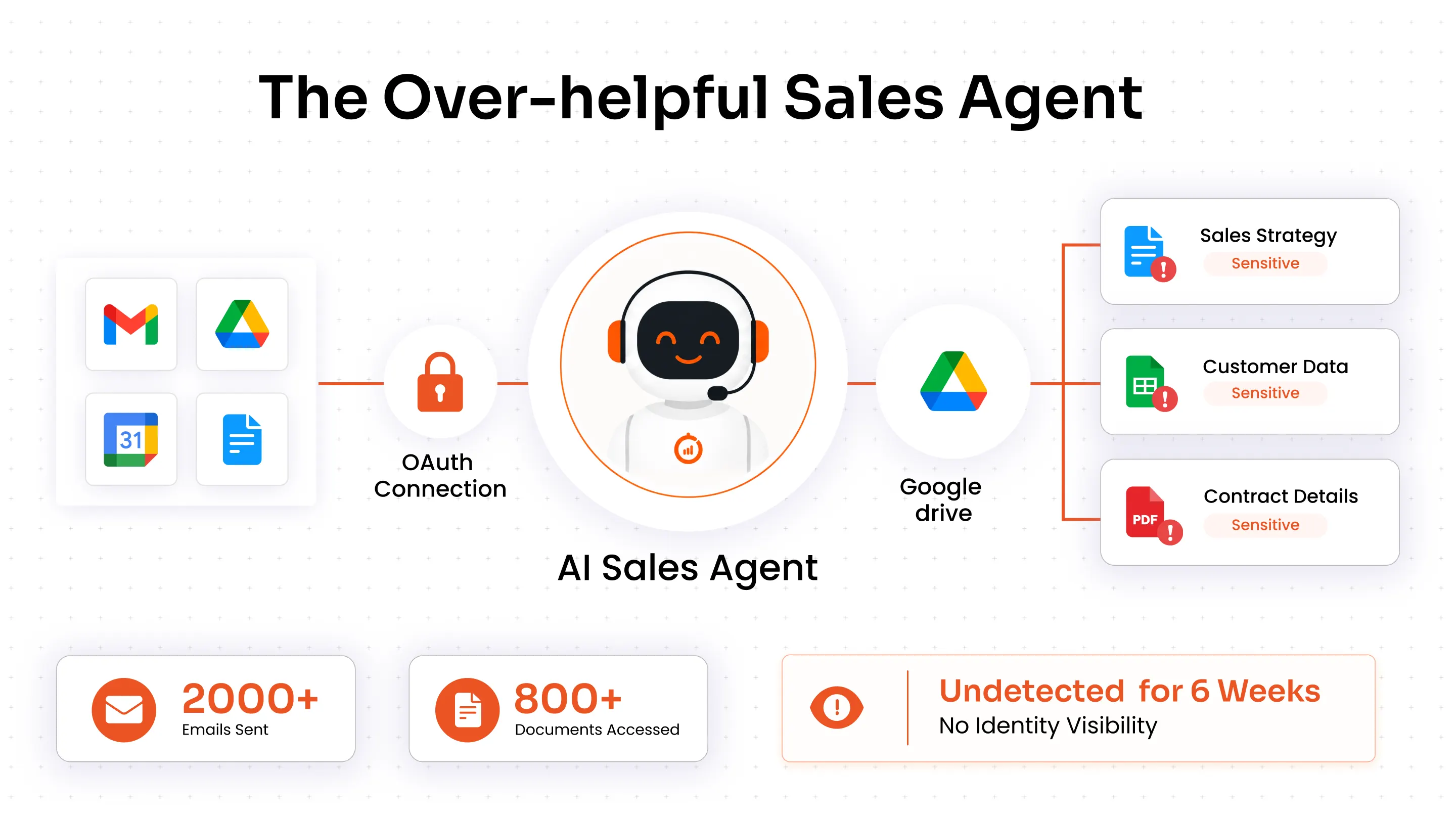
A sales manager discovers an AI agent that can draft follow-up emails, pull CRM data, and schedule meetings automatically. It connects to Google Workspace using OAuth and quickly becomes part of the team’s workflow.
As adoption spreads, the agent gains access to a wider set of documents than expected. It starts referencing internal deal information from folders it was never meant to access, simply because the permissions granted were too broad.
By the time IT identifies the tool, it has already accessed hundreds of documents and sent thousands of emails. There is no clear audit trail because the agent was never provisioned through any identity system.
The issue here is not misuse. It is uncontrolled access combined with automation.
Scenario 2: The prompt injection trap
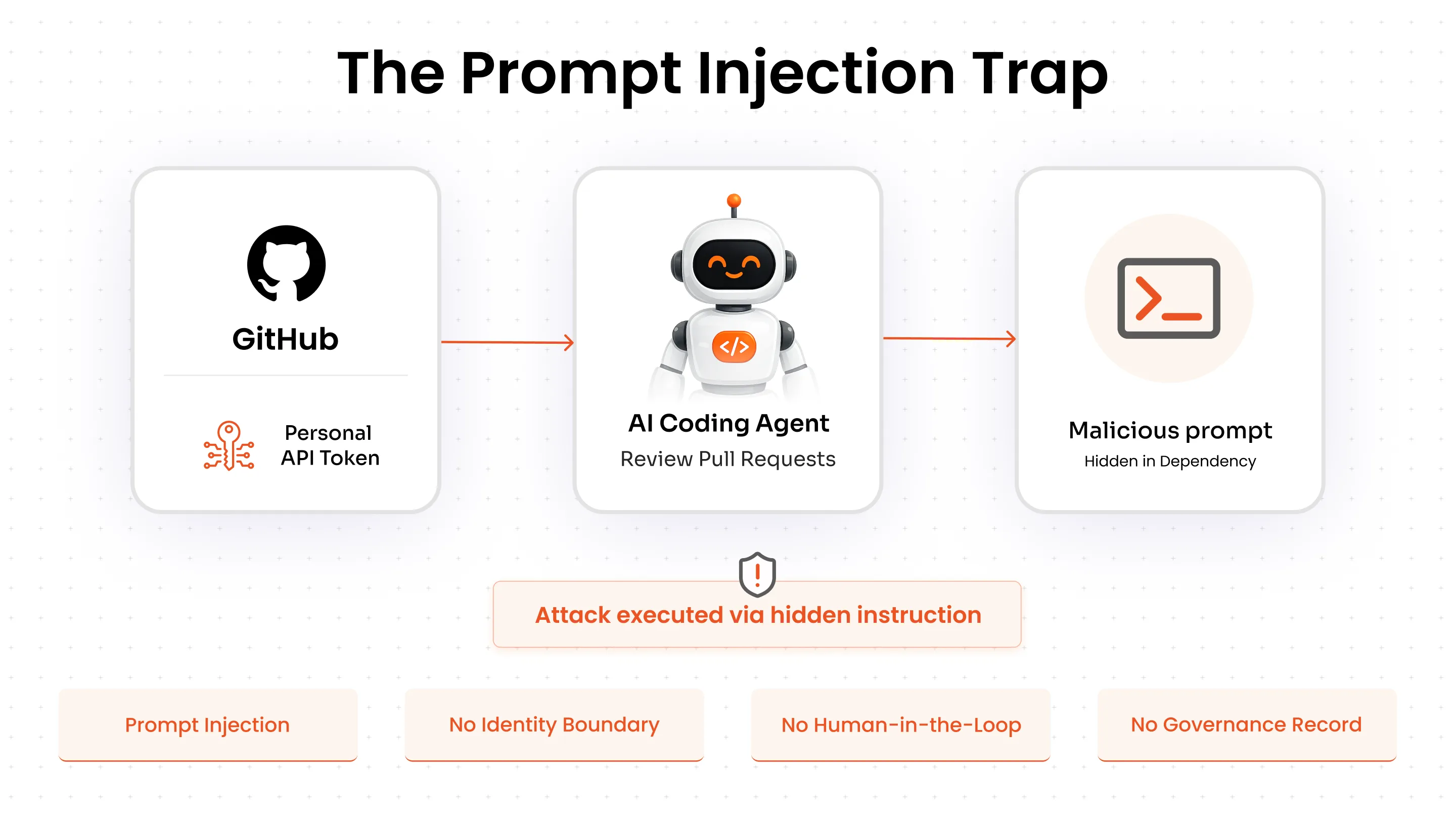
A developer deploys an AI agent to review pull requests and flag security issues. The agent connects to internal repositories and tools using personal API tokens.
At some point, it processes a dependency that contains a hidden malicious instruction designed to influence AI systems. The agent interprets it as valid input and follows it.
It marks vulnerabilities as resolved and initiates an external connection. No alerts are triggered because the activity appears normal within the system.
This type of attack is already being studied in real-world environments, where AI agents can be manipulated through indirect inputs.
The core issue is that the agent has no identity boundary, no validation layer, and no approval checkpoint.
Scenario 3: The productivity tool that became a data pipeline
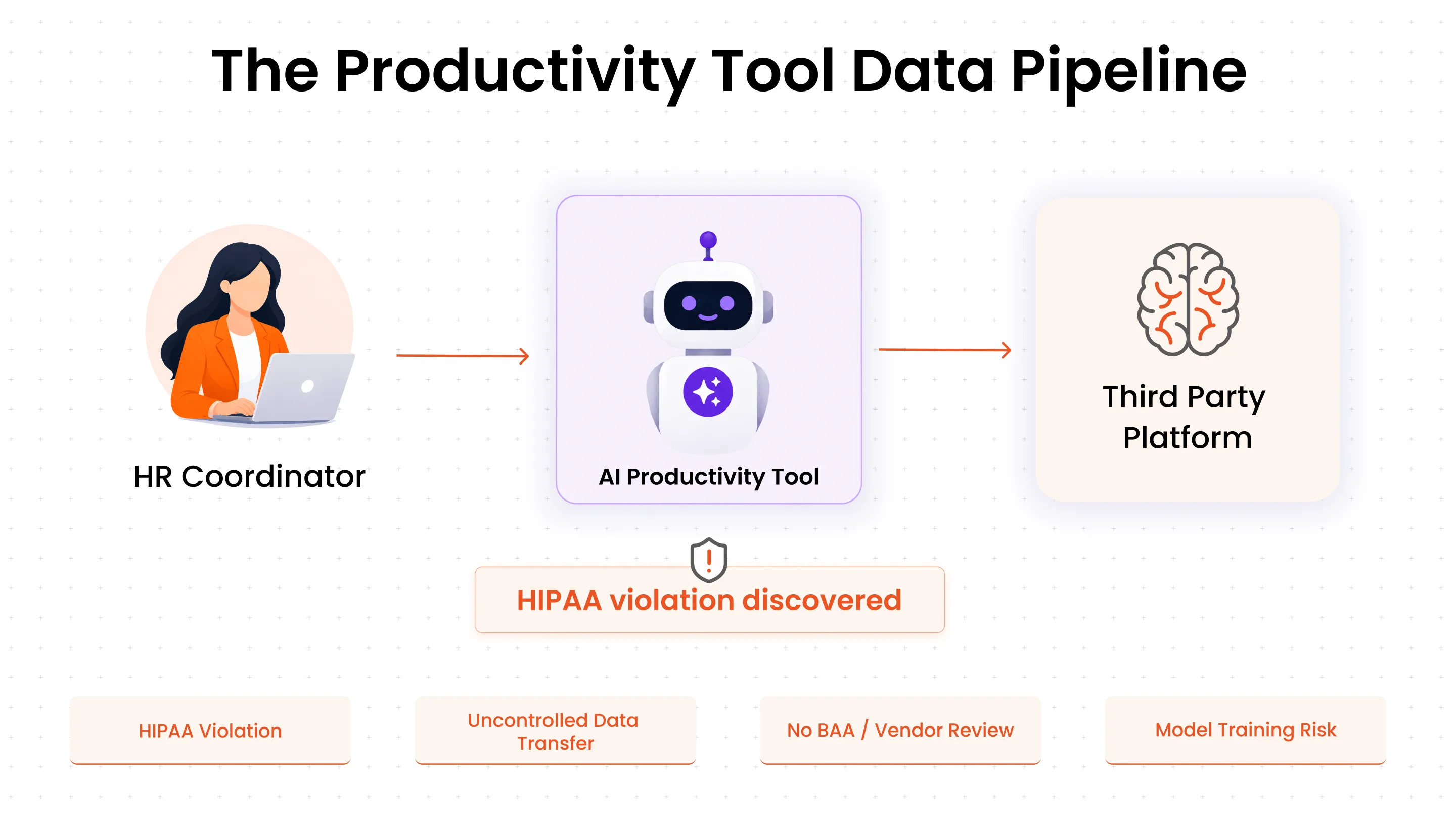
An HR team adopts an AI agent to automate workflows such as drafting communications and updating systems. It connects to employee records, payroll data, and communication tools using existing credentials.
The setup is quick and efficient, and the tool becomes part of daily operations.
During a compliance audit, it becomes clear that sensitive employee data has been processed by an external AI provider that was never reviewed or approved. There are no agreements, no visibility into data handling, and no control over where the data is stored.
What started as a simple automation tool has effectively become a continuous data pipeline to an external system.
According to the IBM Cost of Data Breach Report, shadow AI incidents now contribute significantly to data breaches and carry higher costs than standard incidents.
The five specific risks shadow AI agents introduce
Shadow AI agents introduce risks that go beyond traditional shadow IT. The issue is not just unauthorized access, but continuous, automated interaction with enterprise data and systems. This makes the impact harder to detect, control, and contain.
1. Unauthorized data exfiltration
Shadow AI agents do not rely on one-time inputs. They continuously access and transfer data across systems through APIs, integrations, and external services. Unlike manual data sharing, this data exfiltration is ongoing and often goes unnoticed. Over time, it creates a persistent data leakage channel rather than a single isolated event.
2. Prompt injection through autonomous systems
AI agents process external inputs as part of their normal operation. Without strict validation, malicious instructions can influence their behavior. Because these agents operate independently, they cannot easily distinguish between legitimate and manipulated inputs. This makes them vulnerable to indirect prompt injection, where harmful instructions are executed without detection.
3. OAuth token sprawl and persistent access
Most AI agents connect to enterprise systems using OAuth. In many cases, users grant broad permissions without fully reviewing the scope of access. These tokens often remain active even after the agent is no longer in use. In some cases, access persists beyond employee offboarding, creating a hidden layer of long-lived and unmonitored access.
4. Compliance and regulatory exposure
Shadow AI agents can process sensitive data without meeting regulatory requirements. This can result in personal data being transferred without proper agreements, healthcare data being handled without compliance safeguards, or data being stored in regions that violate residency requirements. The risk is not just exposure, but uncontrolled data processing across systems and jurisdictions.
5. No identity, no accountability, no audit trail
This is the most critical risk. When a shadow AI agent performs an action, there is often no clear record of what accessed the data, what permissions were used, or what actions were taken. Since these agents are not provisioned through identity systems, they operate without visibility. Without identity, there is no accountability. And without accountability, governance becomes impossible. In regulated environments, this alone can lead to compliance failures.
Why shadow AI agents are harder to govern than traditional shadow IT?
Shadow IT was difficult, but it was still manageable. Organizations could detect unauthorized applications through network monitoring, block them using security controls, and enforce approved software lists.
Shadow AI agents don’t follow that model.
They operate inside applications that are already approved. An agent sending emails through Outlook or accessing files through Google Drive does not appear as unauthorized activity. It looks like normal usage because it uses legitimate credentials.
They also don’t require installation. Many agents run through browser extensions, APIs, or lightweight scripts, which means they don’t show up in traditional software inventories.
What makes the problem worse is how quickly they spread. A useful agent is often shared across teams, and within days it can become part of a department’s workflow without any formal review.
Traditional governance was designed for human-driven actions. AI agents operate continuously and at machine speed. By the time an issue is detected, the agent may have already accessed large volumes of data or executed multiple actions.
This is the core challenge. You cannot govern what you cannot see, and shadow AI agents are designed to operate without being seen.
How shadow AI agents enter your environment: the five most common entry points
Shadow AI agents don’t enter through a single obvious channel. They are introduced gradually through tools and workflows that employees already trust and use daily. Because they operate within approved environments, they often go unnoticed until they have already gained access.
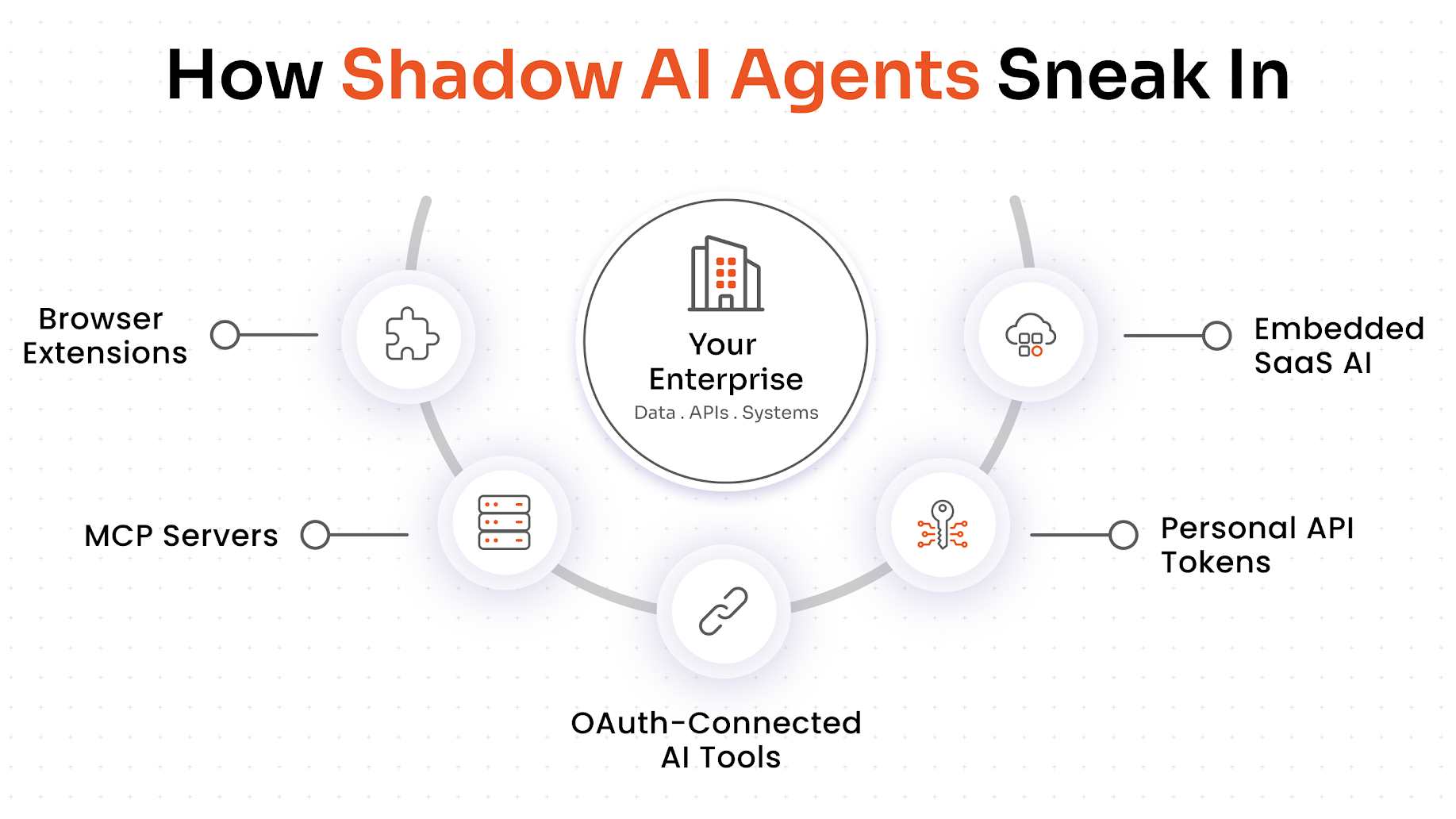
1. Browser extensions with AI capabilities
Browser extensions are one of the easiest ways for shadow AI agents to enter an organization. Many of these extensions act as AI copilots, helping users draft emails, summarize content, or automate tasks directly within the browser. The risk comes from the level of access they request. These extensions can read page content, interact with web applications, and send data to external APIs. Since they appear as standard browser add-ons, they are rarely reviewed with the same scrutiny as enterprise applications, making them a common and often overlooked entry point.
2. MCP (Model Context Protocol) Servers
MCP (Model Context Protocol) is an emerging standard that allows AI agents to connect directly to enterprise tools, data sources, and APIs. While it expands agent capabilities, it can also create new entry points into internal systems. When employees deploy unauthorized MCP servers, they may expose databases, file systems, and internal applications to AI agents without proper oversight. Without strong authentication, authorization, and monitoring controls, agents can access sensitive information or perform actions outside approved governance processes. Because MCP deployments often bypass traditional IT reviews, they can be difficult to discover and manage.
3. OAuth-connected AI tools
Many AI tools connect to enterprise platforms like Google Workspace or Microsoft 365 using OAuth. During setup, users are prompted to grant permissions, often covering email, files, calendars, and more. In practice, these permissions are accepted quickly without detailed review. Once granted, the access persists. Even if the tool is no longer actively used, the connection can remain active in the background, allowing the agent to retain access to enterprise data without visibility or control.
4. Personal API scripts and automations
Developers and technically skilled users often create their own automations using APIs and AI frameworks. These scripts may start as simple productivity tools, such as automating reports or processing data. Over time, they can evolve into more complex systems that behave like autonomous agents. Since they rely on personal API tokens, they operate outside centralized governance. This makes them difficult to track, especially when they connect directly to internal systems like databases, repositories, or communication platforms.
5. AI features inside approved SaaS tools
Many enterprise SaaS platforms now include built-in AI features. These capabilities are often enabled by default or can be activated with minimal configuration. While the application itself is approved, the AI functionality within it may not be fully governed. In some cases, these features can automate actions, access data, or integrate with other systems, effectively behaving like agents. This creates a situation where shadow AI exists inside tools that are otherwise trusted.
How to discover, classify, and govern shadow AI agents?
Managing shadow AI agents requires a structured approach that goes beyond traditional security methods. The goal is not just to detect their presence, but to understand their risk and bring them under control. This is typically done in three stages: discovery, classification, and governance.
1. Discover
The first step is identifying what exists, even if it is not visible through standard tools. Since shadow AI agents often operate within approved systems, discovery needs to focus on access patterns rather than installed applications.
A good starting point is auditing OAuth connections across identity providers. This helps identify third-party AI tools that were never formally approved but still have active access. Reviewing browser extensions across managed devices can also surface AI-enabled tools that interact with enterprise data.
In addition, tracking API tokens created by users is critical. These tokens are often used to connect external AI tools or scripts directly to internal systems. Together, these signals provide a clearer picture of where shadow AI agents may be operating.
2. Classify
Once discovered, the next step is to determine the level of risk each agent introduces. Not every agent requires the same level of response, so classification helps prioritize efforts.
High-risk agents typically have access to sensitive data such as financial records, personal information, or intellectual property. Medium-risk agents may have broad permissions but limited exposure, while low-risk agents usually operate within a narrow scope and access only non-sensitive data.
This step allows security teams to focus on the most critical risks first instead of trying to address everything at once.
3. Govern
After identifying and prioritizing agents, governance becomes the key focus. The goal is to bring approved agents under control without disrupting productivity.
Each agent should be assigned a defined identity, along with clearly scoped permissions based on its function. There should also be an identified owner responsible for how the agent behaves and what it accesses.
For sensitive actions, such as modifying data or sending external communications, adding human approval checkpoints helps reduce risk. Continuous monitoring is equally important to detect unusual behavior or access patterns over time.
Governance is not about stopping AI usage. It is about making it visible, controlled, and accountable within the organization.
Why IAM is the foundation of shadow AI governance?
Across every risk discussed so far, one issue keeps repeating: lack of identity.
Shadow AI agents operate without being formally recognized by enterprise systems. When an agent does not have an identity, it cannot be tracked, monitored, or controlled. It effectively operates outside the boundaries of governance, even while interacting with sensitive data and critical systems.
This is why identity and access management sits at the center of solving the problem.
In a governed environment, every entity that accesses data or performs actions must have an identity. The same principle needs to apply to AI agents. Each agent should be treated like a user or a service account, with clearly defined permissions, a designated owner, and a record of its activity. Without this structure, security teams have no way to enforce policies or investigate incidents.
At the same time, simply restricting AI usage is not a practical approach. Employees will continue to adopt AI tools to improve productivity. If approved options are difficult to access, shadow deployments will continue to grow.
The more effective approach is to make AI usage both easy and governed.
This is where modern IAM platforms built for AI agent governance play a critical role. They allow organizations to bring AI agents into the same control framework as human identities, ensuring that access is defined, monitored, and revocable at any time.
miniOrange AI agent governance provides centralized identity, policy enforcement, and continuous monitoring. Each agent can be provisioned with scoped permissions, assigned ownership, and tracked through an audit trail.
This shifts AI from being an unmanaged and invisible risk to a controlled and accountable part of the enterprise environment.
FAQs
What is the difference between shadow AI and shadow AI agents?
Shadow AI refers to unauthorized AI tools used within an organization, such as chatbots or writing assistants. Shadow AI agents are more advanced, as they operate autonomously and take actions on behalf of users. Unlike tools that require input, agents can access data, trigger workflows, and interact with systems independently, which makes them a higher-risk category.
How do I know if shadow AI agents are running in my organization?
Shadow AI agents are usually detected through access patterns rather than installed tools. Auditing OAuth connections, reviewing browser extensions, and tracking API tokens can help identify unapproved integrations. If there are more AI connections than officially approved tools, it is a strong sign that shadow AI agents are already present.
Are shadow AI agents always a security risk?
Not necessarily, but they become a risk when they operate without visibility or control. Many are introduced to improve productivity, but without governance, they can access sensitive data or perform unintended actions. The real issue is not usage, but lack of oversight and defined permissions.
Can shadow AI agents be controlled without blocking AI usage?
Yes, and this is the most effective approach. Instead of blocking AI tools, organizations should bring them under governance by assigning identities, limiting permissions, and monitoring activity. This allows teams to benefit from AI while maintaining security and compliance.
Why are shadow AI agents harder to detect than shadow IT?
Unlike traditional shadow IT, AI agents operate within approved systems using valid credentials. They do not require installation and often run through integrations or scripts. Because their activity appears as normal system usage, they are much harder to identify using conventional monitoring methods.
What is the biggest risk of shadow AI agents?
The biggest risk is the lack of identity and visibility. When an agent is not tied to an identity, organizations cannot track what it accessed or what actions it performed. This makes it difficult to enforce policies, investigate incidents, or maintain compliance.
What is the regulatory impact of shadow AI agents?
Shadow AI agents can create compliance risks when they process sensitive data without proper controls. This includes violations of regulations like GDPR, HIPAA, or data residency requirements. Since these agents often operate without review, they can unintentionally expose organizations to legal and regulatory consequences.

Leave a Comment