

A mole inside an organization costs you tens of thousands of dollars compared to any third-party malicious entity. Since employees (mostly management and C-suite) have access to the most confidential information, they can easily expose this data (intentionally or accidentally). They can do so by using an unapproved app or tool, adding an incorrect email recipient, making an unauthorized upload, or using a private storage account. The access itself may be permitted. What happens next creates the risk.
One of the many ways to prevent such insider mishaps is to manage them. That's where insider risk management comes into the picture.
Insider risk management identifies, assesses, and mitigates risks from individuals with authorized access to an organization's systems, data, or resources. It addresses accidental errors, negligence, malicious misuse, and compromised accounts. Insiders typically include employees, contractors, vendors, and business partners.
In this article, we will delve deeper into the concept of insider risks.
Why Is Insider Risk Management Important?
The 2026 Ponemon Global Report (sponsored by DTEX) reveals that insider risks cost organizations an average of $19.5 million annually. Based on data from 8,750 IT professionals worldwide, financial losses are highest in North America at $24 million, followed by Europe at $18.6 million.
These numbers will continue to soar unless you take drastic measures to curb them. Insider risk management helps organizations address this tension.
Now, let's look at some of the most solid reasons why insider risk management is essential for any organization.
1. Protect Sensitive Information Beyond the Login
Inside an organization's system, authentication determines who can enter a system. It does not determine whether every subsequent upload, download, transfer, or copy is appropriate.
Insider risk management adds visibility into how authorized users interact with crucial information. This helps organizations spot scenarios where legitimate access leads to unauthorized data use or movement.
2. Reduce Preventable Data Exposure
You must know that not every incident begins with malicious intent. An employee may use personal email to finish work at home or upload confidential material to an unapproved app because it seems more convenient.
Targeted employee training, clear policies, and preventive controls can address these behaviors before they result in a larger security incident.
3. Improve Incident Assessment and Response
A security alert rarely tells the whole story. Investigators need to understand the data involved, the user's responsibilities, the location, and the sequence of events.
A structured program gives security, HR, legal, and business teams a shared process for assessing concerns and deciding the next course of action.
CISA's insider threat guidance follows a related framework: define, detect and identify, assess, and manage. You can inculcate the same in your organization.
Types of Insider Risks Organizations Need to Manage
Insider risks differ in intent and cause. Separating these categories helps organizations choose an appropriate response instead of handling every policy violation as deliberate misconduct.
1. Accidental and Negligent Insider Risks
Accidental risk results from an unintended action, such as sending a confidential attachment to the wrong email recipient.
Negligent risk involves failing to follow expected guardrails. An employee might repeatedly bypass an approved file-sharing process or ignore warnings about restricted data.
The distinction matters. An isolated mistake may call for a workflow improvement or timely guidance. Repeated unsafe behavior may require better controls and additional review. Both are part of an insider risk management program.
2. Malicious Insider Risks
Malicious insiders intentionally misuse their access to harm the organization or benefit themselves or another party.
Potential activities include:
- Stealing intellectual property
- Sharing customer records without authorization
- Committing fraud
- Disrupting business systems
Authorized access can make this activity difficult to distinguish from routine work until investigators scrutinize the context.
3. Risks From Compromised Insider Accounts
An external attacker can also operate through a legitimate contractor, vendor, or employee account. The trick here is that the activity appears under a trusted identity, even though the account owner is not knowingly involved.
Organizations should investigate whether unusual activity reflects user behavior, account compromise, or an approved business task. A suspicious data or financial transfer is a reason to investigate, not proof of employee misconduct.
Common Warning Signs of Insider Risk
Warning signs are activities that deserve closer review. Their significance depends on data sensitivity, business purpose, user responsibilities, and surrounding events.
| Warning Sign | What to Investigate |
|---|---|
| Unusually large downloads | Whether the volume and file selection match a current business task |
| Transfers to personal email or cloud storage | Whether the destination is approved and the content is sensitive |
| Access to information outside normal responsibilities | Whether a project, role change, or approved request explains the access |
| Repeated attempts to bypass controls | Whether the user understands the policy and has a workable approved alternative |
| Unusual access times or locations | Whether travel, remote work, or account compromise explains the change |
| Unexpected file copying or deletion | Whether the actions support an authorized task or create business risk |
These warning signals become more useful when checked together. Insider risk detection depends on correlating activity with data sensitivity, identity, and operational context rather than treating a single unusual event as conclusive.
For example, a large download might support an approved migration. The same download followed by an attempted transfer to personal storage deserves a different level of scrutiny.
Focus on observable behavior and evidence. Employment changes or personal circumstances should not, on their own, become findings of wrongdoing.
How Does Insider Risk Management Work?
Insider risk management is a continuous process. Organizations identify what matters, establish appropriate access, detect concerning activity, assess its significance, and improve controls based on what they learn.
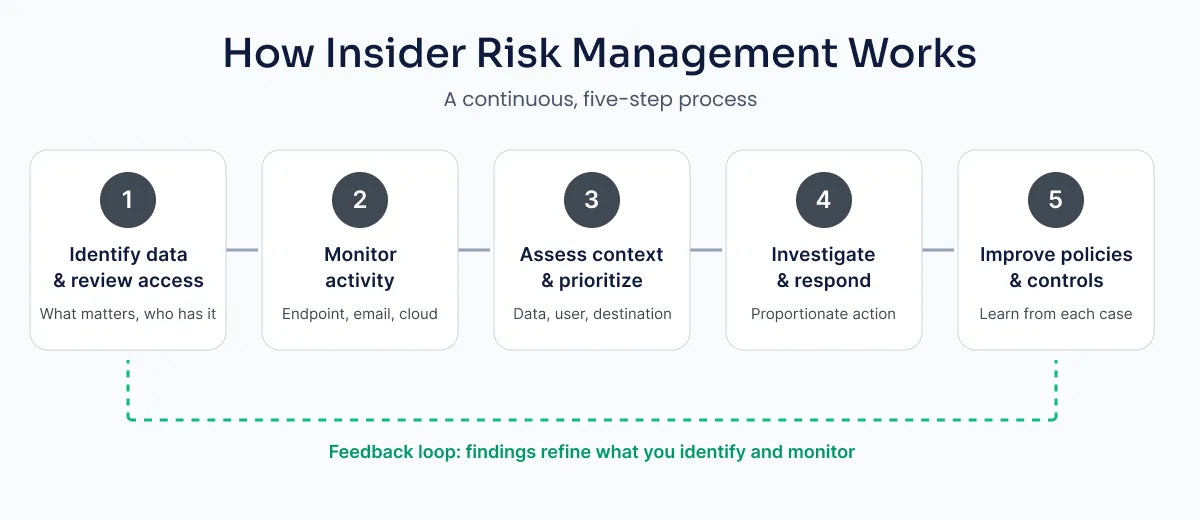
1. Identify Sensitive Data and Review Access
Begin by identifying the information that could cause meaningful harm if exposed, altered, or destroyed. This may include customer records, source code, financial documents, employee information, and confidential business plans.
Then establish:
- Where is the information stored?
- Who can access it?
- Why is that access necessary?
- Which sharing methods are permitted?
- How long should the information remain available?
This creates the foundation for monitoring and enforceable policies. Without it, security teams may generate alerts without knowing which events deserve priority.
2. Monitor Relevant Activity
Collect activity from the systems and channels within the program's scope. Depending on the environment, this may include endpoint events, email activity, cloud sharing, authentication logs, and application access.
Different technologies contribute different evidence. Data Loss Prevention (DLP) identifies sensitive content and policy violations. Identity systems provide authentication and access information. Security information and event management platforms help bring events together for investigation. Behavioral analytics can help identify departures from established patterns.
Coverage matters more than the number of tools. A well-monitored email channel will not reveal every risky transfer occurring through an unmanaged application.
3. Assess Context and Prioritize Risk
Review an event in relation to the data, user, destination, and business activity.
Useful questions include:
- Was the information sensitive?
- Did the user need it for their role?
- Was the destination authorized?
- Did the action violate a defined policy?
- Do related events suggest a mistake, deliberate misuse, or account compromise?
This assessment helps teams prioritize meaningful concerns while avoiding unnecessary escalation. CISA's framework explicitly separates detecting an indicator from assessing and managing the resulting concern.
4. Investigate and Respond Proportionately
Response should reflect the evidence and potential impact.
An accidental sharing attempt may require a warning and an approved alternative. A high-confidence attempt to transfer restricted information may justify blocking the action. Suspected account compromise may require session termination, access restrictions, or credential remediation through the appropriate security systems.
Investigations should follow documented procedures, preserve relevant evidence, and involve authorized stakeholders. Insider risk management requires coordinated decision-making, not just automated alerts.
5. Improve Policies and Controls
Review resolved cases to understand what should change. A repeated violation may reveal an unclear policy, excessive permissions, a detection rule that needs tuning, or a business process that encourages unsafe workarounds.
Use those findings to improve prevention as well as detection. A useful program reduces the conditions that create risk rather than simply generating more cases.
Insider Risk Management vs. DLP: What Is the Difference?
Insider risk management is a broader organizational program. Data loss prevention is a set of controls focused on protecting sensitive information from inappropriate access, disclosure, or movement. DLP supports insider risk management, but it does not replace governance, contextual assessment, or investigation.
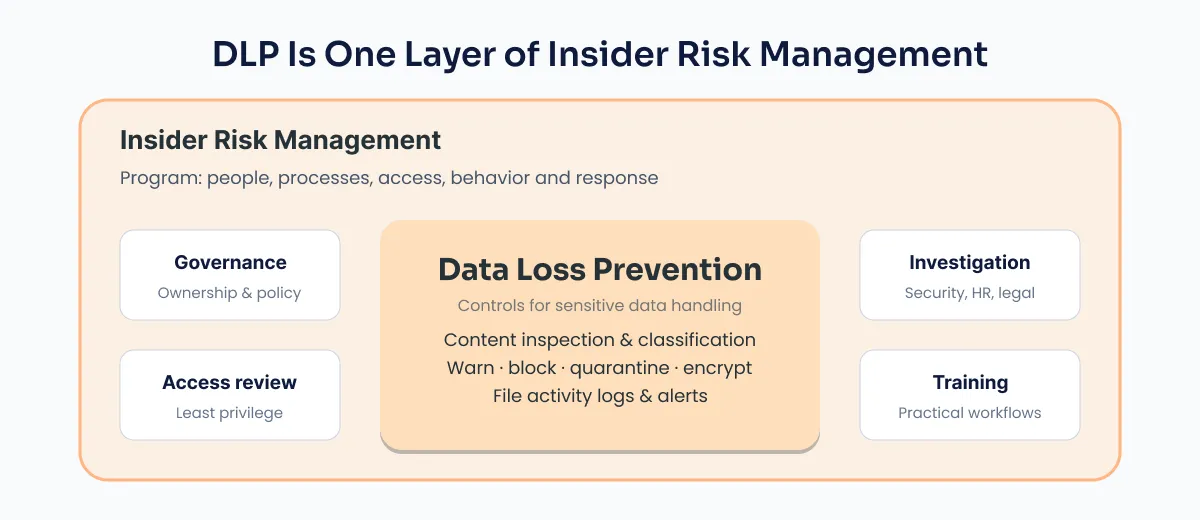
| Area | Insider Risk Management | Data Loss Prevention |
|---|---|---|
| Primary purpose | Assess and reduce risks associated with trusted access | Detect and control inappropriate handling of sensitive data |
| Scope | People, processes, access, behavior, and response | Data discovery, classification, use, and movement |
| Evidence | Identity activity, business context, data events, and investigation findings | Content matches, policy violations, destinations, and transfer details |
| Actions | Investigation, access changes, process improvements, and coordinated response | Alerts, blocking, quarantine, encryption, or other supported controls |
| Ownership | Cross-functional program involving security and relevant business stakeholders | Typically managed by security or data protection teams |
The relationship is practical: DLP can identify or stop a prohibited transfer, while the broader insider risk process determines what happened, why it matters, and whether additional action is necessary. Available enforcement actions vary by product, integration, and channel.
How a DLP Solution Supports Insider Risk Management
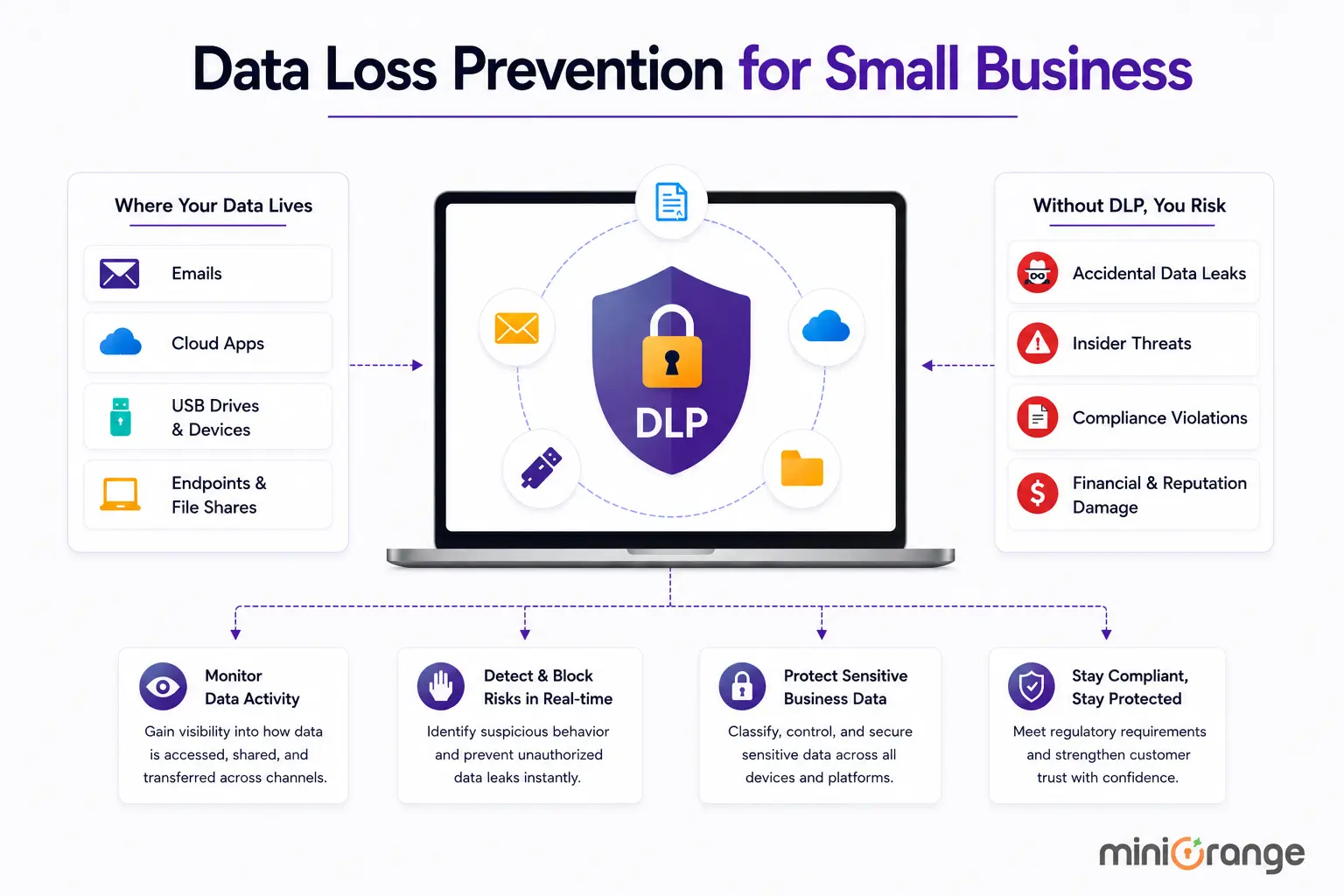
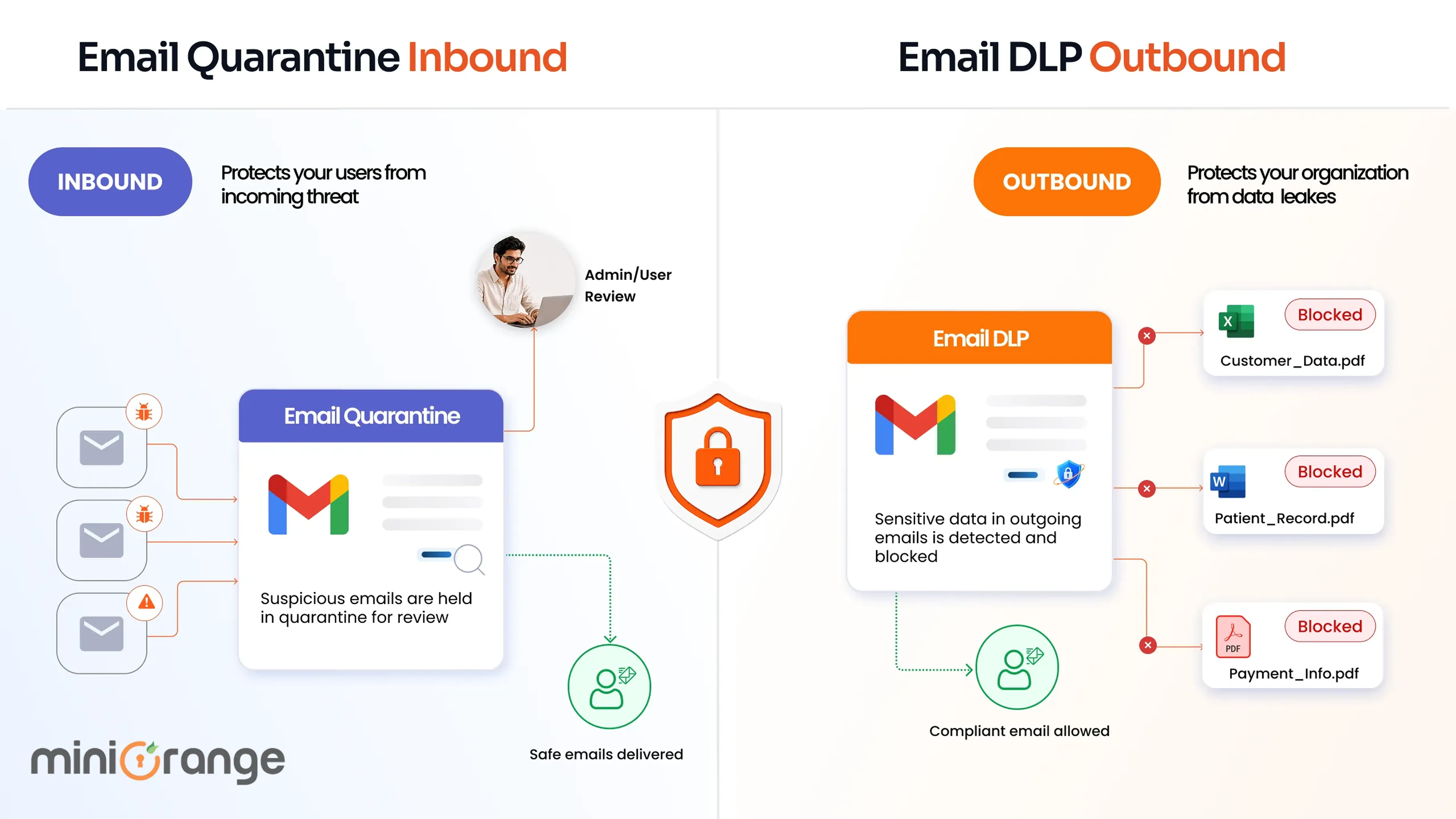
A DLP solution helps translate data-handling policies into technical controls. Instead of relying entirely on employees to recognize sensitive information and remember every rule, organizations can inspect content and apply policies at relevant points of use or transfer.
1. Identify Sensitive Content
Content-aware DLP can inspect information using patterns, keywords, dictionaries, and classification rules. This helps detect material such as personally identifiable information, payment card data, and confidential business content.
miniOrange describes content inspection and classification capabilities that support these use cases. Policies should still be tested against the organization's actual documents to understand detection accuracy.
2. Apply Controls to Risky Transfers
Depending on the implementation, DLP can warn, block, quarantine, encrypt, or otherwise restrict activity that violates policy.
For instance, an organization may prohibit certain records from being copied to removable storage or sent to unapproved recipients. miniOrange lists device controls, content-aware protection, and email policy enforcement among its DLP capabilities.
3. Provide Evidence for Investigation
DLP logs can help establish what information was involved, which action occurred, and whether a policy was triggered. That evidence becomes more useful when investigators connect it with authentication, access, and business context.
miniOrange provides file activity monitoring, policy violation alerts, and reporting capabilities intended to support visibility and review. These features support an insider risk program without independently establishing a user's intent.
Best Practices for Building an Insider Risk Management Program
A sustainable program needs clear ownership, practical policies, and a defensible approach to monitoring. Technology supports those decisions. It cannot make them on the organization's behalf.
1. Define Ownership Across Security, HR, and Legal
Document who reviews alerts, authorizes investigations, approves containment actions, and communicates with affected employees.
Bring privacy and legal stakeholders into program design rather than involving them only after an incident. Monitoring and investigation practices need to reflect applicable obligations and organizational policies.
2. Prioritize High-Impact Data and Scenarios
Avoid trying to monitor every activity with equal intensity.
Start with a manageable set of scenarios, such as unauthorized transfers of customer records, source code exports, or restricted financial documents. Define the data, users, channels, and expected response for each scenario.
This approach connects monitoring to potential business harm and provides a clearer basis for evaluating results.
3. Reduce Unnecessary Access
Apply least privilege so users receive the access needed for their responsibilities. Review permissions when employees change roles, projects end, or contracts expire.
Offboarding should address more than the primary login. It should account for relevant application access, active sessions, shared resources, and other access paths within the organization's environment. Reducing unnecessary access limits opportunities for misuse or compromise.
4. Make Secure Workflows Practical
A policy that says "do not use personal storage" is incomplete if employees lack an approved way to share large files.
Pair restrictions with usable alternatives. Provide targeted guidance when a risky action occurs, and investigate recurring workarounds as potential process problems. Training and governance are core components of an insider risk program, not optional additions to monitoring.
5. Protect Employee Privacy
Define the purpose and scope of monitoring. Limit access to investigation information, establish retention rules, and document how sensitive findings are handled.
Use proportionate monitoring and appropriate legal review. Avoid collecting personal information simply because a tool makes it available. Privacy considerations should shape the program from the beginning.
6. Measure Outcomes, Not Just Alert Volume
More alerts do not necessarily indicate better protection.
Useful measures can include time to assess significant events, repeat violations, investigation outcomes, and the share of reviewed alerts that require action. CISA also offers an Insider Risk Mitigation Program Evaluation tool to help organizations assess program maturity and readiness.
Review these measures alongside operational feedback. A control that repeatedly interrupts legitimate work may need refinement, while a quiet channel may indicate either low risk or missing visibility.
Reduce Insider Risk Without Disrupting Work
Insider risk management works best when organizations connect sensitive data, appropriate access, meaningful activity signals, and proportionate response. The objective is not to eliminate collaboration. It is to make risky actions visible and prevent avoidable harm.
DLP provides an important enforcement layer within that program. miniOrange DLP offers data discovery, classification, content-aware controls, file activity monitoring, and reporting capabilities that can support sensitive data protection.
Evaluate the required channels, platforms, and policy actions against your environment before deployment.
Frequently Asked Questions
1. Who is considered an insider in cybersecurity?
An insider is someone with authorized access to an organization's resources, such as an employee, contractor, vendor, or business partner. The risk comes from how that access is used or compromised, not simply from the person's employment status.
2. What is the difference between insider risk and insider threat?
Insider risk describes the potential for harm associated with trusted access. Insider threat terminology varies across frameworks and vendors, so it should not automatically be treated as a synonym for malicious employees. Organizations should define their terminology and include both intentional and unintentional harm within their program's scope.
3. Can insider risk management help detect compromised accounts?
Yes. Unusual access and data activity associated with a legitimate identity can reveal possible account compromise. Teams should correlate those signals with authentication and other security evidence rather than assuming the account owner performed the activity knowingly.
4. How can organizations manage insider risk without excessive monitoring?
Use a defined, risk-based scope. Prioritize sensitive information and relevant activities, restrict investigator access, establish retention limits, and involve legal and privacy stakeholders. The purpose should be to address identifiable business risks, not conduct unrestricted employee surveillance.
5. What should organizations look for in an insider risk management solution?
Evaluate relevant data-channel coverage, identity context, investigation workflows, privacy controls, integration options, and response capabilities. For DLP specifically, validate content detection, supported platforms, enforcement actions, and reporting using realistic business workflows rather than relying only on a feature list.
Leave a Comment