
The data exfiltration meaning is straightforward once you strip away the jargon: it's the unauthorized transfer of data from a device, server, or network to a location controlled by an attacker or an unauthorized party. This can happen through malware, a compromised insider, or something as simple as an employee copying files to a personal USB drive.
What makes data exfiltration particularly dangerous is that it's often covert by design. Attackers deliberately disguise the outbound transfer to look like normal network traffic, which is why so many exfiltration attempts slip past traditional security tools undetected.
It's also commonly referred to as data extrusion or data exportation, but the outcome is the same: sensitive information leaves your controlled environment without permission.
If you’ve ever wondered what is data exfiltration and why it keeps showing up in breach reports, this guide breaks it down in plain language, covers the techniques attackers use, and walks through practical detection and prevention strategies your team can actually implement.
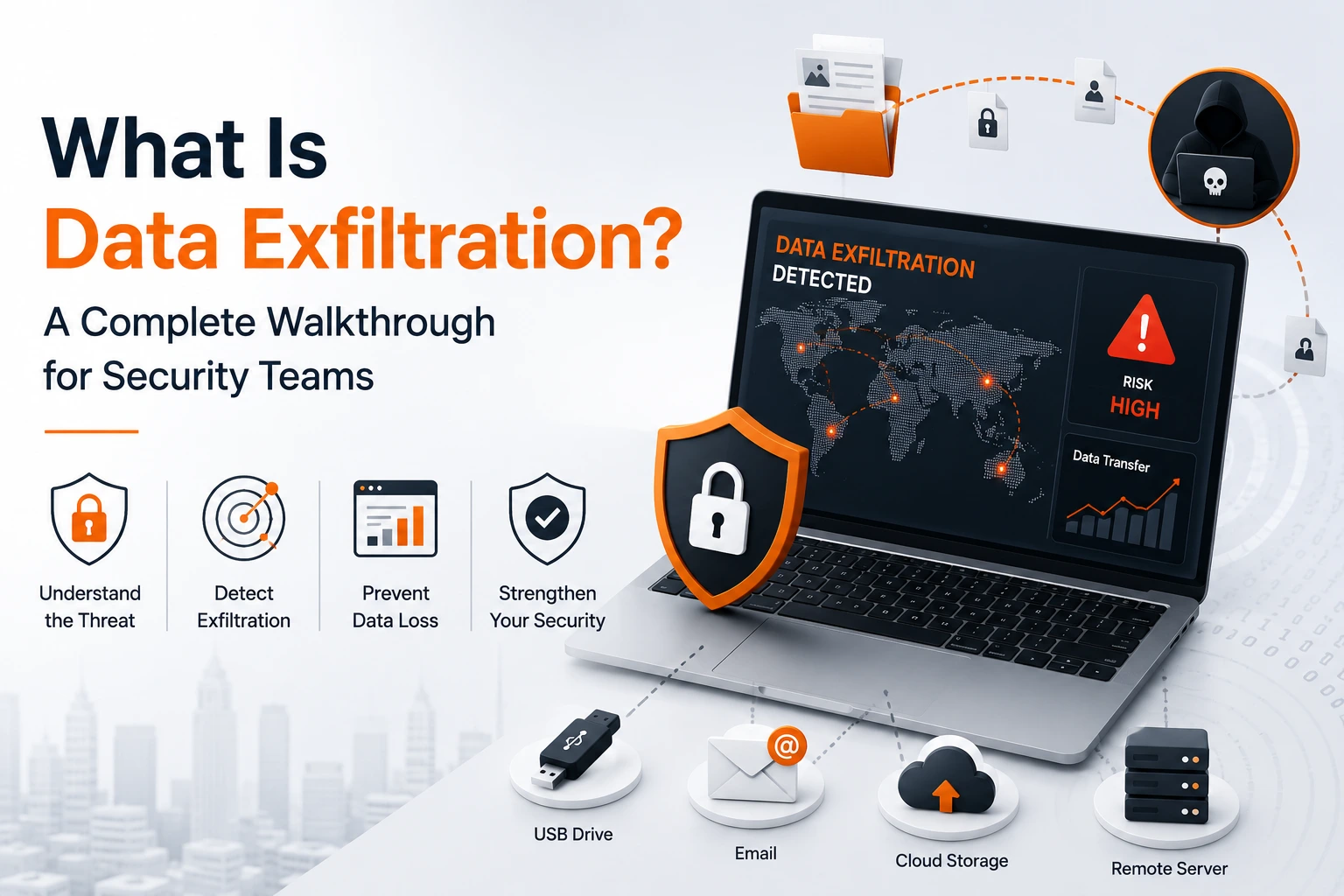
Physical, Network, and Cloud: Where Exfiltration Happens
Data exfiltration doesn't follow a single playbook. It shows up wherever data lives, whether that's on a laptop, moving across your network, or sitting in a cloud storage bucket.
- Physical: This is the oldest and most low-tech form. It involves someone physically removing data using USB drives, external hard disks, printed documents, or even personal smartphones connected directly to a corporate machine.
- Network-Based: Here, attackers or malicious insiders move data over the network itself, using channels like email, FTP transfers, encrypted tunnels, or command-and-control (C2) infrastructure.
- Cloud-Based: This involves exploiting misconfigured storage buckets, compromised API keys, or unauthorized sharing links to pull data out of cloud environments.
What Are the Data Exfiltration Cyber Attack Techniques?
Attackers rarely use just one method. They chain together multiple data exfiltration techniques to increase their chances of success while staying under the radar. Understanding these methods is the first step toward building a defense that actually works.
1. Phishing and Social Engineering Attacks
Phishing remains one of the most reliable entry points for exfiltration. Attackers trick employees into clicking malicious links or sharing credentials, which then opens the door to systems holding sensitive data.
2. Outbound Emails
Sensitive files sent through personal or unauthorized email accounts, sometimes intentionally by a malicious insider and sometimes accidentally, are a surprisingly common exfiltration channel.
3. Insider Threats
Not every threat comes from outside. Employees, contractors, or partners with legitimate access can misuse that access to copy or transfer data for personal gain or to help a competitor.
4. Human Error
Sometimes there's no malicious intent at all. Misconfigured sharing permissions, sending files to the wrong recipient, or leaving cloud storage publicly accessible can expose data just as effectively as a deliberate attack.
5. Credential Thefts
Stolen usernames and passwords, often obtained through phishing kits or credential-stuffing attacks, give threat actors a direct, authenticated path into systems where they can quietly siphon off data.
6. Exfiltration via Removable Storage and External Devices
Insiders can easily move sensitive data onto USB drives, external hard disks, SD cards, external SSDs, or even smartphones used as makeshift storage. Because these transfers happen locally, they often bypass network-based monitoring tools entirely, making them one of the hardest exfiltration methods to detect.
7. Command and Control (C2)
Once malware establishes a foothold, it often communicates with an external C2 server, using that channel to funnel stolen data out in small, encrypted packets designed to evade detection.
8. Downloads to Insecure Devices
Data downloaded onto unmanaged or poorly secured personal devices, such as BYOD laptops without endpoint protection. This creates an easy exit point that bypasses corporate security controls.
9. Malware Attacks
Purpose-built malware, including Trojans and spyware, is specifically designed to search for valuable data and transmit it to attacker-controlled servers, often without any visible signs on the infected machine.
How Data Exfiltration Actually Unfolds
Data exfiltration rarely happens in a single step. It typically follows a sequence, and understanding this sequence helps security teams know exactly where to intervene.
- Initial access: The attacker gains entry through phishing, stolen credentials, or exploiting a software vulnerability.
- Reconnaissance: Once inside, they map the network to locate valuable data, such as customer records, intellectual property, or financial information.
- Privilege escalation: The attacker attempts to gain higher-level access to reach restricted databases or file shares.
- Data staging: Target data is often compressed, encrypted, or moved to a temporary location within the network to prepare for transfer.
- Exfiltration: The data is transmitted out, frequently in small, encrypted chunks over DNS, HTTPS, or a C2 channel to avoid triggering volume-based alerts.
- Covering tracks: Logs may be altered or deleted to delay detection and hinder forensic investigation.
This staged approach is exactly why exfiltration can go on for weeks or months before anyone notices, especially in organizations relying solely on perimeter defenses.
Data Exfiltration vs. Data Breach: What’s the Real Difference?
These two terms get used interchangeably, but they're not the same thing, and the distinction matters when you're building a response plan.
A data breach is a broader event describing unauthorized access to data, while data exfiltration specifically refers to the act of moving that data out.
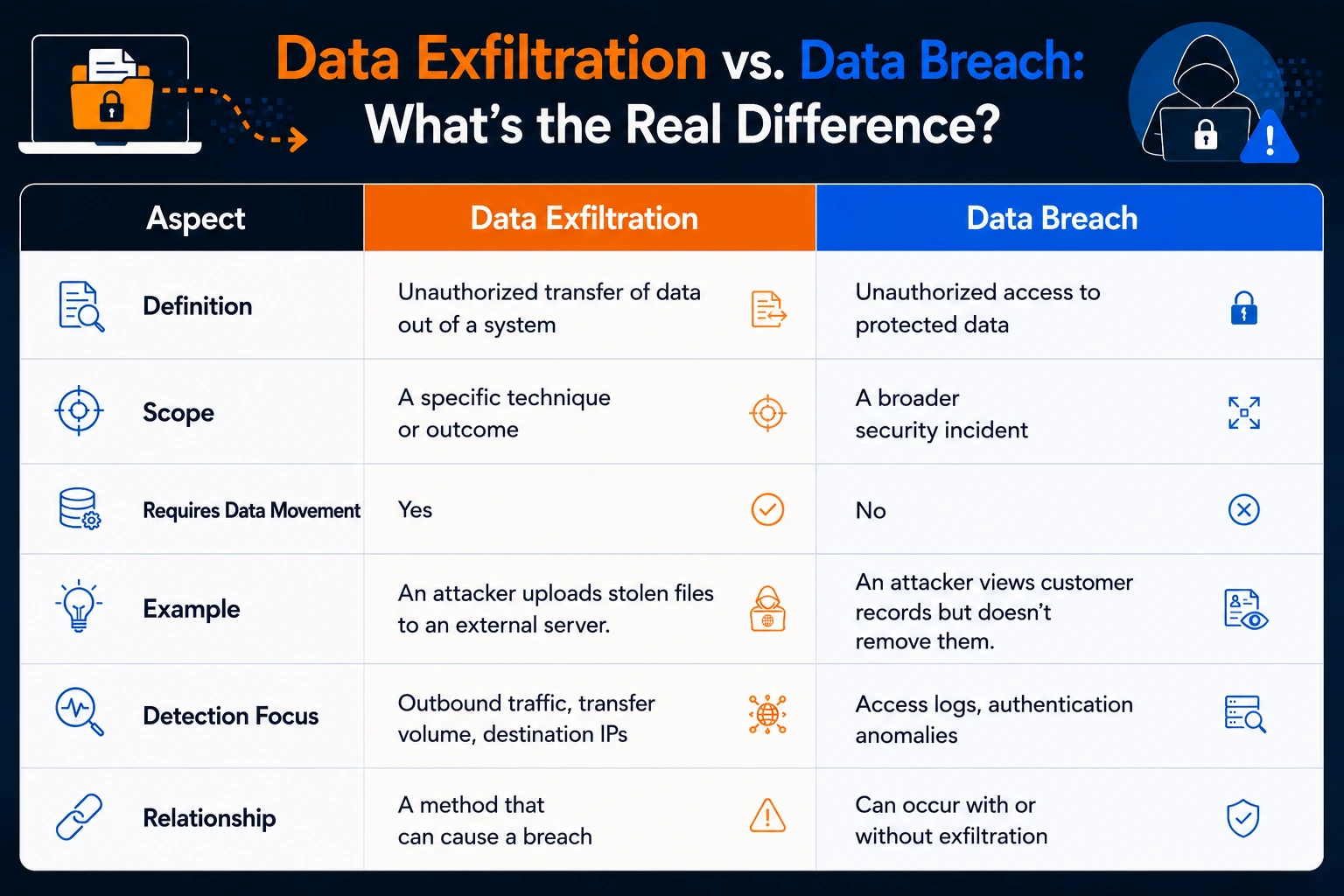
In short, every exfiltration event contributes to a breach, but not every breach involves exfiltration. Some breaches are limited to unauthorized viewing or exposure without any data actually leaving the network.
How to Detect Data Exfiltration Before It’s Too Late
Effective data exfiltration detection depends on visibility across your network, endpoints, and cloud environments. Since attackers work hard to blend in with normal traffic, detection strategies need to focus on subtle anomalies rather than obvious red flags.
1. Centralize Alerts With SIEM
A Security Information and Event Management (SIEM) platform aggregates logs from across your infrastructure and applies correlation rules. The SIEM carries this out to flag unusual behavior, such as a user account suddenly accessing and downloading large volumes of data at odd hours.
2. Watch DNS Traffic for Hidden Tunnels
DNS is frequently abused for exfiltration because it's rarely inspected closely. Monitoring DNS query patterns for unusually long queries, high query volumes, or requests to suspicious domains can reveal DNS tunneling attempts.
3. Inspect Network Protocols for Anomalies
Analyze protocol-level traffic, including unusual use of FTP, HTTPS, or custom ports. It helps identify data leaving through channels that don't match typical business usage.
4. Monitor Who’s Accessing What, and When
Establishing a baseline of normal file access behavior makes it easier to spot deviations, like a user suddenly accessing files outside their usual scope or downloading unusually large batches of documents.
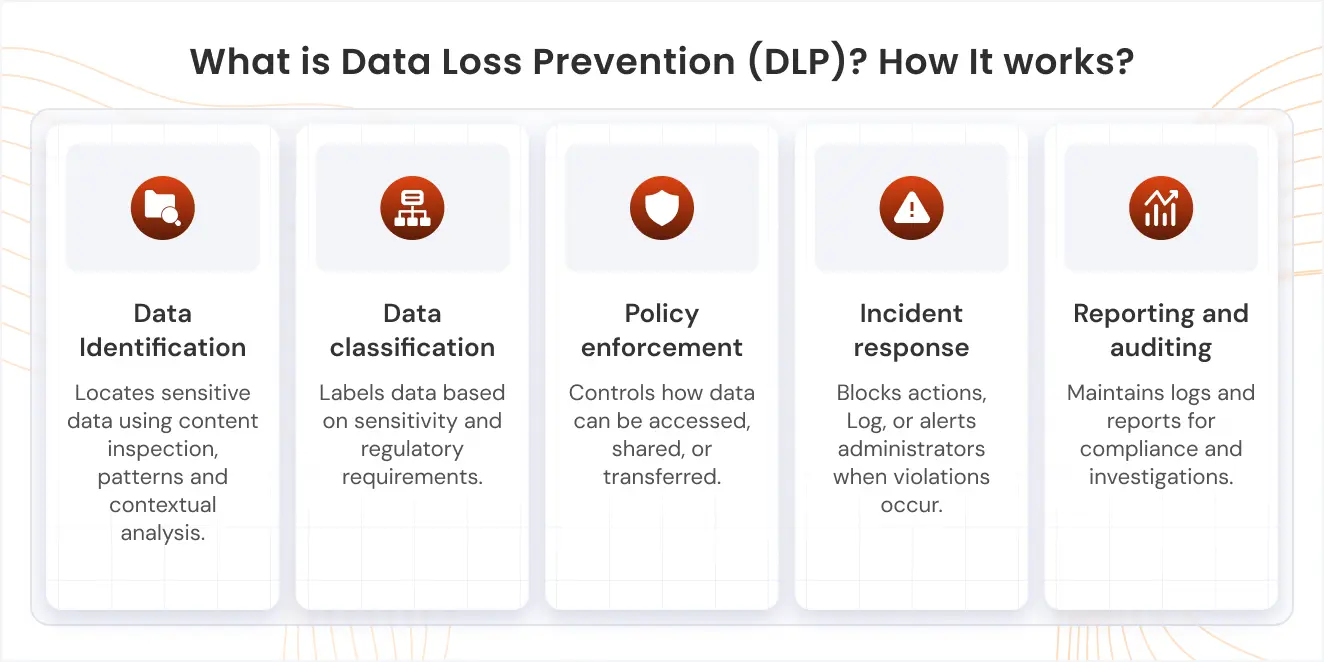
5. Deploy a DLP Solution
Data Loss Prevention (DLP) tools scan content in transit and at rest. It flags or blocks transfers that contain sensitive data patterns like credit card numbers, PII, or confidential business documents.
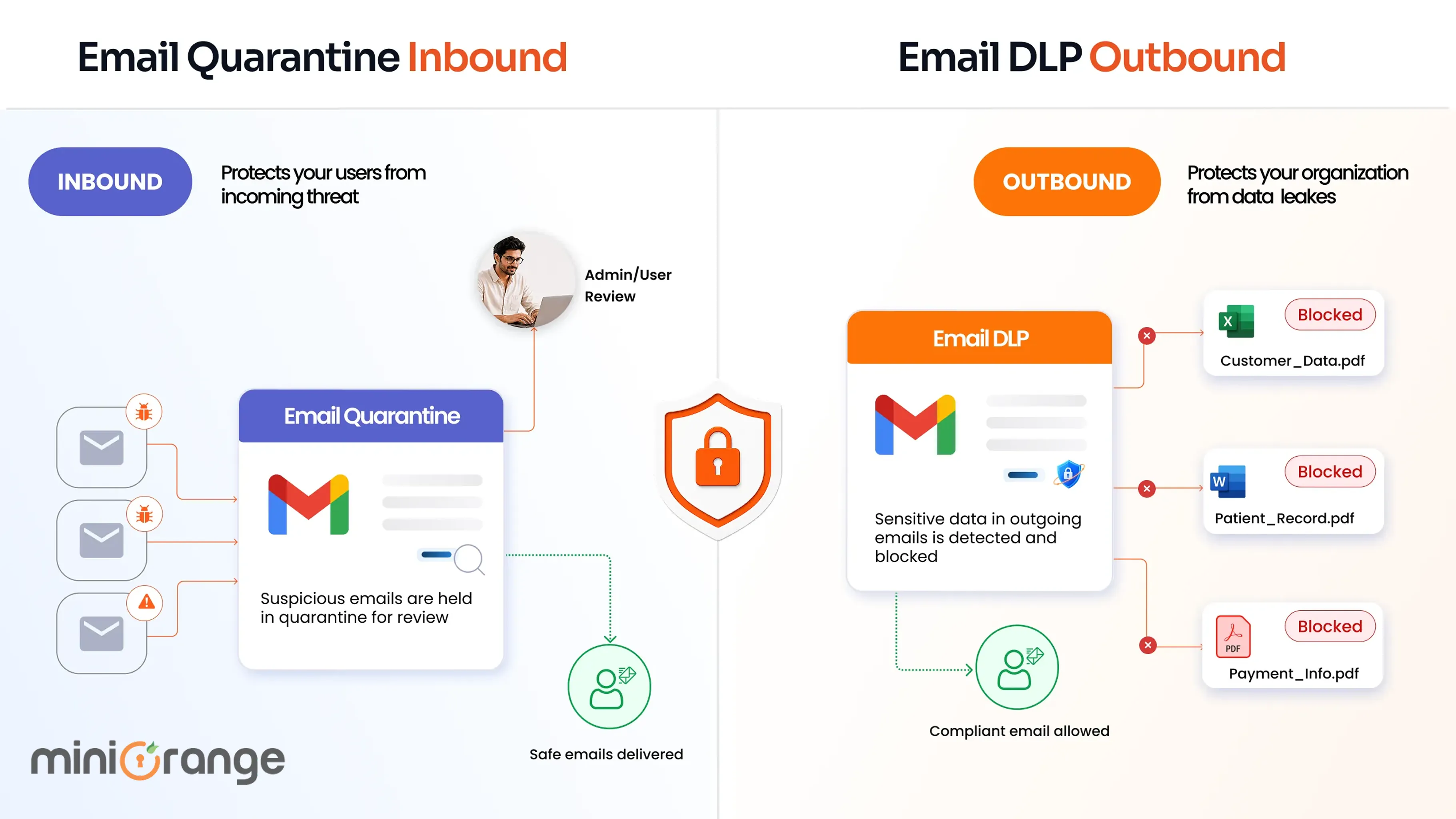
6. Scrutinize Outbound Email Traffic
Since email remains a common exfiltration vector, monitoring outbound messages for large attachments, unusual recipients, or sensitive keywords helps catch leaks before they leave the mailbox.
7. Correlate Endpoint and Cloud Activity Logs
Beyond file servers, tracking activity across endpoints and SaaS applications together gives a fuller picture. This is especially essential since modern data often moves between local devices and cloud storage in the same workflow.
How to Prevent Data Exfiltration From Happening in the First Place
Detection matters, but data exfiltration prevention is what actually stops incidents from turning into full-blown breaches. The strongest security postures combine technology, process, and people-focused strategies.
1. Invest in Threat Detection and Response
Extended Detection and Response (XDR) or Endpoint Detection and Response (EDR) tools provide continuous monitoring across endpoints, catching malicious behavior in real time rather than later.
2. Build a Culture of Security Awareness
Phishing and human error account for a huge share of exfiltration incidents. Regular, practical security training helps employees recognize suspicious emails and understand safe data-handling practices.
3. Strengthen Access With IAM and DLP Solutions Together
Identity and Access Management (IAM) ensures user authentication and authorization via a range of solutions that fall under it. These solutions are Single Sign-On, Multi-Factor Authentication (MFA), adaptive authentication, Role-Based Access Control (RBAC), and more.
While DLP adds a content-level safety net that blocks unauthorized transfers even if access controls are bypassed.
4. Adopt a Zero Trust Architecture (ZTA)
Zero Trust operates on the principle of never trust, always verify. It requires continuous authentication and strict segmentation. This makes it significantly harder for attackers to move laterally and reach sensitive data even after initial compromise.
5. Stay Current With Patch Management
Many exfiltration attacks start by exploiting known, unpatched vulnerabilities. A disciplined Patch Management schedule closes these gaps before attackers can use them.
6. Classify Data and Encrypt It End-to-End
Not all data carries the same risk. Classifying data by sensitivity lets you apply stronger controls. Furthermore, end-to-end encryption ensures that information that matters most, even if it's exfiltrated, remains unreadable to attackers.
7. Use Network Detection and Response (NDR)
NDR solutions analyze network traffic patterns using behavioral analytics. It catches exfiltration attempts that bypass traditional signature-based tools by focusing on how data moves rather than just what it contains.
How Does miniOrange Help Reduce Data Exfiltration Risks?
miniOrange uses defensive solutions to monitor, detect, and block unauthorized data transfers out of the corporate network.
The miniOrange Data Loss Prevention (DLP) solution restricts clipboard actions and stops users from uploading files to unapproved cloud storage (Dropbox or Google Drive). It also blocks unauthorized USM transfers.
Data exfiltration isn't a single event you can solve with one tool or one policy. It's an ongoing risk that requires layered defenses spanning your network, endpoints, cloud environments, and, most importantly, your people.
Resolve data exfiltration with our DLP Solution. Just get in touch with us for a consultation call or demo.
FAQs
1. What causes data exfiltration?
Data exfiltration is typically caused by a mix of external attacks, insider threats, and human negligence.
2. What is data exfiltration vs. infiltration?
Infiltration refers to an attacker gaining unauthorized entry into a system or network, while exfiltration refers to the actual removal of data once that access has been established.
3. What are the most common types of data exfiltration?
The most common types fall into three broad categories: physical exfiltration, network-based exfiltration, and cloud-based exfiltration.
4. Why is data exfiltration increasing?
The rapid shift to cloud platforms, SaaS tools, and even AI-driven workflows has expanded the attack surface, giving both external attackers and malicious insiders more channels to move data undetected.
About the Author

Content Writer
With a background in Journalism and extensive experience in SaaS and cybersecurity content writing, Chaitali Avadhani has contributed to creating various forms of impactful content pieces across multiple verticals. At miniOrange, her role is to craft SEO-friendly and lead-generating content around Identity and Access Management (IAM) products and cybersecurity as a whole.
Leave a Comment