

Multi-Factor authentication (MFA) has been a cornerstone of human identity security, primarily because passwords are easily hacked. But now, as AI agents begin booking meetings, executing code, accessing databases, and making financial transactions on behalf of humans, a critical question emerges: who is authenticating the agent?
Most organizations racing toward AI adoption haven't answered that question yet. And that gap is exactly where attackers are starting to look.
This blog breaks down why traditional MFA fails for AI agents, and how forward-thinking security teams are closing the authentication gap before it becomes a breach.
The Authentication Gap in Agentic AI Implementation
When enterprises begin agentic AI implementation, the priority is usually capability: what can the agent do, how fast can it work, how much can it automate? Security, particularly authentication for AI agents, typically gets bolted on later, if at all.
Here's what that gap looks like in practice:
- AI agents are provisioned with service accounts or API keys that carry broad permissions.
- Those credentials are stored in environment variables or configuration files with minimal protection.
- No MFA layer exists between the agent and the systems it accesses.
- Audit logs capture what the agent did, but not whether the agent was the legitimate actor.
This creates a scenario where a compromised agent, or a malicious prompt injected into the agent's input pipeline, can silently exfiltrate data, modify records, or escalate privileges.
The human never gets an authentication challenge. The MFA software never fires. The breach is invisible until it's not.
Why Traditional MFA Fails for AI Agents?
Traditional MFA fails for AI agents for several structural reasons.
1. Designed for Humans, Not Software
Traditional MFA assumes a human is present to receive and respond to challenges: typing OTPs, tapping push prompts, or confirming logins on a second device.
AI agents run headless and unattended, often in containers, services, or scripts, with no concept of “checking a phone” or “clicking approve,” so the interaction model simply doesn’t map.
2. Forces AI to Impersonate Human Accounts
Because the system can’t challenge an agent directly, organizations often run AI under borrowed human identities or generic “service” users that bypass MFA.
This leads to shared accounts, long‑lived sessions, and hardcoded secrets, making it impossible to attribute actions to a specific agent or to apply least‑privilege cleanly.
3. Relies on Long‑Lived Secrets and Brittle Workarounds
To keep automation running, teams embed API keys, refresh tokens, or session cookies in configurations and code, effectively sidestepping MFA after the first login.
These long‑lived secrets are hard to rotate, easy to leak (logs, repos, CI pipelines), and once compromised, they give attackers persistent access without ever tripping an MFA check.
4. Cannot Express the Right Kind of Assurance
MFA proves “this human is who they claim to be right now,” but AI security needs to prove “this specific agent, running this code, in this environment, under this policy.”
Current MFA factors say nothing about code integrity, model provenance, runtime context, or delegated chains of agents, so even if you bolt MFA on the front, the real assurance AI needs is missing.
What Multi-Factor Authentication Really Means for AI Agents?
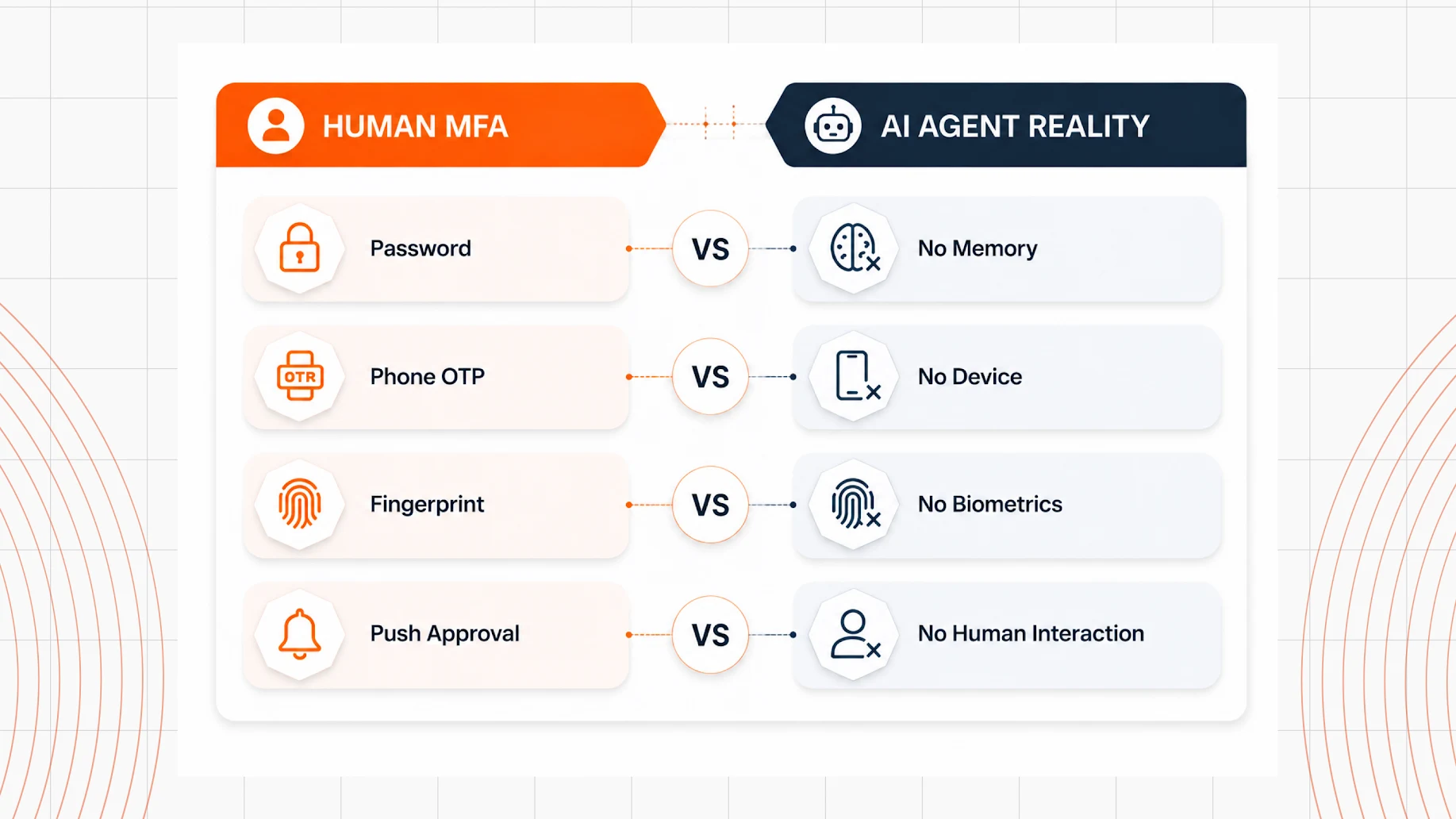
Traditional MFA solution maps neatly onto human cognition and physical possession. You know your password. You have your phone. You are who your fingerprint says you are. None of that maps onto an AI agent, which has no password recall, no phone, and no biometrics.
But the underlying principle of MFA, verifying identity through multiple independent factors, absolutely applies to agents. The factors just need to be redefined.
Authentication for AI agents should combine workload identity, contextual verification, runtime trust, behavioral analysis, and human oversight into a layered assurance model. When two or more of those layers confirm legitimacy simultaneously, the agent is trusted to proceed. When they diverge, action is paused.
This is what modern MFA software needs to evolve toward as agentic AI implementation scales across enterprises.
The Identity Layer is the Next Battleground
For most of security's history, the perimeter was the primary defense. Then, as cloud adoption broke the perimeter, identity became the new boundary. Zero-trust architectures built their entire model around this shift: trust no network, verify every identity.
Agentic AI is triggering the next evolution of that same pattern. As enterprises scale AI adoption in 2026 and beyond, the number of non-human identities operating inside their environments will grow faster than human headcount by an order of magnitude. One enterprise AI deployment can mean dozens of agents, each making thousands of authenticated requests per day, across multiple systems, with minimal human visibility.
That scale makes the identity layer not just important, but the single most consequential security surface in the modern enterprise. The organizations that invest now in workload identity infrastructure, behavioral authentication, and AI agent governance will have a compounding advantage: every new agent they deploy inherits a mature security foundation rather than inheriting the authentication gaps of the first generation.
The organizations that don't will find themselves retrofitting security onto autonomous systems that have already proliferated beyond their ability to audit them. That's a much harder problem, and it's already unfolding at companies that prioritized AI adoption speed over architectural discipline.
FAQs
Why does traditional MFA fail for AI agents?
Traditional MFA was built around human interaction: entering a code, approving a push notification, or scanning a biometric. AI agents operate autonomously and can't perform any of those actions.
Why should AI Agents have their own identities?
When multiple agents share a service account or API key, you lose the ability to distinguish which agent took which action. Unique, agent-specific identities make it possible to audit behavior at the individual agent level.
How Should Authentication Work for AI Agents?
Authentication for AI agents should function as a layered model rather than a single checkpoint. Start with workload identity attestation, followed by behavioral and contextual analysis. Make use of ephemeral tokens and include human authorization for high-risk tasks.
Leave a Comment