

In many organizations, the gap between HR and IT is a "black hole" of productivity and security. When a new hire starts, they often spend their first day staring at a login screen because their access wasn't provisioned. Worse, when an employee leaves, their access to Jira, Slack, or Entra ID might remain active for days or even weeks.
This isn’t just an administrative headache; it’s a major security and compliance risk. Relying on manual tickets and human memory to manage the employee lifecycle is no longer sustainable. To scale safely, organizations must move toward HR-driven access governance.
The Costly Reality of "Manual" Lifecycle Management
When IT teams manually manage access across systems like Active Directory, Okta, and Jira, they inevitably run into critical operational bottlenecks. This raises an important question for leadership: How much money is your business losing while new hires wait for app access? Every hour an employee sits idle without their tools, your organization loses the ROI on their onboarding costs. Manual ticketing means IT is always playing catch-up, turning day-one excitement into day-one frustration.
Beyond productivity, manual management introduces severe security gaps. Are "orphaned accounts" from former employees hiding in your tech stack right now? Without automated offboarding, it is almost guaranteed that a former employee still has access to at least one SaaS tool. These forgotten accounts are prime targets for malicious actors because their unauthorized activity rarely triggers standard IT alerts.
Ultimately, these manual gaps collide during compliance season. Could your team pass a surprise SOC 2 audit of your offboarding logs today? Auditors do not accept spreadsheets or word-of-mouth confirmation. If you cannot produce an immediate, tamper-proof log showing the exact minute an ex-employee's access was severed, you risk failing your compliance certifications. Manual lifecycle management fails because:
- Delayed Productivity: Lost ROI while new hires wait for basic tools.
- Security Gaps: Orphaned accounts remaining active for weeks.
- Audit Failures: A lack of documented, timestamped trails of who granted and revoked access.
Establishing HR as the "Source of Truth"
The most effective way to solve this is to connect your HR events (Hiring, Transfers, Terminations) directly to your access control. By using identity governance capabilities within Jira Service Management (JSM), you turn HR actions into automated workflows. But how does this work in practice, and how do you map HR roles directly to specific Jira groups and Entra ID permissions? By syncing your Identity Provider (IdP) with JSM, HR attributes like department or job title automatically map to IT roles.
A new software engineer is instantly placed into the correct Bitbucket and Jira groups without an IT admin lifting a finger. This continuous synchronization also solves the problem of internal transfers. What happens when an employee changes departments? Internal transfers are where "privilege creep" runs rampant. When a user changes roles, JSM automation can automatically strip away their old department permissions while provisioning their new ones, ensuring they only hold the access they currently need.
This automation extends to external teams as well. Can you automate time-based "Kill Switches" for contractors and temporary vendors? Yes. JSM allows you to set precise expiration dates on contractor access. Once the contract ends, the automation triggers a de-provisioning event, closing the security loop without requiring a manual ticket closure. Through this approach, you achieve:
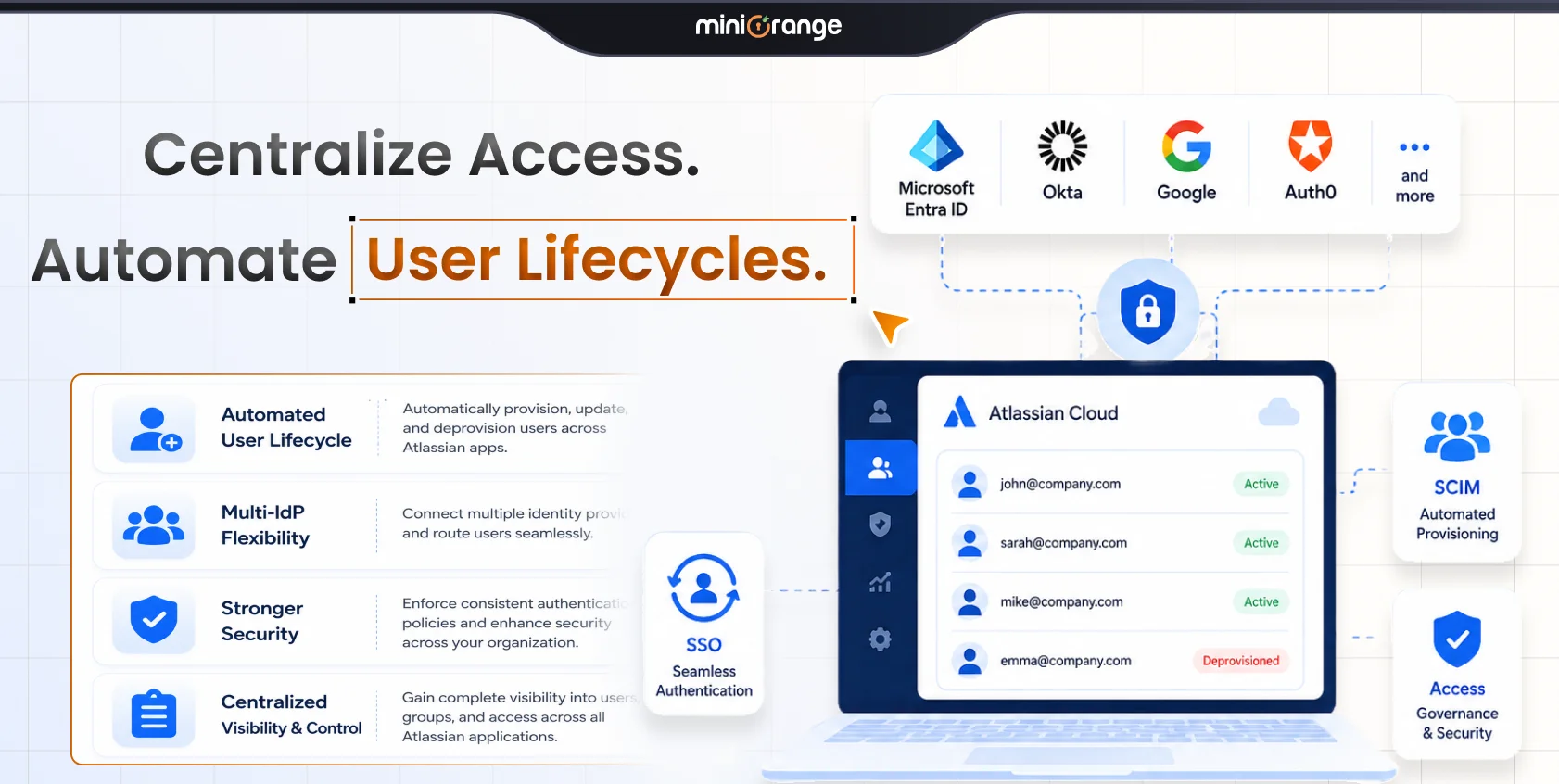
- Automated Provisioning: Instant account creation in Entra ID and Atlassian Access Cloud on day one.
- Approval-Based Access: Automatic manager sign-off workflows for sensitive applications.
- Time-Based Revocation: Pre-scheduled access expiration for temporary contractors.
- Instant Offboarding: A universal "Kill Switch" that revokes all access across integrated systems in seconds.
Access Governance Doesn't End After Provisioning
Granting access is only the beginning. True security requires ongoing oversight to ensure that permissions remain aligned with actual business needs over time. Security compliance isn't a "set it and forget it" task; it demands continuous monitoring, periodic access reviews, and real-time auditing to prevent drift and ensure total visibility across your ecosystem.
Why Centralizing in JSM Matters
Using Jira Service Management as your governance hub means you don't need to buy a separate, complex Identity Governance and Administration (IGA) platform. You leverage the tool your team already uses to create a transparent, auditable, and automated process.
Many IT leaders wonder: Why buy an expensive, standalone IGA platform when you already own JSM? Traditional identity tools are notoriously difficult to deploy and carry heavy licensing fees. JSM, powered by modern marketplace integrations, allows you to run robust lifecycle governance using your existing Atlassian ecosystem.
Furthermore, it simplifies compliance by changing how JSM transforms messy identity logs into a clean, auditor-approved trail. Because every automated action is anchored to a JSM ticket, your audit trail is generated automatically. Auditors can see the exact timeline: the HR trigger, the manager's digital approval signature, and the automated API confirmation from your identity provider.
Best of all, this bridge ensures that non-technical HR staff can trigger IT workflows without leaving their own platforms. HR personnel don't need to learn Jira or Entra ID. They simply perform their usual tasks in tools like Workday or BambooHR, and background webhooks pass the data seamlessly to JSM to kick off the technical workflows.
Summary
The manual approach to onboarding and offboarding is a major liability. When you connect HR events directly to IT actions, you make sure employees have exactly what they need on day one and absolutely zero access the moment they leave.
Automating this lifecycle through Jira Service Management does much more than just save time for your IT team. It strengthens your overall security and keeps your organization completely audit-ready at all times.
Ready to close the lifecycle gap? Explore Identity Governance & Auditing Via Jira Service Management by miniOrange
FAQs
Q1: What happens to a company's security when employee onboarding and offboarding are done manually?
A: Manual access management causes serious delays and security risks. New hires lose productivity waiting days for their software accounts, while terminated employees often retain active access to company data via forgotten "orphaned accounts." Additionally, companies struggle to pass security audits because they lack clear, automated logs showing when access was granted or revoked.
Q2: How do you use HR data to automate IT account creation?
A: Organizations can use HR events or access requests to initiate governed workflows in Jira Service Management. These workflows route requests to the appropriate approvers, apply access policies, and automate provisioning or deprovisioning across connected applications such as Microsoft Entra ID, Okta, Active Directory, GitHub, and AWS. Every action is tracked through audit logs to support governance and compliance requirements.
Q3: How does automation stop role changes and contractors from creating security risks?
A: As employees change roles or responsibilities, organizations can use governed workflows to review, approve, provision, and revoke access, helping reduce the risk of unnecessary or outdated permissions accumulating over time. For temporary vendors and contractors, the system uses time-based expiration dates that act as an automatic "kill switch," revoking all access the exact moment their contract ends.
Q4: What is the benefit of using Jira Service Management over a separate identity tool?
A: Standalone Identity Governance (IGA) platforms are highly complex and expensive. Using JSM leverages a tool the team already owns, saves money on licensing, and allows HR staff to trigger IT workflows. It also automatically builds an auditor-approved audit trail by linking every automated approval and account change directly to a JSM ticket.
Leave a Comment