
Wouldn't it be great if managing user accounts didn't take hours of manual effort? For many IT teams, unfortunately, that's exactly the reality. Every new employee needs access for all the apps they intend to use.
When someone switches roles, permissions need updating.
And when someone leaves, all their access needs to be revoked immediately.
These tasks might sound simple, but they become exponentially more challenging as your company grows. The more apps you use, the more accounts there are to track, the higher the chances of error, and the greater the security risk.
This is why organizations everywhere are adopting automated user provisioning. Regardless of whether your identity provider plays nicely with SCIM, you can automate the entire user lifecycle and ditch that tedious, repetitive manual work.
Automated provisioning removes that work. And with miniOrange User Sync & Group Sync for Jira (with dedicated apps for Confluence, Bitbucket, and Crowd), you can automate the entire lifecycle,whether or not your identity provider supports SCIM.
When manual provisioning becomes a headache
Managing users isn't difficult. It's the repetitive work that overwhelms IT teams.
Every new hire needs accounts in Jira, Confluence, and every other application they'll use. Every role change means updating permissions. Every departure requires finding and disabling accounts before they become a security risk.
This works for small teams. As your directory and application stack grow, it quickly becomes unmanageable:
- New hires wait for access because their accounts aren't ready on day one.
- Former employees keep access after they've left.
- Group memberships and permissions become inconsistent across applications.
- Managing users across multiple identity providers like Entra ID, Okta, and Keycloak increases manual effort.
- Large directories slow down provisioning.
- Auditors ask who has access to what, but there's no single source of truth.
These are the daily realities for IT administrators, IAM engineers, and security teams.
SCIM: the standard that keeps users in sync
When an employee joins, their account is created. When they change roles, their permissions update. When they leave, access is removed without waiting on a manual ticket.
With miniOrange SCIM provisioning for Jira and Confluence, you can:
- Automate the full user lifecycle: create, update, and deactivate accounts without manual steps.
- Sync groups and nested groups, and map IdP groups to Atlassian internal groups.
- Map both standard and custom user attributes to match your directory structure.
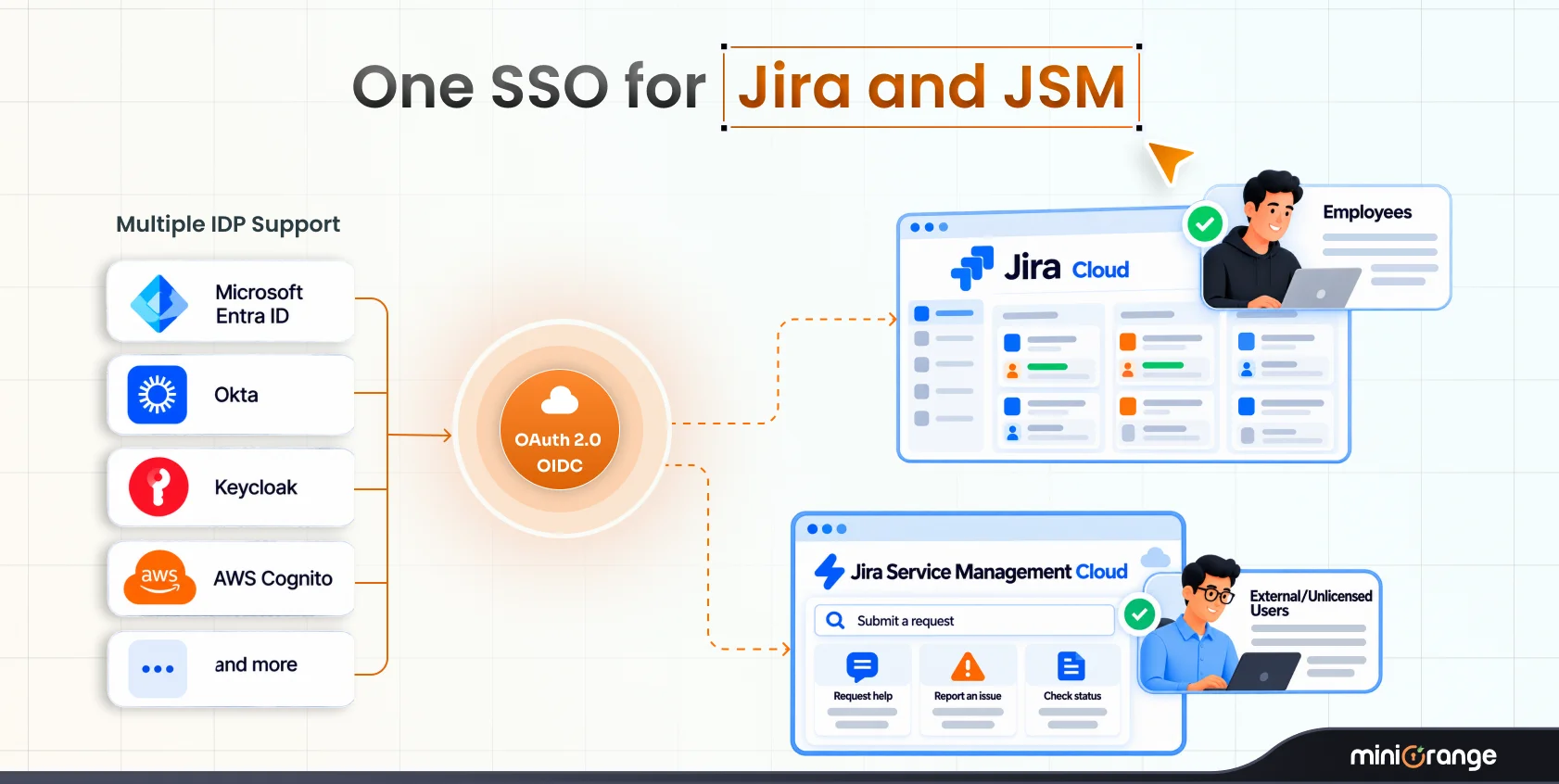
- Connect with 20+ identity providers, including Entra ID, Okta, Google Workspace, OneLogin, Keycloak, and Oracle IDCS.
- Route provisioning to the right IdP automatically based on the user's email domain, useful for multi-tenant setups.
- Run scheduled, manual, or SSO-triggered synchronization on your own operational rhythm.
- Keep full audit logs of every provisioning action for troubleshooting and compliance.
- Handle enterprise-scale directories without slowing sync down.
Instead of drowning in account administration, your team gets to focus on work that actually needs a human.
What if your identity provider doesn't support SCIM?
Not every identity provider supports SCIM, such as Keycloak or other custom identity providers. When that's the case, teams usually fall back on manual provisioning or hand-built scripts. Both approaches are error-prone, require constant upkeep, and add risk.
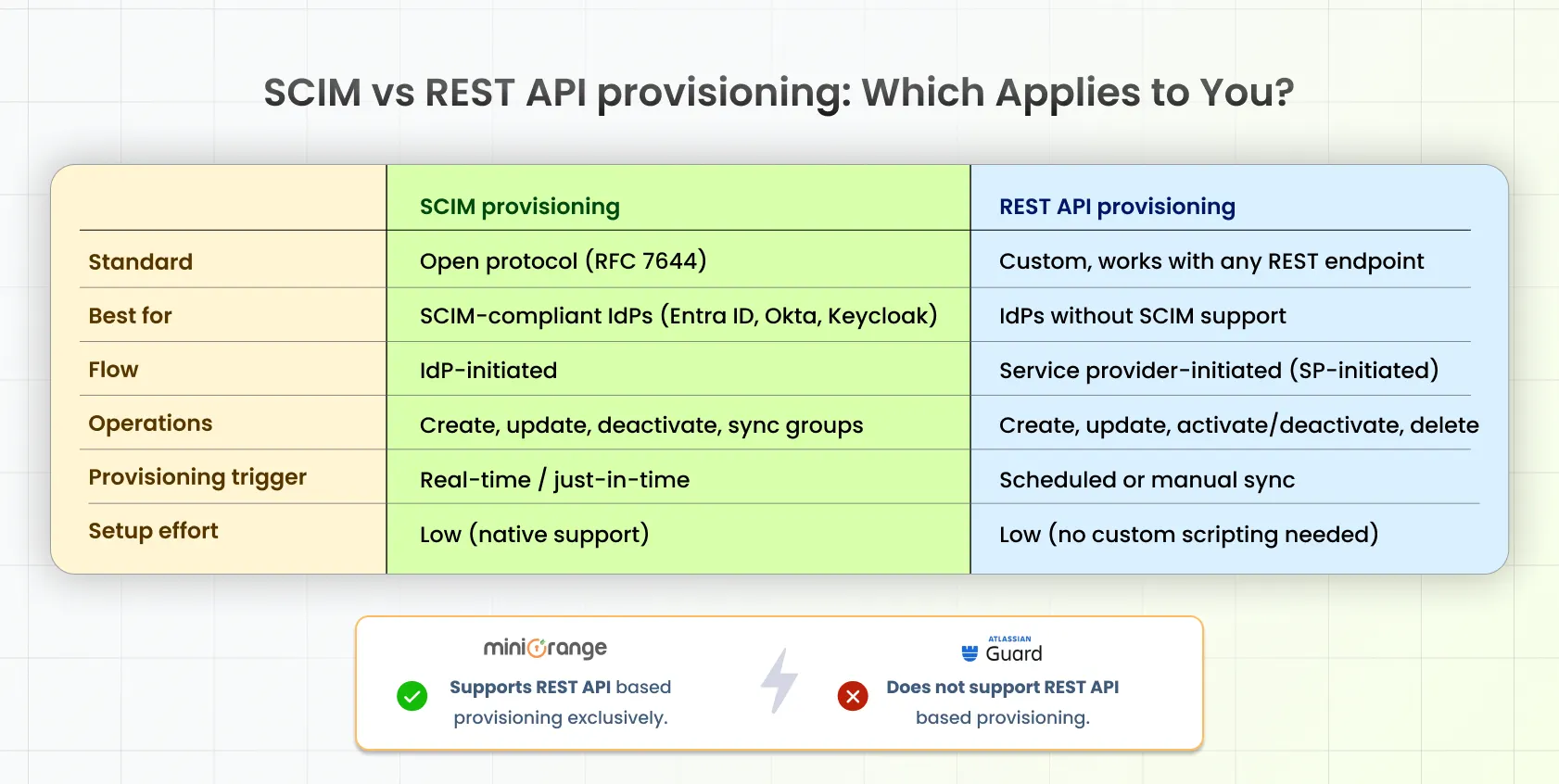
Atlassian Guard relies on SCIM for automated user provisioning and doesn't provide REST API-based provisioning as an alternative. That creates a gap for organizations using identity providers without SCIM support, leaving them with limited options for automating the user lifecycle.
That's the gap REST API provisioning closes.
REST API provisioning for non-SCIM identity providers
miniOrange supports REST API-based provisioning using a service provider-initiated (SP-initiated) flow. That means you can automate user management even when your IdP has no SCIM support at all.
With REST API provisioning, you can:
- Create new user accounts.
- Update existing user details.
- Activate or deactivate accounts.
- Delete accounts when they're no longer needed.
Integrate with virtually any system reachable over a REST API, including Google, Keycloak, or any other custom in-house IdPs.
The advantage is simple. You don't have to rip out and replace your identity provider to get automated provisioning. Keep your current setup and remove the manual work.
Why teams choose miniOrange
miniOrange builds provisioning for real Atlassian environments, including Cloud, Data Center, and hybrid deployments. Teams pick it for:
- Broad identity provider support, 20+ providers, from Entra ID, Okta, and Keycloak to any SCIM-compliant or REST API-based IdP.
- Both SCIM and REST API provisioning, all from one platform, whether your IdP is modern or not.
- Flexible attribute mapping, allowing you to sync standard and custom attributes to fit your directory.
- Auto deprovisioning and license reclaim, disabling users the moment they leave your IdP so you only pay for active seats.
- Regex username transforms and group filtering, so you provision only the groups you need and match usernames reliably.
- Detailed audit logs and admin controls, giving you full visibility, IdP-specific sync rules, and backup/restore.
- No stored credentials. Provisioning runs securely between your Atlassian instance and your IdP. miniOrange stores no user credentials or sensitive data.
The numbers behind it are compelling: 3X faster logins, up to 50% lower license costs, and 24×7 support, trusted by 3,000+ teams including NASA, Starbucks, Walmart, and Mastercard.
The business impact of automated provisioning
Automating provisioning isn't just easier for IT. It pays off across the organization:
- Faster onboarding, new hires get access on day one.
- Lower IT workload, with less time spent on repetitive account administration.
- Stronger security, because access is revoked the moment someone leaves, closing the offboarding gap.
- Reclaimed license spend, as deactivated users stop consuming paid seats.
- Audit readiness, with complete trails that make compliance reporting straightforward.
- Consistent access, ensuring the right permissions in every app, every time.
- Better scalability, so you can manage a growing directory without adding headcount.
A smoother onboarding experience, a stronger security posture, and a lighter load on IT.
Ready to automate user provisioning?
Whether you're already using SCIM or your identity provider isn't quite that modern, you can automate the entire user lifecycle in Jira and Confluence, from the day someone joins to the moment they leave.
See how miniOrange SCIM and REST API provisioning cuts manual work, tightens security, and reclaims license spend.
Explore the solution | Read the documentation
Frequently asked questions
Q. How is SCIM different from REST API provisioning?
SCIM is a formal protocol (RFC 7644) that many identity providers support natively. REST API provisioning is more flexible because it integrates with any system reachable over a REST API, making it ideal when your IdP doesn't support SCIM.
Q.Can I automate provisioning if my identity provider doesn't support SCIM?
Yes. miniOrange's REST API provisioning uses a service provider-initiated (SP-initiated) flow to automate user creation, updates, deactivation, and deletion. There's no need to replace your current identity provider.
Q. Which identity providers does miniOrange support?
miniOrange supports 20+ identity providers, including Entra ID, Okta, Google Workspace, OneLogin, Keycloak, and Oracle IDCS, along with any SCIM-compliant provider. Non-SCIM systems are supported through REST API integration.
Q. Does miniOrange support both Atlassian Cloud and Data Center?
Yes. miniOrange offers dedicated provisioning apps for Jira Cloud, Jira Data Center, Confluence, Bitbucket, and Crowd. Each app can be installed independently from the Atlassian Marketplace.
Q. Does miniOrange handle nested groups?
Yes. It synchronizes groups and nested groups and maps IdP groups to Atlassian internal groups, helping keep permissions and roles consistent across applications.
About the Author

Content Writer
Pallavi Narang is a content writer with more than 4 years of experience. She specializes in driving brand awareness and lead generation through compelling storytelling and strategic marketing campaigns. With a background in SaaS, cybersecurity, and data analytics, Pallavi excels in translating complex concepts into engaging narratives. Outside of work, she is either learning new languages or reading.
Leave a Comment