

Most online shoppers only look at the first page of search results. If your e-commerce store does not rank well, many potential customers will not see it. As online retail becomes more competitive each year, search engine optimization (SEO) is one of the best ways for store owners to attract the right visitors without relying only on paid ads.
This guide walks through what e-commerce SEO means, why it matters, the challenges online store owners commonly face, and the practical steps you can take to keep your product and category pages, and overall store SEO, healthy in 2026.
What is E-commerce SEO?
E-commerce SEO means improving your online store's product pages, category pages, site structure, and content so search engines can find, understand, and rank them for the right searches. Unlike SEO for a blog or a simple website, e-commerce SEO must handle large and changing catalogs, product options, filtered navigation, and seasonal inventory. These factors affect how search engines read and rank your store's pages.
Done well, ecommerce SEO helps potential customers find specific products, compare categories, and land on the right page at the moment they're ready to buy, rather than discovering a competitor first.
Why SEO Matters for E-commerce Stores
Better rankings translate directly into more of the traffic that matters: shoppers actively searching for products like yours. A well-optimized store benefits in several ways:
- More organic visibility. Ranking for product and category terms puts your store in front of shoppers earlier in their buying journey, often before they've decided which brand to purchase from.
- Lower dependence on paid ads. Organic search traffic doesn't carry a per-click cost, so a strong SEO foundation reduces how much a store needs to spend on ads to hit its traffic and revenue targets.
- Compounding returns. Unlike a paid campaign that stops the moment the budget runs out, an optimized product or category page can continue driving ecommerce website traffic for months or years.
- Better user experience. Many of the same fixes that help search engines clean URLs, working links, and clear navigation also make it easier for real shoppers to find what they're looking for, which supports both conversion rates and rankings.
Common SEO Challenges for E-commerce Owners
Online stores face a distinct set of e-commerce SEO challenges that content-only websites typically don't:
- Duplicate content. Product descriptions copied from manufacturers, or near-identical variant pages (different sizes or colors of the same item), can create duplicate content that confuses search engines and dilutes rankings.
- Broken links. Products get discontinued, moved, or renamed constantly. Every time that happens without a proper redirect, it can leave behind broken links and 404 errors that hurt both users and rankings.
- Indexing problems. Large catalogs, faceted navigation, and out-of-stock pages can create thousands of low-value URLs that waste crawl budget, making it harder for search engines to find and index the pages that actually matter.
- Changing product URLs. Renaming a product, updating a category structure, or migrating platforms can change URLs across the entire store, and without careful redirect management, that traffic and ranking history can be lost.
Why Choose miniOrange for E-commerce SEO?
Manually tracking sitemaps, redirects, broken links, and product URL structures across a large catalog is time-consuming and easy to get wrong. This is where a dedicated SEO plugin becomes useful. miniOrange's SEO plugin is built to simplify the technical side of running an SEO-friendly store, giving owners a single dashboard to manage sitemaps, redirects, site audits, and product-level optimization instead of juggling multiple tools or manual processes.
For store owners who want to focus on merchandising and growth rather than technical SEO upkeep, having these controls centralized in one plugin reduces the chance that a routine catalog change quietly costs the store its rankings.
How miniOrange SEO Plugin Helps E-commerce Owners
Manage Product URLs
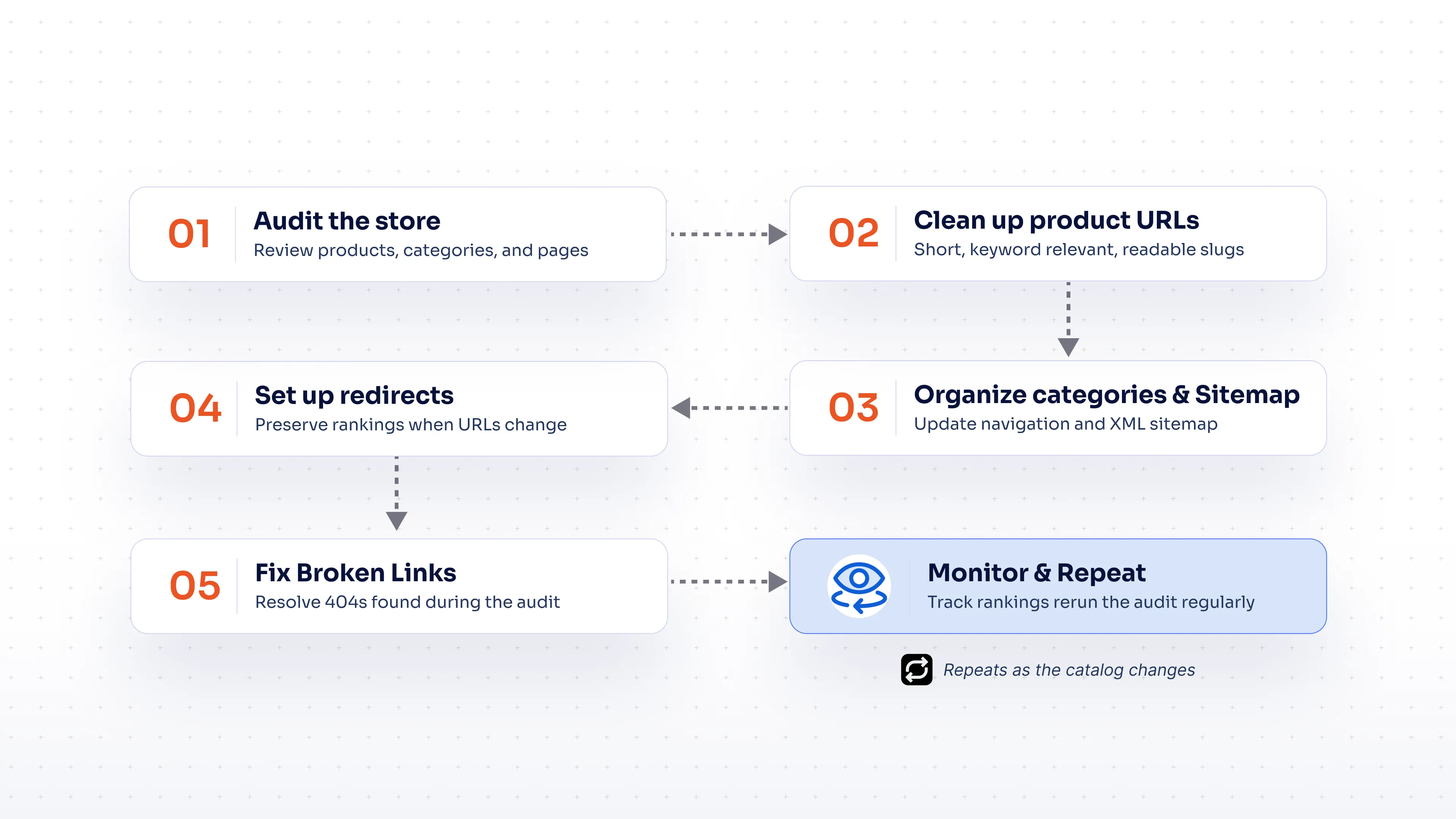
Clean, descriptive, keyword-relevant product URLs help search engines understand what a page is about and crawl it more effectively. Instead of long, parameter-heavy URLs generated automatically by a storefront platform, a well-structured URL Manager makes it easier to keep product URLs short, readable, and consistent, which supports both crawlability and a better experience for shoppers who see the URL in search results or share it directly.
Optimize Category Pages
Category pages act as the connective tissue of an online store, guiding both shoppers and search engines from broad searches down to specific products. Optimizing category pages with clear titles, unique descriptions, and logical URL structure improves navigation and makes it easier for customers to discover related products, which in turn supports longer site visits and better conversion potential.
Category Management for Better Store Organization
As a catalog grows, keeping categories organized becomes harder but more important. Structured category management helps ensure that new products are placed correctly, that categories don't overlap or compete with each other for the same search terms, and that the store's overall navigation stays intuitive as inventory changes.
Sitemap Management for E-commerce Stores
An XML sitemap acts as a roadmap that tells search engines which pages exist and how frequently they change. For stores with large or fast-changing catalogs, sitemap management ensures product, category, and landing pages are discovered promptly, rather than waiting for search engines to find them through crawling alone. This is especially valuable when new products launch or seasonal collections rotate frequently.
Manage URL Changes with Redirects
Products get renamed, discontinued, or reorganized under new categories all the time. When a URL changes without a proper redirect in place, the store risks losing both the traffic and the ranking history built up on that page. A redirect manager lets store owners map old URLs to their new destinations, preserving rankings and ensuring shoppers who click an old link or a bookmarked page still land somewhere useful.
Detect and Fix Broken Links
Broken links create dead ends for shoppers and signal poor site maintenance to search engines. Regularly scanning for and fixing broken links prevents 404 errors from accumulating, keeps the user experience smooth, and protects the overall SEO health of the store.
E-commerce SEO Best Practices for 2026
Several trends are shaping how online stores approach SEO this year:
- AI-driven search. Search engines increasingly summarize and answer queries directly, which makes clear, well-structured product information more important than ever for stores that want to be cited as a source.
- Structured data and product schema. Adding schema markup to product pages helps search engines understand pricing, availability, and reviews, and can improve how listings appear in search results.
- Image SEO. Optimized file names, alt text, and compressed images help product images surface in image search and contribute to overall page performance.
- Category-level optimization. As noted above, well-organized categories continue to be a foundation for both crawlability and user navigation.
- Ongoing technical SEO. Sitemaps, redirects, and broken link monitoring aren't one-time tasks; they need regular attention as a catalog evolves.
An SEO plugin that supports better crawling, indexing, navigation, and overall technical health gives store owners a practical way to keep up with these best practices without needing to manage every detail manually.
Conclusion
E-commerce SEO is an ongoing effort that touches product pages, category structure, technical health, and user experience all at once. Store owners who stay on top of clean product URLs, organized categories, up-to-date sitemaps, and properly managed redirects put themselves in a strong position to grow e-commerce website traffic sustainably.
Tools like the miniOrange SEO plugin make it easier to manage these moving parts from a single place, so store owners can spend less time firefighting technical issues and more time growing their online store SEO performance and sales.
FAQ
1. What is E-commerce SEO and why is it important for online stores?
E-commerce SEO is the process of optimizing an online store's product pages, category pages, and overall site structure so search engines can crawl, index, and rank them effectively. It matters because it drives organic traffic to a store without the ongoing cost of paid advertising.
2. How can SEO-friendly product URLs improve search rankings?
Clean, descriptive product URLs help search engines understand page content and crawl it more efficiently. They also make links easier for shoppers to read and trust, which can support both rankings and click-through rates.
3. Why are category pages important for E-commerce SEO?
Category pages organize a store's catalog into logical groups, helping both search engines and shoppers navigate from broad searches to specific products. Well-optimized category pages support discoverability and a smoother shopping experience.
4. How does an XML sitemap help search engines discover product pages?
An XML sitemap lists a store's important URLs so search engines can find and crawl them efficiently, which is especially useful for large catalogs or stores that add and update products frequently.
5. How does the miniOrange SEO Plugin help E-commerce store owners improve SEO?
The miniOrange SEO plugin centralizes sitemap management, redirects, broken link detection, and URL and category management in one dashboard, helping store owners maintain strong technical SEO health as their catalog grows and changes.

Leave a Comment