

Employees paste code into ChatGPT. They drop customer lists into Gemini for a quick summary. They upload a contract to an AI note-taker before a meeting starts.
None of it feels risky in the moment. But all of it can walk sensitive data straight out of your organization.
AI DLP exists to close that gap.
Artificial Intelligence Data Loss Prevention is built for browser tabs, copilots, and AI agents that touch data without anyone clicking send, not just the email-and-USB-drive scenarios legacy DLP programs were designed around a decade ago.
This article covers what DLP for AI actually means, where legacy DLP programs break down, what a modern DLP for AI solution needs to do, and how miniOrange approaches the problem for teams that don't have a Fortune 500 security budget.
What Is DLP for AI?
DLP for AI extends data loss prevention to cover how people, and increasingly machines, interact with AI tools. That means browser sessions with public LLMs, AI features built into Microsoft 365 and Google Workspace, third-party API integrations, and autonomous AI agents acting on data with no human in the loop.
Classic DLP watches for a file leaving through email or a USB port. AI DLP watches for a paragraph of source code pasted into a chat window, a spreadsheet dragged into an AI summarizer, or an agent pulling a customer record and forwarding it 3 steps down a workflow nobody signed off on.
One recent report from Thomson Reuters' 2026 Future of Professionals found that 34% of professionals use AI that their organization has not approved.
Think about a product manager prepping for a board update. They copy a draft revenue forecast into an AI tool to tighten the wording. Nothing about that action trips a firewall rule or an email filter. But it also just handed unreleased financials to a system outside the company's control.
That's the exact scenario legacy DLP was never built to catch, and it happens dozens of times a day across a typical mid-size company.
The goal hasn't changed: keep sensitive data from leaving your control. The surface area has just expanded and exploded.
AI Challenges Traditional DLP Tools
DLP security programs sorted the world into 4 boxes: email, endpoint, network, and a short list of approved cloud apps.
The process was also quite straightforward: set the policy, watch the traffic, respond to violations. It worked fine when data moved in predictable, mostly human-triggered ways.
AI blind spots show up in three specific places.
Blindspots in Browser Tabs
The browser-based chat window doesn't look like a file transfer. They look like ordinary web traffic. DLP coverage needs to reach browser sessions and SaaS-embedded AI, not just endpoints and email, or the client data someone pastes into a chat window slips through completely untouched.
Blindspots in Understanding User Intent
Here's where legacy DLP gets it wrong most often. A static block-or-allow policy treats every upload the same, whether it's routine or reckless. Most AI-related exposure comes down to deadline pressure: someone who didn't think about where that paste was going before it left the building.
A system that can't tell the difference either blocks too aggressively and gets bypassed, or allows too broadly and leaves data exposed.
Agentic AI raises the stakes further. When an agent can read a database, summarize it, and hand that summary to another tool automatically, the exposure isn't limited to one action a person took. Security teams need visibility into the full path: what the agent read, which tools it called, and where the output landed.
Blindspots Due to Data Type
Most legacy DLP programs were tuned for structured data: card numbers, government IDs, patterns that match a regex. What people paste into AI tools is usually unstructured. Meeting notes. Half-written code. A Slack thread copied for context. Classifiers built for spreadsheets and forms miss most of it.
Capabilities of DLP for AI
A DLP for AI solution needs to handle six things a legacy DLP tool was never designed for.
1. Visibility Across Channels with AI Activity
A DLP for AI solution needs to see where AI activity actually happens: browser sessions, AI features inside sanctioned SaaS platforms, API-based integrations, and the shadow AI tools employees adopt without asking IT first. A tool that only watches endpoints and email misses the browser tab where most AI activity actually lives.
2. Classification of Sensitive and Ordinary Data
Classification is what makes everything else work. If a system can't tell sensitive content from ordinary text in a chat message or a code snippet, policies either flood your team with false positives or miss the exposure entirely. Unstructured data doesn't carry the clean labels regex-based classifiers look for. A snippet that reads "patient ID 44192, discharge notes attached" needs to register as PHI even though it never matches a rigid pattern.
3. Behavioral and Intent-Based Context Awareness
Content alone doesn't tell you much. Two people uploading the same document to the same AI tool can carry very different risks depending on what else they've been doing. Someone using an approved assistant within normal patterns is low risk. The same person suddenly feeding them into an unapproved tool is a different story. Behavior-aware policy tells the two apart instead of treating a routine Tuesday the same as a resignation-week data grab.
4. Real-Time Policy Enforcement
Catching a leak after the fact doesn't help much once data has already reached a public model. Enforcement needs to happen at the moment of action, as the paste happens, as the upload starts, before the request leaves the browser. A block that fires 10 minutes later is a report, not a save.
5. Data Security Posture Management (DSPM) Before DLP
DLP protects data in motion. But if you don't know where sensitive data lives before it starts moving, you're always reacting after the fact. Pairing DLP with DSPM and Data Detection & Response (DDR) fills in the other half: continuous discovery of where sensitive data sits, who can reach it, and how it's already flowing.
6. Enforcing One Policy Across Cloud and SaaS
A large share of AI-related exposure happens inside SaaS platforms, not on a laptop or over email. AI features built into Microsoft 365, Google Workspace, and Salesforce generate activity that classic DLP was never built to reach. Policy needs to follow the data consistently across every surface it touches.
How AI DLP Works
Data Discovery and Classification
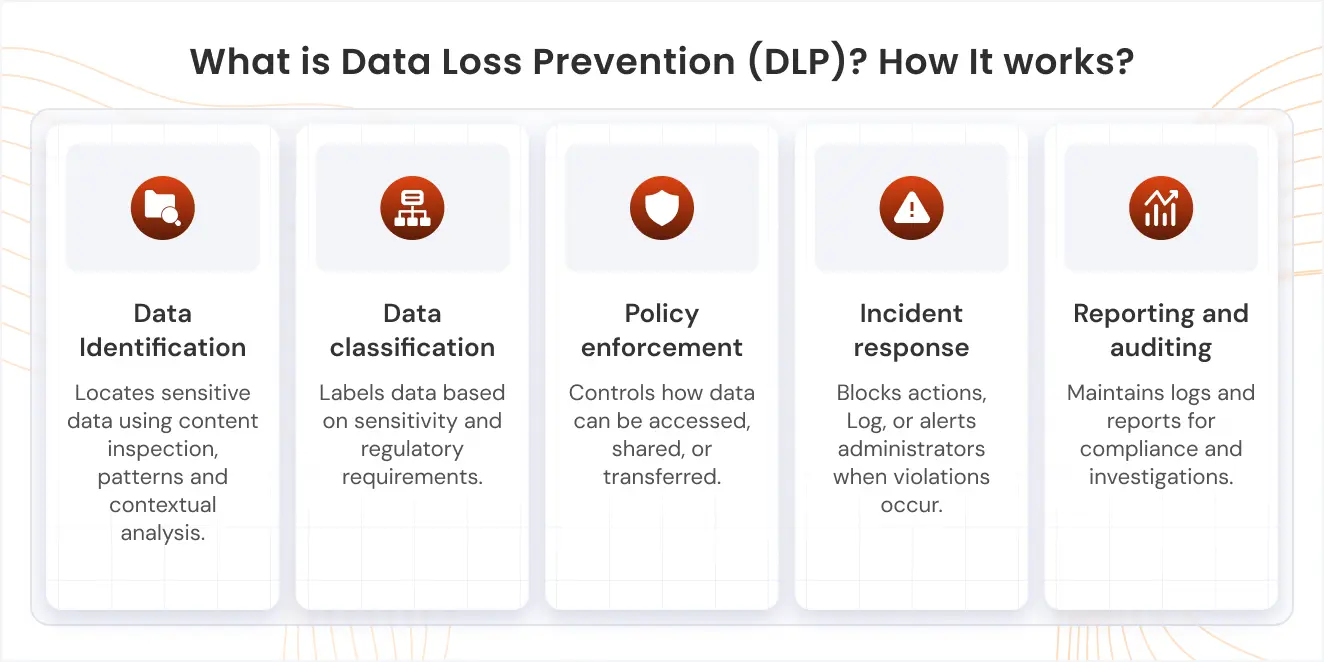
Before you can protect anything, you need to know it exists. AI DLP starts by scanning endpoints, cloud storage, SaaS platforms, and internal repositories to locate sensitive data, then classifies it by sensitivity and regulatory relevance. This step alone often surfaces data nobody remembered was sitting in an open folder.
Context-Aware Policy Enforcement
Once data is classified, policy decisions weigh more than content. Role, device, location, and destination all shape the response. A finance employee on a managed laptop might be allowed to do things a contractor on a personal device isn't, even with the exact same file.
Real-Time Monitoring and Prevention
AI DLP watches data movement continuously instead of leaning on periodic scans. When it spots a risky action, such as pasting a contract into a public chatbot or uploading a spreadsheet to an unsanctioned tool, it can block the transfer, redact the sensitive portion, or flag it for review within the same second the action happens. Some teams start in monitor-only mode for a few weeks to see what normal AI usage actually looks like before switching enforcement on.
Policy Customization
No two organizations handle risk the same way. A healthcare provider needs tight controls on patient records. A software company cares more about source code and API keys. AI DLP lets teams tune policy by department, data type, and region, with templates mapped to regulations like GDPR, HIPAA, and PCI DSS to cut down the manual setup work.
Pros and Cons of AI DLP
AI DLP solves real problems. It also isn't magic, and it's worth being straight about both sides before you buy anything.
Pros (What It Gets Right)
- Cuts false positives by reading context instead of just matching keywords.
- Extends visibility to browser-based AI tools and unstructured data that legacy DLP misses entirely.
- Adapts enforcement to actual behavior, so routine work doesn't get treated like a threat.
- Scales policy across departments and regions without rewriting rules from scratch each time.
Cons (Where It Needs Work)
- Classification models need tuning and time. Out of the box, they won't perfectly match your business context on day one.
- Behavioral baselines take time to build. The first few weeks can mean more false positives, not fewer, until the system learns what normal looks like.
- Agentic AI moves faster than most policy frameworks. Multi-step agent workflows are still a developing area across the industry and its vendors, including miniOrange.
- More visibility means more alerts at first. Teams need a systematic plan, not just a detection tool.
Note: Budget time for tuning alongside deployment, and most of this list stops being a problem within a few weeks.
How miniOrange AI DLP Protects Enterprise Data
miniOrange approaches AI-related data risk the same way it approaches every other data loss channel: find the data, classify it, control where it can go, then keep watching.
Data Discovery scans endpoints, cloud storage, and databases to locate sensitive information before anyone pastes it anywhere. Data Classification and Data Labeling then identify PII, financial records, and other high-risk content, and apply consistent labels so policy enforcement knows what it's looking at, whether that data sits in a spreadsheet or a half-written chat message.
From there, File Upload Controls stop confidential data from reaching non-compliant websites or applications, the same mechanism that keeps a customer list from landing in an unapproved AI tool. Content-Aware Protection inspects uploads and transfers in real time, scanning context rather than just filenames or extensions. Cloud DLP extends that same protection into Google Drive, OneDrive, Dropbox, and the other cloud apps where AI features increasingly live.
Real-Time Alerts & Analytics flag anomalies as they happen instead of surfacing them in a weekly report nobody reads until Monday. And miniOrange's Data Security Posture Management solution closes the loop, giving security teams a continuous view of where risk concentrates so policy tightens where it matters instead of everywhere at once.
Discover, classify, control, monitor, reassess. That's the lifecycle, and it runs continuously as AI usage grows inside your organization, not as a one-time rollout you finish and forget.
Why Choose miniOrange DLP for AI?
If your current DLP was built for email and USB drives, and your employees are already living inside AI tools, that gap is worth closing before it turns into an incident report.
And miniOrange does exactly that.
- Compliance-ready architecture: Policy templates map to GDPR, HIPAA, and other regulatory frameworks, with audit-ready logs that make compliance reporting less of a scramble.
- Easy integration: miniOrange connects with your existing identity providers, email platforms, and cloud apps, so deployment doesn't mean ripping out your current stack.
- Fast deployment: Teams can get policies live in days, not the months-long rollouts common with legacy DLP suites.
- Scale from SMB to enterprise: Enterprise-grade protection shouldn't require an enterprise-sized budget. Whether you're a 50-person team just starting to worry about DLP for LLMs or a global business managing thousands of endpoints, the same platform grows with you.
Conclusion
AI changed how data moves, who or what moves it, and how fast it can leave your control. Legacy DLP programs weren't built for browser tabs, unstructured pastes, or agents acting without a human clicking send.
AI DLP extends the visibility and context you already rely on to where work actually happens now: browser tabs, AI copilots, and the agents quietly moving data between them.
See how miniOrange DLP protects your data across AI tools, endpoints, and the cloud.

Leave a Comment