

Connecting an application to an Identity Governance and Administration (IGA) platform gives your team visibility into its users, accounts, and permissions. However, a working connection does not mean the application is ready for access governance.
To assess its governance readiness, check whether your team can identify the application owner, understand its permissions, match accounts with employee identities, revoke access, and track approval records.
Before onboarding an application, assess two things:
- Governance Priority: How urgently does the application need access governance?
- Application Readiness: Does it have the ownership, data, and integration capabilities needed for effective governance?
These two assessments help your team decide which applications to prioritize and which need preparation before onboarding.
IGA Connected Is Not the Same as Governed
An IGA connector pulls information from an application, such as user accounts, roles, and permissions. But having this data in your IGA platform does not mean your team has everything it needs to manage access.
For example, an application might have 500 user accounts, but 40 do not match any employee records. Reviewers might also see permission names they cannot understand, and nobody knows who should approve access.
Effective IGA integration needs four key capabilities:
- Data ingestion: Pulls user accounts, roles, and permissions from the application.
- Identity correlation: Matches application accounts with the right employee records.
- Access provisioning: Creates user accounts and assigns approved permissions.
- Access remediation: Updates or removes access when an employee's role changes or they leave.
Not every application supports all four capabilities. Some integrations only pull account and permission data. Others support access changes but do not provide complete entitlement details.
These limitations often lead to common access governance gaps:
- Unclear entitlements: Reviewers see technical permission names but cannot understand what access they grant.
- Unmatched accounts: Some application accounts do not link to verified identities.
- Missing application owners: Nobody takes responsibility for approving access or reviewing permissions.
- Incomplete access revocation: The integration retrieves access information but cannot remove permissions after an approval decision.
- Missing audit evidence: Records do not clearly connect an access request, approval, permission assignment, and revocation.
These gaps create everyday access issues. Employees might retain permissions after a role change, managers might approve access without knowing what it allows, and audit teams might struggle to verify timely access removal.
A successful identity governance and administration (IGA) program must address these issues.
Application Readiness vs. Governance Priority
Governance priority determines which applications need attention first based on risk, compliance, and business importance.
On the other hand, application readiness measures whether an application has the ownership, identity data, entitlement clarity, and integration capabilities needed for governance.
Assess them separately to prioritize onboarding and identify preparation gaps.
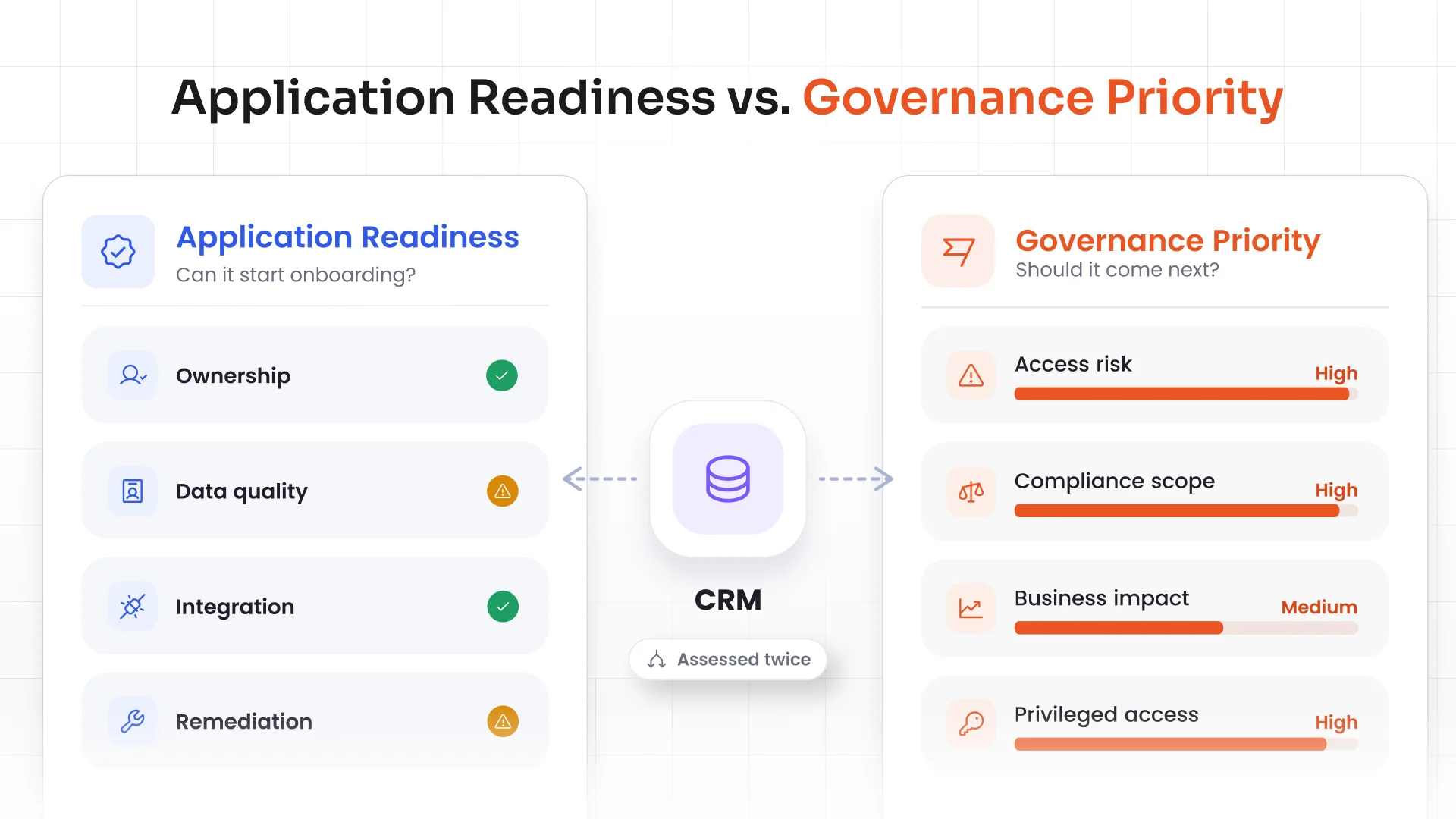
| Assessment | Governance Priority | Application Readiness |
|---|---|---|
| What does it answer? | Should this application come next? | Can this application enter onboarding? |
| What drives it? | Risk, compliance, and business criticality | Ownership, data quality, integration, and remediation |
| Who owns it? | Risk and business stakeholders | IAM delivery team and application owners |
| How quickly does it change? | Changes with business risks and priorities | Improves as preparation work progresses |
| What does it decide? | Application sequencing across rollout waves | Work required before onboarding |
What Determines Governance Priority?
Governance priority in IGA depends on the risk of unmanaged access. Assess each application based on:
- Data sensitivity: Does it store customer, financial, or other sensitive data?
- Regulatory and audit scope: Does it fall under specific compliance requirements?
- Privileged reach: Can users modify other systems, move money, or change critical business records?
- Population size and turnover: How many users access it, and how often does their access change?
- Known exposure: Does it have audit findings, orphaned accounts, excessive permissions, or standing admin access?
Prioritize applications with sensitive data, privileged access, and known security gaps. Apply risk-based access decisions and define priority levels using documented business risks, regulatory obligations, and your organization's risk appetite.
What Application Readiness Actually Measures
A governance-ready application needs more than a working integration. Your team must understand its users, permissions, ownership, and access removal process.
Assess application readiness across five areas. Give each area a score from 1 to 3.
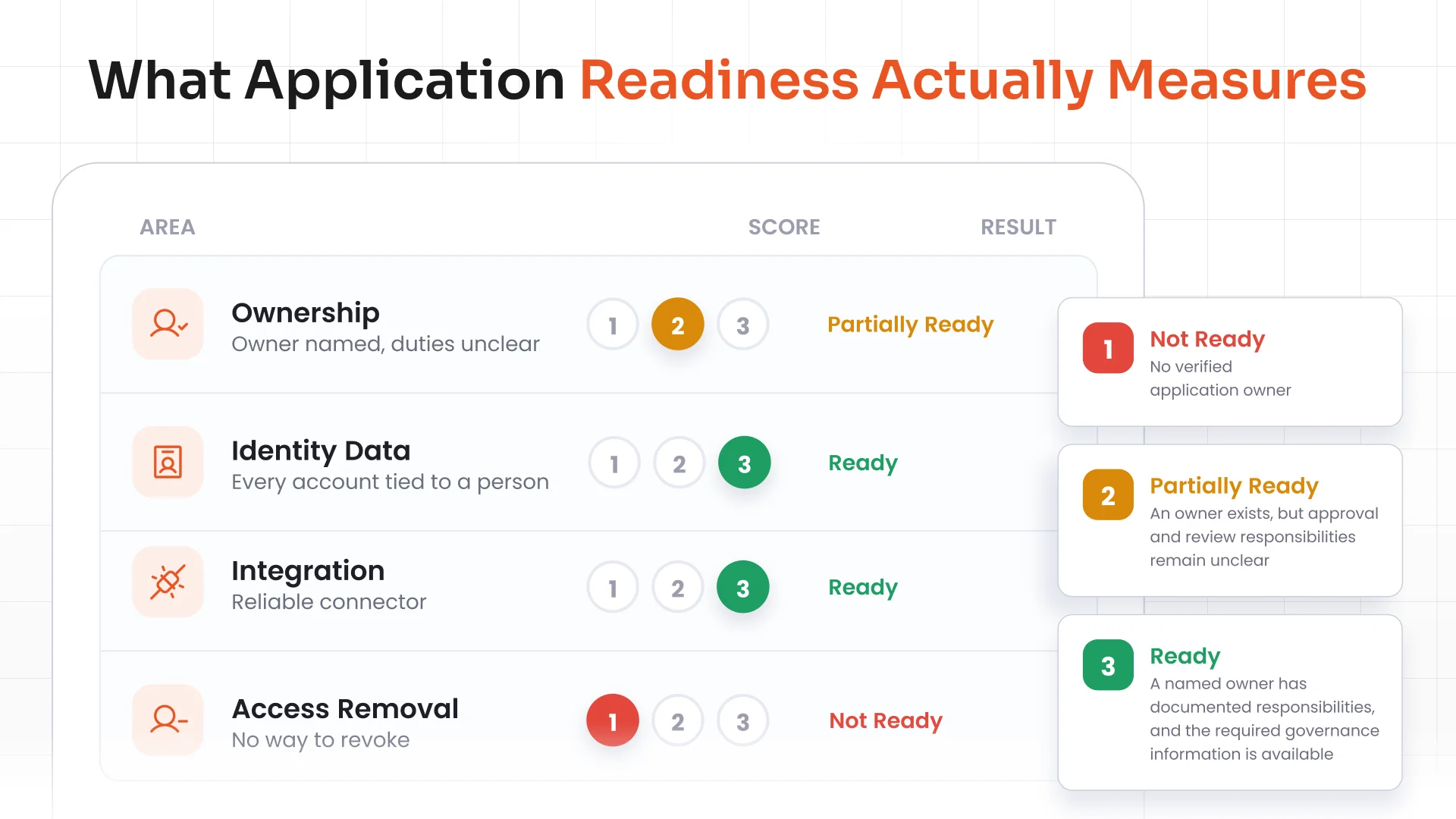
| Score | Meaning | Example |
|---|---|---|
| 1 | Not Ready | No verified application owner |
| 2 | Partially Ready | An owner exists, but approval and review responsibilities remain unclear |
| 3 | Ready | A named owner has documented responsibilities, and the required governance information is available |
This is a practical application readiness scoring model, not an industry-standard IGA maturity framework. Organizations should adapt its criteria to their application environments and governance requirements.
Five Areas to Assess
| Readiness Area | Assessment Question | What to Check |
|---|---|---|
| Owner clarity | Is there a named person responsible for access decisions? | Confirm ownership and documented approval and review responsibilities. |
| Identity data quality | Do application accounts match the correct identities? | Check employee, contractor, service, and other non-human accounts. |
| Entitlement understanding | Can reviewers understand what each permission grants? | Check permission descriptions, role mappings, and entitlement ownership. |
| Integration capability | Does the application support reliable data exchange? | Verify connector, API, synchronization, and write-back capabilities. |
| Remediation capability | Can the application execute approved access changes? | Test provisioning, permission updates, and revocation. |
A higher application readiness score indicates stronger onboarding readiness. However, the total score should not hide critical gaps. An application might score 12 out of 15 but still lack reliable access revocation. Review each area before approving onboarding.
Metrics to Track Alongside the Readiness Score
A readiness score shows whether an application meets the assessment criteria. These metrics help your team track improvements over time:
- Verified application ownership: Percentage of connected applications with a named, verified owner.
- Unmatched account rate: Percentage of application accounts without a verified identity match, tracked over time.
- Revocation execution time: Time between an access review decision and the actual removal of access.
Track these metrics across onboarding waves to see whether ownership, identity matching, and revocation improve.
The Four-Quadrant Model for Sequencing Onboarding
Once you assess governance priority and application readiness separately, plot both scores on a four-quadrant map.
This gives your team a practical way to decide which applications to onboard, which need preparation, and which can wait.
| Governance Priority | Application Readiness | Recommended Action |
|---|---|---|
| High | High | Onboard now. Include these applications in the first rollout wave. |
| High | Low | Prepare first. Assign an owner, standardize entitlements, and fix the integration path. |
| Low | High | Onboard when implementation effort is low or when the application supports another dependency. |
| Low | Low | Defer onboarding and schedule a reassessment. |
Define high and low thresholds based on your organization's needs. Governance priority should reflect data sensitivity, regulatory scope, and privileged access. Readiness should reflect the five assessment areas and any critical gaps.
Follow these actions for each quadrant:
- High priority, high readiness: Include these applications in the first rollout wave. Their risk justifies immediate attention, and their readiness supports onboarding.
- High priority, low readiness: Fix ownership, identity matching, entitlement, and integration gaps before setting an onboarding date.
- Low priority, high readiness: Schedule these applications after higher-risk systems, unless they require little effort or support a key dependency.
- Low priority, low readiness: Defer onboarding and reassess when business priorities or governance capabilities change.
Avoid filling early rollout waves with easy, low-risk applications while critical systems remain unmanaged. Track onboarding progress by risk reduction, not by the number of connected applications.
Share the quadrant map with application owners and business stakeholders so they understand onboarding decisions and preparation requirements.
The Governance-Readiness Checklist for Every Connected Application
Before completing onboarding, verify these eight areas:
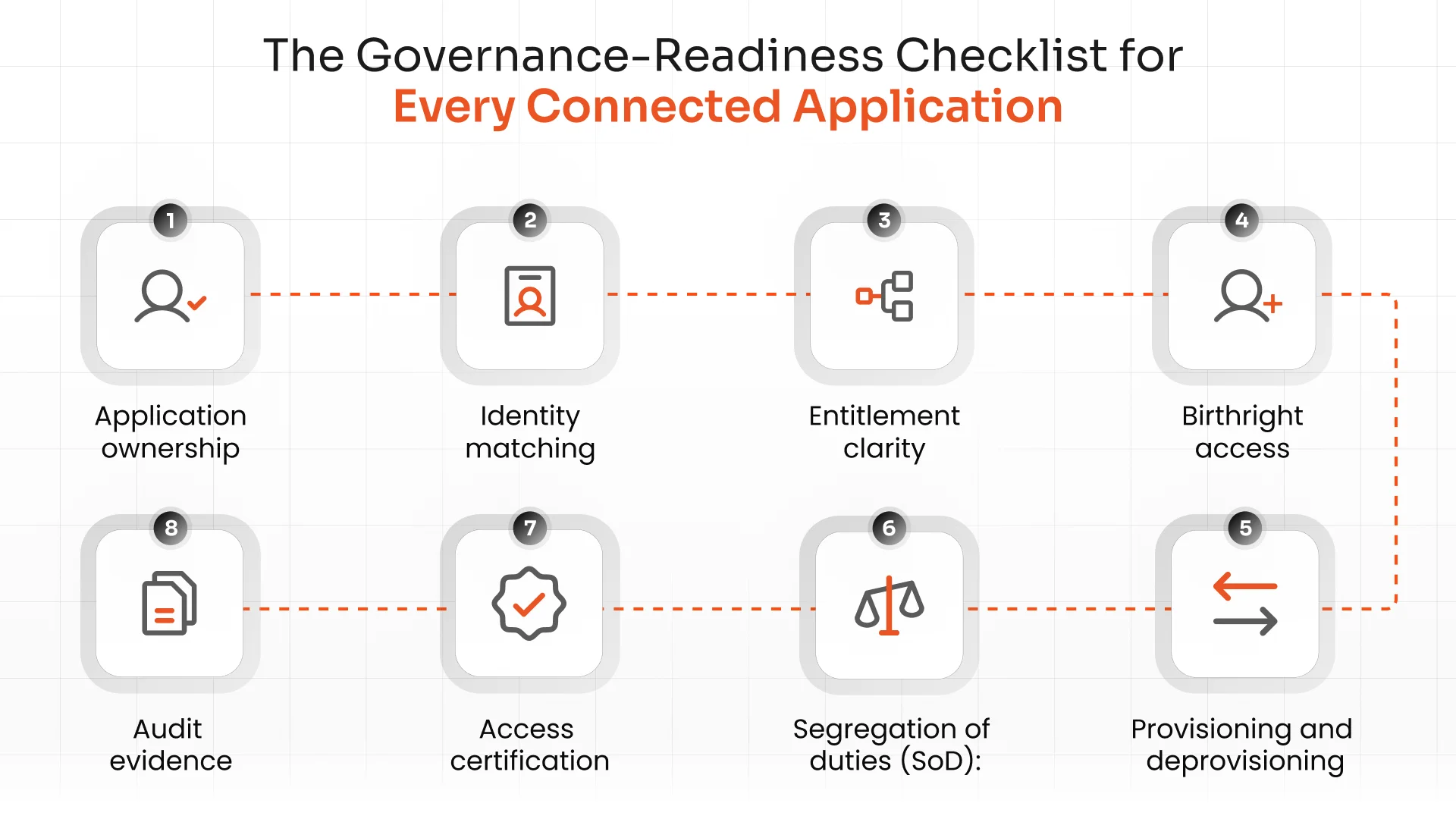
- Application ownership: Is a named person responsible for access approvals, reviews, and revocation?
- Identity matching: Do application accounts link to verified employee or external identities? Are non-human accounts documented with an owner and purpose?
- Entitlement clarity: Do reviewers understand what each permission allows?
- Birthright access: Are standard permissions assigned through approved roles or identity attributes?
- Provisioning and deprovisioning: Does the integration support access assignment and removal? If remediation requires manual work, is there a documented process and SLA?
- Segregation of duties (SoD): Are conflicting permissions identified and controlled where relevant?
- Access certification: Does the application provide reliable data for access reviews?
- Audit evidence: Do records track access requests, approvals, assignments, reviews, and revocations?
Requirements vary by application risk, business purpose, and regulatory scope.
Assign an owner and due date to every failed check. Treat each gap as a preparation task, not a reason to exclude the application.
Understanding how access certification campaigns work also helps your team prepare applications for recurring access reviews.
Where Governance-Ready Applications Still Break After Go-Live
An application might meet every readiness requirement during onboarding but develop gaps later. Monitor these common issues:
- Ownership changes: Nobody takes over access approvals and reviews.
- New entitlements: Application updates introduce undocumented permissions.
- Connector failures: The IGA platform stops receiving current account and entitlement data.
- Incomplete synchronization: Some accounts, permissions, or updates remain missing.
- Broken revocation: Integration changes interrupt access removal.
- Permanent exceptions: Emergency access remains active after the incident ends.
Monitor these indicators:
- Last successful sync: When did the integration last retrieve application data?
- Data freshness: Does the IGA platform contain current account and entitlement information?
- Sync failures: Did scheduled jobs fail or return incomplete data?
- Entitlement changes: Did application updates introduce unrecognized permissions?
Treat connector health alerts as governance issues. Outdated data affects access reviews and decisions.
Review ownership, entitlements, data freshness, and revocation regularly and after significant application updates.
Standards That Support the Readiness and Priority Split
Security frameworks provide guidance for assessing application risk and governance readiness. They do not prescribe the scoring model in this article.
| Framework | Control Reference | Relevance |
|---|---|---|
| NIST CSF 2.0 | GV.OC: Organizational Context | Helps align governance priorities with business needs and regulatory obligations. |
| NIST CSF 2.0 | ID.AM: Asset Management | Supports application inventory and asset visibility. |
| CIS Controls v8.1 | Control 5: Account Management | Supports the management of user, administrator, and service accounts. |
Map these references to your organization's policies, regulatory obligations, and application requirements. They provide supporting guidance, not a universal readiness score.
Common Mistakes When Onboarding Applications into IGA
Avoid these common IGA application onboarding mistakes:
- Treating a working connector as proof of completed governance.
- Combining governance priority and application readiness into one score.
- Prioritizing easy, low-risk applications over critical systems.
- Onboarding high-priority applications before their data supports meaningful reviews.
- Assigning a team alias instead of a named application owner.
- Presenting unclear permission names to business reviewers.
- Treating low readiness as a permanent reason for exclusion.
- Assuming every connector supports automated provisioning and deprovisioning.
- Measuring connected applications instead of governed applications.
Track governance outcomes alongside integration progress. Connector counts show data coverage. Verified ownership, reliable access reviews, and completed revocations show governance progress.
For a broader onboarding playbook, see how to scale IGA application onboarding and application onboarding in IGA.
How miniOrange Makes Connected Applications Governance-Ready
miniOrange IGA helps organizations centralize application governance, policy enforcement, and audit records across connected systems. It supports the activities required to move from application discovery to ongoing access governance.
Your team can:
- Discover applications: Identify and inventory applications across the organization, including systems missing from the documented application portfolio.
- Establish ownership: Assign accountable application owners before starting access reviews and certification campaigns.
- Standardize entitlements: Organize permissions and define roles so business reviewers understand the access they approve.
- Enforce access policies: Apply policies during access requests, approvals, and permission assignments. Include segregation-of-duties (SoD) checks to identify conflicting access.
- Automate access changes: Manage provisioning, deprovisioning, and access revocation so approved review decisions lead to action.
- Maintain audit records: Centralize governance activity and retain evidence of access decisions and related actions.
miniOrange supports access policy enforcement at the request, approval, and grant stages to apply access rules throughout the lifecycle. Its access governance capabilities help manage permissions, access reviews, and ownership across connected applications.
Together, these capabilities support application discovery, entitlement management, controlled access decisions, and automated remediation.
Explore miniOrange Identity Governance to learn how it brings these governance activities together.
Frequently Asked Questions
What does it mean for an application to be governance-ready?
An application is governance-ready when it has a verified owner, reliable identity data, understandable entitlements, a supported integration, and a working remediation process. These capabilities support access reviews, provisioning, deprovisioning, and audit tracking.
What is the difference between application readiness and governance priority in IGA planning?
Governance priority determines which applications need attention first based on risk, compliance, and business criticality. Application readiness measures whether an application has the ownership, data quality, integration, and remediation capabilities needed for onboarding.
Can an application be connected to an IGA platform but still not be governed?
Yes, an application might share account and entitlement data with an IGA platform without supporting effective governance. Missing ownership, unmatched accounts, unclear permissions, and incomplete revocation prevent reliable access management.
What should you do with a high-priority application that is not ready to onboard?
Create a preparation plan. Assign an owner, resolve identity matching issues, standardize entitlement descriptions, establish a reliable integration, and test revocation. Give every task an owner and deadline.
Is a low readiness score a reason to skip an application permanently?
No, a low score identifies gaps your team needs to resolve. Improve ownership, entitlement quality, integration, and remediation, then reassess the application. Keep its governance priority visible.
Who should be named as the owner of an application in IGA?
A business or application stakeholder should take responsibility for access approvals, permission validation, and access reviews. The owner needs to understand the application's purpose and have authority over access decisions. A team alias does not establish individual accountability.
How do you know whether entitlement data is good enough for an access review?
Reviewers should understand what each permission grants, which business function requires it, and whether the access remains necessary. Resolve identity mismatches and document exceptions before launching the campaign.
Which metrics show whether an application is actually governed?
Track these three metrics:
- Verified application ownership: Percentage of connected applications with a named, verified owner.
- Unmatched account rate: Percentage of accounts without a verified identity match.
- Revocation execution time: Time between an access review decision and actual access removal.
These metrics help measure ownership, identity quality, and remediation.
Leave a Comment