
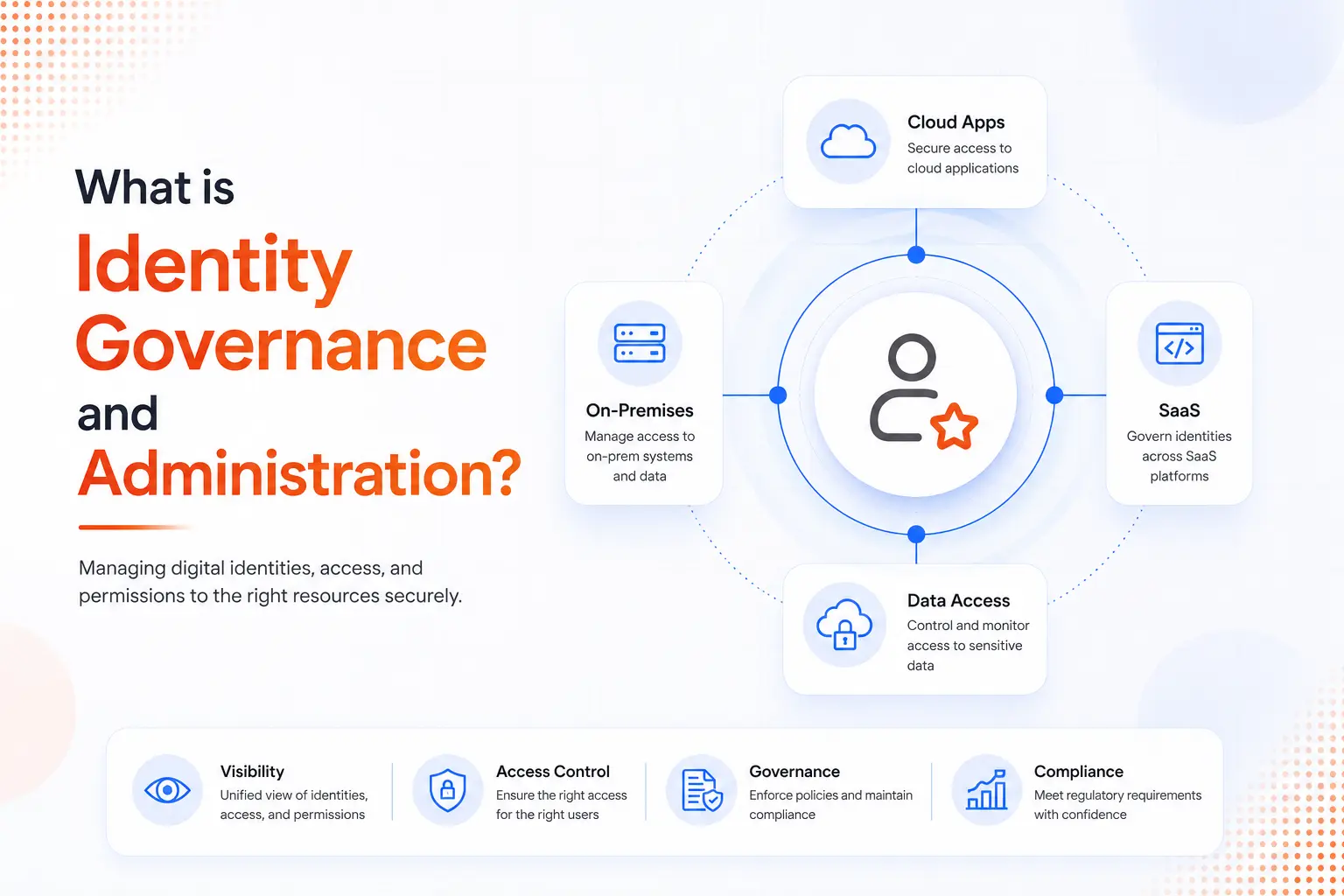
Identity governance answers three basic questions: Who or what has access? Should it have that access? And can you prove it later?
Organizations have managed their employees this way for years. Every employee has an account, an owner, and a business reason for their access. But AI agents introduce new identities that require the same level of governance.
Think about what an AI agent actually does. It is software that reads your data, connects with other applications, and makes changes entirely on its own. To pull that off, it needs permissions. If you just grant that access and look away, you are leaving a massive blind spot in your security.
Governing AI agents through identity governance and administration (IGA) simply means applying your existing security rules to them. You track who owns the agent, check what it can access, and review those permissions regularly.
Why AI Agents Are the Newest Non-Human Identity (NHI)
Non-human identities (NHI) are not new. Service accounts, API keys, and AI chatbots have operated in the background for years. However, AI agents are a newer type of non-human identity, and they behave very differently from traditional ones.
Three key factors set them apart:
- They Are Created Quickly: Developers or business users can set up an agent in minutes, often without raising an IT support ticket.
- They Act Autonomously: An agent can chain multiple steps together and interact with several systems without human intervention at each stage.
- They Access Multiple Systems: A single agent might read a database, send messages through a chat application, and update records, all using the same identity.
This combination of speed and autonomy creates a massive security blind spot. Because these agents are so easy to deploy, they rapidly multiply across your network, often running entirely unnoticed.
You cannot manage what you cannot see. Organizations need total visibility into their AI agents, including who owns them and exactly what data they can access.
Establishing solid machine identity hygiene provides a strong foundation. The next step is to govern AI agents and non-human identities using the exact same identity governance and administration (IGA) platform you rely on for your human workforce.
If you want to start with the fundamentals, learn what AI agent identity actually means before exploring how to govern them.
Where Identity Governance and AI Governance Work Together
When we let AI agents act on their own, we have to ensure they do so securely. To protect the system, cybersecurity teams use two different tools: Identity Governance and AI Governance. They sound similar, but they tackle completely different sides of the problem.
Identity governance decides and records access. It answers who approved an agent, what it can reach, and whether that still makes sense. On the other hand, AI governance monitors behaviour while the agent runs. It looks at what the agent actually does, step by step, once it is live.
Think of a new employee. On day one, HR and IT decide which systems the person can use and why. That is identity governance. After that, a manager watches how the person works and steps in if something looks off. That is closer to AI governance. The first sets access. The second monitors behaviour.
Neither replaces the other. If you only decide access and never monitor runtime behaviour, you miss misuse. If you only monitor behaviour and never review access, permissions pile up without access certification. Here is how to tell them apart:
| Identity Governance | AI Governance | |
|---|---|---|
| Primary focus | Decides who or what gets access | Watches what the agent does at runtime |
| Documentation | Records owner, purpose, and approval | Flags unusual or unsafe behaviour |
| Cadence | Reviews and certifies access on a schedule | Monitors actions continuously |
| Core question | Answers "should it have this access?" | Answers "is it acting as it should?" |
Keep both. One sets the rules. The other checks the play.
Questions Your Identity Governance Program Should Answer for Every AI Agent
Before you worry about what an agent does at runtime, make sure you can answer the governance questions. These are about ownership and lifecycle, not behaviour. If an agent cannot pass this list, it should not hold access.
- Who owns it? A named person, not a team inbox.
- Why does it exist? A short business reason you could say out loud.
- What access does it have? Every system and permission, written down.
- Who approved that access? A real access request with a decision behind it.
- How long should it live? A date, not "until someone remembers."
- Can it be certified? It shows up in your reviews like any user.
- Can it be turned off? You can revoke its access in one clear step.
- Can you trace it back? You hold audit evidence of what it was granted and why.
If the answers are clear, the agent is governed. If they are not, you have an agent nobody is accountable for. That is the one you will be explaining to an auditor later.
Treat AI Agents Like Any Other Identity in the Lifecycle
Every user account moves through a standard lifecycle. IT teams create the account, grant access, review permissions, and eventually shut it down. AI agents must follow the exact same path. The steps below outline the AI agent lifecycle, giving every stage a clear owner and a strict exit point.
| Stage | What Happens | Owner | Exit Point |
|---|---|---|---|
| 1. Discover | Find the agent and record it as a formal identity. | Identity team | Drop it if it has no clear business use. |
| 2. Assign an Owner | Tie a specific, named person to the agent. | Manager or app owner | No owner means no access. |
| 3. Grant Least Access | Give the agent only the permissions the task needs. | Access approver | Deny or trim over-broad access requests. |
| 4. Add to Reviews | Put the agent into your normal access review cycles. | Reviewer | Remove any access the review rejects. |
| 5. Watch Behavior | Monitor what the agent does at runtime. | Security team | Pause the agent immediately on unsafe activity. |
| 6. Retire and Revoke | Shut the agent off when its job ends. | Owner | Pull every credential and close the identity record. |
This is the same provisioning and deprovisioning process used for employees, adapted for AI agents with least-privilege access from the start.
For a deeper walkthrough of each stage, see our guide on AI agent lifecycle management.
Give Every Agent an Owner and a Reason to Exist
Clear ownership helps teams review access properly. When someone is responsible for an agent, they can check whether it still needs access. Without an owner, teams might skip reviews, allowing unused accounts to pile up.
Record the owner's name and a short note explaining what the agent does and why it needs access. If no one takes responsibility for an agent or knows why it exists, check whether you should disable it.
Match Identity Governance to the Actual Risk
Not every AI agent needs the same level of oversight. An agent that reads public reports poses a completely different threat than one that transfers money or changes user records. Applying your strictest controls to every single AI agent will slow down operations and overwhelm your reviewers.
Risk-based governance means classifying agents by the sensitivity of the data they access, the permissions they hold, and the potential impact of their actions.
- Low Risk: Read-only access to public or non-sensitive data. Periodic reviews.
- Medium Risk: Access to internal systems or the ability to modify non-critical records. Standard reviews and monitoring.
- High Risk: Access to sensitive customer data, financial systems, or production environments. More frequent reviews, time-limited access where practical, and stricter controls.
Apply governance comparable to each agent's risk. Reassess the classification when its permissions, purpose, or access to data changes. This helps organizations scale governance without overwhelming reviewers.
Risk tiers work best when policies are enforced throughout the access lifecycle. With access policy enforcement at the request, approval, and grant stages, high-risk agents can trigger additional checks while lower-risk requests avoid unnecessary delays.
Make least privilege the default for AI agents, and grant standing access only when there is a clear business justification.
Metrics That Show You Are Governing Agents
It is easy to report the wrong number. "We connected 400 AI agents" sounds like progress. It is not. Connection is not governance. Measure whether those agents are owned, scoped, reviewed, and retired on time.
Track three things: coverage, access quality, and user lifecycle health.
| Metric | What It Tells You |
|---|---|
| Governance Coverage | Share of agents with a named owner and a business reason. Low coverage means shadow AI. |
| Least Access Rate | Share of agents on least access versus broad access. Shows how tight your grants are. |
| Review Completion | Share of agents reviewed on schedule. Shows your access certification is actually running. |
| Orphaned Agents | Count of agents with no owner. The number you want near zero. |
| Agent Offboarding Time | How long from "job done" to access revoked. Slow offboarding leaves access open. |
| Audit Readiness | Share of agents with full audit evidence on hand. Shows you can answer an auditor fast. |
AI Agent Identity Governance Best Practices to Avoid Common Mistakes
Effective AI agent governance requires more than connecting AI agents to your systems. Organizations need clear ownership, controlled access, regular reviews, and a process for retiring agents when they are no longer needed.
- Use Your Existing Identity System: Do not build a separate process. Put AI agents directly into the identity governance and administration (IGA) system you already use.
- Assign Every Agent an Owner: Document exactly who is responsible for each agent and why it exists. Agents without owners are dangerous and hard to manage.
- Apply Least Privilege: Give the agent only the permissions it needs to do its exact job. Avoid broad, permanent access and use short-lived credentials whenever possible.
- Review Access Regularly: Annual reviews are not enough. Check permissions whenever an agent's job or risk level changes, and include them in your normal access review cycles.
- Combine Reviews With Monitoring: Monitoring shows what an agent is actually doing, while access reviews confirm if it still needs those permissions in the first place.
- Manage the Full Agent Lifecycle: Set clear expiration dates. When an agent finishes its job, retire it and cut off its access immediately.
- Measure Governance, Not Just Connections: Counting how many agents are connected to your systems means nothing if you do not know who owns them, what they can access, or when they were last reviewed.
These practices help make AI agent governance part of everyday identity management. A unified identity platform and consistent access governance processes can help organizations manage AI agents without creating separate governance workflows.
How miniOrange IGA Governs Human and AI Identities in One Place
As AI agents take on more tasks, your existing identity governance processes need to cover them alongside employees and other non-human identities.
miniOrange IGA brings them under one platform, so your team can track who owns each identity, control its access, review permissions, and manage its entire lifecycle.
- Discovery: Identify AI agents and service accounts across connected systems and bring them into a centralized view.
- Ownership: Assign an accountable owner to each agent and document its business purpose.
- Least Privilege: Grant only the permissions each agent needs to perform its tasks.
- User Lifecycle Management: Manage provisioning and deprovisioning as agents are created, updated, or retired.
- Access Reviews: Include AI agents in access reviews and certification campaigns to verify that their permissions remain appropriate.
A unified approach can reduce the need for separate governance processes and make it easier to maintain consistent access policies and audit evidence.
Frequently Asked Questions
Are AI agents non-human identities (NHI)?
Yes. An AI agent is a non-human identity, the same category as service accounts, API keys, and bots. It holds access and acts in your systems, so it needs an owner, a scope, and a review like any other identity.
Is AI governance the same as identity governance?
No. Identity governance decides and records what access an agent has. AI governance watches how the agent behaves at runtime. One sets the access. The other checks the action. You need both.
Does identity governance already cover AI agents?
It can, if you include them. The questions and controls are the same ones you use for people. Most teams just have not added agents to their reviews and lifecycle yet. That is the gap to close.
Who should own an AI agent?
A named person, usually the manager or application owner who relies on it. Not a team inbox and not "IT in general." Ownership is who answers when a reviewer asks whether the agent still needs its access.
Do AI agents still need access reviews if you already monitor them?
Yes. Monitoring shows what an agent does. A review confirms whether it should hold that access at all. Monitoring without reviews leaves permissions unchecked. You want both.
How do you govern an AI agent that was created inside an application?
Discover it first, then bring it into your identity system like any other agent. Give it an owner, scope its access, add it to reviews, and set an end date. An agent built inside an app is still an identity you need to see and control.
How do you measure progress governing AI agents?
Track coverage, access quality, and lifecycle health. Share agents with an owner, share on least access, share reviews on time, and how fast you offboard. Those tell you more than how many agents are connected.
About the Author

Content Writer
Alankrita Shrivastava is a B2B technical content writer specializing in SaaS, cybersecurity, and WordPress security. She translates complex security concepts into clear, practical insights that support both technical decision-making and business outcomes. At miniOrange, she develops content on IAM, including SSO, MFA, and User Lifecycle Management, along with WordPress Plugin Security. She also covers broader security areas such as UEM, MDM, CASB, and DLP. Her work focuses on real-world use cases, security best practices, and solution-driven guidance that helps organizations assess risks, improve access control, and strengthen their overall IT security posture.
Leave a Comment