

AI agents are moving from pilots to production very quickly. As per the PwC’s AI Agent Survey, 79% of the senior executives are already adopting AI agents in their companies.
As agents start calling APIs, retrieving data, coordinating tools, and taking action across systems, the real question is no longer whether they are useful. It is whether each agent can prove who it is, what it is allowed to do, and when that access should expire.
That is why workload identity for AI agents is becoming central to modern security strategy. For enterprises building IAM for agentic AI, the old pattern of shared service accounts, static API keys, and long-lived tokens creates unnecessary risk, weak auditability, and poor non-human identity management.
In practice, AI agents now sit alongside humans and software workloads as first-class actors in enterprise systems. That shift makes workload identity management, machine identity security, and AI agent access control foundational, not optional.
The AI Authentication Gap is Getting Harder to Ignore
Human IAM was designed around Active Directories, user lifecycles, and predictable access patterns. AI agents do not behave that way. They can be created dynamically, run for a short time, invoke multiple tools, and operate with delegated authority across environments.
That mismatch is at the heart of today’s AI identity crisis. When teams secure agents with static secrets or shared credentials, they lose the ability to attribute actions cleanly, scope access precisely, and revoke permissions without collateral damage.
This is also why agentic AI security cannot be treated as a small extension of traditional IAM. As per the recent updates from Microsoft, every agent must be governed, observable, and secure.
Leaders must be able to:
- Limits agent’s access
- Observe that agents do
- Stop what agents must not do
- Inventorize which agents exist
- Check who owns the agents
A centralized agent control helps in consistent governance, regardless of deployment or platform. Furthermore, workload identity is a way to ensure what agents can access.
What Is Workload Identity?
At a practical level, workload identity is a cryptographic identity assigned to a non-human compute entity such as a service, container, function, Virtual Machine (VM), or AI agent. Instead of embedding a static secret in code or configuration, the workload proves its identity and receives access based on trust policies and runtime context.
This usually involves short-lived credentials, automated rotation, and policy-based authorization. In cloud-native environments, open standards such as Secure Production Identity Framework for Everyone (SPIFFE) are commonly used to represent machine identity.
The representation is often done through SPIFFE Verifiable Identity Documents, or SVIDs, that identify what the workload is and where it runs.
A simple way to think about it: an API key is like handing every contractor the same master key and hoping nobody copies it. Workload identity is closer to issuing each person a time-bound badge that proves who they are, where they belong, and what doors they can open.
The Three Actors in Modern Identity
Enterprise identity now revolves around three major actors:
- Humans, who typically use directory-backed identities and stable lifecycle controls.
- AI agents, which act autonomously or semi-autonomously, often with delegated authority and dynamic execution patterns.
- Machines and workloads, including services, containers, functions, and infrastructure components that also need verifiable machine identity.
The important distinction is that AI agents often combine the characteristics of both software and decision-making actors. They do not just authenticate once and sit idle.
Agents call tools, orchestrate actions, and can inherit or use delegated permissions, which is why AI agent authentication needs more than a reused service account.
Why AI Agents Make Workload Identity Urgent
AI agents increase both the scale and complexity of non-human access. As they spread across customer support, DevOps, internal operations, and decision support, identity gaps become prominent.
Here are the three reasons the urgency is growing:
1. Agents Operate with Speed and Delegated Authority
If an agent can trigger a workflow, query a system, or act on behalf of a user, the enterprise needs to know exactly which agent acted, under what policy, and with what permission boundary.
2. Agents are Dynamic and Ephemeral
Unlike many human users, agents and workloads can appear and disappear quickly.
This is where ephemeral credentials matter. When access is short-lived and automatically refreshed, the blast radius of a leaked credential drops significantly compared with a hardcoded token that lives for months.
3. Agents Multiply the Authentication Surface
One employee may have one identity. One AI-driven process may involve multiple agents, tools, APIs, model providers, and downstream systems.
This makes zero trust AI agents a more realistic design principle than implicit trust. Every call should be evaluated based on identity, context, and policy, rather than assuming that anything inside a trusted environment is safe.
The Shift from Secrets to Workload Identity
With static secrets, the system checks whether a presented key or token matches a stored value. That tells you whether a credential is valid, but not always whether the caller is the specific workload you intended, whether it is running in the right environment, or whether that access should still exist.
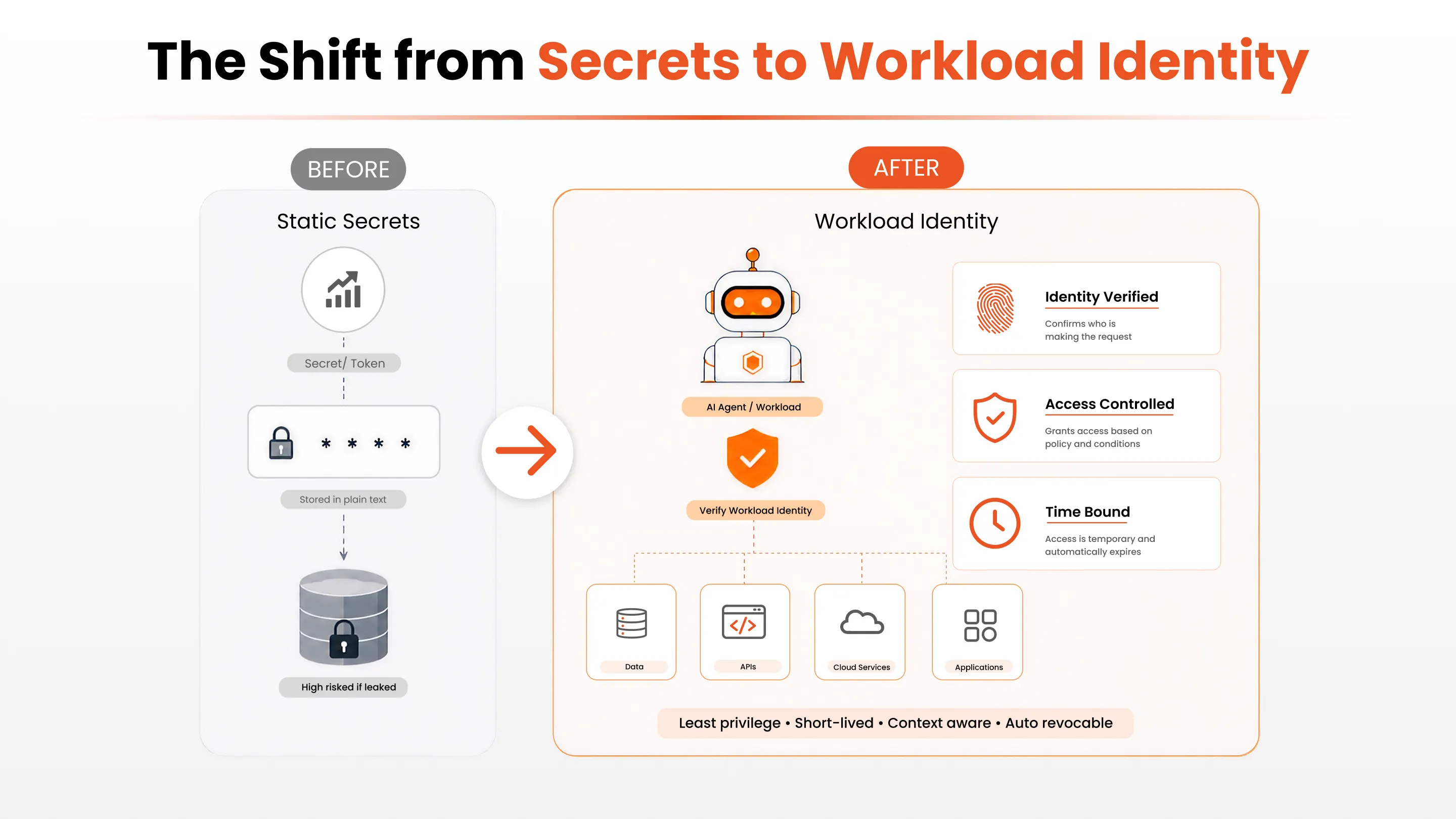
With workload identity, the system starts with a stronger question: what workload is making this request right now, under what attested conditions, and what should it be allowed to access? That is a much better fit for AI agent access control and zero-trust AI agents.
Where Does SPIFFE Fit, and Where It Does Not
SPIFFE is one of the most important standards in workload identity, especially for cloud-native environments. It provides a framework for assigning a standardized, cryptographically verifiable identity to workloads, often through SPIFFE IDs and SVIDs.
Inside internal platforms such as Kubernetes, service meshes, or internal APIs, SPIFFE-style identity can work very well as the primary trust mechanism. But many AI agents also need to access external SaaS tools, cloud services, and APIs that expect OAuth, IAM tokens, or vendor-specific authentication models.
Workload Identity vs. Shared Service Accounts
Shared service accounts and workload identity are both ways to let software talk to other systems, but they work very differently and have very different risk profiles.
Shared service accounts are non‑human accounts whose credentials are reused by multiple applications, scripts, or services to access other systems.
Whereas, workload identity is an identity model where each non‑human workload (application, container, script, AI agent, job, etc.) gets its own verifiable, often short‑lived identity, managed by a trusted platform or identity provider.
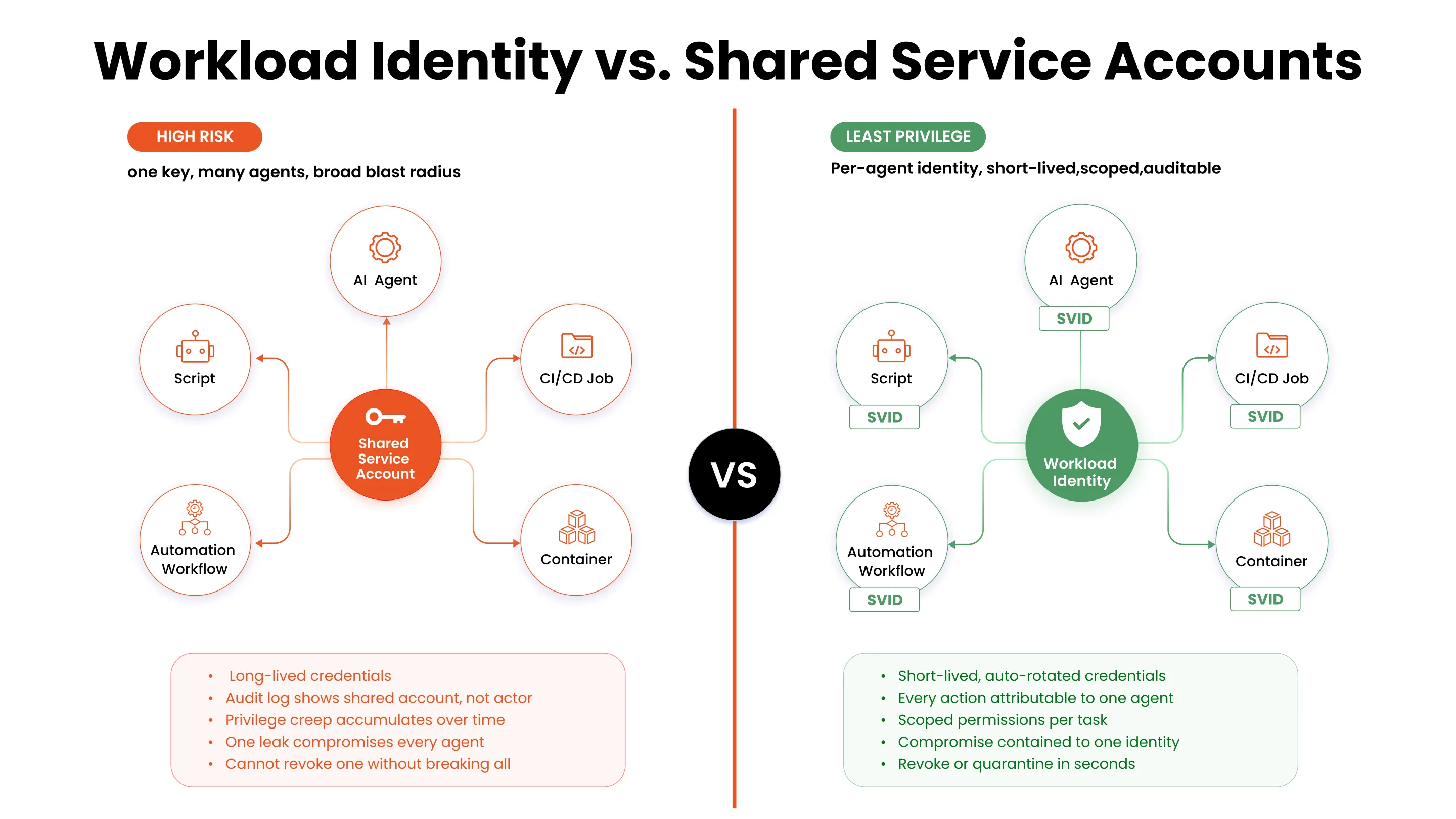
Let’s now look at the full comparison between them.
| Aspect | Shared Service Account | Workload Identity |
|---|---|---|
| Identity Model | One identity reused across multiple agents or tasks. | Distinct identity per workload, agent, or task. |
| Blast Radius | Broad, because one leaked credential can affect many systems or agents. | Narrow, because compromise is limited to a specific identity and time window. |
| Credential Lifetime | Long-lived and manually rotated. | Short-lived and automatically rotated. |
| Audit Trail | Logs often show the shared account rather than the actual actor. | Logs can be tied back to a specific agent identity. |
| Revocation | Hard to disable one entity without disrupting others. | Easy to revoke or isolate workload without broad collateral impact. |
| Privilege Posture | High risk of privilege creep over time. | Better fit for least privilege AI and task-scoped authorization. |
Shared service accounts were originally adopted because they were easy to set up and easy to reuse. The problem is that convenience scales badly in distributed AI systems.
If multiple agents share one identity, teams lose precise provenance, make least privilege harder to enforce, and increase the impact of any compromised credential.
Components of a Workload Identity Architecture
A strong workload identity architecture for AI agents is not just about issuing a certificate. It is a chain of trust that verifies the workload, establishes identity, applies policy, and records actions.
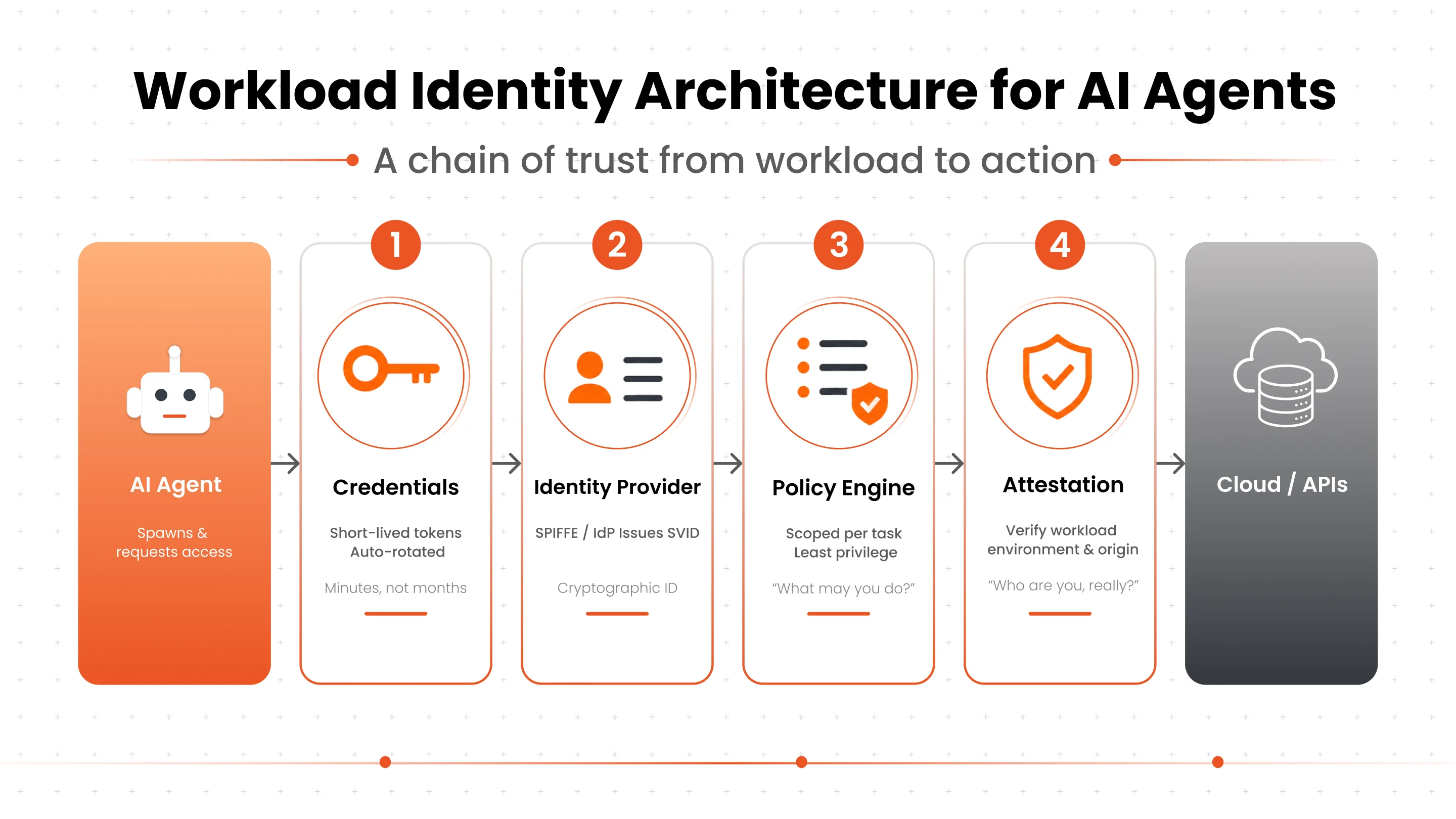
We look at the components that help establish this trust.
- Credential Management: This layer rotates, issues, and expires short-lived credentials automatically. The main goal is to replace static secrets with ephemeral credentials that are delivered only when needed.
- Identity Provider (IdP): This acts as the authority that maps verified workloads to trusted identities. In some environments, this function is built into cloud IAM or a workload identity platform rather than a traditional workforce IdP.
- Policy Enforcement Engine: Policy determines which tools, APIs, data sources, and actions an agent can use, under what conditions, and for how long.
- Workload Attestation Service: Before identity is issued, the system should verify something about the workload and its environment, such as where it is running, what image it came from, or whether it meets security requirements.
The Cost of Ignoring Workload Identity for AI Agents
The business risk of weak AI identity controls is not theoretical. It shows up in outages, breach investigations, compliance failures, and slower engineering velocity.
1. One Credential Problem Can Become a Multi-System Outage
One missed renewal or a leaked token can trigger ripple effects across connected systems, especially when machine identities underpin internal APIs, automation, and service dependencies.
In an AI-heavy environment, that problem gets worse because a single agent can touch multiple tools in sequence.
2. Shared Credentials Make Breaches Harder to Investigate
When several agents share the same identity, forensics gets complicated fast. Teams can see that an account did something, but not necessarily which agent initiated it, whether the action was authorized, or whether the root cause was misuse, misconfiguration, or compromise.
3. Compliance and Assurance Get More Difficult
There’s always been an emphasis on adhering to compliance. The enterprises are expected to align with frameworks such as SOC 2, ISO 27001, and regulated environments. So, to give clear evidence of who accessed what, when, and under what authority to the auditors.
4. Shipping Slows Down When Identity is Fragile
When access models are brittle, engineering teams become conservative. They delay changes, avoid fine-grained permissions because they are hard to manage, and keep broad access in place “for now,” which creates a quiet but expensive drag on delivery speed.
The urgency is growing. It is time to frame AI agent governance as a cross-organizational requirement because every agent introduces risk, takes actions, and needs centralized identity, policy enforcement, and visibility.
Best Practices for Securing AI Agents with Workload Identity
The best workload identity strategies are opinionated but practical. They reduce risk without forcing teams into a months-long identity rewrite.
1. Treat Every Agent as a Workload with its Own Identity
Each agent should have a distinct non-human identity from the moment it is created or deployed. That identity should not be borrowed from a human user, shared across agent types, or embedded as a reusable secret.
2. Enforce Least Privilege Per Task, Not Per Platform
Avoid broad roles that give an agent permanent access to everything it might ever need. Instead, scope permissions to the actual task, tool, and time window involved. This is one of the most important principles in IAM for agentic AI.
3. Prefer Ephemeral Credentials by Default
If a credential has to exist, it should be short-lived, automatically rotated, and easy to revoke. This is one of the clearest ways to reduce the impact of credential theft and improve machine identity security.
4. Build a Signed, Attributable Audit Trail
Agent-to-tool and agent-to-agent calls should be traceable. The audit trail should show which identity acted, what it accessed, whether it was acting on behalf of a user, and which policy allowed the action. This is especially important in delegated AI workflows.
5. Use Identity as a Containment Mechanism
A well-designed identity layer acts like a kill switch. If one agent behaves unexpectedly, teams should be able to revoke or quarantine that specific identity without taking down unrelated services or workflows.
6. Plan for Multi-Protocol Authentication
Do not assume one identity standard will cover every downstream target. AI agents often need to interact with cloud control planes, SaaS applications, APIs, internal services, and model providers.
The right pattern is to use workload identity as the trust anchor and broker short-lived credentials for each downstream protocol as needed.
The Future of AI Agent Security is Identity-First
The next phase of AI security will not be won by hiding more tokens in more places. It will be won by making identity verifiable, short-lived, policy-aware, and attributable at machine speed.
That is the real answer to the growing AI identity crisis. The question is no longer “Can this agent be trusted?” It is “Can this agent prove who it is, what it is allowed to do, and whether that access is still valid right now?” Workload identity gives enterprises a practical way to answer that question for every request.
As AI agents become more deeply embedded in operations, non-human identity management will become part of core security architecture, not just a niche cloud concern. Organizations that move early on workload identity federation, ephemeral credentials, and zero trust AI agents will be in a stronger position to scale safely without slowing innovation.
FAQs
What is workload identity, and why does it matter for AI agents?
Workload identity is a cryptographic identity for a non-human entity such as an AI agent, service, or container. It matters because it improves AI agent authentication, enables tighter AI agent access control, and reduces reliance on long-lived secrets.
What is the difference between workload identity and a service account?
A service account is often a reusable identity with static or long-lived credentials. Workload identity is usually unique per workload, short-lived, policy-bound, and easier to attribute in logs and audits.
How do AI agents authenticate to cloud services securely?
The most secure pattern is to establish a trusted workload identity first, then use that identity to obtain the right short-lived cloud or application credential for the target service.
What is SPIFFE, and how does it apply to AI agent security?
SPIFFE is an open standard for workload identity that helps assign cryptographically verifiable identities to workloads. For AI agent security, it is especially useful as a core internal identity layer.
What are the risks of shared service accounts for AI workloads?
They weaken attribution, increase blast radius, make least privilege harder to maintain, and complicate incident response. Those issues become more severe as the number of agents and integrations grows.
How does zero trust apply to non-human identities?
Zero trust for non-human identities means every request is evaluated based on verified identity, context, and policy rather than implicit trust. For AI agents, that usually means strong workload identity, short-lived access, least privilege, observability, and fast revocation.
Leave a Comment