
AI agents now operate across enterprises in ways that most teams do not fully track. They respond to customers, trigger workflows, analyze data, and make decisions in real-time.
Most organizations cannot confidently answer three critical questions:
- How many AI agents exist in the environment
- What systems and data can they access
- How their behavior evolves over time
This lack of visibility creates a growing and often hidden risk surface.
AI agents do not behave like traditional software. They interpret context, learn from interactions, and adjust their decisions. This makes them highly effective but also unpredictable.
Adoption is accelerating. A large portion of enterprise operations will depend on AI agents in the coming years. Governance has not evolved at the same pace. Most identity systems still focus on human users and static service accounts.
TL;DR
- AI agents act as autonomous digital workers, but often lack governance
- Traditional IAM systems cannot manage adaptive and decision-driven entities
- AI Agent Lifecycle Management ensures control across identity, access, monitoring, and decommissioning
- Key risks include poor visibility, excessive permissions, and weak accountability
- Identity-first architecture supports secure and scalable AI adoption
- miniOrange enables unified lifecycle management for human and non-human identities
What Is AI Agent Lifecycle Management ALM
Definition
AI Agent Lifecycle Management defines how organizations govern AI agents as accountable digital entities. Each agent has a defined identity, controlled access, and traceable actions from deployment to decommissioning. This includes structured Identity provisioning and governance of non-human identities within a centralized framework.
This model shifts AI agents from background automation to governed non-human identities with clear ownership and accountability. Every agent becomes visible, controlled, and auditable across its lifecycle.
Why Lifecycle Matters
AI Agents Evolve After Deployment
AI agents do not remain fixed once deployed. They learn from new data, adapt to changing inputs, and operate across dynamic environments. Their behavior can shift without explicit updates, which makes initial configurations insufficient. Organizations must continuously evaluate how agents perform in real-world conditions to ensure they remain aligned with business intent, security policies, and expected outcomes over time.
Continuous Learning Creates Continuous Risk
Every interaction an AI agent processes can influence its future decisions. This creates a system where risk evolves alongside the agent. Over time, agents may expand access, interact with sensitive data, or behave beyond their intended scope. Without continuous oversight, these changes can introduce hidden vulnerabilities, compliance gaps, and unintended outcomes that remain unnoticed until they impact operations.
Static Governance Does Not Work
Traditional governance models rely on one-time provisioning and periodic reviews. These approaches assume systems behave predictably after deployment. AI agents do not follow this pattern. Their dynamic nature requires governance that operates continuously. Organizations must validate access, monitor behavior, and enforce policies in real time to maintain control and prevent gaps that arise from outdated or static governance methods.
Machine-Speed Governance
AI agents operate at speeds that exceed human oversight. They access systems, process data, and trigger actions within seconds. If governance processes move more slowly, organizations lose control over agent activity. To maintain alignment, governance must operate at the same pace through automation, real-time monitoring, and dynamic policy enforcement, ensuring that every action remains within defined boundaries.
ALM vs Traditional Software Management
AI agents require a different governance model than traditional software. The difference is not limited to behavior. It extends across identity, access, monitoring, and accountability.
| Aspect | Traditional Software | AI Agents |
|---|---|---|
| Behavior | Traditional software follows fixed logic defined during development. It produces predictable outputs for given inputs and does not change unless manually updated. | AI agents adapt based on data and interactions. Their behavior evolves, which introduces variability and requires continuous evaluation to ensure alignment with intended outcomes. |
| Identity | Software typically operates using shared or static service accounts. These identities lack context, such as ownership, purpose, or risk classification. | AI agents require distinct non-human identities with clear ownership, metadata, and traceability. This enables accountability and supports governance across the lifecycle. |
| Access Control | Access is assigned during setup and remains largely unchanged. Permissions are often broad to avoid operational friction. | Access must be dynamic and context-aware. AI agents require just-in-time access that adjusts based on task, sensitivity, and risk to prevent over-privileging. |
| Governance Model | Governance focuses on provisioning and periodic audits. Controls are applied at specific checkpoints rather than continuously. | Governance must operate continuously. Organizations need real-time policy enforcement, ongoing validation, and adaptive controls that evolve with the agent. |
| Monitoring | Monitoring is reactive and log-based. Teams review events after execution, often during incidents or audits. | Monitoring must be proactive and real-time. Organizations need behavioral tracking, anomaly detection, and drift analysis to identify issues as they occur. |
| Accountability | Actions are tied to systems rather than clear ownership. Tracing responsibility for specific outcomes can be difficult. | Every action must be traceable to an identifiable agent with defined ownership. This ensures accountability, supports audits, and enables faster incident response. |
| Lifecycle Scope | Focus remains on deployment and maintenance. Decommissioning is often overlooked, leaving residual access in place. | Lifecycle management spans deployment to decommissioning. Proper retirement ensures credentials are revoked, data is cleared, and no residual risk remains. |
The 5 Pillars of AI Agent Lifecycle Management
Pillar 1: Identity Establishment Deployment
Every AI agent must start with a verifiable identity. This includes assigning a unique cryptographic identity, tagging metadata such as owner, purpose, and risk classification, and defining baseline access policies using least privilege principles. Without identity, organizations cannot establish control or accountability, which makes this step foundational to the entire lifecycle.
Identity establishment also requires integration with a central identity registry. This ensures that every agent is visible within the organization’s governance framework. When identity is enforced at deployment, teams can track ownership, enforce policies consistently, and prevent unauthorized or unmanaged agents from entering the environment.
Pillar 2: Access Orchestration Operations
AI agents require dynamic access that reflects real-time context rather than static role-based permissions. Access must adjust based on task requirements, data sensitivity, and operational conditions. This includes just-in-time credential issuance and context-aware controls that restrict access when conditions change or risk levels increase.
Organizations must also map entitlements across systems to ensure agents receive only the access they need at a given moment. This approach reduces over-privileged access and limits exposure. Effective orchestration ensures that every action taken by an agent aligns with the principle of right access at the right time in the right context.
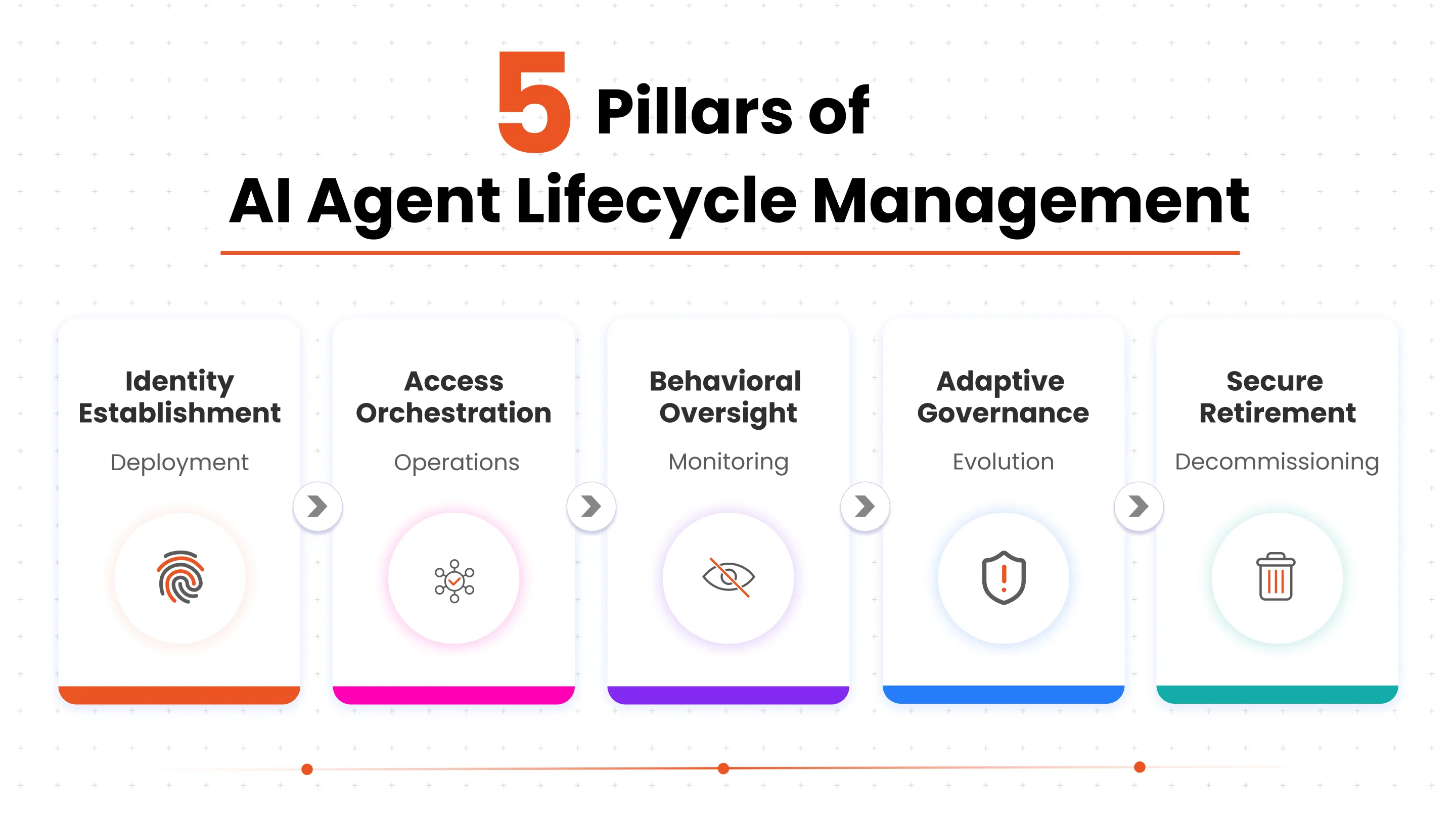
Pillar 3: Behavioral Oversight Monitoring
Continuous monitoring is essential once AI agents begin operating. Organizations must track agent activity in real time using Continuous behavioral monitoring to detect anomalies, identify drift, and maintain visibility into decision patterns.
Behavioral oversight also involves detecting anomalies and identifying drift from expected patterns. As agents evolve, their behavior may deviate from initial baselines. Organizations must maintain detailed audit trails and monitoring systems to ensure that these changes are identified early and addressed before they lead to security or compliance risks.
Pillar 4: Adaptive Governance Evolution
AI agents do not operate in fixed conditions. Their capabilities expand, their access needs change, and regulatory requirements evolve. Governance must adapt accordingly through structured processes such as permission recertification, capability reviews, and policy updates aligned with changing risk profiles.
Adaptive governance ensures that AI agents evolve without introducing unnecessary risk. This includes regular reviews, policy updates, and Adaptive performance optimization to balance efficiency with control while maintaining alignment with business objectives and Security requirements.
Pillar 5: Secure Retirement Decommissioning
When an AI agent is no longer required, organizations must follow structured processes for Risk-controlled decommissioning. This ensures that all credentials are revoked, data is sanitized, and no residual access remains within the system. Without proper retirement, inactive agents can retain access and become hidden vulnerabilities.
Secure retirement also involves sanitizing stored data and clearing any residual memory associated with the agent. Organizations must confirm that no traces remain within connected systems. This step ensures the complete elimination of residual risk and prevents dormant agents from becoming entry points for security threats.
Why Organizations Struggle with AI Agent Governance
The Identity Visibility Gap
Many AI agents are created outside formal IT oversight, which leads to shadow deployments that remain untracked. Organizations lack a central inventory of these autonomous systems, making it difficult to enforce governance or assign ownership. miniOrange addresses this through automated discovery and registration, ensuring every agent is identified, onboarded, and governed within a centralized identity framework.
Permission Proliferation
AI agents often receive broad access at creation to ensure they function without friction. Over time, these permissions expand further as capabilities grow, leading to access creep and unnecessary exposure. This increases the risk of misuse and data compromise. miniOrange solves this with dynamic, policy-driven access controls that adjust permissions based on context, usage, and risk.
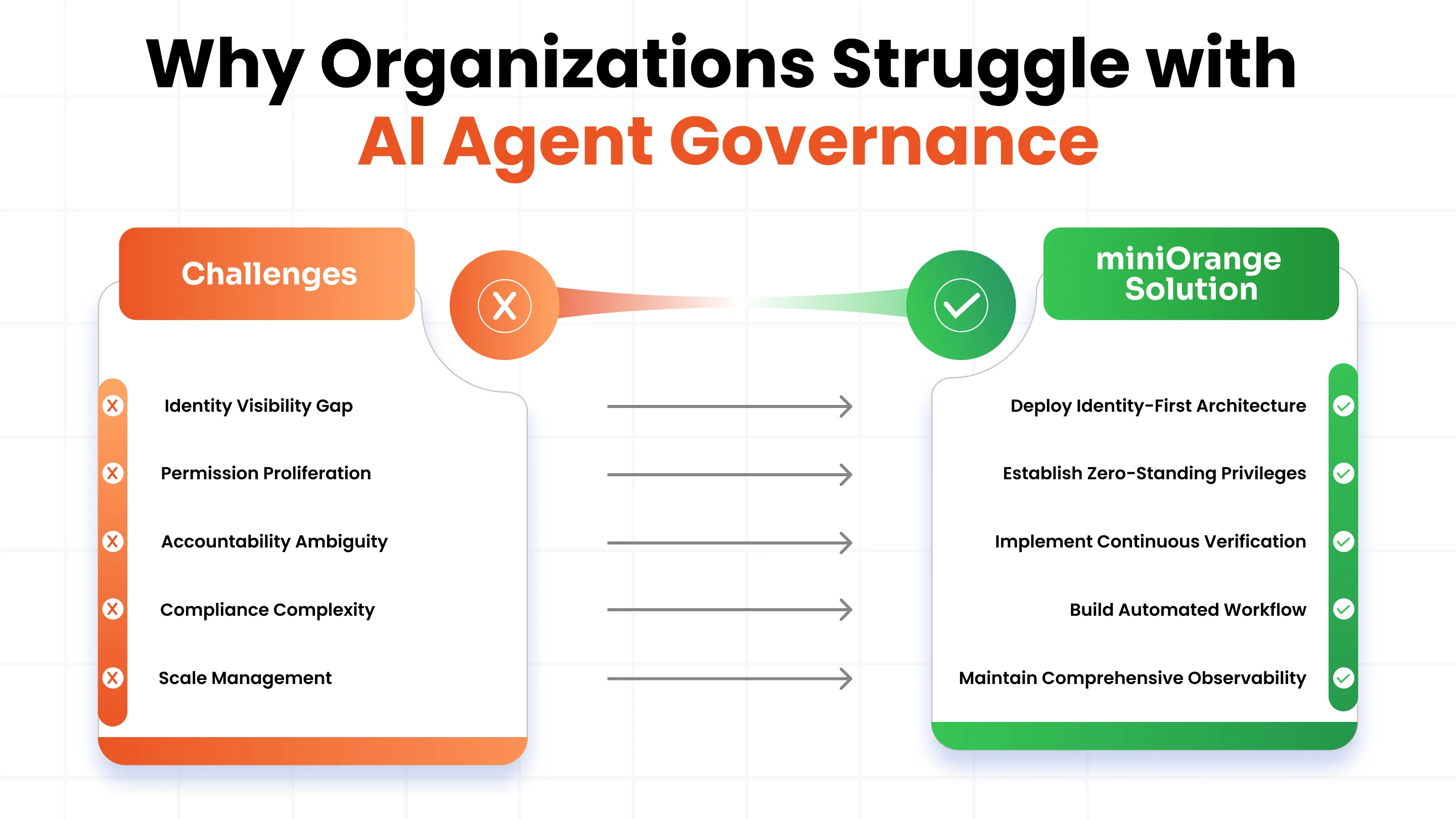
Accountability Ambiguity
Organizations struggle to determine responsibility for actions performed by AI agents. There is often no clear owner, and tracing decisions back to an accountable entity becomes difficult. This creates gaps in both security investigations and audits. miniOrange enables immutable ownership attribution, ensuring every agent action is linked to a defined identity with full traceability.
Compliance Complexity
AI regulations continue to evolve, with requirements for transparency, traceability, and risk management. Organizations must maintain detailed audit trails for autonomous decisions, which becomes difficult without structured governance. Regulatory compliance efforts often remain reactive and manual. miniOrange simplifies this with built-in compliance reporting that ensures continuous audit readiness and alignment with regulatory requirements.
Scale Management
AI agents operate at machine speed, while governance processes often depend on manual intervention. This mismatch creates delays, inconsistent enforcement, and operational inefficiencies. As the number of agents grows, managing them becomes increasingly complex. miniOrange addresses this with automated lifecycle workflows that scale governance processes and ensure consistent policy enforcement across all agents.
Implementing AI Agent Lifecycle Management Best Practices
Deploy Identity-First Architecture
Organizations should treat AI agents as first-class identities within their ecosystem. Each agent must have a defined identity, ownership, and governance controls from the moment it is created. This ensures consistency in how access is managed and monitored across both human and non-human identities.
Centralizing identity management allows organizations to enforce policies across all entities. Integration with identity providers, governance systems, and access control tools ensures that AI agents operate within the same security framework, improving visibility, accountability, and control across environments.
Establish Zero-Standing Privileges
AI agents should not retain permanent high-level access. Instead, access must be granted only when required for a specific task. This reduces long-term exposure and limits the impact of compromised credentials or misuse.
Organizations should implement just-in-time access with approval workflows and automatic expiration. This ensures that elevated permissions exist only for the required duration and are revoked immediately after use, maintaining strict control over sensitive operations.
Implement Continuous Verification
Initial provisioning is not sufficient for AI agents. Their behavior and access requirements change over time, which makes continuous verification essential. Organizations must regularly reassess identity, permissions, and activity to ensure alignment with policies.
Behavioral monitoring plays a key role in this process. By analyzing patterns and detecting anomalies, organizations can identify deviations early. This allows them to respond quickly and maintain control over evolving agent behavior.
Build Automated Workflows
Manual governance processes cannot keep pace with the speed of AI operations. Organizations must automate key lifecycle activities such as onboarding, access provisioning, and decommissioning to ensure consistency and scalability.
Automated workflows enable self-service agent registration with built-in guardrails. They also trigger deprovisioning when conditions are met and enforce policies in real time, ensuring that governance operates at the same speed as AI agents.
Maintain Comprehensive Observability
Organizations must maintain full visibility into how AI agents operate across systems. This includes tracking actions, decisions, and interactions in real time to ensure transparency and control.
Observability should include decision logging, explainability, and cross-system correlation. This allows organizations to understand how agents behave, trace outcomes back to specific actions, and support compliance through detailed and accessible records.
Plan for Regulatory Evolution
AI regulations continue to evolve, and organizations must prepare for changing requirements. Governance frameworks should be flexible enough to adapt without disrupting operations.
Using configurable policy engines and maintaining audit-ready documentation ensures that organizations can respond quickly to new regulations. This approach supports long-term compliance while allowing AI adoption to scale without introducing regulatory risk.
The Business Impact of Effective ALM
Risk Reduction Metrics
Effective AI Agent Lifecycle Management reduces the attack surface by eliminating orphaned agents and enforcing strict identity control. It prevents unauthorized data access by ensuring agents operate within defined permissions. Continuous monitoring and traceability improve compliance audit outcomes, enabling organizations to demonstrate control over AI-driven actions and reduce exposure to security and regulatory risks.
Operational Efficiency
ALM enables faster deployment of AI agents by embedding security and governance into the process from the start. This reduces delays caused by manual approvals and fragmented controls. Automated workflows lower governance overhead, while built-in compliance reporting removes the need for time-consuming audit preparation, allowing teams to focus on innovation rather than operational bottlenecks.
Trust and Transparency
AI Agent Lifecycle Management improves trust by making agent decisions traceable and explainable. Organizations gain visibility into how actions are performed and why decisions are made. This builds confidence among stakeholders and supports informed decision-making. Leadership teams also benefit from clear visibility into AI-related risks, enabling better governance at the organizational level.
How miniOrange Approaches AI Agent Lifecycle Management
Unified Identity Fabric
miniOrange provides a single platform to manage both human and non-human identities within one unified system. This removes fragmentation and eliminates the need for separate tools to manage AI agents. Organizations gain consistent visibility and control, ensuring that all identities operate under the same governance framework without creating silos or gaps.
This unified approach allows teams to enforce policies consistently across users, applications, and AI agents. It simplifies management while improving accountability, making it easier to track actions, control access, and maintain a clear view of all identities operating within the environment.
Policy-Driven Automation
miniOrange enables organizations to define policies that automatically govern AI agent behavior and access. Pre-built templates support common agent types, which helps teams implement controls quickly without starting from scratch. This reduces deployment time while maintaining strong governance.
Customizable workflows allow organizations to adapt policies based on specific business needs. These workflows ensure that access provisioning, monitoring, and decommissioning follow consistent rules, enabling governance to scale alongside AI adoption without increasing operational complexity.
Continuous Compliance
miniOrange ensures compliance through real-time policy enforcement and continuous monitoring. Organizations can track agent activity as it happens, ensuring that all actions align with defined policies and regulatory requirements.
Automated audit trail generation provides complete visibility into agent actions and decisions. This eliminates the need for manual tracking and simplifies audit processes, allowing organizations to demonstrate compliance at any time with accurate and up-to-date records.
Integration Ecosystem
miniOrange integrates seamlessly with existing enterprise systems, including identity providers, SIEM platforms such as Splunk, IBM QRadar, and Microsoft Sentinel, along with SOAR tools like Palo Alto Cortex XSOAR and Splunk SOAR. This allows organizations to extend their current infrastructure without disruption while strengthening governance and visibility across AI agent environments.
Its API-first architecture ensures flexibility and scalability. Organizations can connect AI agent lifecycle management with existing workflows, enabling smooth data exchange and consistent policy enforcement across all systems and environments.
Secure Your AI Agent Ecosystem with Identity-First Governance
AI agents are becoming core to enterprise operations, but without structured governance, they introduce significant risk. AI Agent Lifecycle Management ensures every agent is identifiable, controlled, and accountable throughout its lifecycle. With an identity-first approach, organizations can scale AI adoption securely while maintaining visibility, compliance, and control, and miniOrange provides the foundation to make this possible.
FAQs
What is the difference between ALM and MLOps?
MLOps focuses on building, training, and deploying machine learning models. ALM governs the lifecycle of AI agents that use those models, including identity, access, monitoring, and decommissioning, ensuring agents operate securely and remain accountable across environments.
How does AI agent lifecycle management relate to zero-trust security?
AI Agent Lifecycle Management aligns with zero trust by enforcing continuous verification and least-privilege access. It ensures agents are never trusted by default and must validate identity, context, and behavior before accessing systems or sensitive data.
What are the compliance requirements for AI agents under the EU AI Act?
The EU AI Act requires transparency, traceability, and risk classification for AI systems. Organizations must track decisions, monitor data usage, and maintain audit trails. ALM supports these requirements through continuous monitoring and structured governance.
How do you prevent shadow AI agents in enterprise environments?
Organizations can prevent shadow AI agents by implementing centralized identity registration and automated discovery. This ensures every agent is tracked, assigned ownership, and governed through defined onboarding processes, eliminating unmanaged deployments.
What is the role of identity governance in AI agent security?
Identity governance ensures each AI agent has defined ownership, controlled access, and traceable actions. It provides accountability and enables organizations to enforce policies consistently across all human and non-human identities.
What happens if an AI agent is compromised during its lifecycle?
If an AI agent is compromised, organizations must revoke access immediately, isolate the agent, and review its activity. ALM enables rapid response through real-time monitoring and traceability, helping contain impact and prevent further risk.
About the Author

Content Writer
Minal is an experienced B2B content writer. She has written over 250 articles across industries like UI/UX, real estate, automotive, digital marketing, SaaS, AI & ML, and cybersecurity. She brings her interest in cybersecurity to life by creating clear, engaging content tailored for technical, non-technical, and creative pieces. Her aim is to simplify complex topics, highlight product value, and connect with both technical and non-technical audiences.
Leave a Comment