
Identity and Access Management (IAM) implementation has evolved far beyond password management and login security. Modern organizations operate across SaaS applications, cloud infrastructure, APIs, remote work environments, and hybrid systems where identity now acts as the primary access control layer.
As businesses grow, identity environments often become fragmented. Different applications rely on separate authentication methods, permissions accumulate over time, and legacy systems operate outside centralized governance. This creates security gaps, excessive access, inconsistent policies, and limited visibility into who can access critical systems and data.
IAM implementation helps organizations centralize authentication, automate provisioning workflows, enforce least-privilege access, and strengthen governance across cloud and on-premise infrastructure.
This guide covers IAM implementation planning, architecture, deployment, governance, challenges, costs, and long-term optimization strategies.
What Is IAM and Why Does Implementation Matter?
Identity and Access Management (IAM) is the framework of technologies, policies, and processes used to manage how users, applications, and systems authenticate and access organizational resources.
A structured IAM implementation connects authentication, authorization, identity lifecycle management, and governance into a centralized access model. Instead of managing authentication separately inside every application, organizations enforce consistent access policies across systems, infrastructure, and users.
IAM implementation also improves visibility into permissions, privileged access, authentication activity, and provisioning workflows, helping organizations reduce identity-related security risks while improving operational control.
Core Components of an IAM Framework
A modern IAM framework combines several IAM capabilities that work together to secure users, applications, and infrastructure throughout the identity lifecycle.
Authentication
Verifies user identity before access is granted.
Authorization
Determines what authenticated users can access and what actions they can perform.
Single Sign-On (SSO)
Centralizes authentication across applications through a single login session.
Multi-Factor Authentication (MFA)
Adds additional verification layers beyond passwords to strengthen identity security.
Identity Lifecycle Management
Automates onboarding, role changes, and offboarding workflows across systems.
Privileged Access Management (PAM)
Secures administrative accounts, service accounts, and elevated permissions.
Access Governance
Supports access reviews, policy enforcement, compliance reporting, and entitlement monitoring.
Audit Logging and Monitoring
Provides visibility into authentication events, privilege changes, and suspicious access activity.
Why IAM Implementation Is Critical
Identity has become one of the most targeted attack surfaces in enterprise environments. Fragmented authentication systems, unmanaged privileges, and inconsistent access policies make it difficult for organizations to maintain visibility and control over access.
A well-planned IAM implementation helps organizations:
- Centralize authentication and access governance
- Reduce excessive and unmanaged access
- Strengthen MFA and privileged access controls
- Improve compliance readiness
- Automate provisioning and deprovisioning workflows
- Support Zero Trust security initiatives
- Improve visibility into authentication and access activity
Pre-Implementation Assessment and Planning
Successful IAM implementation starts with understanding the current identity environment before deploying tools or configuring integrations.
Conduct an Identity and Access Inventory
The first step is identifying every identity across the environment, including employees, contractors, vendors, service accounts, APIs, and privileged users. Beyond identifying users, organizations also need visibility into:
- Existing privilege levels
- Shared or orphaned accounts
- Current authentication methods
- Manual provisioning dependencies
This process helps uncover unmanaged identities and excessive permissions before implementation begins.
Audit Existing Applications and Infrastructure
IAM implementation depends heavily on application compatibility and integration readiness. Organizations should assess all cloud applications, SaaS platforms, on-premise systems, legacy applications, and internal APIs currently in use.
For each application, teams should evaluate supported authentication protocols, provisioning capabilities, authorization models, and directory dependencies. This assessment helps prioritize integrations and identify systems that may require custom connectors or federation layers.
Define Security and Compliance Requirements
IAM architecture should align with both security goals and operational requirements from the start. This includes defining:
- MFA enforcement policies
- Privileged access controls
- Passwordless authentication goals
- Audit logging requirements
- Third-party access governance
Establishing these requirements early prevents policy inconsistencies and redesign efforts later in the implementation lifecycle.
IAM Implementation Plan Structure
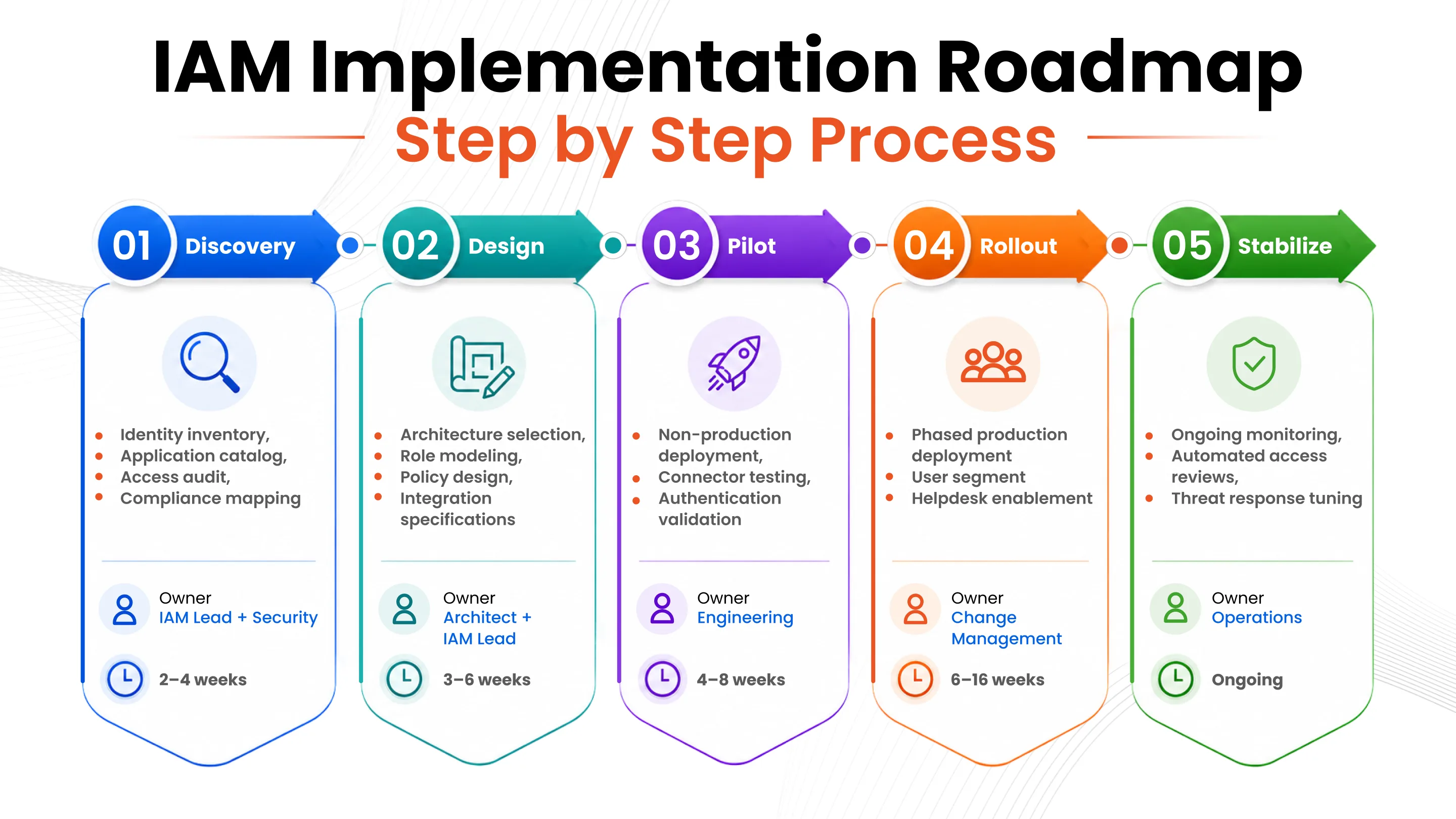
A successful IAM deployment depends heavily on having a structured rollout plan before implementation begins. Without clear ownership, phased deployment timelines, governance alignment, and testing checkpoints, IAM projects often face delays, inconsistent access policies, integration failures, and operational disruption.
| Phase | Activities | Owner | Duration |
|---|---|---|---|
| Discovery | Identity inventory, application catalog, access audit, compliance mapping | IAM Lead + Security | 2–4 weeks |
| Design | Architecture selection, role modeling, policy design, integration specifications | Architect + IAM Lead | 3–6 weeks |
| Pilot | Non-production deployment, connector testing, and authentication validation | Engineering | 4–8 weeks |
| Rollout | Phased production deployment by user segment, helpdesk enablement | Engineering + Change Management | 6–16 weeks |
| Stabilize | Ongoing monitoring, automated access reviews, threat response tuning | Operations | Ongoing |
Defining Access Models, Roles, and Policies
The access model is the foundation of IAM implementation because it determines how permissions are assigned, how authorization decisions are enforced, and how organizations maintain least-privilege access.
Role-Based Access Control (RBAC)
Role-Based Access Control assigns permissions through predefined roles instead of managing access individually for every user. Users inherit permissions based on their job responsibilities or operational functions, which simplifies access management and standardizes entitlement assignment across the organization.
Attribute-Based Access Control (ABAC)
Attribute-Based Access Control evaluates access dynamically using contextual attributes related to the user, device, application, or environment. Instead of relying only on static role assignments, ABAC allows organizations to make real-time authorization decisions based on factors such as location, device compliance, risk level, or time of access.
Policy-Based Access Control (PBAC)
Policy-Based Access Control centralizes authorization decisions within a dedicated policy engine instead of embedding access logic directly inside applications. Applications query centralized policies to determine whether access should be granted, which helps organizations maintain consistent authorization controls across hybrid infrastructure, APIs, and distributed environments.
Role Engineering and Access Modeling
Role engineering is the process of designing scalable access structures based on actual entitlement usage and operational requirements. Organizations analyze existing permissions, identify common access patterns, and create structured roles that align with business functions while maintaining least-privilege access principles.
Designing Least-Privilege Access Policies
Least-privilege access ensures users only receive the minimum level of access required to perform their responsibilities. Strong IAM implementations continuously evaluate permissions, restrict unnecessary privileged access, and enforce governance controls that prevent excessive entitlements from accumulating over time.
Choosing the Right IAM Architecture
The IAM architecture chosen during implementation affects scalability, integration complexity, governance consistency, and long-term operational management.
Cloud-Native IAM Architecture
Cloud-native IAM architecture is designed for organizations operating primarily across SaaS applications and cloud environments. These platforms typically provide centralized Single Sign-On (SSO), Multi-Factor Authentication (MFA), and lifecycle management through vendor-managed infrastructure, helping organizations scale identity management without maintaining complex on-premise systems.
On-Premise IAM Architecture
On-premise IAM architecture is commonly used in regulated environments that require full control over identity infrastructure and access to data. Organizations with legacy applications, internal directories, or strict compliance requirements often rely on on-premise IAM to maintain tighter operational control.
Hybrid IAM Architecture
Hybrid IAM architecture combines cloud-based identity services with existing on-premise infrastructure, allowing organizations to modernize identity management gradually while extending centralized authentication and governance policies across both environments.
Federated IAM Architecture
Federated IAM enables users to authenticate across multiple organizations or domains using trusted identity relationships and standards such as SAML, OAuth 2.0, and OpenID Connect. This model is commonly used for partner access, vendor collaboration, and customer-facing applications.
Key IAM Architecture Decisions
Organizations must define their authoritative identity source, authentication protocols, MFA strategy, and policy enforcement model early in the implementation process. These decisions play a major role in maintaining consistent access controls across cloud, on-premise, and hybrid environments.
Step-by-Step IAM Implementation Process
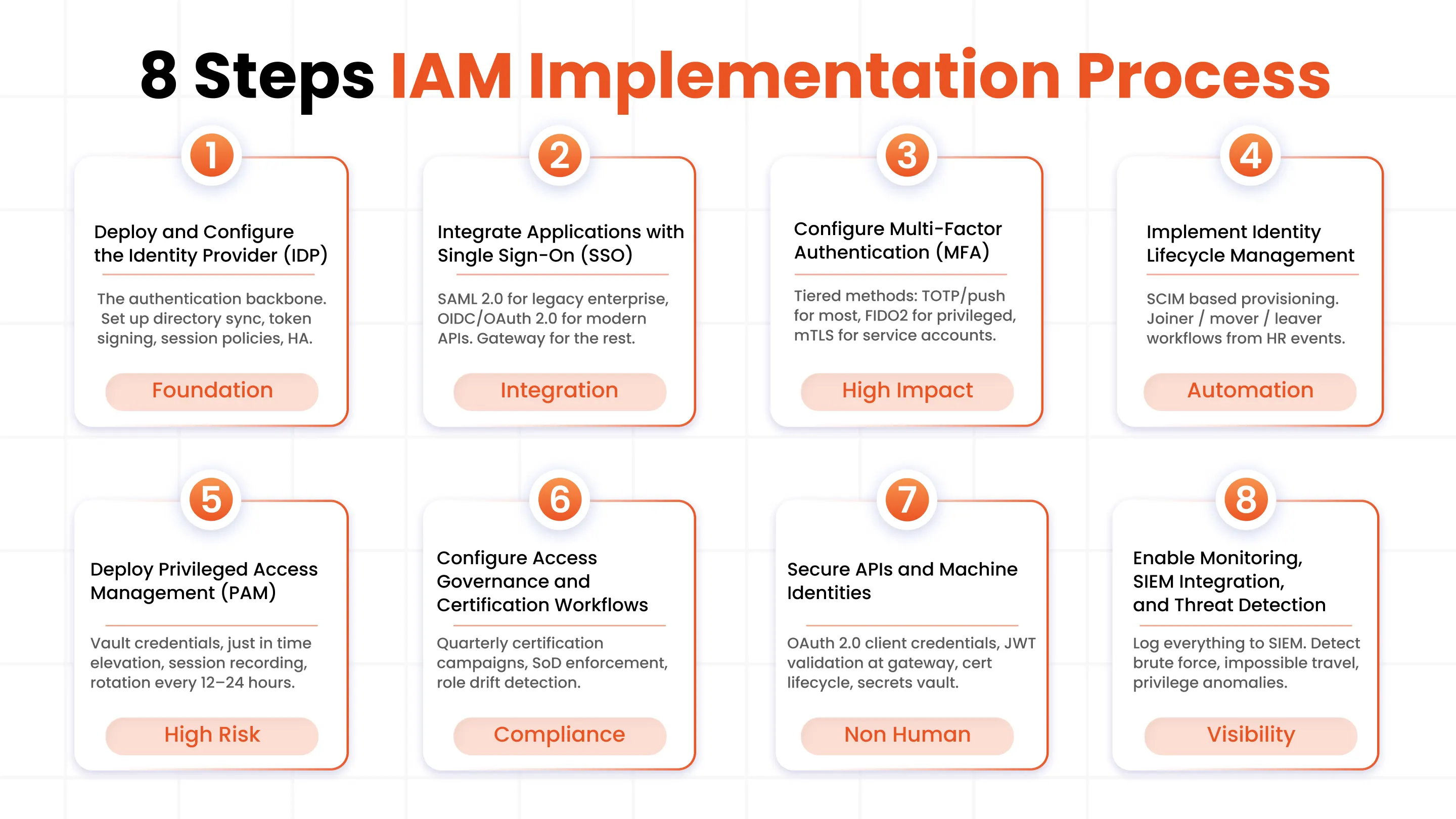
Each stage in the IAM implementation is built on the previous one, which is why organizations that skip foundational planning often encounter governance gaps, inconsistent policies, and integration issues later in the rollout lifecycle.
Step 1: Deploy and Configure the Identity Provider (IdP)
The Identity Provider acts as the authentication backbone of the IAM environment by centralizing identity verification across connected systems and applications. During this stage, organizations configure the IAM platform, connect identity directories such as Active Directory or LDAP, establish federation services, and define authentication policies that will support downstream integrations.
Step 2: Integrate Applications with Single Sign-On (SSO)
Once the Identity Provider is operational, organizations begin integrating applications into centralized authentication workflows using standards such as SAML, OAuth 2.0, and OpenID Connect. This phase often includes both modern SaaS integrations and legacy application support, making application compatibility and testing critical for ensuring consistent authentication and authorization behavior.
Step 3: Configure Multi-Factor Authentication (MFA)
Multi-Factor Authentication significantly strengthens identity security by adding additional verification layers beyond passwords. Organizations typically implement MFA policies based on risk level, device posture, user type, application sensitivity, and access location while gradually introducing stronger authentication methods such as adaptive MFA, passwordless authentication, and FIDO2 security keys.
Step 4: Implement Identity Lifecycle Management
Identity Lifecycle Management automates onboarding, role modifications, transfers, and offboarding workflows across connected systems. Integrating lifecycle automation with HR systems and provisioning standards such as SCIM helps organizations reduce manual provisioning effort while minimizing orphaned accounts, delayed deprovisioning, and excessive access accumulation.
Step 5: Deploy Privileged Access Management (PAM)
Privileged Access Management secures administrative accounts, service accounts, and elevated permissions that represent high-risk attack targets within the environment. PAM implementation typically includes credential vaulting, password rotation, session monitoring, privileged access approvals, and just-in-time access controls to reduce exposure to privileged account misuse.
Step 6: Configure Access Governance and Certification Workflows
Access governance ensures permissions remain appropriate over time through continuous reviews, policy enforcement, and entitlement monitoring. Organizations typically implement access certification campaigns, separation of duties controls, role reviews, and privileged access audits to improve compliance readiness and reduce long-term access sprawl.
Step 7: Secure APIs and Machine Identities
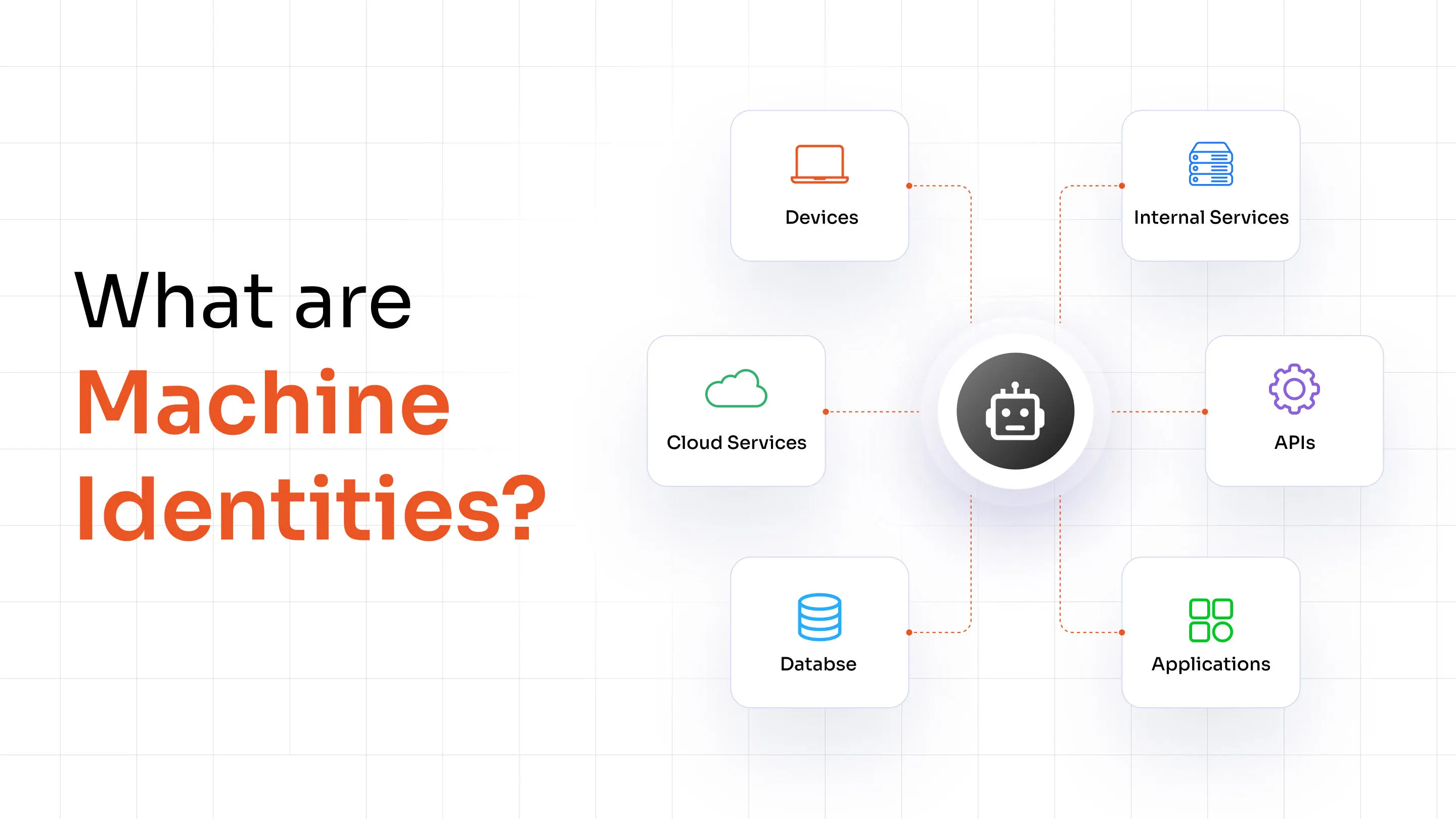
Modern environments often contain more machine identities than human users, including APIs, service accounts, automation workflows, containers, and CI/CD pipelines. IAM implementation should include governance controls for machine identities through certificate management, secrets management, token rotation policies, and OAuth-based authorization frameworks.
Step 8: Enable Monitoring, SIEM Integration, and Threat Detection
IAM implementation should always include centralized monitoring and visibility into authentication activity, privileged access behavior, policy violations, and suspicious login patterns. Integrating IAM telemetry with SIEM and security analytics platforms helps organizations improve threat detection, incident response visibility, and long-term governance monitoring across cloud and on-premise environments.
IAM Implementation in Cloud Environments
Step 1: Centralize Identity Management Across Cloud Applications
Connect SaaS applications and cloud platforms to a centralized Identity Provider (IdP) to standardize authentication and user access management.
Step 2: Configure SSO and MFA
Implement Single Sign-On (SSO) and Multi-Factor Authentication (MFA) across cloud applications to improve both security and user experience.
Step 3: Automate Provisioning and Access Governance
Integrate lifecycle management workflows to automate onboarding, role updates, and deprovisioning across cloud systems and SaaS applications.
Step 4: Enable Centralized Monitoring
Monitor authentication activity, enforce access policies consistently, and integrate IAM telemetry with SIEM platforms for visibility and threat detection.
IAM Implementation in On-Premise Environments
Step 1: Assess Existing Directories and Legacy Infrastructure
Identify Active Directory environments, LDAP systems, legacy applications, and existing authentication workflows before deployment begins.
Step 2: Extend Centralized Authentication to Internal Systems
Integrate on-premise applications and infrastructure with centralized authentication services using federation layers, LDAP integration, or proxy-based authentication where required.
Step 3: Secure Privileged and Administrative Access
Implement Privileged Access Management (PAM), credential vaulting, and privileged session controls for administrative accounts and sensitive infrastructure.
Step 4: Strengthen Governance and Audit Visibility
Centralize audit logging, access reviews, and compliance monitoring across internal systems to improve governance and operational visibility.
IAM Implementation in Hybrid Environments
Step 1: Synchronize Identities Across The Systems
Connect cloud directories, Active Directory, HR systems, and SaaS platforms to maintain consistent identity data and provisioning workflows.
Step 2: Standardize Authentication and Access Policies
Apply consistent Single Sign-On (SSO), Multi-Factor Authentication (MFA), and authorization policies across both cloud and on-premise environments.
Step 3: Centralize Governance and Access Monitoring
Monitor authentication activity, privileged access, and provisioning workflows through centralized governance and SIEM integrations.
Step 4: Implement Zero Trust-Based Access Controls
Continuously evaluate user identity, device posture, and session risk to secure remote access and hybrid workforce environments consistently across infrastructure.
Common IAM Implementation Challenges
IAM implementation becomes complex when organizations try to integrate modern identity controls across legacy systems, cloud platforms, and distributed environments.
Legacy Application Integration
Many legacy applications do not support modern authentication standards such as SAML or OpenID Connect, making centralized authentication difficult. Organizations often rely on federation layers, reverse proxies, or custom integrations to extend SSO and MFA into older systems.
Role Explosion and Access Complexity
Poorly structured role models can create overlapping roles and excessive permissions over time. This increases governance complexity and makes access reviews harder to manage.
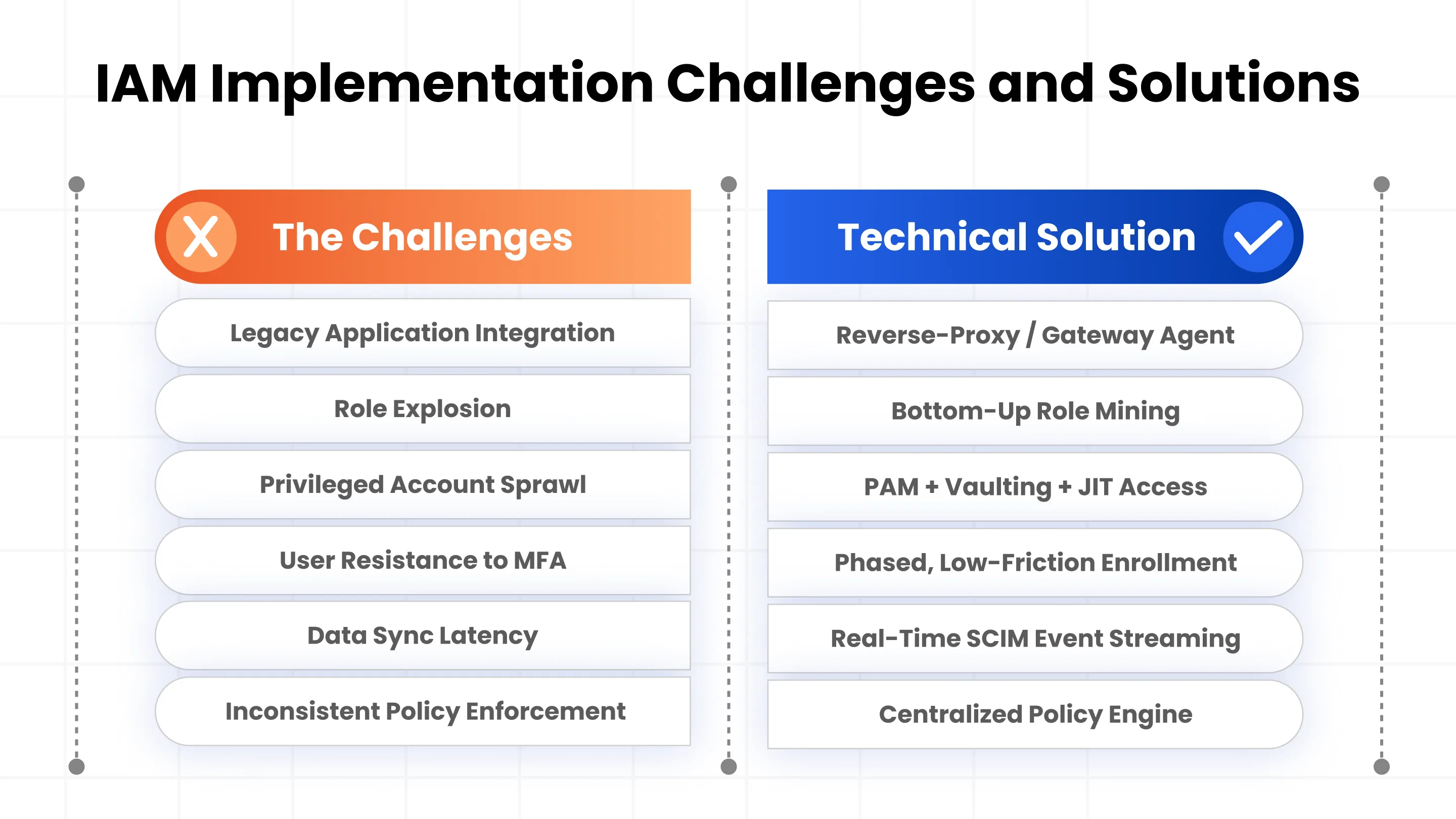
MFA Adoption Resistance
Users often view Multi-Factor Authentication as disruptive, which can slow adoption during rollout. Gradual implementation and user-friendly authentication methods help improve adoption rates.
Privileged Account Sprawl
Administrative accounts and unmanaged service accounts often accumulate across environments without proper oversight. This creates visibility gaps and increases privileged access risk.
Identity Synchronization Delays
Disconnected directories and delayed provisioning workflows can create inconsistencies between cloud applications, HR systems, and on-premise infrastructure, often leaving outdated access active longer than intended.
Inconsistent Policy Enforcement
Organizations operating across cloud and on-premise environments frequently struggle to maintain consistent authentication and authorization policies without centralized governance.
IAM Implementation Costs and Budget Planning
IAM implementation costs vary based on organization size, infrastructure complexity, integration scope, and compliance requirements. Beyond platform licensing, organizations should also account for deployment, governance, and long-term operational management.
IAM Platform and Licensing Costs
Most IAM platforms are priced based on user count, deployment model, and supported capabilities such as SSO, MFA, lifecycle management, access governance, and PAM. Cloud-native platforms generally follow subscription pricing, while on-premise deployments may introduce additional infrastructure and maintenance costs.
Integration and Deployment Costs
Application integration is often the largest IAM implementation expense. Legacy systems and hybrid environments typically require additional testing, federation work, synchronization planning, and custom integrations before centralized authentication can be deployed successfully.
Governance and Operational Costs
IAM implementation also introduces ongoing governance responsibilities across users, applications, and privileged accounts. Organizations must continuously manage access reviews, compliance reporting, authentication monitoring, and role optimization as infrastructure evolves.
Cost Drivers in IAM Implementation
Legacy applications, hybrid infrastructure, and custom integrations often increase IAM deployment timelines and operational costs. Organizations with large application inventories or complex role structures typically require longer testing, governance planning, and integration effort during rollout.
Working with an IAM Implementation Partner
Many organizations work with an IAM implementation partner to reduce deployment complexity, accelerate integrations, and improve long-term governance.
Why Organizations Use IAM Implementation Services
IAM implementation partners help organizations design scalable identity architectures, integrate applications, configure governance policies, and reduce operational risk during rollout.
What an IAM Partner Typically Delivers
Implementation partners commonly support architecture planning, application integrations, role engineering, lifecycle automation, MFA deployment, and governance configuration. Many also provide post-deployment support, monitoring, and ongoing IAM management services.
How to Evaluate an IAM Implementation Partner
Organizations should evaluate IAM partners based on platform expertise, integration experience, governance capabilities, deployment methodology, and long-term support options. Experience with hybrid environments, legacy application integration, and compliance-driven deployments is often critical.
IAM Implementation Partner Cost Considerations
IAM implementation partner costs vary depending on deployment scope, number of integrations, infrastructure complexity, and ongoing support requirements. Organizations should evaluate both short-term deployment costs and long-term operational value when selecting a partner.
Post-Implementation Governance and Optimization
IAM implementation does not end after deployment. As organizations add applications, onboard users, and expand infrastructure, identity governance must continuously evolve to maintain security, compliance, and operational efficiency.
Continuous Access Reviews and Governance
Organizations should regularly review user permissions, privileged access, and role assignments to prevent excessive access accumulation over time. Access certification campaigns and separation of duties reviews help maintain governance consistency across the environment.
Monitoring Authentication and Access Activity
Continuous monitoring helps organizations detect suspicious login behavior, policy violations, privileged access misuse, and authentication anomalies. IAM telemetry should integrate with SIEM and security analytics platforms to improve visibility and incident response.
Optimizing Roles and Access Policies
Access models and role structures should be refined continuously as business operations and infrastructure evolve. Organizations should monitor role usage, remove unnecessary permissions, and simplify access structures wherever possible.
Measuring IAM Program Effectiveness
Organizations should track metrics such as provisioning time, MFA adoption rates, orphaned account reduction, and access review completion rates to evaluate IAM implementation effectiveness and identify areas for improvement.
FAQs
What is the first step in IAM implementation?
The first step is conducting an identity and access assessment to identify users, applications, directories, authentication methods, and existing access risks across the environment.
How long does IAM implementation take?
IAM implementation timelines vary based on organization size, integration complexity, and infrastructure maturity. Small deployments may take a few months, while enterprise IAM implementations can extend across multiple phases over a year or longer.
What is the difference between IAM and PAM?
IAM manages authentication, authorization, and identity governance across all users and systems, while Privileged Access Management (PAM) specifically secures administrative accounts and elevated access.
What are the biggest IAM implementation challenges?
Common IAM implementation challenges include legacy application integration, role complexity, identity synchronization issues, MFA adoption resistance, and maintaining consistent policies across cloud and on-premise environments.
How much does IAM implementation cost?
IAM implementation costs depend on user count, deployment scope, infrastructure complexity, integrations, compliance requirements, and governance needs. Costs typically include licensing, deployment services, integrations, and ongoing operational management.
Which IAM architecture is best for hybrid environments?
A hybrid IAM architecture is typically the best approach for organizations operating across both cloud and on-premise environments because it centralizes authentication and governance while supporting legacy infrastructure.
About the Author

Content Writer
Minal is an experienced B2B content writer. She has written over 250 articles across industries like UI/UX, real estate, automotive, digital marketing, SaaS, AI & ML, and cybersecurity. She brings her interest in cybersecurity to life by creating clear, engaging content tailored for technical, non-technical, and creative pieces. Her aim is to simplify complex topics, highlight product value, and connect with both technical and non-technical audiences.
Leave a Comment