

Think about how different development environments are now compared with a few years ago. Your apps probably run across multiple clouds. CI/CD pipelines automatically deploy code. AI services constantly call APIs, databases, and cloud resources.
But many machine identities are still stuck on something vulnerable: Secrets, API keys, service accounts, and static credentials.
The problem is that they’re no longer fit for modern infrastructure demands. Static credentials are difficult to rotate. They increase your attack surface. They create operational overhead. And when they leak, attackers gain access to whatever resources those credentials can reach.
While we have spent years securing human access with Multi-Factor Authentication (MFA) and Single Sign-On (SSO) solution, machine identities have largely been left behind.
That is where Workload Identity Federation (WIF) changes the game. Instead of storing credentials, workloads authenticate through trusted identity providers (IdPs) using short-lived tokens and standards like OpenID Connect (OIDC).
Let’s break down how it works.
What is Workload Identity Federation?
Workload Identity Federation is an authentication mechanism that allows applications, services, containers, CI/CD pipelines, AI agents, and workloads to access cloud resources without storing long-term credentials.
Instead of relying on a pre-shared secret key, a federated workload identity relies on trust relationships between identity providers and cloud platforms.
When a workload needs to access a specific cloud resource, it fetches an identity token from its own trusted external IdP. It then hands this token over to the target cloud provider, which checks the signature, confirms its validity, and exchanges it for a highly scoped, short-lived access token. Once the task is done, that temporary token expires automatically, greatly reducing the presence of long-lived credentials that attackers can exploit.
Some key features are:
- Secretless authentication: Workloads do not require stored passwords, API keys, or downloaded service account key files in third-party tools.
- OIDC-based trust relationships: Authentication relies entirely on modern, cryptographically signed tokens utilizing OpenID Connect (OIDC).
- Temporary credentials: Tokens issued to your workloads are ephemeral, often expiring in an hour or less, drastically minimizing exposure risks.
- Zero standing privileges: Workloads have no permanent, always-on access pathways; access is granted dynamically at runtime.
- Multi-cloud support: It acts as a cross-platform bridge, enabling seamless identity verification across AWS, Azure, Google Cloud, and on-premises clusters.
Why Traditional Service Accounts Are No Longer Enough
For a long time, standard practice dictated creating a service account inside your cloud environment, exporting its private key as a JSON or YAML file, and dropping it into your application environment variables. While this worked fine when architectures were simple, it has become a liability in today's cloud-native landscape.
Today, apps are distributed, and pipelines are automated. You’ve got containers appearing and disappearing constantly.
Challenges with Static Credentials
When you rely on traditional service accounts, you deal with a perpetual cycle of managing long-lived secrets:
API keys: Static strings that grant immediate access to software platforms, rarely changing once created.
Service account keys: Cryptographic files downloaded from cloud consoles that grant full administrative or scoped programmatic access indefinitely.
Access tokens: Long-lived credentials or improperly extended tokens used to reduce re-authentication overhead.
Where Security Concerns Arise
These static credentials can immediately introduce security vulnerabilities:
Credential leakage: Secrets can be inadvertently pushed to public source control, printed in build logs, or cached in insecure build runners.
Secret sprawl: As your infrastructure expands, tracking exactly where every service account key is stored across hundreds of repositories and servers becomes increasingly difficult.
Manual rotation burdens: Because rotating a key manually requires updating multiple dependent applications, human error often leads to unexpected system downtime.
Privilege escalation: If an attacker compromises a long-lived service account key with overly broad permissions, they gain persistent, undetected lateral access to your infrastructure.
What This Means to You
This is not just a theoretical concern. According to Verizon’s 2025 data breach investigations, credential abuse remains the leading initial attack vector. On top of that, machine identities outnumber human identities by 144 to 1.
Attackers know that human accounts are heavily guarded by MFA. They deliberately look for the unmonitored, long-lived service account keys hiding inside codebases and CI/CD pipelines to bypass traditional perimeters. That’s why many cloud incidents today involve machine credentials rather than user accounts.
How Workload Identity Federation Works
Now that you know the why, let’s look at what’s under the hood. How exactly does an external service prove who it is without typing in a password or passing a secret token?
Step-by-Step Authentication Flow
Step 1
Workload requests an identity token from its trusted IdP.
Step 2
The identity provider issues a signed OIDC token.
This token usually contains claims such as:
- Issuer (iss)
- Subject (sub)
- Audience (aud)
- Repository information
- Pipeline context
- Workload metadata
Step 3
The cloud provider validates:
- Issuer
- Audience
- Signature
- Claims
If validation succeeds, the workload is trusted.
Step 4
Instead of handing over permanent credentials, the platform issues temporary credentials that expire automatically.
Step 5
The workload accesses cloud resources securely with the temporary credentials. The token expires automatically after its configured validity period.
Workload Identity Federation and OIDC
You can’t talk about machine identity without talking about OIDC. The entire architecture relies on workload identity federation OIDC integrations to handle trust.
What is OIDC?
OIDC is an identity layer built on top of OAuth 2.0.
While OAuth 2.0 handles authorization, OIDC introduces standardized authentication with JSON Web Tokens (JWTs). These signed tokens carry identity claims and metadata, which allows remote systems to verify assertions.
Why OIDC is Used in WIF
Integrating workload identity federation with OpenID Connect solves several challenges that traditional credential models create:
- Standardized
OIDC is widely adopted across IAM vendors and cloud providers.
- Secure
Tokens are protected via public/private key cryptography.
- Token-based
No shared secret exchange required.
- Widely Supported
Nearly every major developer tool, CI/CD utility, and infrastructure environment natively supports OIDC.
- Eliminates Shared Secret
There are zero shared passwords that can be stolen.
Common OIDC Providers
There are various native OIDC providers available that can assert workload identities directly to cloud resources:
- GitHub Actions
- Azure DevOps
- Google Cloud
- Kubernetes
- Okta
- Entra ID
- GitLab
Direct Workload Identity Federation Explained
As identity architecture has matured, cloud providers have introduced an optimized approach known as direct workload identity federation.
In a traditional model, workloads often authenticate using an intermediate cloud-native service account key. Cloud providers can eliminate that hop with direct workload identity federation. External identity tokens are trusted directly within the target cloud's Identity and Access Management (IAM) framework.
Benefits of Direct Workload Identity Federation
- Reduced Complexity
No need to manage auxiliary service accounts inside your cloud console just to support federation.
- Better Security
Drastically reduce the exposure surface, as there are no persistent credential artifacts.
- Faster Authentication
A shorter authentication path reduces operational overhead.
- No Key Management
There’s no key generation or rotation schedule.
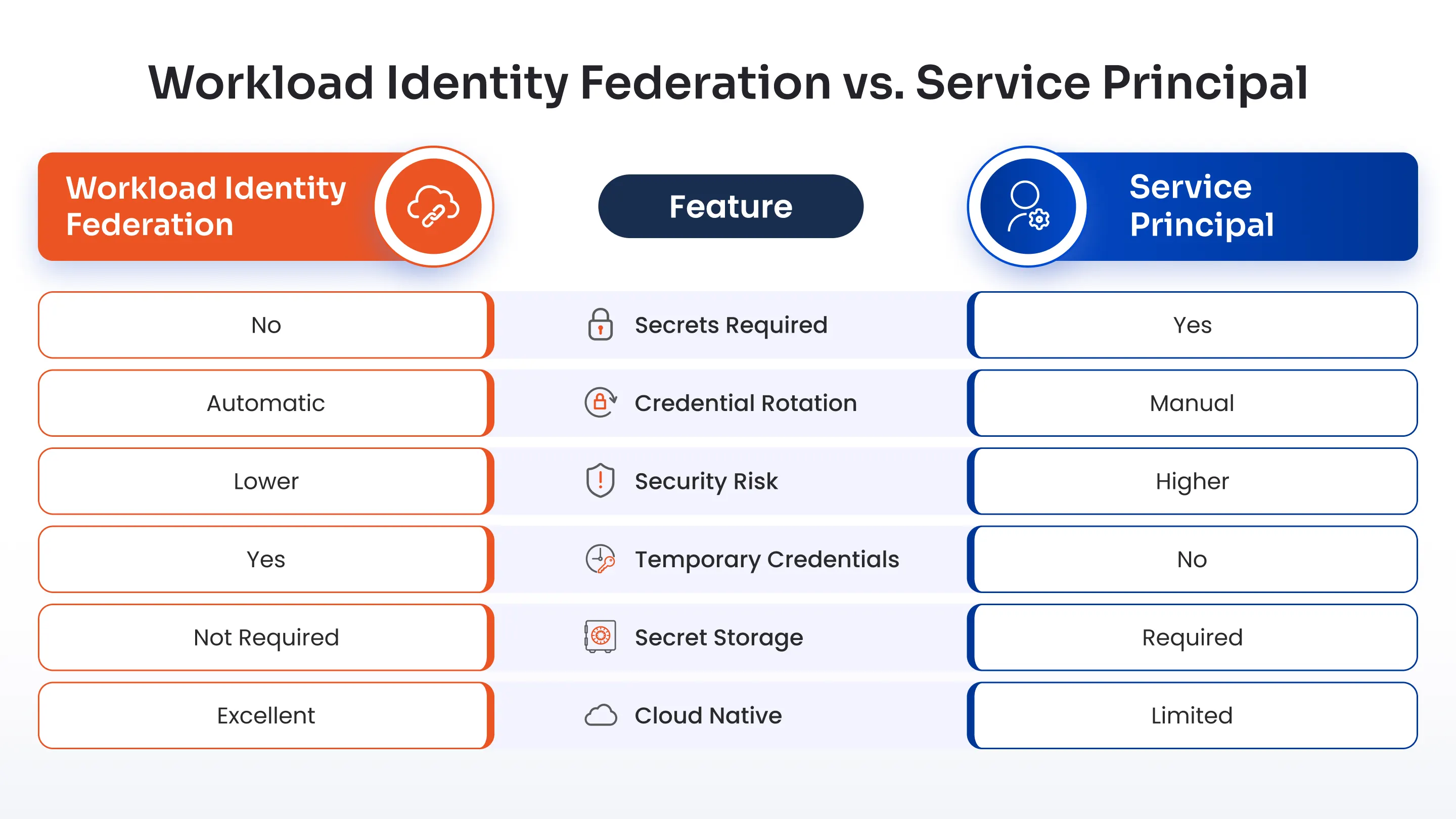
Workload Identity Federation vs. Service Principal
If you are evaluating your security architecture, you might find yourself comparing a workload identity federation vs. a service principal configuration. While both grant programmatic access to application components, their underlying execution models are drastically different.
Workforce Identity Federation vs. Workload Identity Federation
It’s common for teams to confuse workforce and workload federation. While they sound almost identical, they serve two completely different areas of IAM.
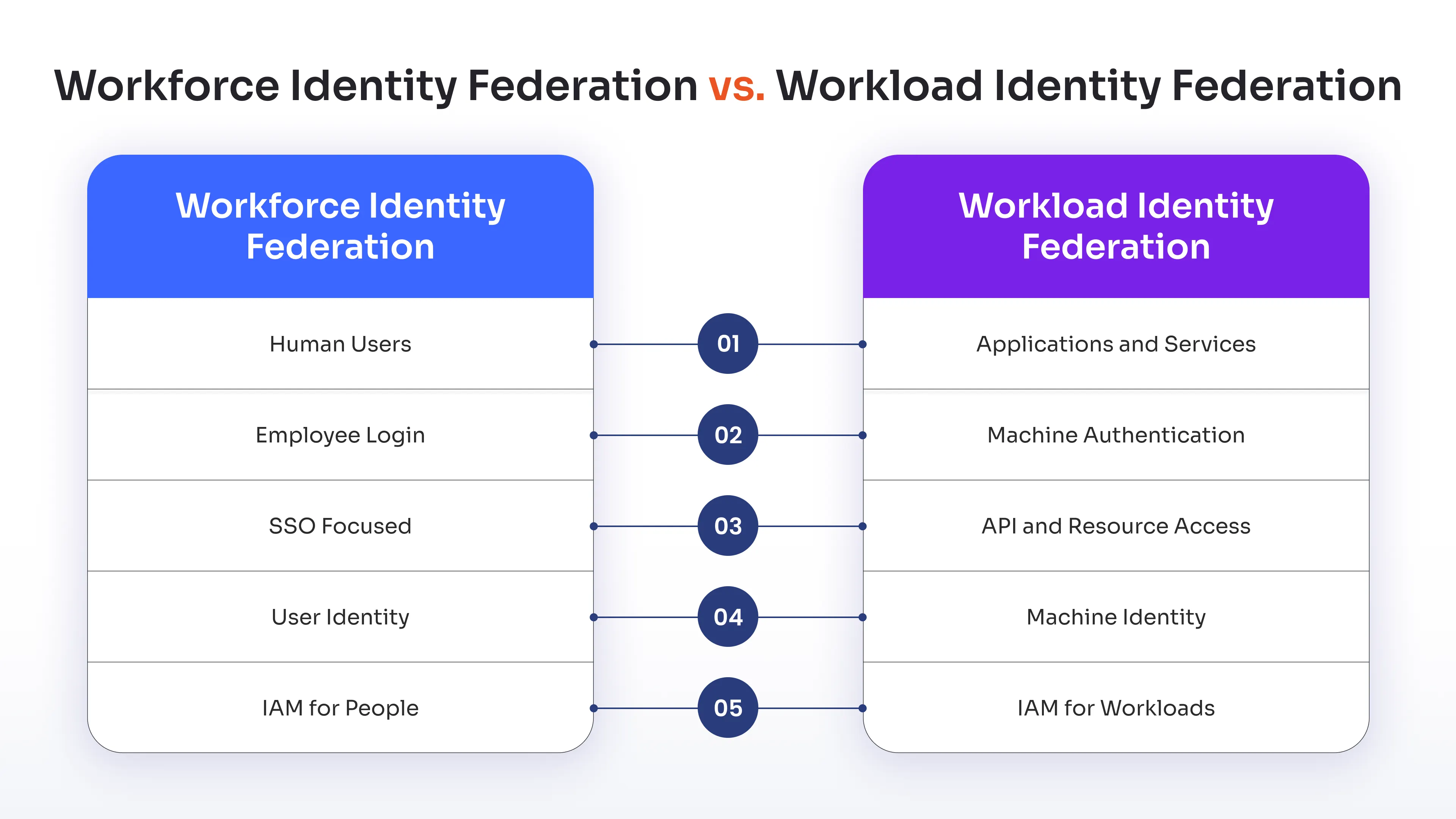
Here’s an example to simplify the distinction:
In the workforce identity federation, an employee logs into AWS using Microsoft Entra ID. In workload federation, a GitHub pipeline accesses AWS without stored credentials.
Common Workload Identity Federation Use Cases
Let’s tap into how WIF shows its value in daily engineering operations. Here are four major architectural use cases.
1. CI/CD Pipelines
CI/CD systems constantly require cloud access. Traditionally, this was solved using stored secrets. But today, teams are using federation to dynamically deploy software without storing long-lived cloud keys inside their code repositories.
Common platforms include:
- GitHub Actions: Use OIDC to push build artifacts straight to cloud infrastructure.
- Azure DevOps: Leverage a federated workload identity Azure DevOps configuration to securely connect multi-stage release pipelines directly to your targeted multi-cloud environments.
- GitLab CI/CD: Use short-lived runners that authenticate dynamically to provision architecture using code engines.
2. Multi-Cloud Authentication
If you run apps across multiple clouds, managing credentials across providers can become overwhelming.
Federated authentication simplifies cross-cloud trust. It allows an application natively hosted on one cloud to act as a trusted entity on another. You can authenticate across AWS, Azure, and Google Cloud Platform without managing multiple secrets.
3. Kubernetes Workloads
Containers are very dynamic, and embedding credentials into pods creates risk. By utilizing WIF, you allow your Kubernetes pods to securely interact with databases, storage, and APIs without embedding static credentials.
4. AI and LLM Workloads
This is an emerging use case as we lean heavily into autonomous artificial intelligence and Large Language Model (LLM) deployments. They are mostly dependent on external APIs and cloud resources. Workload identity federation ensures these intelligent agentic systems authenticate securely without needing developers to hardcode static credentials.
Benefits of Workload Identity Federation
Migrating from an old-school secret-based architecture to a federated model is a smart choice from both security and operational perspectives.
Security Benefits
- Eliminate Long-Lived Secrets
You completely remove the operational risk of credentials sitting statically inside application source code, production containers, or deployment pipelines.
- Reduced Attack Surface
Your risk profile changes entirely. Attackers can’t steal credentials that don’t exist.
- Better Compliance
Workload federation aligns your architecture with rigid security frameworks like SOC 2, ISO 27001, and HIPAA by default.
Operational Benefits
- Easier Credential Management
You can easily manage credentials as you don’t have to rotate them periodically, track their expiry, or set up secure secret distribution channels.
- Improved Developer Productivity
Developers can focus entirely on writing feature code instead of worrying about configuring vaults, fetching access strings, or fixing broken builds caused by expired API keys.
Supported Identity Providers and Platforms
One of the best things about Workload Identity Federation is its deep integration with modern platforms. It is widely supported and continues to expand.
Identity Providers
- Microsoft Entra ID
- Okta
- Auth0
- GitHub Actions
- Azure DevOps
- GitLab
Cloud Providers
- AWS
- Azure
- Google Cloud Platform
- Snowflake
- HashiCorp Cloud Platform
This indicates that federated machine authentication is becoming mainstream.
Workload Identity Federation Best Practices
While shifting to federation drastically improves your security posture, it is not a silver bullet. You still need to configure your trust relationships carefully to ensure your systems remain tightly secure.
1. Use Short-Lived Tokens
Keep token lifetimes as brief as possible to reduce potential exposure risk. Ideally, restrict them to the exact execution window your workload requires.
2. Apply Least Privilege
Don’t grant your federated identities complete access across your cloud environment. Scope permissions down strictly to the specific resources and operations required for the job.
3. Validate OIDC Claims
Ensure your cloud provider checks specific claims like the exact issuer, the unique audience string, and the specific subject field.
4. Monitor Federation Activity
Continuously track token exchanges, log failed authentication requests, and audit post-exchange resource access.
5. Enable Conditional Access Policies
Increase your workload security further by applying contextual controls and policy restrictions where your platform supports them.
Future of Workload Identity Federation
Looking ahead, there are several trends that are increasing the adoption of WIF. The industry is steadily moving toward more passwordless and secretless authentication models.
1. Zero Trust Security
Organizations are realizing that perimeter security is no longer enough. They’re adopting zero trust security, and federated machine authentication naturally drives that move.
2. Cloud-Native Architectures
The sheer volume of serverless platforms and containers makes managing static keys near impossible at scale. They support short-lived identity models.
3. AI Agent Security
As AI agents become autonomous and start handling real-world data processing, they’ll need secure machine identities. Securing them with verifiable trust paths is becoming critical.
4. Machine Identity Management (MIM)
Organizations want centralized governance for non-human identities. Federation supports that direction.
5. Passwordless Infrastructure
Organizations are elevating machine identities to the same level of governance as human accounts. That means moving away from static credentials. Workload identity federation is part of that transition.
How miniOrange Helps Secure Workload Identities
Managing fragmented machine identities across multiple clouds can become too much as your infrastructure grows. And you can’t protect them with outdated tools in a modern, cloud-native ecosystem. That’s where miniOrange comes in.
miniOrange provides you with a suite of services and products that bridge the gap between human and machine identities.
Federated Authentication
Enable federated authentication across applications, workloads, and identity systems. We support the common protocols, including SAML and OAuth/OIDC.
OIDC Provider Support
Streamline your token exchange flows. Give your team a standardized, passwordless way to handle machine authentication across your entire stack.
Identity Lifecycle Management
Automate the entire lifespan of your service profiles and machine accounts. Provision, monitor, and decommission machine identities automatically, eliminating the risk of orphaned credentials.
Centralized Access Control
Manage application permissions, and enforce fine-grained access policies consistently from a single dashboard.
Zero Trust IAM
Zero trust follows the "never trust, always verify" principle. We support that by enabling continuous authentication and context-aware security policies in every single machine-to-machine exchange.
Machine Identity Governance
Ensure all your Non-Human Identities (NHIs) are bound by clear ownership, granular role-based permissions, continuous activity monitoring, and automated credential rotation.
FAQs
What is workload identity federation?
Workload Identity Federation is a machine authentication model that lets applications, automated pipelines, containers, and services securely access cloud resources by exchanging external identity tokens (like OIDC assertions) for short-lived cloud credentials, completely eliminating the need for stored, long-lived access keys or passwords.
How does workload identity federation work?
Workload identity federation operates via a programmatic trust exchange: a workload requests an identity token from its own local identity provider, passes that signed token to a target cloud provider, which validates the cryptographic signature and token claims, and in return, issues a short-lived access token for secure resource usage.
Is workload identity federation more secure than service principals?
Yes, it is significantly more secure. While traditional service principals rely on static client secrets or certificates that can be leaked or stolen, workload identity federation utilizes short-lived, dynamically exchanged credentials and leaves no persistent secrets behind to be exploited.
What is workload identity federation OIDC?
This refers to utilizing the OpenID Connect (OIDC) protocol standard to drive the federation architecture. OIDC uses cryptographically signed JSON Web Tokens (JWTs) to safely carry machine identity assertions between independent infrastructure environments without passing sensitive master passwords or shared keys.
What is the difference between workforce identity federation and workload identity federation?
Workforce identity federation focuses entirely on human users, allowing employees to log into their cloud management portals using corporate Single Sign-On (SSO). Workload identity federation focuses strictly on machine-to-machine interactions, enabling applications, CI/CD tools, and software scripts to access backend cloud APIs securely.
Can Azure DevOps use workload identity federation?
Yes, absolutely. Azure DevOps fully supports workload identity federation, allowing you to configure native service connections that communicate directly with cloud providers via secure, short-lived OIDC tokens rather than relying on permanent secret keys embedded in your build pipelines.
Does workload identity federation support AI agents?
Yes, it is an ideal security model for autonomous AI agents, LLM integrations, and automated operational workflows. It allows these modern systems to securely connect to cloud APIs, data stores, and external resources using federated identities, preventing credential leaks within the AI code base.

Leave a Comment