

Your customers can now delegate more of their shopping process to an AI agent: finding products, comparing options, building a cart, and helping complete a purchase.
For BigCommerce merchants, that creates a new identity question: who is the agent acting for, what can it access, and which actions can it take? And the most important question: is it actually acting for someone?
Identity and Access Management (IAM) platform provides the controls around those interactions. It can authenticate customers, establish identities, restrict access, and add verification before sensitive actions.
What Is Agentic Commerce in BigCommerce?
Agentic commerce uses AI agents to perform shopping-related tasks on behalf of customers/users. An agent might search for products, compare options, build a cart, or assist with checkout.
For a BigCommerce merchant, an agentic commerce setup can involve an external AI agent interacting with the store’s storefront or APIs through an approved integration.
A typical workflow could look like this:
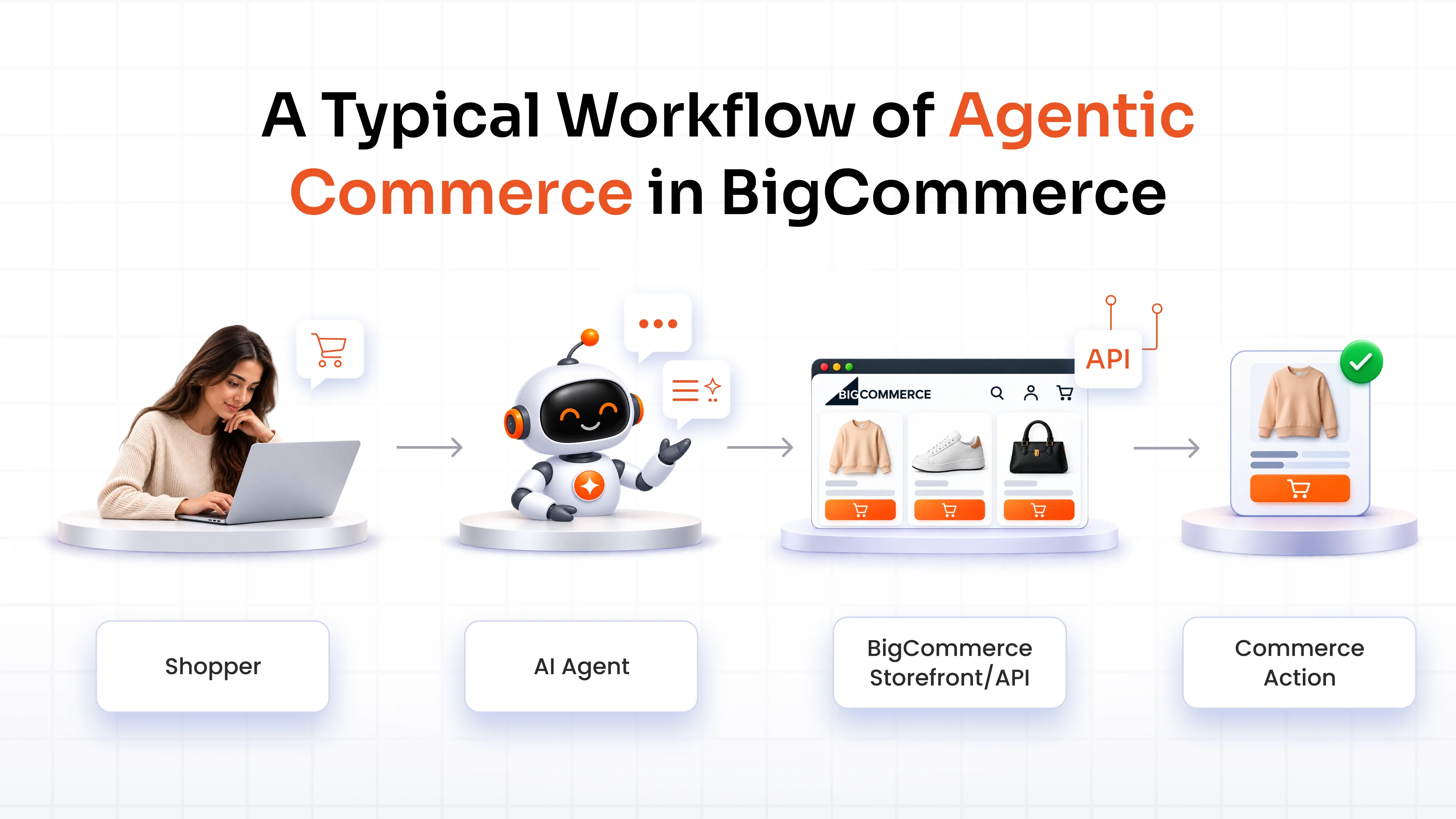
The level of access depends on how the integration is built. An agent searching public product information needs very different permissions from one accessing a customer’s account or modifying a cart.
For example, a shopper could ask an AI assistant to find a particular product within a given budget. The agent could retrieve relevant product information, compare available options, and help the customer decide what to buy. If the integration supports authenticated customer actions, the agent could then interact with the shopper's account or an existing cart.
BigCommerce provides the commerce platform and APIs that an agentic system can interact with, while the AI agent and its supporting infrastructure may come from another application or service.
Why Agentic Commerce Needs IAM
Traditional ecommerce already has identity risks. An attacker who takes over a customer account could view personal information, access saved details, or make unauthorized purchases.
AI agents add another layer to that problem because an action can originate from software acting on a customer's behalf.
A secure system therefore needs to answer several questions before allowing an agent to interact with a BigCommerce store:
- Who is the customer?
- Which AI agent is making the request?
- What has the customer allowed that agent to do?
- Which BigCommerce resources can the agent access?
- Does the requested action require additional verification?
- Can the merchant trace and revoke the agent's access?
Customer authentication and agent authorization should be handled separately. A customer’s successful login shouldn’t automatically give an AI agent unrestricted access to the customer’s account.
This is where Customer Identity and Access Management (CIAM) becomes relevant. A CIAM layer can manage customer identities, authentication methods, sessions, and access policies across customer-facing applications. It can also work with external identity providers and authentication methods, giving merchants more control over how customers establish their identity.
IAM Controls for Secure Agentic Commerce
IAM controls for agentic commerce cover four areas: establishing identity, limiting permissions, adding verification for sensitive actions, and monitoring activity.
| IAM control | Purpose in agentic commerce | BigCommerce context |
|---|---|---|
| Authentication | Establishes the customer’s identity and identifies connected apps | Customer login API, SSO, social login, passwordless authentication |
| Authorization | Defines and limits what an AI agent can access, change, or do | Limit access to specific customer or commerce resources |
| Step-up authentication | Adds verification before higher-risk actions | Require MFA before sensitive account or transaction actions |
| Monitoring | Tracks and records access and actions for detection and investigation | Monitor API requests, failed access authentication attempts, and transactions |
1. Authenticate Customers and Agents
The customer can authenticate through methods such as SSO, social login, or passwordless authentication, while the agent uses its own approved credentials.
BigCommerce's Customer Login API can support alternative storefront sign-in flows. Separating the 2 identities also makes it possible to revoke an agent's access without disabling the customer's account.
2. Control Agent Access
An agent that searches products doesn't need access to customer profiles or order history. An agent that's allowed to update a cart may need additional permissions, while actions involving account changes or purchases can require further authorization.
Use least-privilege permissions and scoped credentials. Short-lived tokens can further limit how long an agent retains access where the integration supports them.
3. Protect Customer Accounts
A customer may authorize an AI agent to perform routine shopping tasks without intending to approve every action automatically. The system should define which actions require another confirmation.
For example, browsing products or adding an item to a cart could follow the agent's existing permissions, while changing account details or completing a purchase could trigger MFA or explicit customer approval.
4. Monitor Agent Activity
Automated actions need to be traceable. Record events such as agent authentication, API requests, authorization failures, permission changes, and sensitive account or transaction activity.
This gives security teams a way to investigate unexpected behavior and revoke access when an agent, credential, or integration behaves outside its permitted scope.
How BigCommerce SSO and CIAM Lead to Trusted AI Shopping
BigCommerce SSO and CIAM can work together as part of a broader identity architecture.
A simplified flow looks like this:
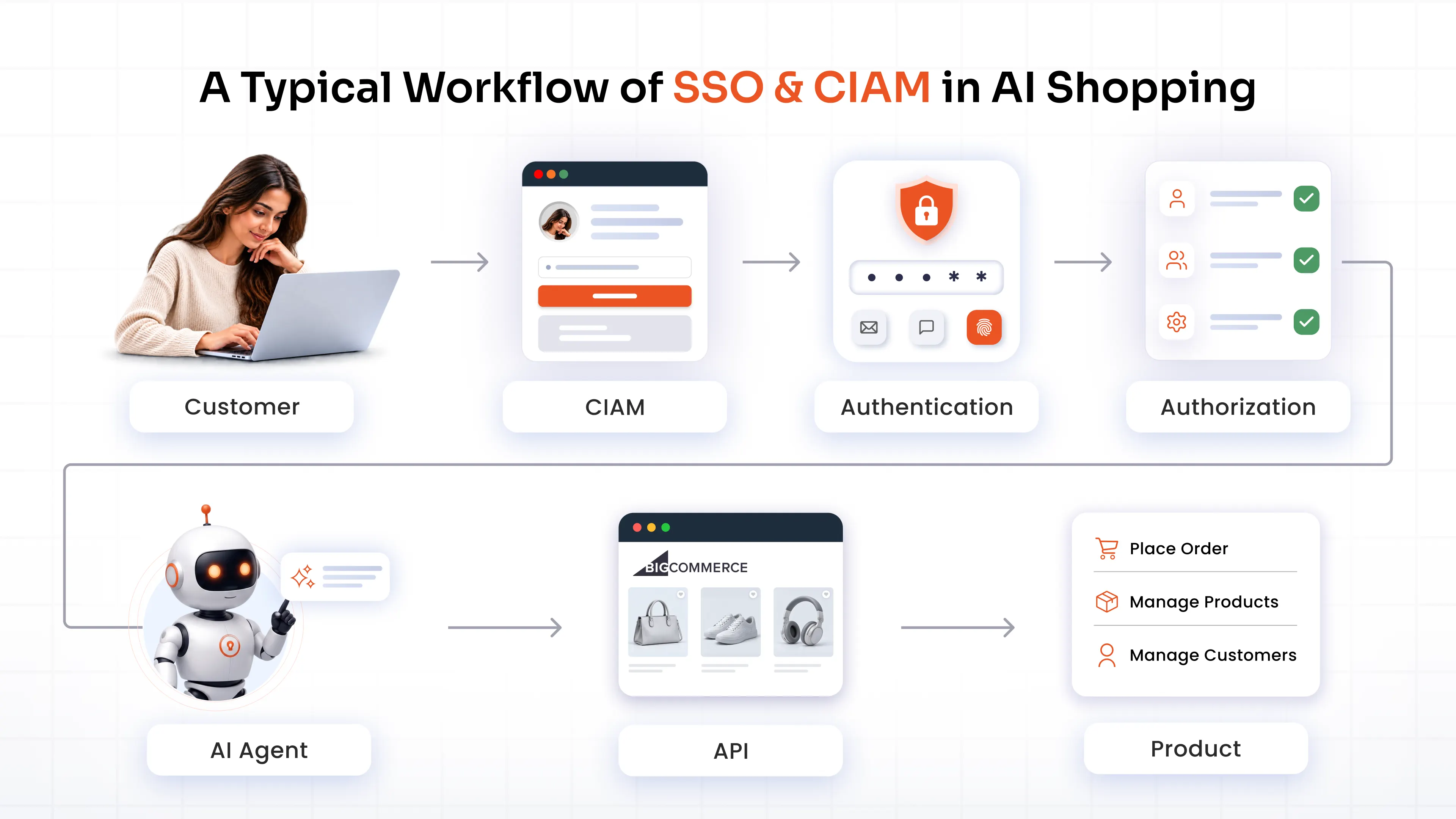
The customer first establishes their identity through the selected authentication method. The identity layer can apply the policies that govern the customer’s session and the agent acting on their behalf.
Consider a shopper who asks an AI assistant to find a replacement product and add it to an existing cart. The agent may need permission to retrieve product information and interact with a specific cart. It doesn't necessarily need access to the customer's complete account profile or order history. If the shopper then asks the agent to place the order, the system can apply a stronger authorization rule before allowing that transaction.
BigCommerce SSO can simplify customer authentication across connected applications, while CIAM can provide centralized control over customer identities and authentication policies.
An external identity provider can also be connected when the BigCommerce storefront is part of a wider customer ecosystem that includes mobile apps, portals, loyalty programs, or other digital services.
Best Practices for Securing Agentic Commerce
Agentic commerce introduces a simple rule for IAM teams: an authenticated agent still needs boundaries.
Businesses should consider these practices:
- Apply least privilege: Give an agent only the permissions required for its assigned task.
- Use scoped, short-lived credentials: Limit what a credential can access and how long it remains valid.
- Separate customer and agent identities: Don't treat the customer's login credentials as the agent's credentials.
- Require approval for sensitive actions: Purchases, changes to account information, refunds, or access to sensitive data may require explicit customer confirmation.
- Use MFA for higher-risk activity: Add stronger authentication when a transaction or account action carries greater risk.
- Monitor and revoke access: Track agent activity and provide a way to terminate suspicious sessions or permissions quickly.
The need for these controls is becoming clearer as AI agents move from answering questions toward taking actions. Current agent-security initiatives increasingly focus on agent identity, delegated authority, consent, scoped credentials, and controls around what an agent is allowed to do.
Secure BigCommerce Customer Experiences With IAM
Agentic commerce gives AI agents more responsibility in the customer journey, which makes identity and access controls part of the commerce architecture. An IAM solution can keep those interactions tied to verified identities, limited permissions, and customer approval where needed.
For example, miniOrange can be used to add customer-facing identity capabilities around a BigCommerce environment, including SSO, social login, MFA, passwordless authentication, and external identity provider integration, while authorization and monitoring help control what connected AI agents can do.
Secure Your BigCommerce Environment with miniOrange CIAM.
FAQs
How does BigCommerce SSO work with AI agents?
BigCommerce SSO can authenticate customers through an identity provider and provide a consistent sign-in experience across connected applications. In an agentic workflow, that identity can then be linked to the permissions governing an AI agent's access.
What is BigCommerce CIAM?
BigCommerce CIAM refers to using customer identity and access management capabilities around a BigCommerce customer experience. CIAM can manage customer authentication, identity data, sessions, access policies, and external identity provider integrations.
How does BigCommerce social login improve customer authentication?
BigCommerce Social Login lets customers authenticate through supported external identity providers instead of maintaining another store-specific password. It can simplify sign-in while relying on the authentication controls provided by the connected identity provider.
How can AI agents be securely authorized in BigCommerce?
Give each AI agent only the permissions required for its task. Businesses can use scoped access, separate agent credentials, short-lived tokens where supported, and additional approval for sensitive actions.
How does IAM protect customer data in BigCommerce?
IAM controls which identities can access customer resources and which actions they can perform. Least-privilege policies can prevent an AI agent from accessing customer information that isn't required for its assigned task.
How can businesses secure AI-powered shopping experiences?
Businesses can separate customer authentication from agent authorization, apply least-privilege access, use scoped credentials, add verification for sensitive actions, monitor activity, and provide mechanisms for quickly revoking agent access.
Leave a Comment