

If an AI agent wants to access an API, how does it prove its identity and gain access securely? Explore OAuth, JWTs, API keys, and service identities to understand how modern AI agents authenticate, authorize, and interact with APIs.
What Is AI API Authentication?
AI API authentication is the process by which an AI agent proves its identity to an API before gaining access to data or performing actions. Every time an agent calls an external service querying a database, triggering a workflow, or retrieving user information that service needs to know: who is asking, and are they allowed?
Unlike a traditional application that runs fixed code on behalf of a developer, AI agents behave more dynamically. They reason, plan, and take multi-step actions often without a human in the loop for every request. An AI agent might call an email API to schedule a meeting, query a CRM to retrieve account data, or invoke a billing API to generate an invoice all within a single conversation thread.
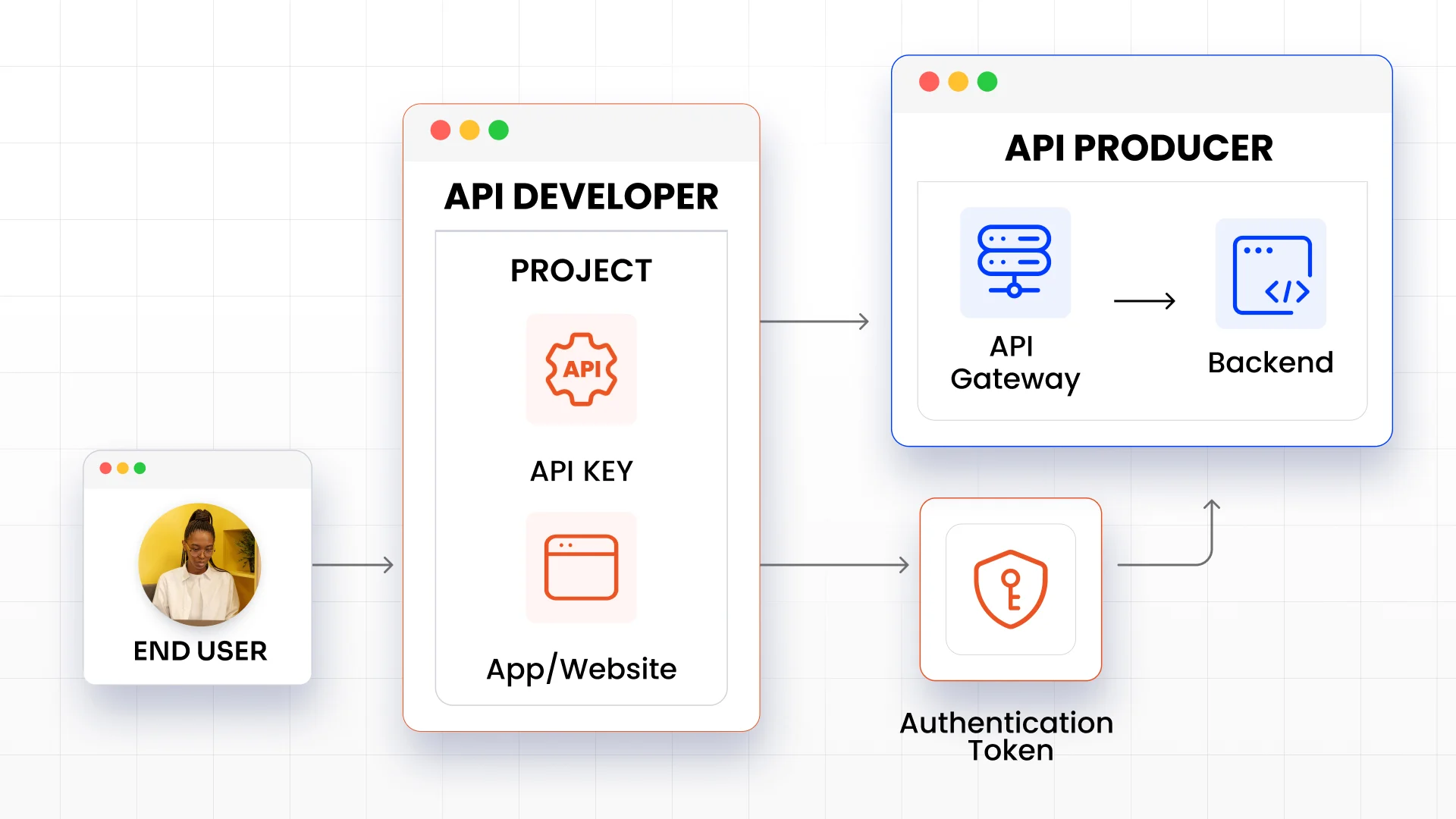
This distinction matters for authentication. A traditional app calls an API the same way every time. An AI agent calls dozens of different APIs, across different sessions, often on behalf of different users and the security model must account for all of that.
Why do AI Agents Need Secure API Authentication?
The case for treating AI agent authentication seriously comes down to what happens when it goes wrong. Insecure AI API access creates attack surfaces that did not exist before agents became mainstream.
Unauthorized API access occurs when agents are not properly authenticated, allowing bad actors to impersonate an agent or exploit its permissions to reach data they should not have. Stolen credentials, particularly long-lived API keys embedded in code or configuration files are a leading source of breaches. Unlike human users who log in interactively, AI agents often authenticate programmatically, meaning credential theft goes undetected for far longer.
Excessive permissions are equally dangerous. An agent provisioned with broad API access "just in case" it needs it creates a large blast radius if compromised. Autonomous actions amplify the risk: while a human user might make one unauthorized request before being caught, an AI agent can execute hundreds of API calls in seconds.
For enterprise teams deploying AI at scale, these risks are not theoretical. They are the reason authentication for AI agents deserves dedicated security design not an afterthought.
AI Agent Identity: Who Is Making the API Request?
Before you can secure AI agent API access, you need to answer a more fundamental question: who or what is the identity making the request?
Human identities are tied to individual people. They come with names, email addresses, and authentication flows designed for interactive login MFA prompts, browser sessions, and consent screens.
AI agent identities are different. An agent is not a human. It cannot complete a CAPTCHA, tap a push notification, or read an email to verify itself. It needs to authenticate programmatically, at machine speed, often without any human involvement in the session.
This is why the concept of service identities and machine identities has become critical. A service identity is a credential set issued to a software process rather than a person it represents what the agent is, not who is running it. These are sometimes called **non-human identities (NHIs).
Why does this distinction matter? Because applying human authentication patterns to AI agents breaks in practice. An agent given a user's personal credentials would inherit that user's full access far more than it needs. A shared service account used by multiple agents makes attribution impossible: if something goes wrong, you cannot tell which agent caused it.
Dedicated agent identities solve both problems. Each agent gets its own identity with scoped permissions, its own audit trail, and its own lifecycle provisioned when the agent is created, revoked when it is retired.
How AI Agents Authenticate to APIs?
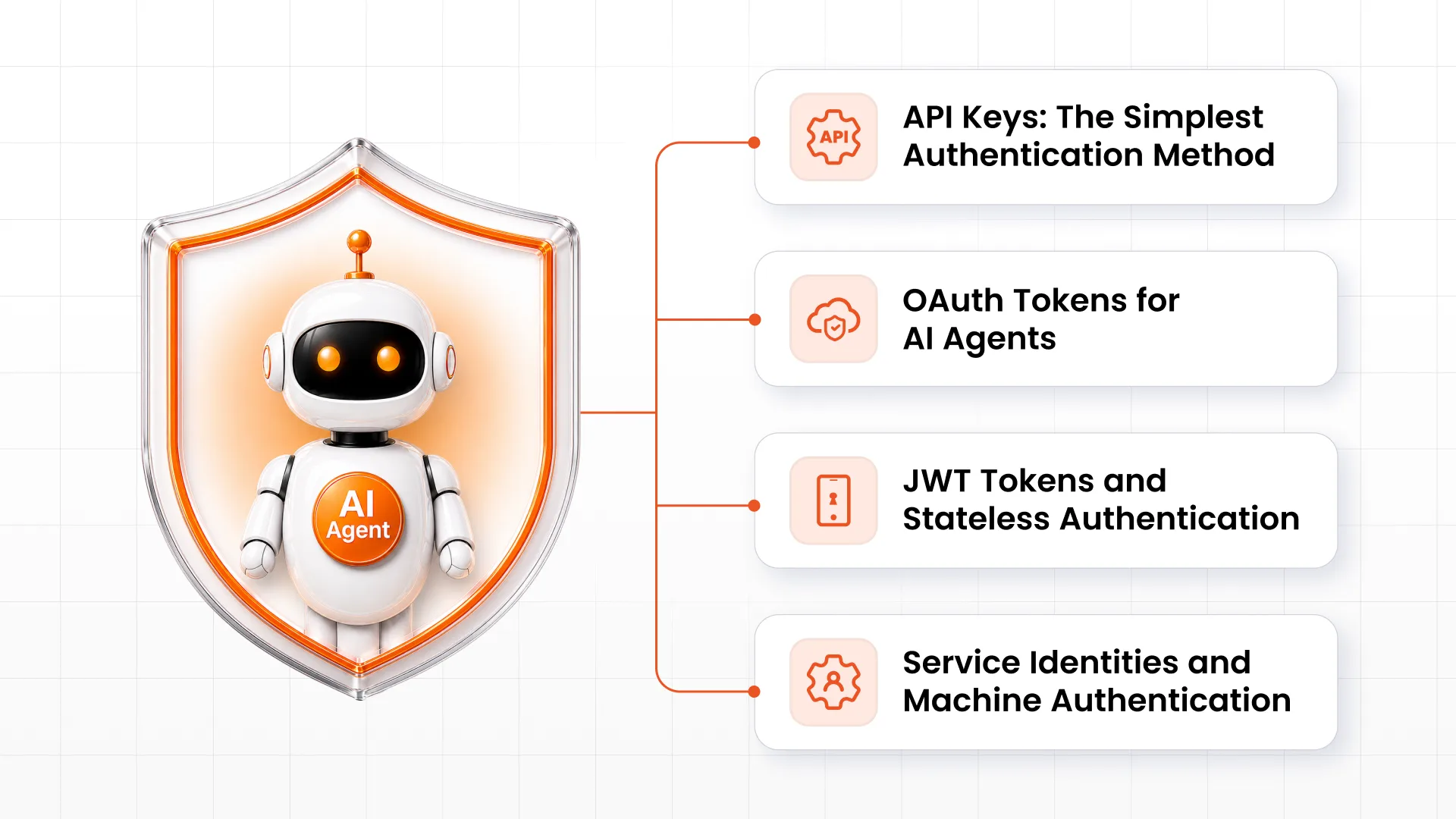
API Keys: The Simplest Authentication Method
API keys are the most straightforward way for an agent to authenticate to an API a static string passed in a request header that the API uses to identify the caller. They are easy to implement and widely supported.
The problem is that API keys are also the least secure option for AI agents. They do not expire by default, do not encode any information about the caller's permissions, and cannot be scoped to specific operations. A leaked API key grants full access until it is manually rotated. For agents calling many APIs across many environments, managing and rotating keys becomes operationally complex and error-prone.
API keys are acceptable for low-risk, internal API calls where the key is stored securely (never hardcoded) and rotated regularly. They should not be the default authentication method for agents with access to sensitive data.
OAuth Tokens for AI Agents
OAuth 2.0 is the most widely recommended authentication framework for AI agents. Originally designed to allow users to delegate limited access to third-party applications, OAuth maps naturally to AI agent access patterns.
For agents acting autonomously without a user present the Client Credentials flow is the appropriate OAuth pattern. The agent authenticates directly with an authorization server using its client ID and secret, receives a scoped access token, and uses that token to call the target API. The token has a defined expiry, encodes the agent's allowed scopes, and can be revoked independently.
For agents acting on behalf of a user, OAuth's delegated access model applies the user grants consent for the agent to act within their permissions, and the token carries both the user's identity and the agent's scoped access. This is covered in more detail in the delegation section below.
The key advantage of OAuth for AI agents: tokens expire, scopes limit what the agent can do, and every token is independently revocable. Unlike API keys, a compromised OAuth token can be invalidated without rotating credentials across the entire system.
JWT Tokens and Stateless Authentication
JSON Web Tokens (JWTs) are a token format commonly used within OAuth flows though they can also be used independently. A JWT is a signed, self-contained token that encodes claims about the caller: who they are, what they are allowed to do, and when the token expires.
For AI agents, JWTs offer stateless authentication: the API receiving the request can verify the token's signature and read its claims without calling back to an authorization server for every request. This makes JWT-based authentication fast and scalable across distributed systems where agents are calling many services in parallel.
The trade-off is revocation. Because JWTs are stateless, an issued token remains valid until it expires there is no built-in way to invalidate it early unless the API checks a revocation list. This makes short expiry windows essential for agent workloads: tokens should expire in minutes to hours, not days.
Service Identities and Machine Authentication
Service identities are the foundation of secure machine-to-machine authentication. Rather than borrowing a human user's credentials, an AI agent is provisioned its own identity registered in an identity provider, assigned specific permissions, and given credentials (typically a client certificate or client ID/secret pair) that it uses to authenticate.
Cloud environments often implement this through workload identity: the cloud platform itself attests to the identity of a running workload, issuing short-lived credentials automatically without the agent needing to manage long-lived secrets. AWS IAM Roles for EC2, Google Cloud Workload Identity Federation, and Microsoft Entra's managed identities are examples of this pattern.
For enterprise AI deployments, service identities give security teams the control they need: each agent has a known identity, each identity has defined permissions, and every action is attributable.
OAuth vs JWT vs API Keys: Which Is Best for AI Agents?
| Method | Security | Scalability | Best Use Case |
|---|---|---|---|
| API Keys | Low static, long-lived, no scope | High simple to implement | Low-risk internal APIs; legacy integrations |
| OAuth Tokens | High scoped, expiring, revocable | High industry standard | Agent-to-API calls; delegated user access |
| JWT Tokens | Medium-High signed, stateless | Very High no server round-trip per request | High-throughput agent workloads; microservices |
| Service Identities | High platform-attested, short-lived | High cloud-native environments | Cloud-based agents with managed identity support |
For most enterprise AI agent deployments, OAuth 2.0 with short-lived JWTs as the token format is the recommended combination OAuth provides the authorization framework, JWTs provide the stateless, verifiable token format.
Authentication vs Authorization: What AI Agents Can Access
Authentication and authorization are related but distinct and confusing the two is a common source of security gaps in AI deployments.
Authentication answers: Is this agent who it claims to be? It verifies identity the agent presents its credentials, the identity provider validates them, and issues a token.
Authorization answers: Is this agent allowed to do what it is trying to do? Even a fully authenticated agent should only be able to access the specific APIs, endpoints, and data it has been explicitly granted permission for.
In OAuth, authorization is expressed through scopes named permissions that define what the token holder can do. A token with the scope calendar.read can read calendar data but cannot create or delete events. A token with crm.write can update records but cannot access billing APIs.
The principle of least privilege applies directly here: an AI agent should be issued tokens with only the scopes required for its specific task. An agent that summarizes emails should have read-only email access not write access, not contact management access, not calendar access.
This is one of the most important security controls for AI agents, because the alternative broad permissions "just in case" means a compromised or misbehaving agent can cause far greater damage.
How AI Agents Access APIs on Behalf of Users?
One of the most important and most misunderstood scenarios in AI agent authentication is delegated access: when an agent acts on a user's behalf rather than as itself.
Consider this example: a user asks their AI assistant to schedule a meeting. The agent needs to call the Outlook Calendar API but it should act with the user's permissions, creating an event on the user's calendar, not a generic system calendar. The user is the one granting access; the agent is the one executing the action.
This is where OAuth's delegated authorization model applies. The user completes an interactive OAuth consent flow approving specific scopes like Calendars.ReadWrite and the agent receives an access token tied to that user's identity and limited to those scopes. Every API call the agent makes carries that delegated token, so the Calendar API sees the request as coming from the authorized user, with verifiable scope constraints.
For multi-service agent workflows where the agent calls Service A, which in turn needs to call Service B while preserving the user's identity Microsoft's On-Behalf-Of (OBO) flow provides a mechanism to re-issue tokens across service boundaries. The intermediate service exchanges the incoming user token for a new token scoped to the downstream API, with the user's identity preserved throughout the chain.
As security researcher Christian Posta notes, this is where traditional OAuth starts to show its limits with AI agents: when the caller is no longer a predictable application but an autonomous agent making decisions on its own, questions of accountability and auditability become much harder to answer with standard OAuth flows alone.
Common Security Risks in AI API Authentication
Leaked API Keys
Long-lived API keys embedded in agent code, configuration files, or environment variables are a perennial source of credential leaks. Unlike passwords, API keys do not expire and are not tied to a specific session a leaked key remains valid until manually rotated. For AI agents calling many APIs, the attack surface is proportional to the number of keys in use.
Token Theft and Abuse
Access tokens intercepted in transit or extracted from agent memory can be used by attackers to impersonate the agent. While short-lived tokens limit the window of abuse, poorly secured token storage or transmission over unencrypted channels creates real risk.
Overprivileged Agents
An agent provisioned with broad API access full admin scopes "for convenience" becomes a high-value target. If compromised, it can access, modify, or exfiltrate far more than its actual task requires. The blast radius scales with the agent's permissions.
Prompt Injection and Unauthorized API Calls
Malicious instructions hidden in content the agent reads a webpage, a document, an email can manipulate the agent into making API calls it was never intended to make. A prompt injection attack that successfully hijacks an authenticated agent inherits all of the agent's API permissions. This makes authentication scope directly relevant to prompt injection risk: a narrowly scoped agent causes far less damage when compromised.
Shared Service Accounts
When multiple AI agents share a single service account, individual agent actions become impossible to attribute. If one agent triggers a security incident, investigators cannot determine which agent was responsible and revoking the shared account disrupts all agents that depend on it.
Best Practices for Securing AI Agent API Access
Use Short-Lived Tokens
Issue OAuth access tokens with short expiry windows minutes to hours, not days. Short-lived tokens limit the damage window if a token is stolen. Pair them with refresh tokens that can be revoked centrally if a compromise is detected.
Apply Least Privilege Access
Grant each AI agent only the OAuth scopes it specifically needs for its defined tasks. Review and revoke unused permissions regularly. Treat scope creep in AI agents the same way you would treat privilege creep in human accounts.
Secure Service Identities
Give each AI agent its own service identity, not a shared credential, not a human user's account. Use platform-managed identities where available (cloud workload identity, managed service accounts) to avoid storing long-lived secrets entirely.
Monitor and Audit API Activity
Log every API call made by an AI agent with full context: token ID, scopes used, endpoint called, timestamp, and outcome. Anomalous patterns of an agent calling APIs outside its normal scope, unusually high request volumes, or calls at unexpected times should trigger alerts.
Use an Identity and Access Management (IAM) Solution
A centralized IAM solution provides the infrastructure for managing agent identities at scale: provisioning service accounts, enforcing scope policies, issuing and revoking tokens, and maintaining audit trails across every agent deployment.
Where MFA, SSO, and PAM Fit Into AI Security
MFA for Human-in-the-Loop Approval
While AI agents cannot complete MFA challenges autonomously,an MFA solution plays an important role at the boundaries where humans interact with agent workflows. High-risk actions an agent requesting expanded permissions, a user granting OAuth consent for sensitive scopes, or an administrator approving an agent's access policy change should require MFA from the human approving the action. This prevents an attacker who has gained access to an admin account from silently expanding an agent's permissions.
SSO for Centralized AI Application Access
Single Sign-On provides a centralized access point for the human-facing side of AI deployments the dashboards, management consoles, and configuration interfaces used to set up and govern AI agents. Centralizing access to these tools through SSO means every login is monitored, every session is attributable, and access can be revoked from a single place if a team member leaves or an account is compromised.
PAM for Protecting API Credentials and Service Accounts
Privileged Access Management solution is the right tool for managing the credentials AI agents use to authenticate. API keys and client secrets are privileged credentials they grant programmatic access to sensitive systems. PAM solutions vault these credentials, rotate them automatically on a defined schedule, log every access event, and can revoke them instantly if anomalous behavior is detected. For organizations running many AI agents across many APIs, PAM brings the same discipline to machine credentials that it has long applied to human admin accounts.
The Future of AI API Authentication
The authentication patterns AI agents use today OAuth, JWTs, service identities are well-established and effective. But the way agents are deployed is evolving rapidly, and authentication standards are evolving to keep up.
Workload identity federation is becoming the standard for cloud-native agent deployments: the cloud platform attests to the identity of a running workload and issues short-lived credentials automatically, eliminating the need to manage long-lived secrets entirely.
Agent-to-agent authentication is an emerging challenge. As multi-agent systems become common orchestrators that spawn sub-agents, agents that call other agents as part of a workflow the question of how agents authenticate to each other (not just to APIs) needs its own answer. Standards like the Model Context Protocol (MCP) and evolving OAuth extensions for agentic flows are beginning to address this.
Agent governance will become a compliance requirement. As regulators look at AI deployments the same way they look at privileged access, organizations will need to demonstrate that every AI agent has a defined identity, a scoped permission set, and a complete audit trail. The Cloud Security Alliance's research on agentic AI identity management points in this direction: ephemeral credentials, continuous authorization, and fine-grained access control are not optional features they are the foundation of accountable AI.
The trajectory is clear: AI agents will be treated as first-class identities, with the same lifecycle governance, audit requirements, and access controls that apply to human users and privileged accounts.
Conclusion
AI agents are already calling APIs across enterprise environments reading data, triggering workflows, and acting on behalf of users. The authentication decisions made now determine how secure those interactions are. API keys are simple but risky. OAuth with short-lived, scoped tokens is the recommended standard. Service identities give each agent a dedicated, attributable credential. And IAM, PAM, and SSO provide the governance layer that ties everything together.
The agents will keep getting more capable. The authentication infrastructure that governs them needs to keep pace.
Talk to the miniOrange team about securing your AI agent deployments →
FAQs
What is AI API authentication?
AI API authentication is the process by which an AI agent proves its identity to an API before being granted access. It ensures that only authorized agents with defined, scoped permissions can call specific APIs and take actions within those systems.
How do AI agents authenticate to APIs?
AI agents authenticate using one of several methods: API keys (simple but less secure), OAuth 2.0 tokens (recommended scoped, expiring, revocable), JWT tokens (stateless and fast), or service identities issued by the platform or identity provider. For most enterprise deployments, OAuth 2.0 with short-lived JWTs is the recommended combination.
What is the difference between OAuth and JWT authentication?
OAuth is an authorization framework that defines how tokens are issued, scoped, and revoked. JWT is a token format a signed, self-contained string that encodes claims about the caller. They are often used together: OAuth defines the authorization flow, and the issued token is formatted as a JWT. OAuth handles the "who gets access and to what" question; JWT is how that decision is represented in a token.
Why do AI agents need service identities?
Service identities give each AI agent a dedicated, unique credential that is not tied to any human user's account. This enables precise attribution (knowing exactly which agent made a request), scoped permissions (only granting the access that agent specifically needs), and clean lifecycle management (provisioning when the agent is created, revoking when it is retired). Shared credentials across multiple agents make attribution and revocation impossible.
Are API keys secure enough for AI agents?
For low-risk, internal API calls with proper secret management, API keys can be acceptable. For enterprise AI deployments involving sensitive data, API keys should not be the primary authentication method. They do not expire by default, cannot be scoped to specific operations, and are difficult to rotate across many agents simultaneously. OAuth tokens with short expiry windows and defined scopes are significantly more secure.
How can organizations secure AI agent API access?
The core practices are: use short-lived OAuth tokens with least-privilege scopes, provision dedicated service identities for each agent, vault API credentials in a PAM solution, monitor all API activity for anomalous patterns, require MFA for human approval of high-risk agent actions, and use a centralized IAM platform to manage agent identity lifecycle.
What role does IAM play in AI API authentication?
IAM provides the infrastructure for managing AI agent identities at scale provisioning service accounts, defining and enforcing scope policies, issuing and revoking tokens, and maintaining complete audit trails. Without an IAM framework, agent authentication becomes ad hoc: credentials scattered across systems, permissions inconsistently applied, and no central visibility into what agents are accessing.
Can MFA be used with AI agent workflows?
Not directly AI agents cannot complete interactive MFA challenges. However, MFA applies at the human boundaries of AI workflows: when a user grants OAuth consent for an agent, when an administrator modifies an agent's permissions, or when a human approves a high-risk action the agent has requested. MFA at these decision points prevents attackers who have compromised a human account from silently expanding an agent's access.
Leave a Comment