

We all know that a Privileged Access Management system protects identities that have privileged access. Usually, we think of people, such as employees or IT administrators. But that is not even the tip of the iceberg.
Knowing the types of identities in PAM is important because there are many identities that are often overlooked by businesses. And it is these identities that create security vulnerabilities.
This comprehensive guide breaks down what those identities are, the risks they carry, and what specific features in a PAM system secure them.
What Is an Identity in PAM
An identity is the digital representation of a person, application, service, machine, or other entity that needs to access a system. It allows the system to recognize the entity, authenticate it where required, and determine what resources it can access.
Not all identities fall within PAM’s scope. The identity becomes relevant in PAM when it has elevated permissions or can access sensitive data. An intern logging into their corporate email is not relevant. But a database administrator who can modify production records is.
A PAM system controls these identities' access through measures such as privileged credential vaulting, granular access permissions, just-in-time (JIT) access, session monitoring, and audit trails.
Different Types of Identities in Privileged Access Management
You need to categorize the access points to build a strong defense. Let’s break down the exact identities your PAM strategy must secure.
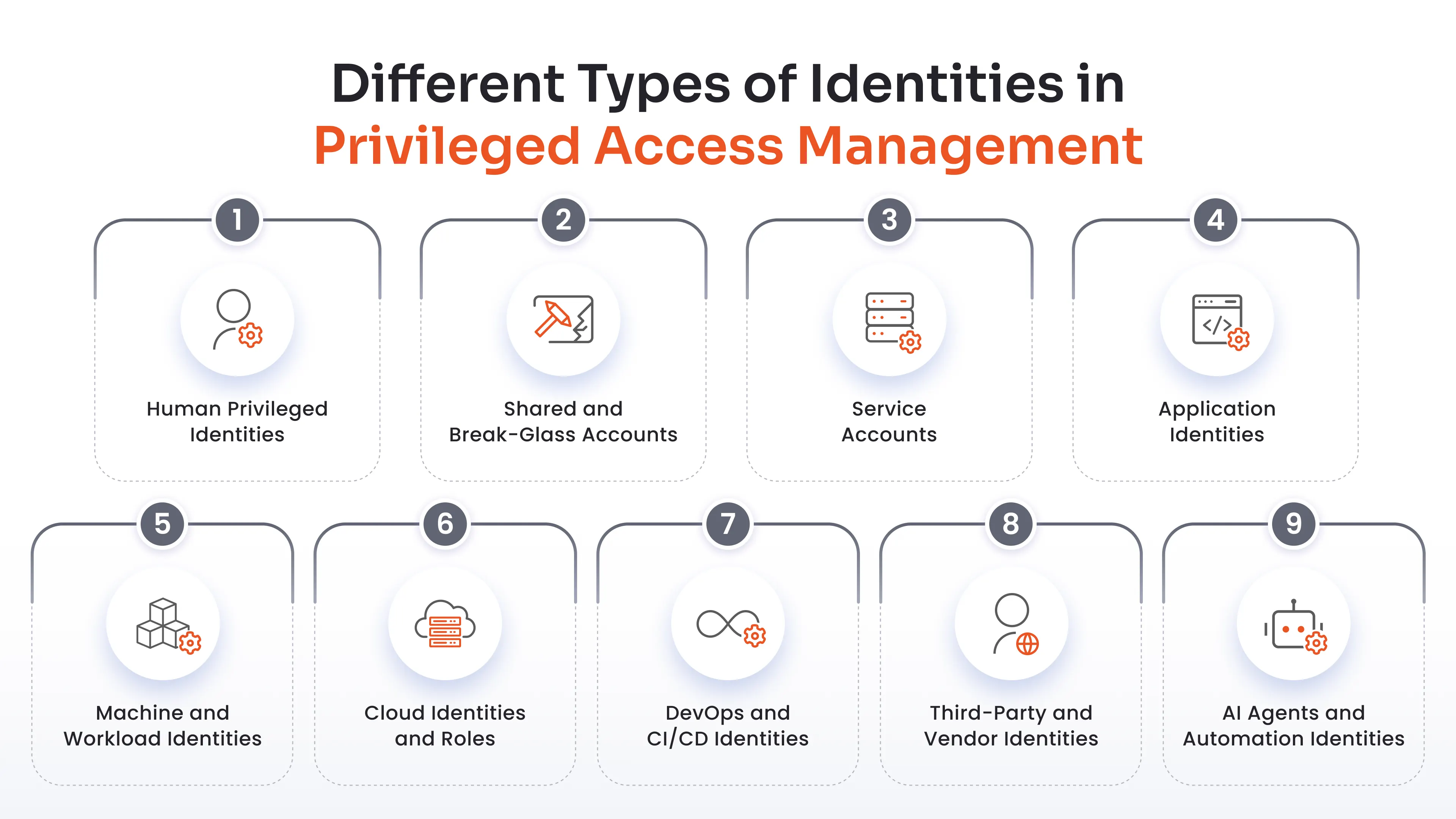
Human Privileged Identities
This is the most well-known digital identity in the context of PAM. But it does not constitute the largest share.
Human privileged identities belong to people who need elevated access to perform their jobs. These individuals typically include system administrators, database engineers, cloud architects, and network managers.
Common examples include:
- Root and administrator accounts: Accounts with extensive control over operating systems, servers, or infrastructure.
- Domain administrators: Accounts with elevated privileges across a directory environment.
- Database administrators: Accounts that can change database configurations, manage users, or modify sensitive records.
- Network administrators: Accounts used to configure routers, switches, firewalls, and other network infrastructure.
- Security administrators: Accounts that manage security policies, access controls, or critical security tools.
The main challenge with securing these identities is the fact that they are human. Attackers bet on the fact that errors will happen. People will reuse passwords, fall for phishing emails, or copy and paste sensitive data into Jira tickets.
An effective PAM solution acknowledges human nature and protects human admins from their own mistakes. It should offer features such as Multi-Factor Authentication (MFA), time-bound access, credential vaulting, and real-time session monitoring.
For instance, if a credential is compromised, credential rotation will render it useless in moments.
Shared and Break-Glass Accounts
Shared accounts allow multiple authorized people to use the same account or credential. These can be a nightmare to secure. Yet organizations retain them for convenience or to support legacy systems.
The major problem here is accountability. If anything goes wrong, how do you know who is behind it?
Shared accounts can also become difficult to manage when employees leave or when several users know the same password.
Then you have break-glass accounts, which come into play during emergencies. If there is a crisis where normal authentication is not available, you use a break-glass account to regain control of your network. These accounts intentionally bypass normal security checks.
Given the level of access these accounts have, a PAM solution should intercept these shared logins, vault them, and rotate the shared credentials. It should record a video of every keystroke made during the shared session.
For emergency access, make sure the recovery process remains viable if your primary PAM service becomes unavailable. A break-glass mechanism that depends entirely on the failed system may not meet the recovery requirement.
Service Accounts
Service accounts allow applications, background services, scheduled tasks, and automated processes to authenticate to other systems. These are the most common non-human identities in PAM.
For instance, backup software can use a dedicated service account to log in at midnight to retrieve the data and store the backup. Human involvement is not required, which is good but also risky.
The risks often stem from a lack of ownership and weak lifecycle management. These accounts may have more permissions than they need, use credentials that rarely change, or still retain access after the project ends.
Hardcoded passwords in scripts and configuration files are also a concern, as anyone who obtains them may be able to extract the credentials and reuse them elsewhere.
Attackers target service accounts because they often fly under the radar of normal monitoring. They also do not trigger MFA prompts.
Securing them requires an automated discovery engine and continuous credential rotation, which PAM solutions generally provide.
Application Identities
Applications often need their own identities to communicate with databases, APIs, cloud services, or other applications. Depending on the platform, these identities may take the form of application registrations, service principals, or other application-specific security principals.
These identities often rely on hardcoded secrets, long-lived API keys, or static security tokens. They differ from human identities because their activity usually originates from software rather than a person.
Exposed client secrets, improperly protected keys, excessive permissions, and credentials shared across multiple applications can create vulnerabilities.
PAM helps you assign an identifiable owner and define a purpose for each application. You can then limit each application's permissions to the resources and actions it needs.
Machine and Workload Identities
Machine identities represent devices or other computing entities. Workload identities identify running workloads, such as containers, services, or processes, so that they can authenticate when accessing other resources.
Unlike human identities, they work at lightning speeds and authenticate the physical hardware and the virtual computing environments themselves. They scale up and down based on traffic. For instance, you might have one hundred web servers today and five hundred tomorrow. You cannot possibly provision identities for them manually.
This introduces risks such as misconfigured permissions, lack of tracking, and excessive access that persists even after a workload is retired.
Managing these privileged identity types requires extensive automation. Your PAM platform must issue short-lived certificates and secure tokens on the fly. It must authenticate these workloads based on their cryptographic properties, not just simple, static passwords.
Cloud Identities and Roles
Users, service principals, workloads, and other entities can receive permissions to manage cloud resources or perform actions within a cloud account or subscription.
Cloud platforms also use roles and policies to define permissions, which is different from an identity. It is a set of permissions that an identity may be assigned or allowed to assume.
Problems occur when those permissions are too broad or become permanent. An attacker can access sensitive data and alter settings by getting their hands on such identities.
As cloud identities are typically decentralized, tracking them across multiple cloud providers is a challenge. You need a centralized PAM platform that enforces the principle of least privilege across your entire multi-cloud setup.
DevOps and CI/CD Identities
DevOps environments depend on automated workflows to build software. These workflows may use pipeline identities, deployment service accounts, repository credentials, API tokens, and other machine credentials.
DevOps tools need high-level access to do their jobs. If an attacker manages to compromise your CI/CD pipeline, they can inject malicious code directly into your live product. Look at the infamous SolarWinds breach.
Other major risks include secrets stored in repository files, pipeline variables with inadequate protection, credentials shared across environments, and deployment identities with excessive permissions.
An effective PAM solution integrates natively into the existing CI/CD workflow. It injects secure secrets on the fly without breaking the agility and speed of the DevOps team.
Third-Party and Vendor Identities
Businesses often provide access to third-party vendors or consultants. Their digital identities do not belong to you. They use their own devices, which are unmanaged and operate entirely outside your corporate firewall. But you have to give them privileged access to your internal systems so that they can do their work.
While their identities are human, their access requirements differ from those of your regular employees. The major difference is that they need access to a limited number of systems for a limited time.
Things get problematic when you give them unrestricted access or fail to revoke their access even after they do their job. Not that those vendors intend to target you, but if their account is compromised, it can sabotage your business. You can do little, as you do not control the security posture of a vendor's personal laptop.
To ensure security, do not give the vendors standing VPN access. Modern PAM secures vendor access through heavily hardened, clientless gateways.
The vendor accesses the specific application they need purely through a standard web browser without accessing the underlying architecture.
AI Agents and Automation Identities
AI agents have changed the way we approach cybersecurity over the past few years. What makes them interesting is that they act autonomously. They run complex workflows, analyze things, call APIs, initiate actions, and make decisions.
AI agents need deep, privileged access to your internal systems to work at their best. That makes them the most volatile non-human identities in PAM. An old-school static security policy cannot handle the level of power and unpredictability they have.
An agent may also act faster than a human operator, making excessive permissions harder to contain once a credential or workflow is compromised. You need to monitor them in real time.
You need a PAM platform that evaluates every single API call an AI agent makes before it executes. You must issue ephemeral credentials that exist only for the exact duration of that specific, authorized task.
Why It Is Necessary to Secure Both Human and Non-Human Identities
The simple reason is that attackers do not discriminate. They only care about what that specific identity allows them to do. They go for the path with the least resistance.
For decades, the cybersecurity industry focused almost exclusively on securing human identities. With AI in the game, non-human identities now vastly outnumber human identities by an estimated ratio of fifty to one in modern enterprises.
Furthermore, non-human identities typically have more privileges than human identities. An employee might log off at 5 p.m., while a machine identity might have permanent, 24/7 access to your most critical databases.
Just securing either type of identity is like leaving half of your doors open. You must apply all security principles equally to a senior database engineer and to an automated AI workflow.
Your PAM strategy should address both groups while recognizing how they are different.
- Reduce excessive privileges: Limit what people, applications, and automated processes can do if their credentials are compromised.
- Limit the exposure of credentials: Store privileged secrets securely and manage their rotation rather than scattering them across scripts, configuration files, and shared documents.
- Reduce standing access: Use JIT access where appropriate so that elevated permissions are available only when needed.
- Improve accountability: Maintain logs and session records that help establish which identity accessed a resource and what activity occurred.
- Control third-party access: Give vendors access to the systems they need without automatically extending that access across the network.
- Address the full identity lifecycle: Review access when people change roles, workloads are retired, applications are replaced, or vendor engagements end.
How Modern PAM Secures Different Identity Types from a Single Platform
Legacy PAM solutions were built for humans. They were essentially glorified password vaults. They cannot handle the speed and scale of AI-related vulnerabilities.
Modern PAM is an identity-first security platform. It continuously evaluates contextual risk and applies relevant controls. Here is how it applies specific, targeted controls to the different types of identities in PAM:
| Identity Type | Key Risks | Relevant PAM Controls |
|---|---|---|
| Human Admins | Phishing, credential theft, malicious insider threats, accidental human error. | Password vaulting, Adaptive Multi-Factor Authentication (MFA), live Session Recording, Just-in-Time (JIT) access. |
| Service Accounts | Unrotated static passwords, invisible standing privileges, lack of clear ownership. | Automated network discovery, continuous automated credential rotation, complete lifecycle management. |
| Machine & App Identities | Hardcoded secrets left in source code, API key exposure, credential sprawl. | Ephemeral secret generation, dynamic runtime secrets injection, secure API access control. |
| Vendors & Third-Party | Unmanaged personal devices, excessive VPN access, lingering permissions after contracts end. | Agentless secure remote access gateways, network session isolation, strict time-bound access limits. |
| AI Agents & Workloads | Unpredictable automated actions, rapid lateral movement, hijacked prompt workflows. | AI runtime authorization checks, ephemeral secret management, anomaly detection & behavioral analytics. |
Secure Human and Non-Human Identities with miniOrange PAM
miniOrange PAM is specifically built for the modern, fast-paced enterprise. It goes far beyond basic, legacy password vaulting. It delivers a powerful Identity-Centric PAM architecture that firmly secures every privileged interaction across your entire infrastructure.
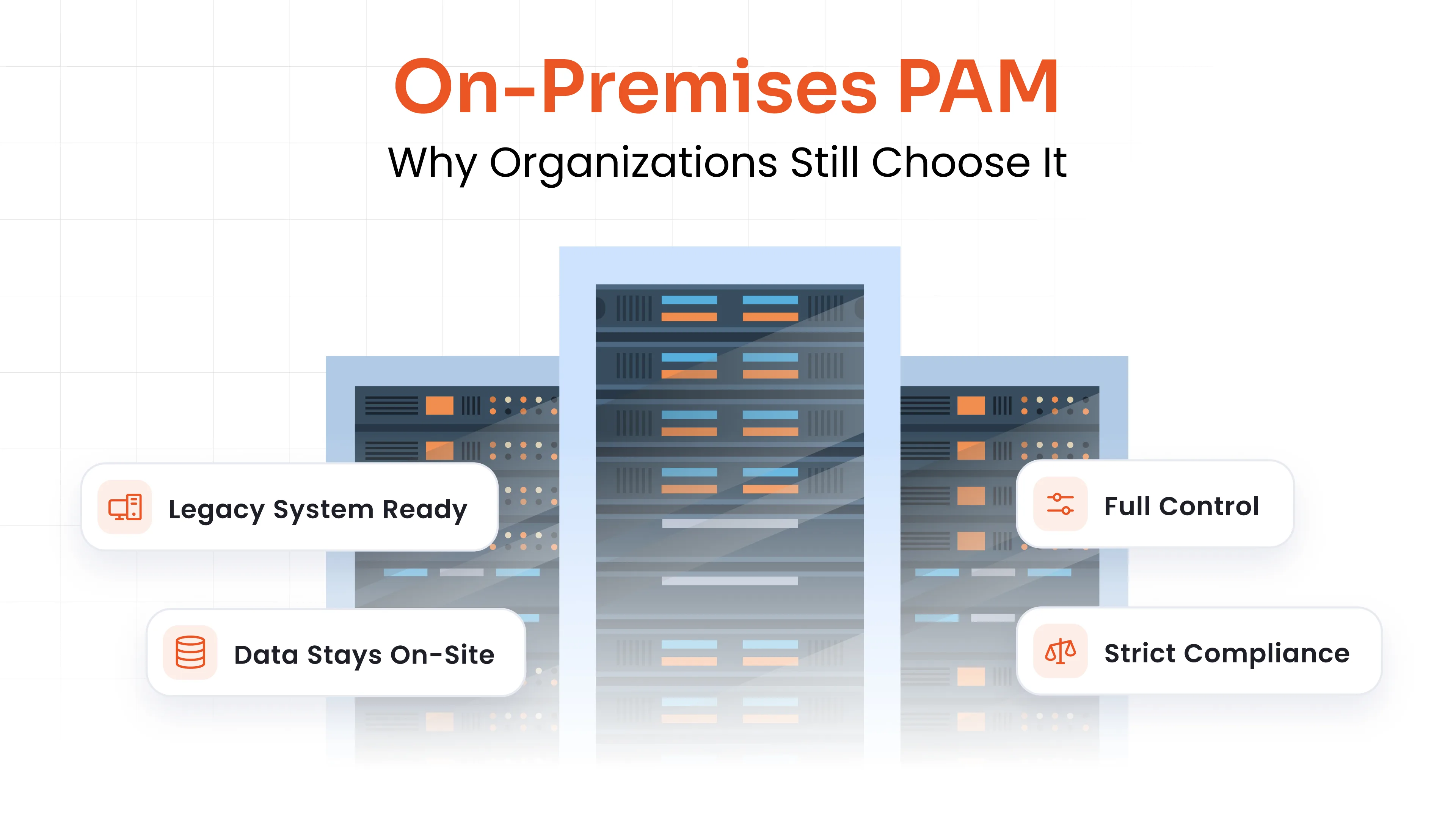
miniOrange PAM secures your legacy on-premises servers, your modern multi-cloud environments, your core databases, and your complex hybrid systems from a unified platform. Here’s how:
- Zero Standing Privileges (JIT): Grants temporary, risk-assessed access and automatically revokes it the moment a task finishes.
- Non-Human Identity Governance: Discovers hidden service accounts and API keys, replacing static credentials with dynamic, ephemeral secrets.
- Real-Time Session Monitoring: Logs human and machine activity, flags anomalies instantly, and auto-terminates suspicious sessions.
- Secure Vendor Access: Replaces risky VPNs with isolated, browser-based gateways to keep third parties off your core network.
- Complete AI Agent Security: Inspects AI requests at runtime in milliseconds, confining autonomous agents to strict policy limits.
You gain uncompromising control over every privileged identity, regardless of where it lives or what digital form it takes.
FAQs
What is the difference between human and non-human identities?
Human identities represent people, such as administrators, employees, contractors, and vendors. Non-human identities represent software or computing entities, such as service accounts, applications, APIs, machines, workloads, and AI agents. Both may need access to sensitive resources, but they often use different authentication mechanisms and require different controls.
Are service accounts considered privileged identities?
A service account is considered a privileged identity when it has elevated permissions that allow it to perform sensitive or administrative actions. Not every service account is privileged. Its classification depends on the permissions it holds and the resources it can access.
How does PAM secure non-human identities?
PAM can secure non-human identities by protecting privileged credentials, restricting access to sensitive resources, supporting credential rotation, applying least-privilege controls, and maintaining audit trails. For AI agents and supported automated workflows, relevant capabilities may also include scoped, short-lived credentials and policy-based authorization.
How are cloud and workload identities managed?
Cloud and workload identities are managed through the identity and access mechanisms provided by their respective platforms. Administrators assign appropriate permissions, configure authentication, review access, and retire unused identities. PAM complements these controls by governing privileged access and protecting credentials for supported resources and workflows.
Why do AI agents need identity and privileged access controls?
AI agents may access APIs, databases, applications, and infrastructure to complete tasks. If an agent uses credentials with excessive privileges, a compromised workflow or unauthorized action could affect critical systems. Identity and privileged access controls help restrict the agent's permissions, govern access to tools and resources, and provide visibility into its activity.
Leave a Comment