
Privileged Access Management (PAM) has become a cornerstone of enterprise security, but the environments it protects have changed dramatically. Organizations now manage cloud infrastructure, SaaS applications, remote workforces, third-party vendors, machine identities, and AI-driven workloads that constantly request privileged access.
Security teams need to verify every identity, understand the context of each request, and grant only the minimum level of access required. This shift has led to Identity-Centric PAM, a modern approach that places identities, rather than credentials, at the center of privileged access decisions.
By combining continuous verification, least privilege, and contextual intelligence, organizations can strengthen Zero Trust security while reducing the risk of privileged account compromise.
What Is Identity-Centric PAM?
Identity-Centric PAM solution is a modern approach to Privileged Access Management that makes verified identities the foundation of every privileged access decision. Instead of granting access because a user possesses privileged credentials, it determines whether a verified identity should receive elevated permissions based on context, risk, and business requirements.
Unlike traditional PAM, which primarily focuses on securing privileged passwords, Identity-Centric PAM evaluates multiple trust signals before allowing privileged access, including:
- User identity and role
- Authentication strength
- Device posture
- Login location and time
- Behavioral risk
- Business justification
These signals work together to ensure privileged access is granted only when it's appropriate and automatically revoked once the approved task is complete.
Why Identity Has Become the Security Perimeter
Enterprise environments have expanded well beyond corporate networks. Employees connect from anywhere, workloads run across public and private clouds, vendors access critical systems remotely, and automated applications communicate through APIs.
At the same time, organizations are managing significantly more identities than ever before. Human users now share enterprise environments with service accounts, containers, automation tools, and AI agents, each requiring different levels of privileged access.
This evolution has shifted security from protecting network boundaries to protecting identities.
Instead of trusting requests because they originate from an internal network, organizations continuously verify every identity requesting privileged access. Identity-Centric PAM applies this principle consistently across employees, contractors, vendors, applications, and machine identities, making identity the primary control point for privileged access.
How Traditional PAM Was Built and where it Falls Short
Traditional PAM introduced essential controls such as password vaulting, credential rotation, and privileged session recording. These capabilities remain valuable, but they were built for environments where privileged users were relatively few and infrastructure changed slowly.
Today's enterprise environments demand a more adaptive approach.
Static Controls Cannot Keep Pace with Dynamic Infrastructure
Cloud-native infrastructure changes constantly. New workloads are provisioned automatically, applications are deployed through CI/CD pipelines, and cloud resources scale within minutes.
Traditional PAM wasn't designed for this level of change.
Security teams now manage privileged access across:
- Multi-cloud platforms
- SaaS applications
- Kubernetes environments
- Infrastructure as Code (IaC)
- Hybrid data centers
Managing dynamic environments through long-lived credentials introduces unnecessary operational overhead while increasing security risk.
Modern PAM replaces static privileges with identity-driven, time-bound access that adapts to continuously changing infrastructure.
Identity Sprawl Makes Privileged Access Harder to Govern
Every new application, cloud platform, or business system introduces additional identities and permissions.
Over time, organizations accumulate:
- Employees with excessive permissions
- Contractors who retain access after projects end
- Shared administrator accounts
- Dormant privileged accounts
- Inconsistent access policies across applications
This growing identity sprawl makes it difficult to answer simple but critical questions:
- Who has privileged access?
- Why do they have it?
- Do they still need it?
Without continuous governance, unnecessary privileges remain active, expanding the organization's attack surface.
Identity-Centric PAM continuously evaluates identities and aligns privileged access with current roles, responsibilities, and business needs.
Standing Privileges Create Persistent Risk
Many organizations still assign permanent administrator rights to simplify day-to-day operations.
Although convenient, standing privileges provide attackers with continuous opportunities for privilege escalation. Once a privileged account is compromised, attackers can often move laterally across systems without requiring additional approvals.
Identity-Centric PAM minimizes this risk through Just-in-Time (JIT) Privileged Access, where elevated permissions are granted only for approved activities and automatically removed when work is complete.
This approach significantly reduces the exposure window while supporting the principle of least privilege.
Non-Human Identities Are Expanding Rapidly
Human users are no longer the only privileged identities within enterprise environments.
Organizations now depend on:
- Service accounts
- APIs
- Containers
- Automation scripts
- DevOps pipelines
- AI agents
Many of these identities operate continuously and often hold highly privileged permissions to perform business-critical tasks.
Without proper governance, they become difficult to monitor and easy to exploit.
Identity-Centric PAM extends privileged access controls beyond human administrators, applying consistent authentication, authorization, monitoring, and lifecycle management to every identity interacting with enterprise resources.
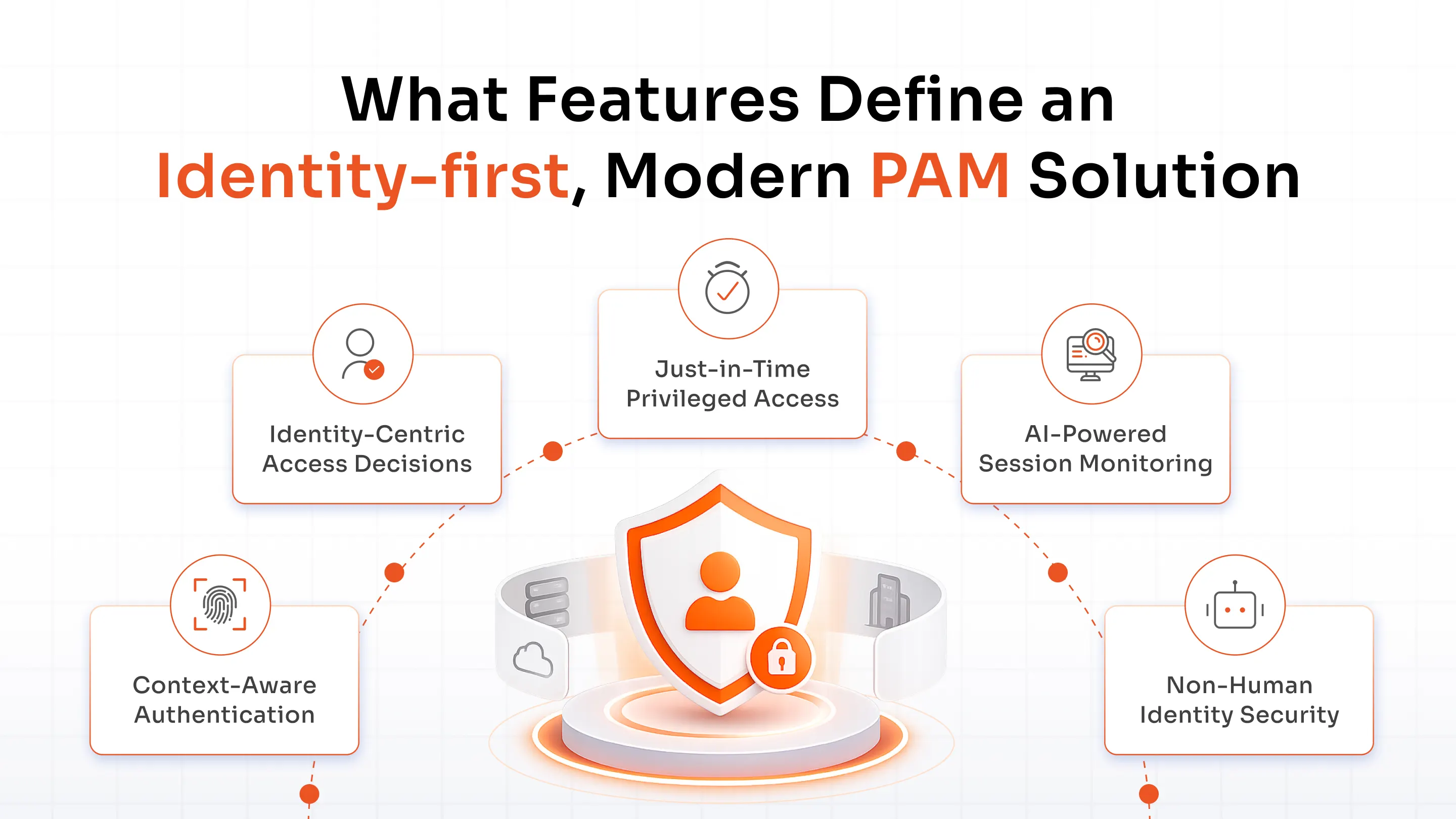
What Features Define an Identity-first, Modern PAM Solution?
A modern PAM solution goes far beyond credential vaulting. It combines identity intelligence, contextual authentication, and continuous monitoring to secure privileged access across cloud, hybrid, and on-premises environments.
Identity-Centric Access Decisions
Modern PAM evaluates privileged requests using real-time identity signals instead of relying solely on passwords or privileged accounts.
Access decisions consider user roles, authentication methods, device health, behavioral patterns, and contextual risk before elevated permissions are granted.
Why it matters: Even if credentials are compromised, attackers still need to satisfy multiple trust requirements before receiving privileged access.
Just-in-Time Privileged Access
Modern PAM eliminates unnecessary standing privileges by granting JIT elevated permissions only when users require them to complete approved tasks.
Once the task is finished, access is revoked automatically without manual intervention.
Why it matters: Temporary privileges reduce the attack surface while improving operational security.
Context-Aware Authentication
Not every privileged request carries the same level of risk.
Modern PAM evaluates contextual factors such as:
- User location
- Device compliance
- Authentication strength
- Time of access
- User behavior
- Risk score
Higher-risk requests can trigger additional authentication or stricter access policies before privileges are granted.
Why it matters: Organizations can balance strong security with a better user experience by adapting authentication to the level of risk.
AI-Powered Session Monitoring
Traditional PAM records privileged sessions for auditing. Modern PAM takes this a step further by using AI and behavioral analytics to continuously analyze privileged activity in real time.
It can identify suspicious behavior such as unusual commands, abnormal login patterns, privilege escalation attempts, or policy violations while a session is still active.
Why it matters: Detecting anomalous privileged activity early helps security teams investigate threats faster and reduce the potential impact of compromised identities.
Non-Human Identity Security
Modern enterprises manage far more than privileged user accounts. Service accounts, APIs, containers, automation scripts, CI/CD pipelines, and AI agents all require elevated access to perform business-critical tasks. In many organizations, these non-human identities outnumber employees, making them one of the fastest-growing attack surfaces.
Unlike human users, machine identities often operate continuously and authenticate automatically. If they aren't governed properly, they can accumulate excessive permissions, use hardcoded credentials, or remain active long after they're needed.
A modern PAM for AI agents secures these identities by:
- Discovering and inventorying machine identities
- Eliminating hardcoded credentials through credential vaulting
- Rotating secrets automatically
- Applying least-privilege policies
- Monitoring privileged activity in real time
By extending privileged access controls beyond human users, Identity-Centric PAM helps organizations secure every identity interacting with critical systems.
Traditional PAM vs. Identity-Centric PAM
While both approaches aim to protect privileged access, they differ significantly in how access decisions are made.
| Traditional PAM | Identity-Centric PAM |
|---|---|
| Protects privileged credentials | Protects verified identities |
| Long-lived administrator privileges | Just-in-Time privileged access |
| Static access policies | Dynamic, context-aware policies |
| Password vaulting as the primary control | Identity intelligence and continuous verification |
| Focuses mainly on human administrators | Secures both human and non-human identities |
| Session recording for audits | AI-powered monitoring and behavioral analytics |
| Designed primarily for on-premises environments | Built for cloud, hybrid, and SaaS environments |
| Authentication at login | Continuous verification throughout the session |
Identity-Centric PAM builds on traditional PAM capabilities instead of replacing them. Password vaulting, credential rotation, and session recording remain essential, but they're strengthened with identity intelligence, contextual risk analysis, and continuous access validation.
How Identity-Centric PAM Enables Zero Trust
Zero Trust is built on a simple principle: never trust, always verify. Identity-Centric PAM brings this principle into privileged access management by evaluating every request before, during, and after access is granted.
Verify Every Identity
Every privileged request begins with identity verification. Users and workloads must authenticate using strong methods such as MFA, certificates, or passwordless authentication before requesting elevated access.
Evaluate Context Before Granting Access
Identity alone isn't enough. Modern PAM also evaluates contextual signals such as device posture, login location, authentication strength, user behavior, and risk level before approving privileged actions.
Grant Least-Privilege Access
Instead of permanent administrator rights, users receive only the permissions required to complete a specific task. Once the activity is complete, privileged access is removed automatically.
Monitor Activity Continuously
Privileged sessions are monitored throughout their duration. AI-driven analytics detect abnormal commands, unusual behavior, or attempts to misuse privileges, enabling security teams to respond before an incident escalates.
By continuously verifying identities and limiting privileged access, Identity-Centric PAM helps organizations put Zero Trust principles into practice rather than treating them as a theoretical framework.
Benefits of Identity-Centric PAM
Identity-Centric PAM helps organizations reduce risk while making privileged access easier to manage across modern IT environments.
Reduced Attack Surface
Replacing standing privileges with Just-in-Time access minimizes the number of privileged accounts available to attackers.
Stronger Compliance
Comprehensive audit trails, identity-based access controls, and session monitoring simplify compliance with regulations and frameworks such as ISO 27001, PCI DSS, HIPAA, SOC 2, and NIST.
Better Visibility Across Identities
Security teams gain a centralized view of privileged users, service accounts, applications, and machine identities, making it easier to identify excessive permissions and policy violations.
Faster Access Management
Identity-driven policies automate provisioning, privilege elevation, and access revocation, reducing administrative effort while improving operational efficiency.
Improved User Experience
Adaptive authentication and Just-in-Time access allow legitimate users to obtain privileged access quickly without compromising security.
Secure Cloud and Hybrid Environments
Identity-Centric PAM provides consistent privileged access controls across cloud platforms, SaaS applications, on-premises infrastructure, and hybrid environments.
Why Organizations Are Moving Toward Identity-First Security
Organizations are adopting identity-first security because identities have become the primary target for modern cyberattacks. As enterprises continue their digital transformation, securing identities has become just as important as securing infrastructure.
Several trends are accelerating this shift.
Cloud-First Operations
Cloud adoption has introduced dynamic infrastructure where users, workloads, and applications constantly change. Identity-driven access controls provide the flexibility needed to secure these environments.
Growth of SaaS Applications
Every SaaS platform introduces additional identities, roles, and permissions. Identity-first security helps organizations maintain consistent governance across hundreds of applications.
Hybrid Work and Third-Party Collaboration
Employees, contractors, and vendors routinely access enterprise resources from different locations and devices. Identity-based verification ensures privileged access remains secure regardless of where requests originate.
AI and Automation
Organizations increasingly rely on AI agents, automation platforms, and machine identities to perform critical operations. These identities require the same governance, visibility, and least-privilege controls as human users.
Increasing Compliance Requirements
Regulatory frameworks continue to emphasize identity governance, least privilege, auditability, and continuous monitoring. Identity-Centric PAM helps organizations meet these requirements while improving their overall security posture.
Identity-first security isn't replacing traditional security controls. Instead, it provides the intelligence and context needed to make privileged access decisions more accurate, adaptive, and resilient against evolving threats.
How miniOrange Delivers Identity-Centric PAM
Modern privileged access requires more than credential management. miniOrange PAM combines identity intelligence with privileged access controls to help organizations secure human and non-human identities across cloud, hybrid, and on-premises environments.
With miniOrange, organizations can:
- Verify privileged users using MFA and adaptive authentication.
- Enforce Just-in-Time privilege elevation to eliminate standing access.
- Apply role-based access controls aligned with business responsibilities.
- Secure service accounts, APIs, and machine identities alongside human users.
- Monitor privileged sessions using real-time analytics and behavioral monitoring.
- Simplify compliance with centralized reporting and detailed audit trails.
- Deploy consistently across cloud, hybrid, and on-premises infrastructure.
Whether you're modernizing legacy PAM or building a Zero Trust architecture, miniOrange provides the visibility, control, and flexibility needed to secure privileged access at enterprise scale.
Secure Privileged Access with Identity at the Center
Privileged access remains one of the most valuable targets for attackers, but the way organizations manage it has fundamentally changed. As enterprises adopt cloud-native infrastructure, embrace AI-driven automation, and support distributed workforces, privileged access decisions must account for far more than administrator credentials.
Identity-Centric PAM addresses this challenge by shifting the focus from managing privileged accounts to governing the identities behind every privileged action. By combining identity intelligence, Just-in-Time access, contextual authentication, continuous monitoring, and comprehensive auditing, organizations can significantly reduce their attack surface while strengthening Zero Trust security and meeting evolving compliance requirements.
About the Technical Expert

PAM Engineering Lead
Pradeep is a Senior Software Engineer at miniOrange, bringing over 7 years of experience in designing and securing enterprise access infrastructures. He leads the architecture and implementation of miniOrange’s Privileged Access Management solutions that help organizations enforce least-privilege controls, secure critical systems, and reduce identity-based risk across cloud and on-prem environments. He works closely with security and IT teams to build scalable privilege governance frameworks aligned with compliance and operational requirements. His expertise spans PAM architecture, secure system design, and identity-first security engineering for modern enterprises.
About the Author

Content Writer
Minal is an experienced B2B content writer. She has written over 250 articles across industries like UI/UX, real estate, automotive, digital marketing, SaaS, AI & ML, and cybersecurity. She brings her interest in cybersecurity to life by creating clear, engaging content tailored for technical, non-technical, and creative pieces. Her aim is to simplify complex topics, highlight product value, and connect with both technical and non-technical audiences.
Leave a Comment