Hello there!
Need Help? We are right here!

Need Help? We are right here!
Search Results:
×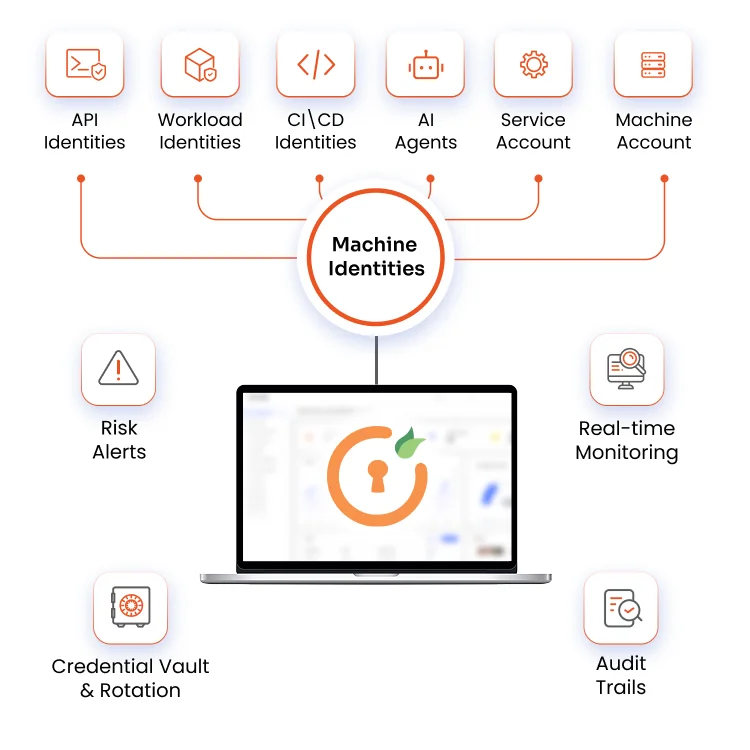
Your environment has thousands of machine identities operating autonomously. Most of them are over-permissioned, under-governed, and entirely invisible to your security team.
AI agents, APIs, bots, and workloads generate thousands of machine credentials that become difficult to track, rotate, or revoke at scale. Each unmanaged credential is an open door for cyber attackers.
Many orphaned and dormant service accounts operate without ownership, governance, or lifecycle controls, creating permanent blind spots that security teams cannot see, audit, or remediate.
AI agents are routinely granted persistent, high-level access instead of least-privilege or just-in-time permissions. These excessive permissions aren’t routinely tracked or revoked after a job is done, leaving a security gap.
Secrets embedded in code, scripts, and CI/CD pipelines dramatically increase the risk of credential leakage and unauthorized access, and they are notoriously difficult to find and rotate.
Compromised machine identities can traverse systems, escalate privileges, and reach critical infrastructure across cloud and hybrid environments, often before any alerts.
Traditional Privileged Access Management (PAM) was primarily built for humans. But, AI agents operate at machine speed, dynamically requesting access to APIs, tools, databases, and infrastructure at runtime.
At the same time, most organizations can’t even inventory, classify, or govern these NHIs. Plus, manual, ticket-based approvals can’t keep up with autonomous systems that run 24/7 and generate thousands of access requests per hour.
To counter this reality, you need a modern PAM solution specifically designed for AI agents and non-human identities to continuously discover them, govern their access, and enforce least privilege.
PAM for non-human identities provides centralized control, visibility, and governance for AI agents, bots, workloads, and machine identities.
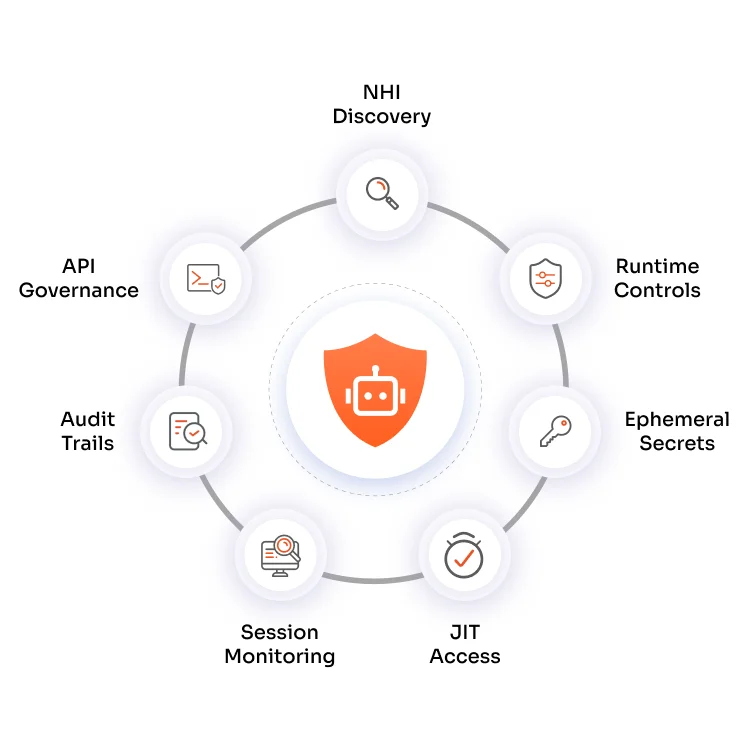
Discover undocumented service accounts, machine identities, API keys, and automation secrets across your entire cloud and on-premise environment.
Enforce access policies at the exact moment of each request, evaluated against workload identity, task type, risk score, and API sensitivity in real time. Risky requests are denied before any damage is done.
Replace static, long-lived credentials with dynamically generated secrets scoped to a single session and set to expire automatically.
Grant access only when it is needed and only to the specific resources a task requires. Access windows close the moment the task is complete. There’s no standing privileges, no forgotten sessions, and no residual risk.
Track behavioral patterns across every AI session continuously, with command logging, anomaly detection, and behavioral analytics in real-time.
Isolate every privileged AI session in a controlled boundary and maintain immutable audit logs for every action, API request, command execution, and privileged workflow. So, you are ready for compliance reporting and forensic investigation.
Define precisely which APIs, tools, databases, and external systems each AI agent can access. Enforce these boundaries with granular, context-aware policy controls at runtime.
Explore comprehensive PAM features, integration methods, compliance benefits, and everything you need in one place.
Your download should start now. If not, please email us at idpsupport@xecurify.com.
Please enter a valid email-id

An AI agent initiates a request to access a system, database, API, or cloud resource at runtime. Every request is intercepted and logged before access is granted.
The request is evaluated in real-time against workload identity, task type, risk score, API sensitivity, and policy rules; then approved, modified, or denied without human intervention.
For approved requests, short-lived, scoped credentials are generated, securely delivered to the agent, and are valid only for the duration of the task.
All commands, API calls, and data interactions are tracked and analyzed continuously. Behavioral analytics detects anomalies and flags deviations from expected patterns, triggering alerts or automated containment responses instantly.
When the task completes or the credential window expires, access is automatically revoked. No cleanup tickets. No forgotten sessions. No standing privileges remain in any system.
Claim your free trial of miniOrange PAM and secure every AI agent with centralized access controls and governance.
Aspect
Traditional PAM
AI Agent PAM
Static passwords
Ephemeral credentials
Human-centric
Machine + AI identities
Persistent, standing access
JIT and on-demand access
Manual provisioning
Dynamic runtime authorization
Limited visibility
Continuous behavioral monitoring
Vault-only approach
Agentless, cloud-native runtime enforcement
miniOrange PAM covers every autonomous identity and workflow across your stack.

Govern AI assistants accessing enterprise systems, sensitive data, and internal tools with policy-based controls and full audit trails for every interaction.

Eliminate hardcoded secrets from build and deployment pipelines by replacing them with short-lived, dynamically injected credentials that expire after each run.

Bring every service account under active governance with lifecycle management and automatic privilege reviews to eliminate dormant, over-privileged accounts.

LLMs need to call tools, APIs, and data sources on their own. PAM brokers those calls with JIT, scoped credentials, so LLM workflows never hold long‑lived secrets.

Apply fine-grained, context-aware access policies to every API endpoint and tool integration, enforced at runtime.

Secure Kubernetes workloads with PAM that issues just‑in‑time and least‑privilege access to pods, namespaces, and clusters.
A single unified platform for managing human and non-human identities with the same policy engine, the same controls, and the same audit trail.
Lower total cost of ownership than traditional PAM, without sacrificing enterprise-grade capabilities. Flexible pricing that scales with your environment, not against your budget.
No agents to deploy, no proxies to maintain, no infrastructure to manage. miniOrange integrates natively with your cloud providers and identity platforms, keeping operational complexity at zero.
Go from deployment to securing your first non-human identity in days, not months. Pre-built integrations, guided onboarding, and a clean admin experience mean your team focuses on security and not setup.