

Adaptive authentication is a security approach that dynamically adjusts authentication requirements based on the risk level of a login attempt.
Instead of applying static security rules to every user, it looks at context such as device, location, behavior, and access patterns to determine whether to allow, challenge, or block access.
To calculate risk levels, adaptive authentication engines continuously monitor specific contextual signals such as:
- User behavior patterns (e.g., login time, frequency)
- Device characteristics (e.g., is the device recognized?)
- Network information (e.g., IP address, location)
- Type of action being performed (e.g., fund transfer)
For example, the system grants access when low risk is detected, such as an employee logging in from a managed laptop on a trusted office network. If high-risk signals are triggered, the system automatically demands additional authentication, such as a biometric scan or time-based one-time password (TOTP).
This makes adaptive authentication a core component of Zero Trust architectures and adaptive identity security.
The Problem with Traditional MFA
Traditional MFA follows a one-size-fits-all model. Every login triggers the same second-factor authentication, regardless of risk. This typically includes authentication methods like OTPs over SMS or email, push notifications, authenticator apps, or hardware tokens.
On paper, this sounds secure. In reality, it creates several issues:
- Constant interruptions during routine workflows
- Reduced productivity for employees
- Frustration-driven workarounds
- MFA fatigue leading to risky approvals
Users eventually stop seeing MFA as protection and start seeing it as a nuisance. And when security feels annoying, people find ways around it.
This issue is common in enterprises using Windows MFA login, MFA servers, or on-premises deployments with legacy authentication flows.
How Does Adaptive Authentication Work?
Adaptive authentication works by evaluating each login attempt in real time and adjusting the level of verification based on risk. Instead of applying the same authentication rules to every user, it analyzes context and behavior to determine whether a login is safe or potentially risky.
Here’s how the process typically works:
1. Signal Collection
When a user attempts to log in, the system collects multiple data points related to the request. These signals can include device type, IP address, location, time of access, and user behavior patterns. The goal is to understand whether the login attempt matches the user’s normal activity. This step lays the foundation for identifying anything unusual or suspicious.
2. Risk Analysis
Once the signals are collected, the system evaluates them using predefined policies, rules, or machine learning models. Each login attempt is assigned a risk score based on how closely it aligns with expected behavior. For example, a login from a known device may be considered low risk, while one from a new location may increase the risk level. This analysis helps determine how much verification is required.
3. Policy Decision
Based on the calculated risk score, the system applies security policies to decide the next step. These policies define how the system should respond to different risk levels. The decision is dynamic and can vary for every login attempt, even for the same user. This ensures that security is applied based on context rather than fixed rules.
4. Authentication Outcome
Finally, the system takes action based on the decision made. Low-risk logins may be allowed without interruption, while medium-risk attempts may require additional verification such as MFA. High-risk attempts can be blocked or flagged for further investigation. This approach ensures that users get a smooth experience when risk is low and stronger protection when risk is high.
Common Risk Signals Evaluated by Adaptive Authentication
Adaptive authentication relies on multiple signals to assess the risk of each login attempt. These signals provide context about the user, their behavior, and the environment from which access is being requested.
Some of the most common signals include:
- Device information: The system checks whether the login is coming from a known or previously trusted device. With device restriction policies, access from new or unrecognized devices can be restricted or treated as higher risk, triggering additional authentication.
- Location Restriction: It evaluates whether the login location matches the user's usual patterns and applies location-based access restrictions. A sudden login attempt from a different country or region can be flagged as suspicious or blocked.
- IP address: The system analyzes the IP address to identify whether it is associated with known threats or unusual activity. IP restrictions can be applied to allow access only from trusted IPs, while suspicious or flagged IPs trigger additional verification.
- Time Restriction: Login attempts are compared against typical access times. Time restriction enforces access based on predefined login hours, helping identify unusual login attempts, such as late-night or unexpected hours, that may indicate potential risk.
- User behavior: Behavioral patterns like typing speed, login frequency, or navigation habits are analyzed. Deviations from normal behavior can signal that the user may not be legitimate.
- Network context: The system evaluates whether the user is connecting through a secure or public network. Logins from unsecured or unknown networks may be treated as higher risk.
By analyzing these signals together, the system builds a more accurate understanding of whether a login attempt is legitimate or potentially malicious.
Based on the risk level, adaptive authentication can take different actions:
- Low risk: Access is granted without additional verification, ensuring a seamless user experience.
- Medium risk: Additional authentication steps, such as MFA, are triggered to confirm the user’s identity.
- High risk: Access is blocked or flagged for further investigation to prevent unauthorized entry.
This approach ensures that security measures are applied only when needed, allowing organizations to maintain strong protection without creating unnecessary friction for users.
Key Technologies Behind Adaptive MFA
Adaptive MFA relies on multiple technologies that continuously evaluate context and risk-based signals to make authentication decisions without unnecessary user interruptions. Key technologies include:
1. Risk-Based Authentication
At its core, risk-based authentication evaluates each login attempt in real time by analyzing signals such as location, IP reputation, login velocity, and behavioral patterns. Based on the resulting risk score, the system decides whether to allow access, trigger step-up authentication, or block the request.
2. Device Fingerprinting
Device fingerprinting identifies known devices by creating unique profiles based on attributes like browser type, OS version, and device configuration. Familiar devices enable frictionless authentication, while new or altered devices raise risk and trigger additional checks.
3. Rule-Based Adaptive Authentication
Rule-based adaptive authentication uses predefined conditions set by IT teams. These “if-this-then-that” rules consider factors like user role, location, device trust, time of access, and IP risk to decide whether to allow access, require MFA, or block the login.
4. Behavior-Based Adaptive Authentication
Behavior-based adaptive authentication learns normal user habits over time. It understands patterns like usual login devices, common locations, and typical access times. If something looks unusual, the system adds extra verification or blocks access to prevent potential threats. Together, these technologies enable authentication that is intelligent and unobtrusive.
Adaptive Authentication vs Risk-Based Authentication vs Adaptive MFA
These terms are often used interchangeably, but they represent different parts of the same authentication approach. Understanding how they relate to each other helps clarify how modern identity security works in practice.
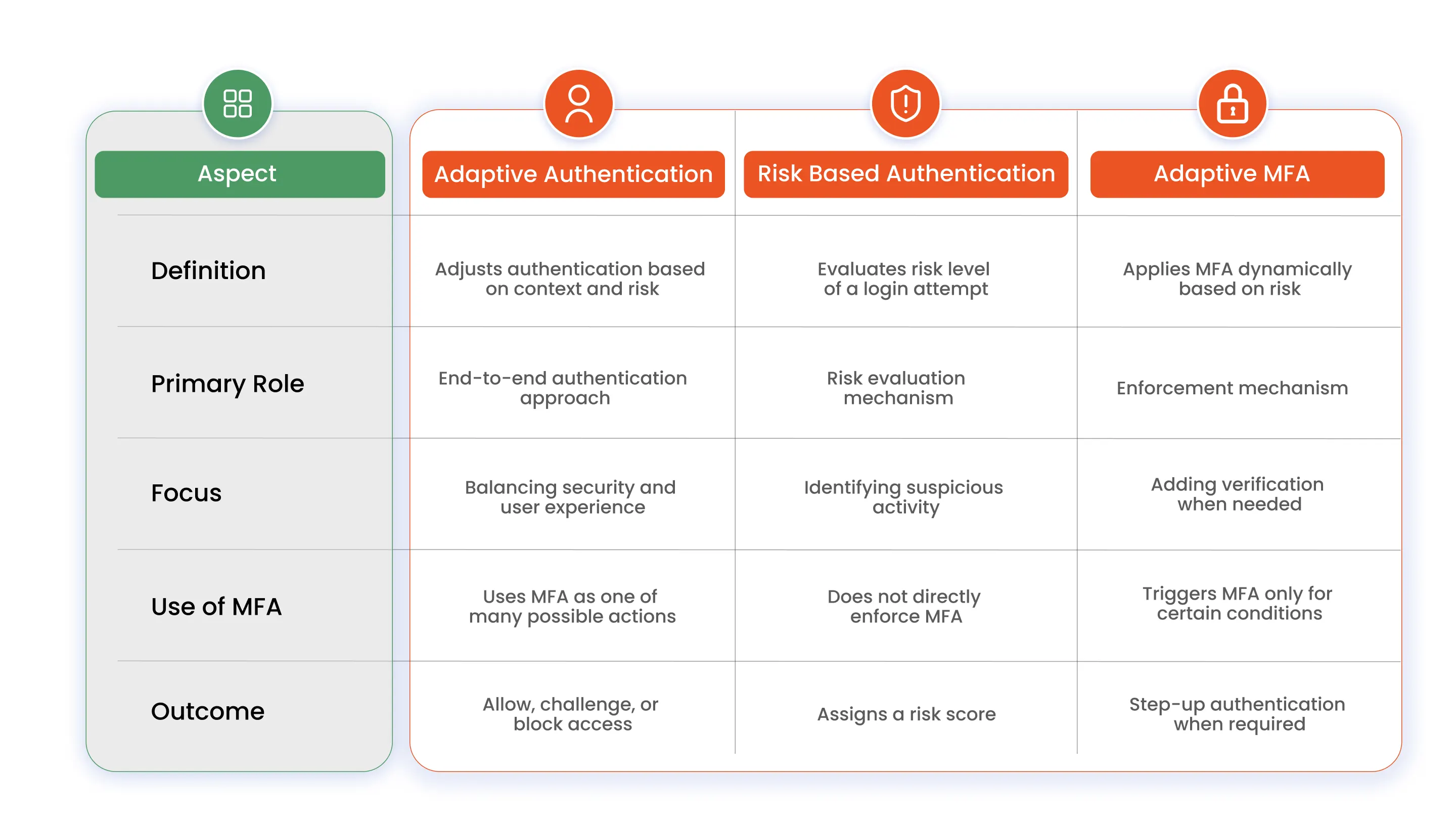
The difference between these concepts becomes clearer when you look at how they work together in a real authentication flow.
Adaptive authentication and risk-based authentication are closely related, but they are not the same. Risk-based authentication solutions focus on evaluating a login attempt and assigning a risk level based on signals such as device, location, and behavior. It acts as the decision-making layer that determines whether a login is safe or suspicious.
Adaptive authentication builds on this by taking action based on that risk. Instead of just identifying risk, it dynamically adjusts the authentication process by allowing access, requiring additional verification, or blocking the request. In simple terms, risk-based authentication decides the risk, while adaptive authentication decides how to respond to it.
Adaptive MFA fits within this flow as an enforcement mechanism. It refers to applying multi-factor authentication solution only when necessary, based on the risk level of a login attempt. Instead of prompting users for MFA every time, it is triggered only when unusual or high-risk behavior is detected.
This approach improves both security and usability. Users are not interrupted during normal activity, while suspicious login attempts receive stronger verification. As a result, organizations can reduce MFA fatigue while still maintaining strong protection.
Benefits of Adaptive Authentication
Adaptive authentication brings a practical balance between security and usability. Instead of applying the same authentication rules to every login, it adjusts verification based on real-time context and risk.
This helps organizations strengthen security without adding unnecessary friction. Here are some of the key benefits of adaptive authentication:
- Stronger Protection Against Account Takeover: Adaptive authentication detects unusual login behavior and flags suspicious attempts in real time. Even if credentials are compromised, abnormal signals can trigger additional verification. This reduces the success of attacks like phishing and credential stuffing.
- Better User Experience with Fewer Unnecessary Prompts: Users logging in from trusted environments are not repeatedly asked for verification. This reduces friction and allows faster access to systems. Security checks are applied only when needed.
- Reduced MFA Fatigue: Instead of prompting MFA at every login, adaptive authentication triggers it only for risky attempts. This helps reduce MFA fatigue caused by constant verification prompts while maintaining strong security where it’s actually needed.
- Improved Access Control: Access decisions are based on context rather than fixed rules. Organizations can apply stricter checks for high-risk scenarios and simpler access for low-risk ones. This creates more flexible and effective control.
- Faster Detection of Suspicious Activity: Every login attempt is evaluated in real time, making it easier to spot unusual patterns. This allows organizations to respond quickly to potential threats. It also improves visibility into user access behavior.
Common Use Cases for Adaptive Authentication
Adaptive authentication is used across industries where secure access needs to adapt to changing user behavior, devices, and environments. It helps organizations apply the right level of security without slowing users down, making it suitable for both internal systems and customer-facing applications.
Here are some of the key use cases of adaptive authentication:
Remote Workforce and VPN Access
With remote and hybrid work becoming standard, employees access systems from different locations, networks, and devices. This makes it difficult to rely on fixed authentication rules. Adaptive authentication evaluates each login based on context, such as device and location, and applies additional checks only when needed. This ensures secure access for remote users while keeping the login experience smooth for trusted activity.
SaaS and Cloud App Protection
Organizations today rely on multiple cloud applications connected through Single Sign-On (SSO). A single compromised account can provide access to multiple systems, increasing the risk. Adaptive authentication monitors each access request and evaluates user context before granting entry. This helps secure cloud applications without adding friction to everyday workflows.
Sensitive Admin or High-Risk Access
Administrative accounts have elevated privileges and can impact critical systems if compromised. Because of this, they require stronger and more dynamic security controls. Adaptive authentication applies stricter verification when unusual access patterns are detected, such as new devices or unexpected locations. This ensures that high-risk access is always protected without relying on static rules.
Customer-Facing Applications
In customer applications, security must be strong without affecting user experience. Adaptive authentication allows genuine users to log in quickly while identifying suspicious behavior in real time. If risk is detected, additional verification steps can be applied without interrupting all users. This helps prevent fraud while maintaining a seamless login experience.
Financial and Banking Systems
Financial systems handle sensitive data and transactions, making them a prime target for fraud. Adaptive authentication analyzes user behavior, transaction patterns, and access context to detect anomalies. Suspicious activity can trigger additional verification or block actions altogether. This helps reduce fraud while ensuring legitimate users can access services without delays.
How Adaptive Authentication Supports Modern Identity Security?
Adaptive authentication plays a critical role in modern identity security strategies, especially within Zero Trust frameworks. In a Zero Trust model, no user or device is trusted by default, and every access request must be verified continuously.
Instead of relying on static authentication rules, adaptive authentication evaluates user behavior, device context, and access patterns in real time. It applies context-aware verification to ensure that each access request is validated based on its risk level.
This dynamic approach allows organizations to enforce security policies that adapt to changing conditions, rather than relying on fixed controls. As a result, adaptive authentication becomes a key component of adaptive identity cybersecurity, helping organizations protect access while maintaining usability.
Best Practices for Implementing Adaptive MFA
Rolling out Adaptive MFA requires more than enabling a feature. It needs a thoughtful approach to balance security and usability. Here are some of the best practices to follow while implementing Adaptive MFA:
- Start with risk segmentation: Not all systems need the same level of policy enforcement. Begin with high-risk apps, such as admin portals or financial tools, then expand gradually. This phased rollout reduces disruption while maximizing security impact.
- Define clear trust signals: Clearly identify what qualifies as trusted, whether it’s managed devices, corporate networks, or known user behaviors. Strong trust definitions help reduce false positives and improve authentication accuracy.
- Integrate with identity systems: Adaptive MFA should align closely with identity providers and directories. Whether you are working with cloud identity platforms or MFA Active Directory on-premises environments, tight integration ensures consistent policy enforcement and visibility.
- Balance security with usability: Overly strict policies can reintroduce friction. Regularly review authentication patterns and user feedback to fine-tune risk thresholds. The goal is strong protection without constant interruptions.
- Support hybrid environments: Many organizations still operate across cloud and on-prem infrastructure. If you are running MFA Active Directory on-premises setups, choose solutions that support hybrid deployment to ensure a smooth transition to modern authentication.
Common Mistakes to Avoid While Implementing Adaptive MFA
Adaptive MFA is most effective when implemented carefully. Avoid these common mistakes to maintain its effectiveness:
- Treating it as a basic MFA upgrade: Adaptive MFA isn’t just traditional MFA with minor tweaks. It requires policy tuning, contextual signals, and ongoing optimization to work effectively.
- Overly aggressive risk scoring: If risk thresholds are too strict, users may still face frequent prompts. Proper calibration ensures adaptive MFA remains truly adaptive.
- Ignoring device trust: Device context plays a major role in risk evaluation. Without strong device recognition, the system loses valuable signals that help distinguish trusted access from suspicious activity.
- Not aligning with identity governance policies: Adaptive MFA should align with broader identity governance practices like access reviews and lifecycle management. Without this alignment, enforcement can become inconsistent.
Strengthen Your Security with miniOrange Adaptive Authentication
As organizations scale, managing authentication across users, devices, and applications becomes complex.
This is where a unified solution becomes essential.
miniOrange offers an Adaptive Authentication solution that helps organizations apply risk-based access control across enterprise environments. It continuously evaluates login attempts using contextual signals such as device, location, and user behavior.
The platform integrates with cloud, on-premise, and hybrid systems, allowing organizations to secure access without disrupting user experience. It also supports Adaptive MFA solution, Single Sign-On (SSO) platform, and multiple authentication methods to create a flexible and scalable identity strategy.
With miniOrange, organizations can:
- Reduce dependency on static authentication methods
- Apply context-aware security policies
- Improve user experience without compromising security
- Strengthen protection against modern identity threats
FAQs
What is adaptive authentication?
Adaptive MFA is a smarter form of Multi-Factor Authentication that adjusts security checks based on the risk of each login or action. It looks at context like IP, device, location, and behavior to decide when to apply extra verification.
How does adaptive authentication work?
It collects contextual signals, analyzes risk, and decides whether to allow, challenge, or block access. The process happens in real time for every login attempt.
Is adaptive authentication the same as risk-based authentication?
They are closely related, but not identical. Risk-based authentication evaluates risk, while adaptive authentication uses that evaluation to adjust the login process dynamically.
How is adaptive authentication different from traditional MFA?
Traditional MFA applies the same verification steps for every login. Adaptive authentication applies MFA only when needed, based on risk level.
Can adaptive authentication improve user experience?
Yes, it reduces unnecessary login steps for low-risk users while maintaining strong security for high-risk scenarios.
Is adaptive authentication useful for remote work and SaaS apps?
Yes, it is especially useful in environments where users access systems from different locations and devices. It ensures secure access without adding unnecessary friction.
Leave a Comment