

Your data leaks in ways you don't expect. A developer pastes source code into ChatGPT. A finance employee emails a payroll spreadsheet to a personal inbox. A salesperson uploads a client list to a personal Google Drive before their last day. All of these are breaches, rather, potential breaches.
That's exactly why data loss prevention (DLP) tools exist. But picking the right one? That's where it gets complicated. You're looking at 14 vendors with overlapping claims, wildly different architectures, and pricing that nobody publishes openly.
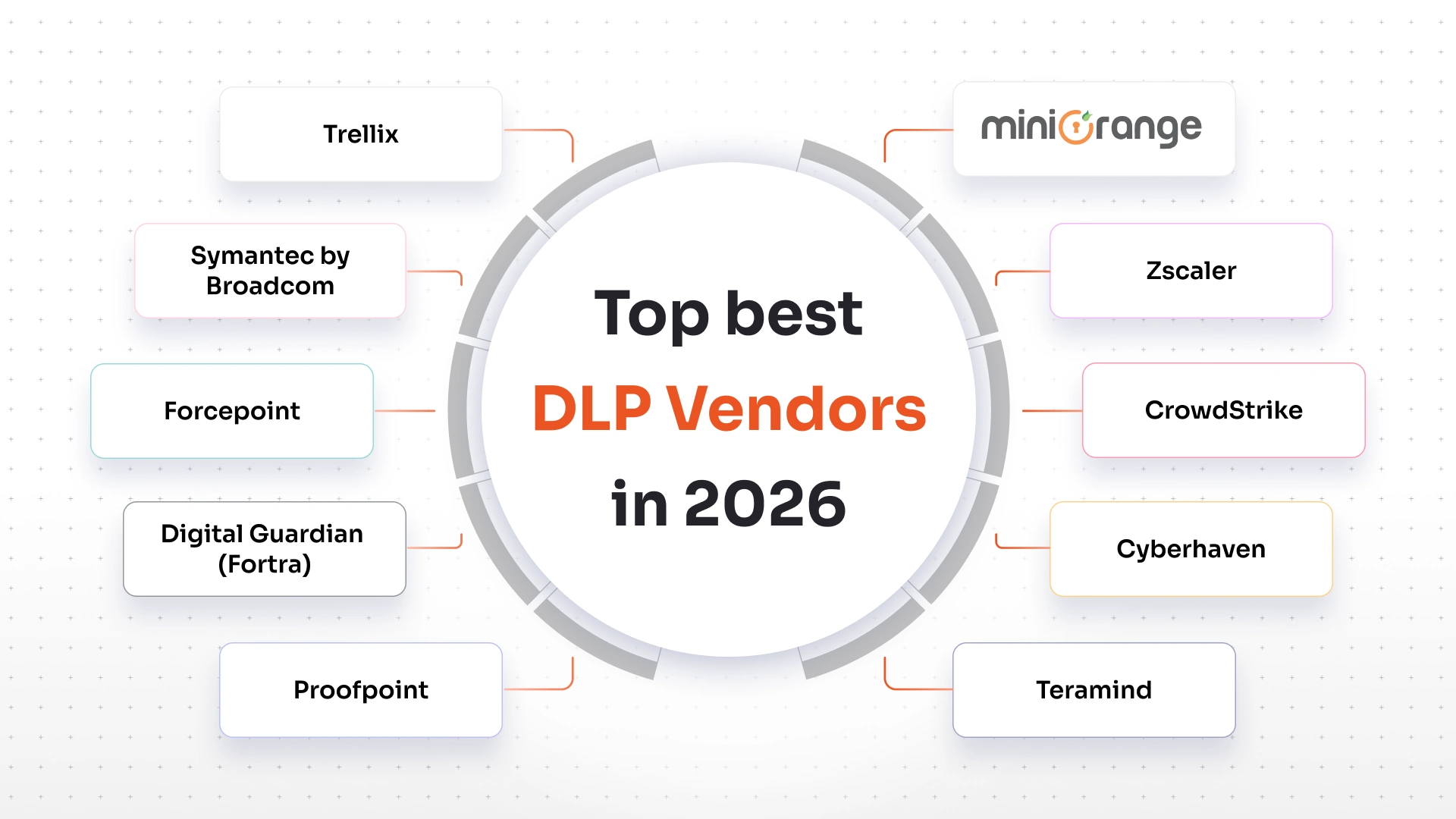
So we did the work: researched each DLP vendor, pulled verified user reviews from Gartner Peer Insights, cross-referenced real-world deployment experiences, and laid out what actually matters when you're buying. We scored the DLP tools on things that actually show up after purchase. For example, channel coverage, deployment complexity, policy management overhead, GenAI visibility, etc.
Here's what we found.
Quick comparison: top DLP vendors at a glance
| DLP tools | Best capabilities | Best for | Pricing tier |
|---|---|---|---|
| miniOrange | Multi-channel coverage (endpoint, email, network) at SMB-accessible pricing and deployment speed; native Atlassian DLP | SMBs, mid-market, SaaS teams, HIPAA/PCI/GDPR | Low to Medium |
| Trellix DLP | Endpoint + network + XDR integration, centralized ePO | Large enterprises in the Trellix ecosystem | High |
| Microsoft Purview | Native Microsoft 365 coverage, compliance templates | Microsoft 365-standardized organizations | Medium to High |
| Symantec DLP (Broadcom) | Multi-channel coverage, fingerprinting, OCR, CASB integration | Large regulated enterprises with dedicated IT staff | High |
| Forcepoint DLP | Risk-Adaptive Protection, behavior-based controls | Insider risk-focused enterprises, financial/govt | High |
| Digital Guardian (Fortra) | Kernel-level endpoint agents, EDM, IP protection | R&D, defense, IP-heavy environments | High |
| Proofpoint Enterprise DLP | Email DLP, threat intelligence integration | Email-primary risk orgs, existing Proofpoint users | Medium to High |
| Zscaler Data Protection | Inline cloud/web inspection, SASE architecture | Cloud-first orgs, remote workforces | Medium to High |
| CrowdStrike Falcon DP | Falcon agent-based, GenAI controls, data flow context | Existing Falcon users, unified endpoint+DLP | High |
| Cyberhaven | Data lineage tracking, DDR, GenAI channel coverage | IP protection, cloud-native, insider risk | High |
| GTB Technologies DLP | Content-aware detection, OCR, high accuracy | Mid-market, compliance-driven, regulated sectors | Medium |
| Teramind DLP | Behavior baselines, UAM + DLP combined | Insider threat-heavy orgs, call centers, finance | Low to Medium |
| Netwrix 1Secure | Cross-OS endpoint control, device control, and offline enforcement | SMBs, removable media control, compliance logs | Low to Medium |
| Netskope | Inline SaaS/cloud inspection, SSE architecture | Cloud-heavy orgs, distributed teams | Medium to High |
Top 14 DLP vendors in 2026
1. miniOrange DLP
miniOrange DLP solution covers endpoints, email, cloud apps, and networks from a single dashboard, at a price point and deployment speed that most enterprise-grade tools don't offer at this tier. It covers Confluence and Jira natively, which matters for software teams where sensitive project data lives in Atlassian environments. It integrates with Active Directory for user management and policy enforcement, and has a purpose-built integration for ChatGPT to monitor sensitive data inputs before they reach the model.
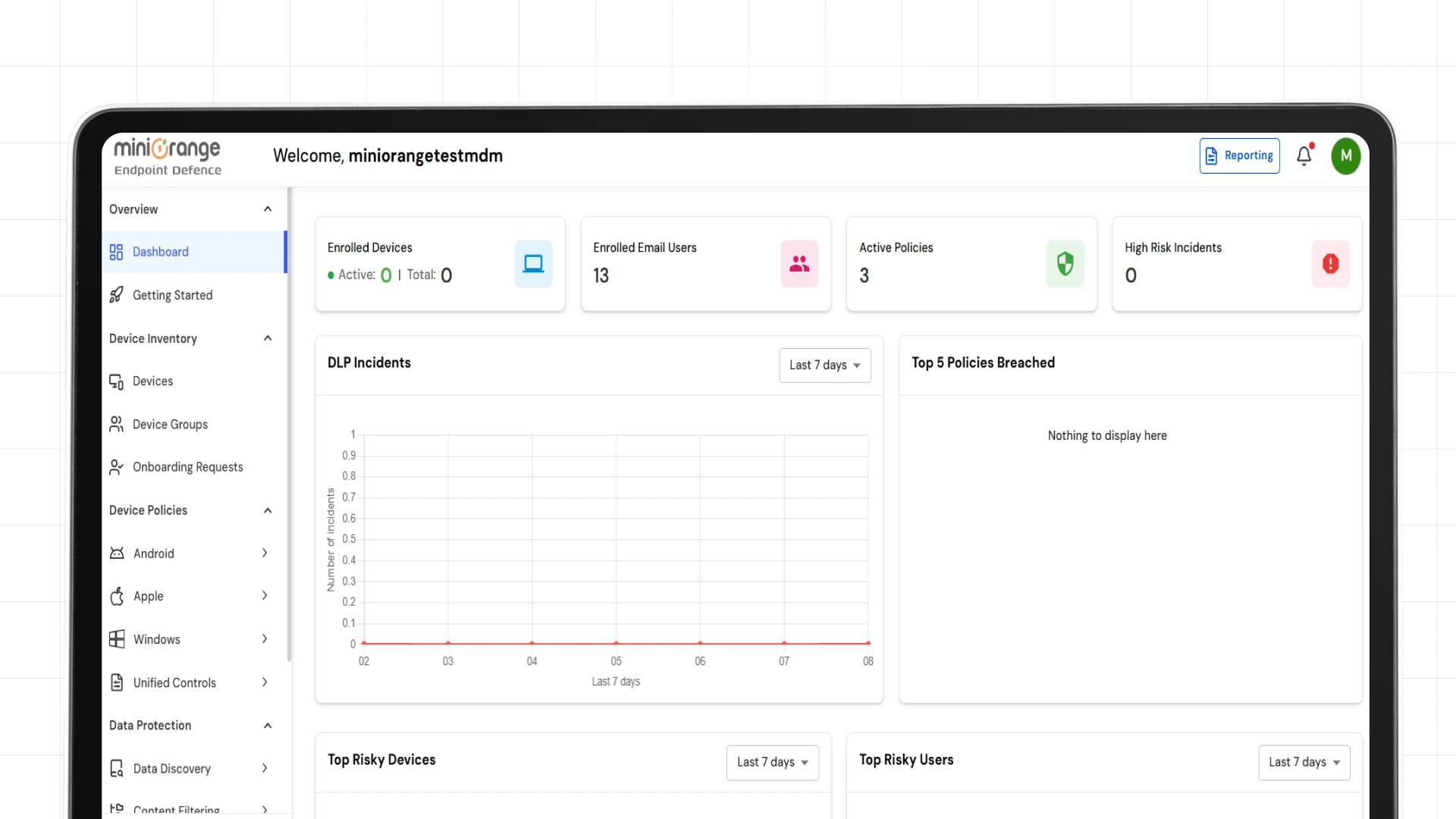
This data loss prevention (DLP) software vendor has built-in compliance support for HIPAA, GDPR, PCI DSS, and SOX, along with audit log generation.
Features
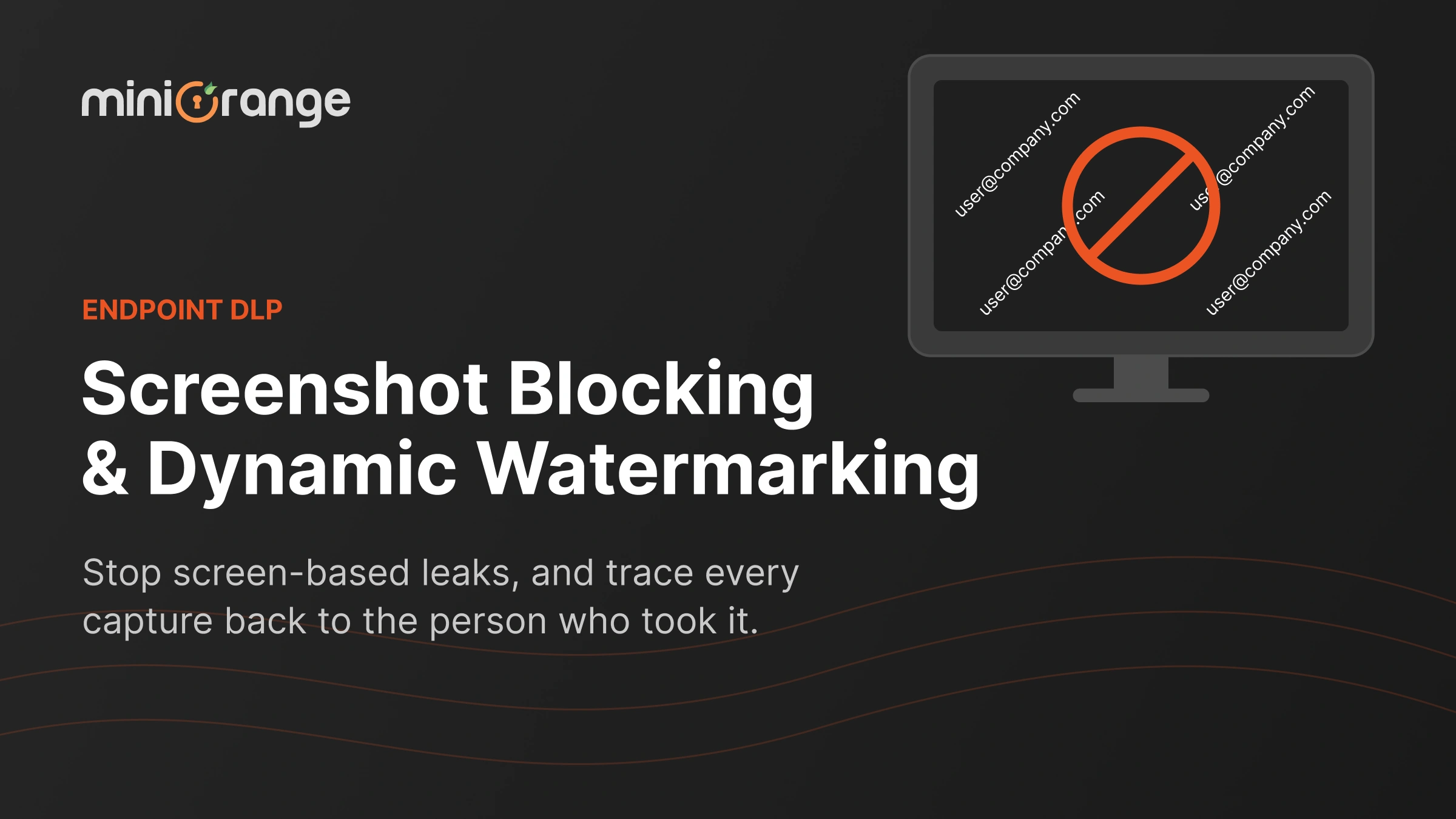
- Endpoint DLP blocks unauthorized USB drives, external HDDs/SSDs, and printers; prevents screenshots and clipboard misuse; enforces policies offline.
- Email DLP scans outbound emails and attachments across Gmail, Outlook, Office 365, Zoho, and Mithi; quarantines policy-violating content for admin review.
- Data Discovery: scans endpoints and cloud storage to locate sensitive data like PII, PCI & PHI before a policy violation happens.
- Network DLP inspects web traffic, blocks risky websites, and applies time-based and browser-level access controls.
- Atlassian DLP scans Confluence pages, attachments, and Jira content for PII exposure; supports automated redaction and custom regex policies.
Pricing Tier: Modular, pay-per-endpoint. Free demo available at miniOrange DLP.
Best for: SMBs and mid-market companies, SaaS teams, healthcare, finance, and legal organizations that want multi-channel coverage with a faster deployment path.
2. Trellix DLP
Trellix is the rebrand of McAfee Enterprise DLP. It's a multi-channel platform with deep endpoint protection, network scanning, and tight integration with the Trellix XDR/EDR ecosystem. Centralized management runs through ePolicy Orchestrator (ePO), so one agent handles DLP alongside other Trellix security tools.
The UI is a little complex. And the Trellix DLP tool in itself is a mature enterprise platform with a relatively steep learning curve. Organizations should expect dedicated administration and tuning, especially if they are deploying it outside an existing Trellix stack.
Pricing tier: High. Contact Trellix for current licensing.
Best for: Large enterprises already in the Trellix ecosystem, SOC teams that want DLP tied into XDR workflows.
3. Microsoft Purview DLP
Purview DLP is the most natural starting point if your organization runs Microsoft 365. It's built directly into Teams, SharePoint, Exchange, and OneDrive, with pre-built sensitivity labels and compliance templates connected to Microsoft's compliance center.
Microsoft has expanded Purview to include pay-as-you-go options for non-Microsoft data sources. Organizations with significant non-Microsoft infrastructure should validate current connector coverage before assuming full parity.
Pricing tier: Medium to High, depending on your Microsoft 365 plan. Some DLP capabilities require higher-tier licensing or separate add-ons. Check Microsoft's current licensing guide.
Best for: Microsoft 365-standardized organizations, compliance-driven programs (GDPR, HIPAA, PCI DSS).
4. Symantec DLP by Broadcom
Symantec DLP has been in the market for a long time and shows it. It covers endpoints, networks, email, cloud storage, and web traffic under one policy framework, with fingerprinting, OCR, and context-aware detection. It integrates with Broadcom's CloudSOC CASB and Information Centric Analytics for insider risk analysis.
The operational reality: feature-rich enterprise DLP platform that needs regular maintenance, performance tuning, and careful deployment planning. In larger deployments, organizations should expect dedicated resources for ongoing policy management and system upkeep.
Pricing tier: High. Contact Broadcom directly for current licensing.
Best for: Large regulated enterprises (financial services, healthcare, government) with the IT resources to deploy and maintain it.
5. Forcepoint DLP
Forcepoint combines DLP with behavioral analytics and Risk-Adaptive Protection: policy enforcement adjusts based on each user's real-time risk score. Per Forcepoint's product documentation, it includes over 1,800 pre-built classifiers and templates across email, endpoints, web, and cloud.
The behavioral analytics layer adds a learning curve on top of the standard DLP setup, and policy management requires significant ongoing effort at scale.
Pricing tier: High. Contact Forcepoint for current licensing.
Best for: Organizations where insider risk is a primary concern, financial services and government, and enterprises that want behavior-aware controls.
6. Digital Guardian (Fortra)
Digital Guardian deploys kernel-level agents on Windows, macOS, and Linux to monitor data at the OS core. Exact Data Matching (EDM) and Database Record Matching (DBRM) identify intellectual property across source code, engineering specs, and financial models. OCR scanning covers screenshots and images for embedded sensitive text.
Deployment is heavier than cloud-native alternatives, with significant initial setup and ongoing management requirements.
Pricing tier: High. Contact Fortra for current licensing.
Best for: R&D organizations, defense contractors, and technology companies protecting source code and proprietary designs.
7. Proofpoint Enterprise DLP
Proofpoint's DLP integrates with its broader email security and threat intelligence platform, and is particularly strong on email DLP: identifying sensitive content in outgoing messages, attachments, and user behavior patterns across email workflows.
Users often praise Proofpoint DLP for reporting and its tight integration with email security workflows. Some feedback also points to deployment complexity in larger environments, so organizations should plan phased rollout and tuning as they scale.
Pricing tier: Medium to High. Typically bundled with Proofpoint's broader platform. Contact Proofpoint for current pricing.
Best for: Organizations already on Proofpoint for email security, compliance teams focused on email-borne data loss.
8. Zscaler Data Protection
Zscaler's DLP runs as part of its Zero Trust Exchange, a cloud-native SASE platform. It inspects web and cloud traffic in-line without on-premises appliances, integrated with Zscaler's secure web gateway, CASB, and zero trust network access for unified policy enforcement.
Organizations with significant on-premises, offline, or local-file workflows should validate channel coverage carefully, because some legacy use cases may require additional controls or complementary tooling.
Pricing tier: Medium to High. DLP is part of the broader Zero Trust Exchange. Contact Zscaler for bundle pricing.
Best for: Cloud-first organizations, distributed remote workforces, companies already using Zscaler for SASE.
9. CrowdStrike Falcon Data Protection
CrowdStrike adds DLP to its existing Falcon agent, meaning no new agent deployment for organizations already on Falcon EDR. It provides data flow context, content classification, and GenAI-specific controls to stop data leaking into AI tools.
CrowdStrike positions Falcon Data Protection as giving strong visibility into data flows, and its unified Falcon console simplifies operations for teams already using Falcon.
Pricing tier: High. Contact CrowdStrike for current pricing.
Best for: Existing Falcon users, enterprises that want DLP as part of a unified endpoint protection strategy.
10. Cyberhaven
Cyberhaven built its platform around data lineage: tracking a file from origin through every copy, paste, edit, and share, across endpoints, cloud apps, and SaaS tools. This gives it context that traditional content-scanning tools miss. It also covers GenAI channels, scanning data flowing into ChatGPT, Claude, Gemini, and Perplexity.
Cyberhaven is cloud-native, but organizations with substantial on-prem or hybrid requirements should validate how its coverage maps to their legacy workflows.
Pricing tier: High. Request a demo for pricing.
Best for: IP protection, cloud-native companies, insider risk-heavy environments.
11. GTB Technologies DLP
GTB Technologies is a specialized DLP vendor. Users on Gartner Peer Insights consistently rate it highly and point to responsive customer support and willingness to accommodate customization requests. The platform supports content-aware detection across endpoints, network, and cloud, with OCR, fingerprinting, and custom data classification. The vendor relationship tends to be more hands-on than larger self-serve platforms.
Pricing tier: Medium. Contact GTB for current pricing.
Best for: Compliance-driven mid-market companies, regulated sectors (finance, healthcare, legal) that want high detection accuracy.
12. Teramind DLP
Teramind combines DLP, user activity monitoring, and insider risk management in one platform. It builds behavior baselines per user and flags deviations, so a developer who suddenly starts copying files to a USB at 11 pm shows up as unusual even without a prior incident.
Setup can be involved, especially for smaller teams without dedicated security staff, because Teramind relies on behavioral analytics and policy tuning.
Pricing tier: Low to Medium. Current pricing is published on teramind.co.
Best for: Organizations with serious insider threat exposure, financial services, call centers, and remote-work-heavy companies.
13. Netwrix 1Secure
Netwrix covers DLP through 1Secure (cloud-based monitoring) and Endpoint Protector (cross-platform endpoint DLP). Netwrix emphasizes endpoint policy enforcement across Windows, macOS, and Linux, including device control and compliance monitoring, but specific offline caching behavior should be verified in the product documentation.
Pricing tier: Low to Medium. Current pricing is published on netwrix.com.
Best for: SMBs and mid-market companies, cross-OS endpoint coverage, and compliance programs requiring detailed audit logs.
14. Netskope
Netskope started as a cloud-native DLP platform and has since expanded into endpoint protection and broader hybrid environments. Its core strength is inline inspection of SaaS apps, cloud storage, and web traffic, with granular activity-level controls. Its SSE architecture gives organizations a unified policy layer across cloud, web, and endpoint channels.
If you're evaluating Netskope, verify its current endpoint and hybrid coverage directly with the vendor, since its scope has expanded beyond the original cloud-only framing.
Pricing tier: Medium to High. Contact Netskope for current pricing.
Best for: Cloud-heavy and SaaS-heavy organizations, distributed teams, security teams building a converged SSE and DLP architecture.
How to choose the best DLP tool for your business
Fourteen DLP tools. Wildly different architectures, price points, and deployment models. Here's how to cut through the noise for your business.
1. Start with where your data actually lives
Most DLP buying decisions go wrong because organizations evaluate data protection software or DLP tools in abstract. Your data doesn't live in the abstract. It lives in specific places: your Microsoft 365 tenant, your Salesforce org, your developers' laptops, your Confluence workspace. Map those locations before you open a demo.
If 90% of your sensitive data moves through Microsoft 365, Purview DLP is a logical starting point. If your developers work in GitHub and paste code into AI tools constantly, Cyberhaven or CrowdStrike Falcon makes more sense. If you're a 200-person SaaS company with no on-premises footprint, Netskope or Zscaler covers your actual surface area.
2. Match deployment time to your reality
Cloud DLP tools generally deploy faster than endpoint or hybrid platforms. SaaS-native DLP tools like Purview and Netskope can reach initial coverage in a matter of weeks via API integration. Endpoint DLP tools take longer because of agent rollout, OS testing, and group policy configuration. Enterprise hybrid platforms (Symantec, Forcepoint, Digital Guardian) are typically the longest deployments, often spanning several months when you include policy tuning and full channel coverage.
Factor that into your decision. A long rollout has a real cost in salary, risk exposure, and delayed compliance. Ask each vendor directly for their median deployment time, then ask for customer references to verify it.
3. Think about who manages it after deployment
This is the question that doesn't come up in demos. Feature parity between vendors often disappears when you ask: how many hours per week will your team spend maintaining this? Tuning false positives, updating policies, and managing exceptions.
DLP tools like miniOrange are designed to be manageable by small IT teams. Whereas the DLP tools like Symantec and Trellix are built for dedicated security operations centers. Know which one describes your organization.
4. Industry and compliance context
- Healthcare (HIPAA): miniOrange, Digital Guardian, Symantec, Proofpoint, GTB
- Financial services (PCI DSS, SOX): Forcepoint, Symantec, Trellix, GTB, miniOrange
- Legal and professional services: miniOrange, Proofpoint, Digital Guardian
- Software and SaaS companies: miniOrange, Cyberhaven, CrowdStrike, Netskope
- Government and defense: Digital Guardian, Forcepoint, Trellix, Symantec
5. Organization size
- SMBs (under 500 employees): miniOrange, Teramind, Netwrix Endpoint Protector
- Mid-market (500 to 5,000 employees): miniOrange, Forcepoint, Microsoft Purview, GTB
- Enterprise (5,000+): Symantec, Trellix, CrowdStrike, Cyberhaven, Forcepoint
6. AI tool exposure
If your employees actively use ChatGPT, Gemini, Claude, or Perplexity for work, make sure your DLP covers prompt-level content inspection. DLP tools that handle this today: Cyberhaven, Netskope, CrowdStrike Falcon, miniOrange (via ChatGPT DLP integration).
Why miniOrange is a better alternative
Most DLP buyers in the SMB and mid-market range don't need a platform built for a 10-person SOC. They need coverage across endpoints, email, cloud apps, and network traffic, deployed fast, and managed by a small IT team.
miniOrange does that from a single dashboard. Its modular per-endpoint pricing means you pay for what you actually protect. Native Atlassian integration covers Confluence and Jira, which most DLP tools ignore entirely. And its built-in support for HIPAA, GDPR, PCI DSS, and SOX reduces the gap between purchase and audit-readiness.
The honest trade-off here is that miniOrange is newer than Symantec, Trellix, or Forcepoint. If your organization requires a vendor with a long deployment history in large regulated enterprises, those names carry weight with security committees.
But if you're evaluating on coverage breadth, deployment simplicity, and cost relative to what you actually need, miniOrange competes directly with the DLP tools positioned at a much higher price tier.
Request a free demo to see miniOrange DLP in your environment before you commit.

Leave a Comment