

SQL sits behind many everyday application functions. It helps websites find customer records, verify login details, search products, process orders, and update account information. When an application handles SQL queries incorrectly, an attacker can sometimes change what the database is asked to do.
That weakness can expose sensitive information, alter records, bypass authentication, or disrupt a service. The risk also grows when an application gives its database account more permissions than it needs.
This blog explains SQL injection, how a simple input can change a database query, the main attack types, common targets, potential impact, and practical ways to prevent them.
What Is SQL Injection?
SQL stands for Structured Query Language. Applications use SQL to communicate with relational databases. A login page might query a users table, while an online store might query products, orders, and customer records.
A SQL injection attack is one of the top web security threats. It happens when an attacker places SQL logic into application input, and the application sends it to the database as part of a query. The problem usually starts when code combines user input with SQL instructions instead of treating the input only as data.
Common entry points include:
- Login Forms: Username and password fields often trigger database queries.
- Search Fields: Search terms can reach database queries behind product or content searches.
- URL Parameters: IDs and filters in URLs can become query inputs.
- API Requests: API parameters can reach database queries through backend services.
- Web Forms: Account, order, support, and profile forms can expose additional input points.
The vulnerability comes from how the application builds and executes the query. A database does not know whether a value came from a trusted user or an attacker, so the application must keep external input separate from SQL instructions.
How does a SQL Injection Attack Work?
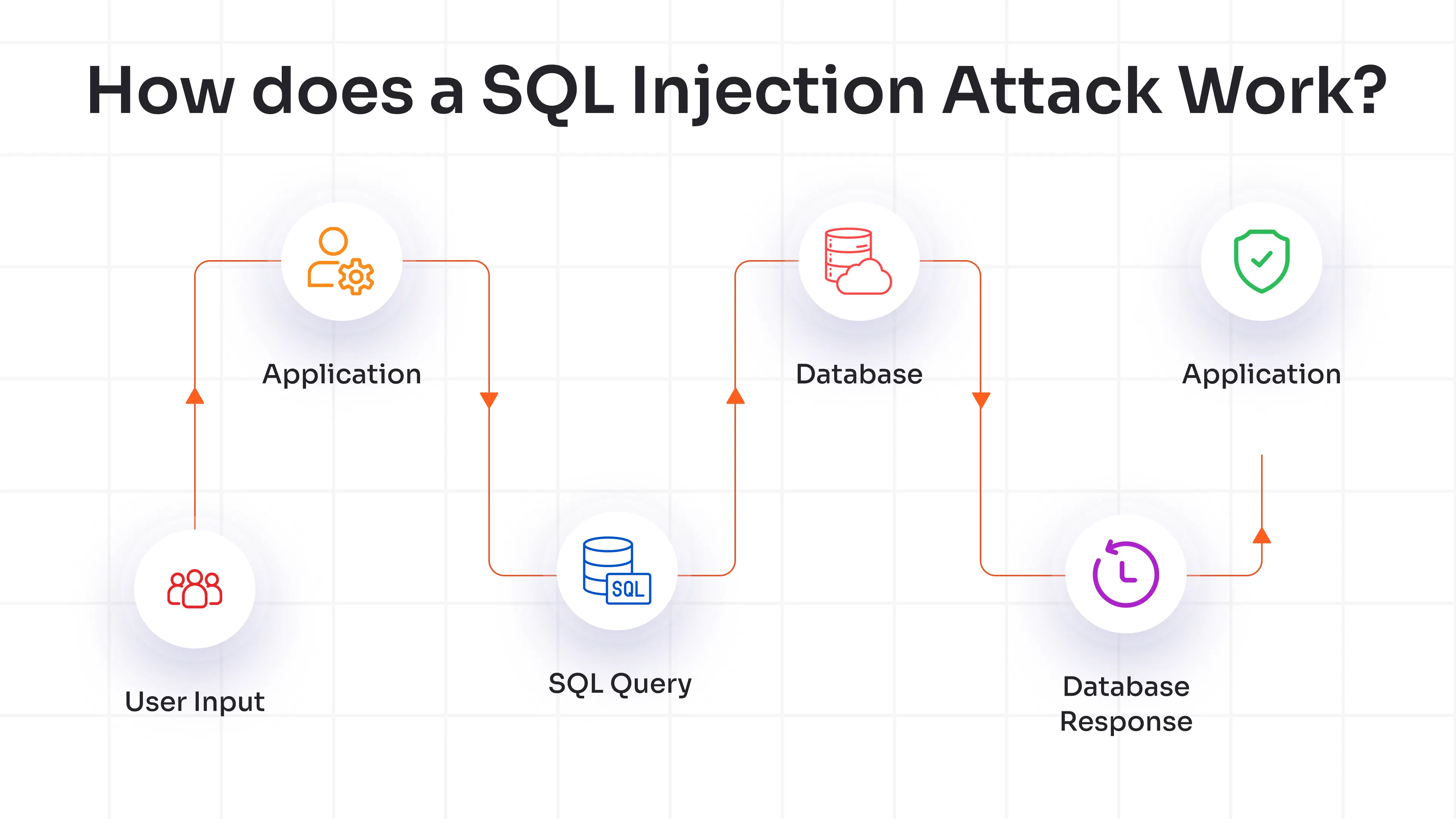
A SQL injection attack starts when an application accepts input from a user and uses it to build a database query. The application sends the query to the database, which processes the instructions and returns a response.
The risk appears when the application mixes untrusted input with SQL instructions. An attacker can manipulate the input, change the query’s logic, and make the database perform an action the developer never intended.
User Enters Input → Application Adds It to an SQL Query → Attacker Manipulates the Input → Database Runs the Altered Query → Sensitive Data Is Accessed, Changed, or Exposed
Normal SQL Query
Imagine an online store that asks for a product ID so it can retrieve the matching product record. The application expects a value such as 2048 and uses it to find that product.
A simplified query could look like this:
SELECT * FROM products WHERE productId = 2048;
The database receives the query, looks for product ID 2048, and returns the matching product record. The input supplies a value, while the application controls the SQL instruction.
Malicious SQL Injection Query
A vulnerable application might allow an attacker to add SQL logic to the same product ID field. For example, the input could alter the query so it checks an additional condition.
SELECT * FROM products WHERE productId = 2048 OR 1=1;
The condition 1=1 is always true. Depending on the application and query, the database could therefore return more records than the developer intended. The important point is not the exact input. It is the fact that the user's value changed the SQL instruction itself.
What Happens After the Injection?
The database processes the query it receives. The result depends on the query, the application's database permissions, and the data available to that account.
A successful attack could expose records, change information, bypass authentication, or delete data. A database account with broad permissions increases the possible impact because the attacker could inherit those permissions through the vulnerable application.
This is why secure query construction and least-privilege database accounts work together. One protects the query, while the other limits the damage if a flaw remains.
What Are the Types of SQL Injection Attacks?
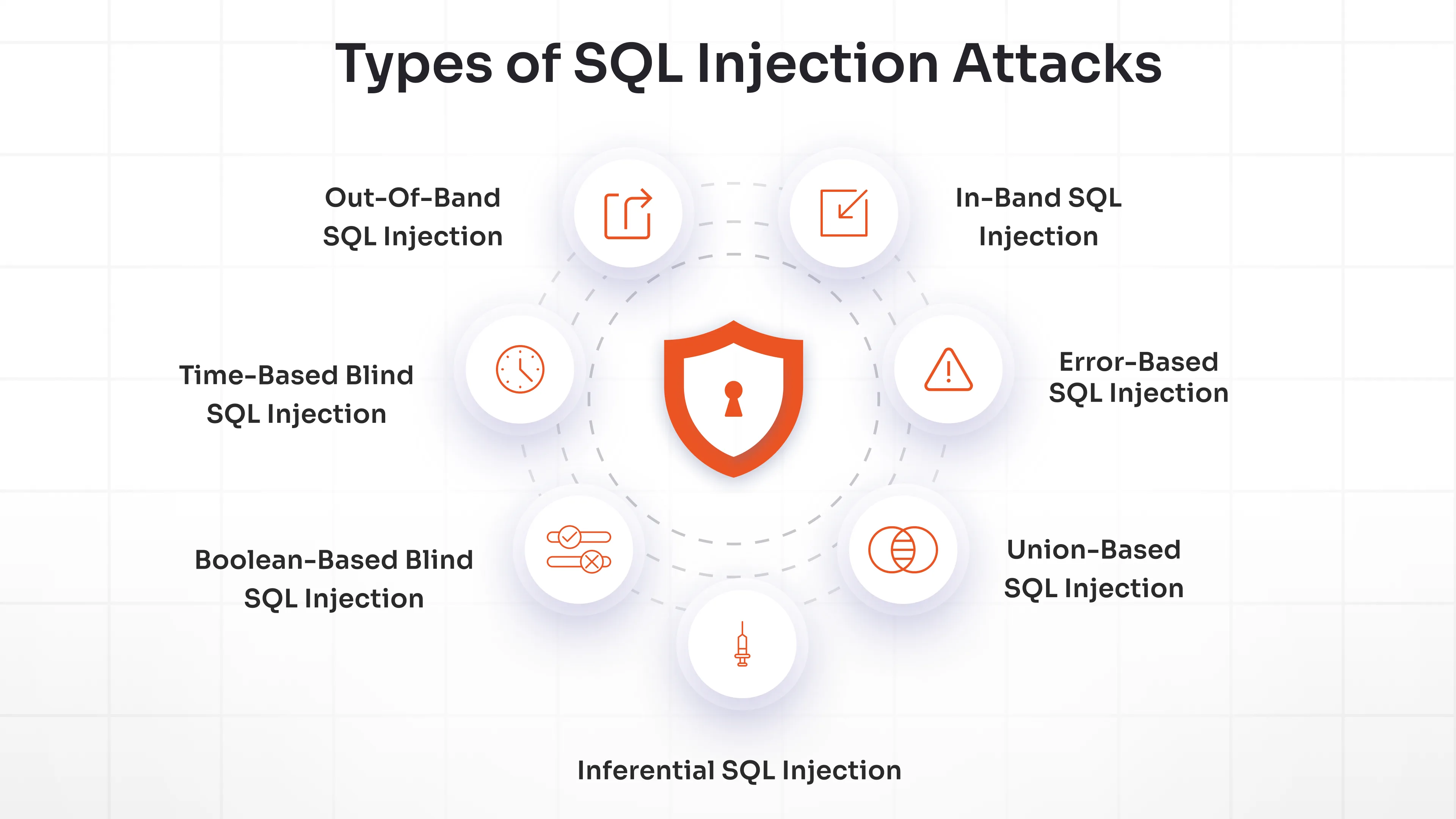
SQL injection attacks are one category of cybersecurity vulnerabilities that target different interpreters or systems. The technology processing the input determines the type of injection involved.
In-Band SQL Injection
In-band SQL injection sends the malicious input and receives the database result through the same application channel. The two common forms are error-based and union-based injection.
Error-Based SQL Injection
Error-based injection deliberately causes a database error and examines the information returned by the application. A detailed error message could reveal table names, column names, query fragments, or database details.
SELECT productName FROM products
WHERE productId = '2048';
-- Unexpected input can change the query and trigger a database error.
If the application displays the raw database error, the response could reveal useful technical details. A secure application should show a controlled message while keeping detailed errors in restricted logs.
Tip: Keep detailed database errors out of user-facing responses. Log them securely so developers can troubleshoot without exposing database details.
Union-Based SQL Injection
Union-based injection attempts to combine the original query with another SELECT statement through the SQL UNION operator. If the application displays the query result and the injected statement matches the original result structure, data from another table could appear in the response.
SELECT productName, price FROM products
UNION SELECT name, email FROM customers;
The first query returns product names and prices. The second query returns two compatible values from a customer table. In a vulnerable application, combining the results could expose customer information where the application expected product data. The exact column count, data types, query structure, and database permissions determine whether an attempt succeeds.
Tip: Parameterized queries prevent user input from changing the structure of the SQL statement, which blocks the core condition required for this technique.
Inferential SQL Injection
Inferential, or blind, SQL injection applies when the application does not display database results directly. The attacker studies changes in the application's response and uses those changes to infer information.
Boolean-Based Blind SQL Injection
Boolean-based blind injection sends conditions that should evaluate as true or false. The attacker compares the application's responses to determine whether the database accepted the condition.
SELECT productName FROM products
WHERE productId = '2048' AND 1=1;
The condition 1=1 is true. An attacker could compare the response with a request containing a false condition such as 1=2. If the application responds differently, those differences could reveal information about the underlying query or data.
Tip: Consistent application responses reduce information leakage, but parameterized queries remain the primary defense because they stop input from becoming SQL logic.
Time-Based Blind SQL Injection
Time-based blind injection uses response time as the signal. An attacker submits a condition that could delay the database response when the condition is true, then compares response times across requests.
SELECT productName FROM products
WHERE productId = '2048' AND <condition_that_controls_a_delay>;
The exact delay function depends on the database system, so the snippet above shows the logic rather than a database-specific function. During authorized testing, security teams use the syntax supported by the target database.
Tip: Monitor unusual response-time patterns during security testing and investigate repeated requests that probe the same database function.
Out-Of-Band SQL Injection
Out-of-band injection sends the attack through the vulnerable application but retrieves information through a separate channel. Attackers might consider this method when the application's normal response does not provide useful database results.
SELECT external_function(<attacker-controlled_value>)
FROM sensitive_data;
The exact syntax depends on the database system and its configuration. The example above represents the concept rather than a copy-paste query. The key difference is that the database response travels through a separate channel.
Tip: Security testing should account for outbound network paths and database features that could allow a vulnerable query to communicate outside the normal application response.
What Are the Common Targets of SQL Injection Attacks?
Any application that accepts external input and sends that input to a SQL database could contain an injection point. Common targets include:
- Web Applications: Search, filters, account functions, and forms often send user input to database queries.
- APIs: Request parameters often pass through backend services before they reach database queries.
- Login and Authentication Systems: Sign-in checks often query usernames, passwords, sessions, or account records.
- E-Commerce Applications: Product, order, inventory, payment, and customer functions often depend on database queries.
- Customer Portals: Profile, support, account, and search features create additional places where user input enters an application.
- Database-Connected Business Applications: Internal tools face the same risk when they send untrusted input into database queries.
An application's location does not remove the risk. The key concern is whether untrusted input can change a database query.
What Can a SQL Injection Attack Do?
The impact of a SQL injection attack depends on the vulnerable query and the database permissions behind it. A successful attack could:
1. Expose Sensitive Data: Attackers could retrieve customer, employee, financial, or other confidential records.
2. Bypass Authentication: A vulnerable login query could allow an attacker to interfere with credential checks.
3. Modify Database Records: Account details, orders, transactions, or other records could be changed.
4. Delete or Corrupt Data: Excessive database permissions could allow destructive operations.
5. Escalate Privileges: A vulnerable application with broad database permissions could give an attacker more authority than intended.
6. Disrupt Services: Malicious database operations could affect application availability or data integrity.
7. Create Financial and Regulatory Consequences: A breach could lead to recovery costs, investigations, legal exposure, regulatory action, and customer trust issues.
SQL Injection Attack Example
Consider a website with a login form. The application receives a username and password, then checks the database for a matching account.
A simplified normal query could look like this:
SELECT * FROM users
WHERE username = 'alex'
AND password = 'example';
The application expects both values to remain data. A vulnerable application could instead insert those values directly into the SQL statement without separating them from the query structure.
An attacker could then provide crafted input that changes the logic of the query. If the application sends the altered statement to the database, the database processes the new logic instead of treating the entire value as ordinary text.
This example explains why an attacker does not always need direct database credentials. The application already has a database connection, so a vulnerable query can become the path to unauthorized database activity.
Tip: During code reviews, ask whether any user-supplied value can change the structure of a SQL query. If it can, the query needs a safer construction method.
How to Prevent SQL Injection Attacks
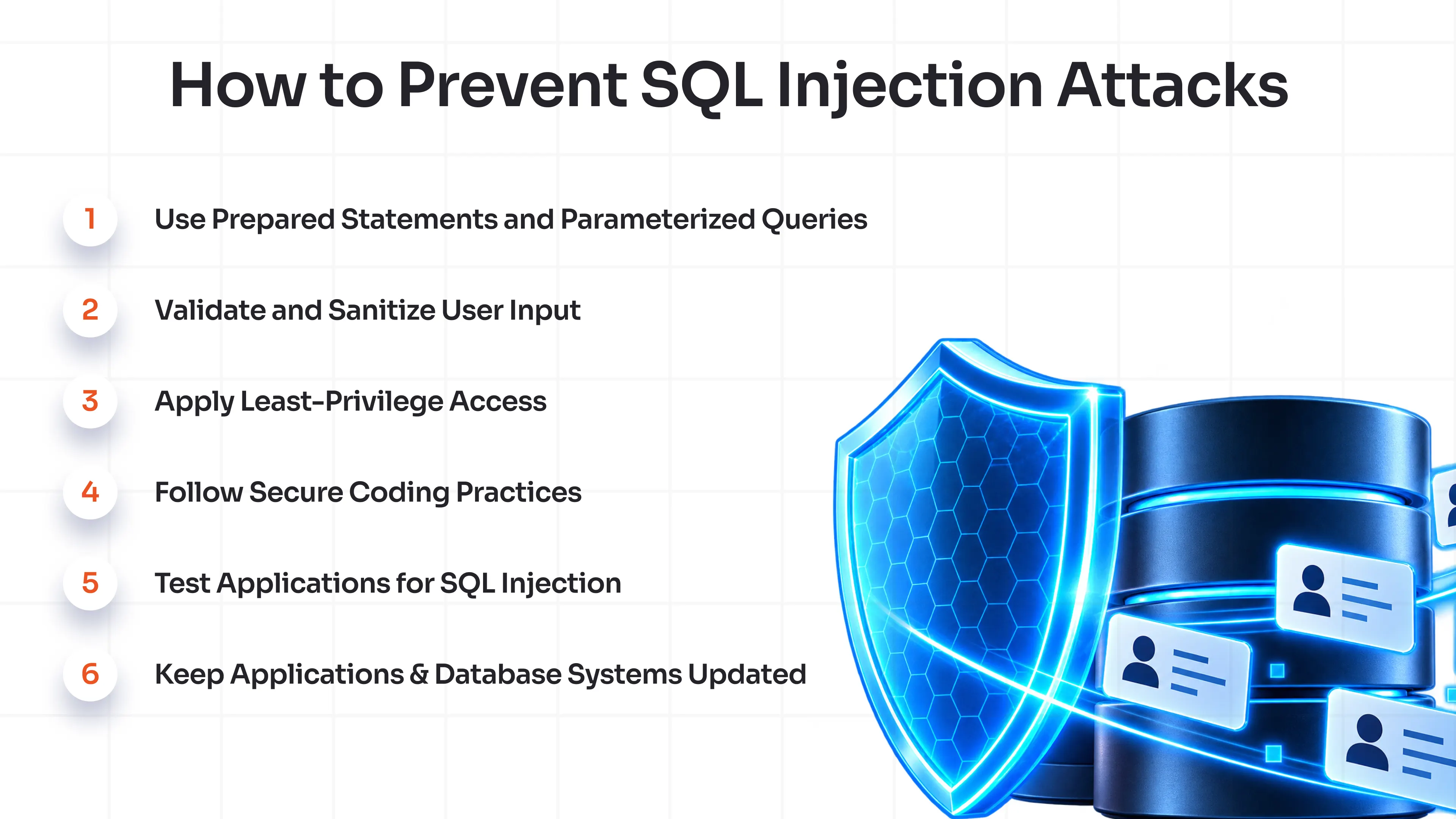
Strong SQL injection prevention starts with separating SQL instructions from user-supplied data. Several supporting controls then reduce the likelihood of exploitation and limit the impact of a successful attack.
Use Prepared Statements and Parameterized Queries
Prepared statements and parameterized queries keep SQL structure separate from the values supplied by users. The application defines the query first and passes user input as a parameter.
The database then treats the parameter as data rather than SQL instructions. OWASP identifies prepared statements with parameterized queries as the primary defense against SQL injection.
Validate and Sanitize User Input
Input validation checks whether submitted information matches the format the application expects. For example, an account ID that should contain numbers should reject unexpected formats.
Validation adds another security layer, but it should not replace parameterized queries. OWASP notes that input validation alone does not provide complete protection against SQL injection.
Apply Least-Privilege Access
An application's database account should have only the permissions its functions require. A service that reads customer records does not need permission to delete every table.
Least privilege reduces the possible impact of a successful SQL attack because the attacker inherits only the permissions available to the compromised application account.
Follow Secure Coding Practices
Development standards should define safe database query patterns and require code reviews for database-related changes. Frameworks and database libraries often provide parameterized query methods, so developers should follow the secure pattern supported by their technology stack.
Test Applications for SQL Injection
Security testing helps teams find vulnerable queries before attackers do. Code review, static application security testing, dynamic application security testing, vulnerability scanning, and authorized penetration testing can reveal different classes of weaknesses.
Testing should include APIs, URL parameters, search functions, forms, and less obvious database-connected features. Automated testing also fits well into development pipelines because teams can check new code before deployment.
Keep Applications and Database Systems Updated
Security updates address known weaknesses in application frameworks, database systems, libraries, and other components. Keeping these systems current reduces exposure to vulnerabilities that could compound an injection flaw.
Teams should also track identified issues, remediation owners, and closure dates so security reviews have clear evidence of the work completed.
SQL Injection vs. Other Injection Attacks
Injection attacks target different interpreters or systems. The technology processing the input determines the type of injection involved.
| Attack | What It Targets | Typical Risk |
|---|---|---|
| SQL Injection | SQL databases and queries | Unauthorized database access or manipulation |
| Command Injection | Operating system commands | Unauthorized command execution on a host |
| LDAP Injection | LDAP queries and directory services | Unauthorized directory searches or authentication bypass |
| NoSQL Injection | NoSQL databases and queries | Unauthorized data access or database manipulation |
Strengthen Your SQLi Defense with miniOrange
SQL injection (SQLi) attacks exploit weaknesses in web applications and databases to gain unauthorized access to sensitive data. While secure coding practices such as input validation and parameterized queries are essential, organizations also need strong identity and access controls to reduce the impact if an application vulnerability is exploited.
miniOrange delivers a comprehensive identity security layer through its Identity and Access Management (IAM) solution, helping organizations protect application access, prevent compromised credential misuse, and limit exposure to critical systems.
- The Single Sign-On (SSO) solution centralizes authentication and application access through one secure platform, giving IT teams greater visibility and control over business applications.
- The Multi-Factor Authentication (MFA) solutionadds an extra verification step beyond passwords, helping prevent unauthorized logins when credentials are compromised.
- The Privileged Access Management (PAM) solution secures high-risk privileged accounts and sensitive infrastructure through controlled, time-bound access to critical resources.
A stronger security strategy starts with clear control over who can access your applications and sensitive data. Contact miniOrange to learn how our identity security solutions can support your SQLi defense strategy.
Conclusion
SQLi attacks often begin with an ordinary input field, which makes secure development decisions especially important. Treating every external input as untrusted and separating data from database instructions creates a stronger security boundary from the start.
Security also becomes easier to sustain when developers build protection into everyday coding standards. Consistent query practices give teams a shared foundation for reviews, testing, and future development.
The most effective SQL injection prevention happens before suspicious input reaches the database. When security becomes part of how applications are built, teams spend less time fixing avoidable weaknesses and more time building systems people can trust.
FAQs
What can happen if a SQL injection attack is successful?
A successful SQL injection attack could expose sensitive records, bypass authentication, modify or delete database information, or disrupt an application. The impact depends on the vulnerable query, the data involved, and the permissions assigned to the database account.
What is the difference between blind SQL injection and regular SQL injection?
Blind SQL injection does not directly show the database result. Instead, an attacker studies application behavior, such as content changes or response timing, to infer information. In-band injection can return information through the same communication path used to send the malicious input.
How can I check whether my application is vulnerable to SQL injection?
Start with a code review that identifies queries built from external input. Security teams can then combine application security testing, vulnerability scanning, and authorized penetration testing across web forms, APIs, URL parameters, search functions, and other database-connected features.
Is input sanitization alone enough to prevent SQL injection?
No, input sanitization alone does not provide complete protection. Parameterized queries or prepared statements should provide the primary defense, while input validation, least-privilege database permissions, secure coding practices, and regular testing add further protection.
How can developers prevent SQL injection in APIs?
Developers should validate API parameters and pass them to the database through parameterized queries instead of inserting raw request values into SQL statements. The database account should also have limited permissions, and security testing should cover API endpoints and their parameters.
Leave a Comment