

A March 2026 Cloud Security Alliance study surveyed 228 IT and security professionals. It found that:
- 68% struggle to distinguish AI agent activity from human activity.
- 74% report excessive access among AI agents.
These findings point to a growing identity governance problem. Organizations struggle to identify agents, assign accountability, and control their access.
Traditional identity governance and administration (IGA) revolves around people. A new employee joins, HR creates a record, a manager approves access, and reviewers check it on a schedule. Every step in that chain connects back to a person.
AI agents skip that path entirely. They act on their own, move across applications, and change what they need as tasks change. Modern IGA solutions must govern both human and non-human identities throughout their lifecycle.
The 5 Identity Governance Gaps at a Glance
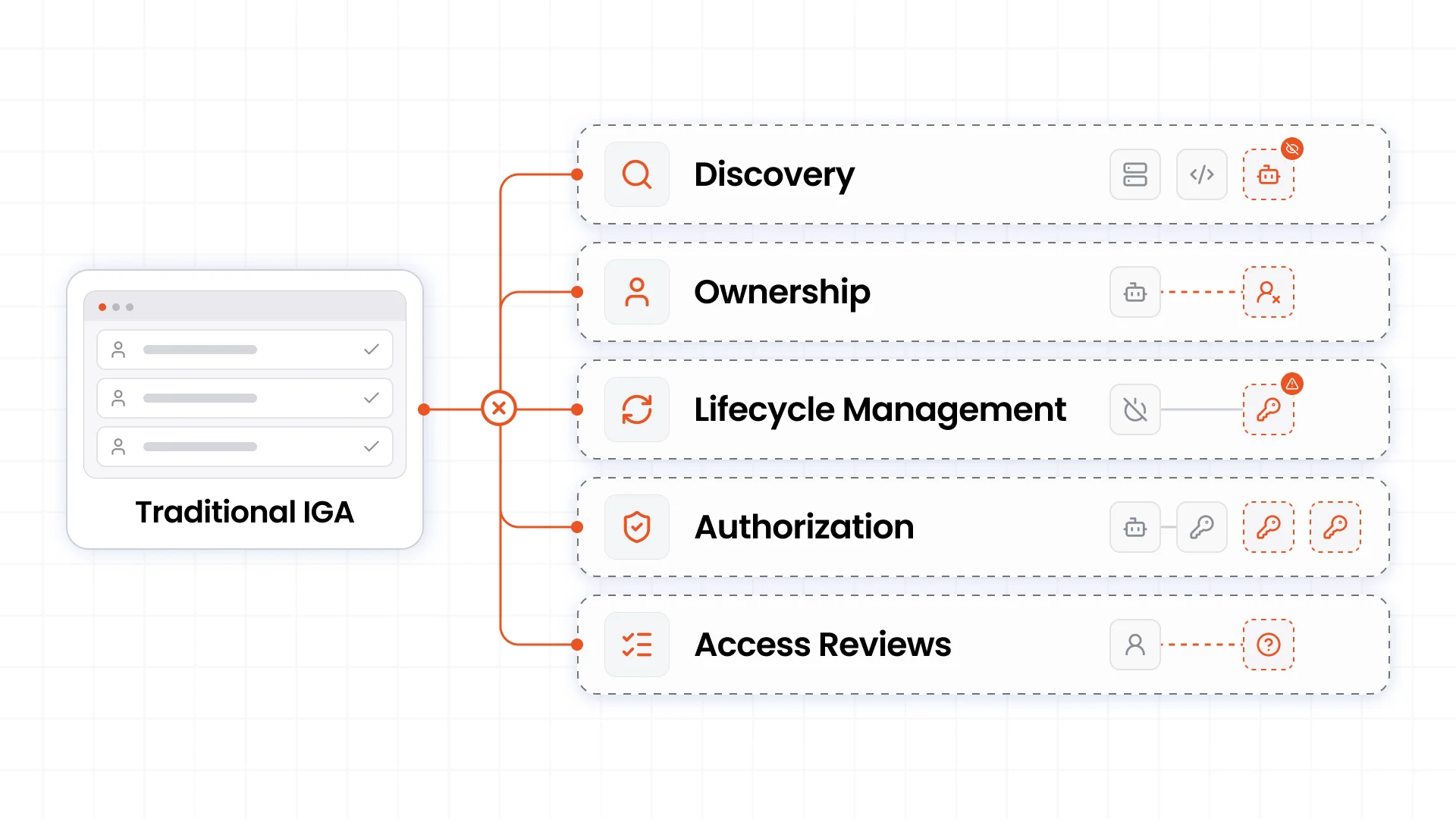
Traditional IGA assumes that every identity belongs to a person. AI agents break that assumption in five ways. Each row below shows what goes wrong and which traditional IGA limitation causes it.
| Gap | What Goes Wrong |
|---|---|
| Discovery | Unregistered AI agents and their credentials escape oversight. |
| Ownership | Unclear AI agent ownership leaves access without accountability. |
| Lifecycle Management | Retired AI agent workloads leave active credentials behind, creating machine identity lifecycle gaps. |
| Authorization | AI agents retain permissions beyond what their tasks require. |
| Access Reviews | Reviewers lack the context and usage data needed to validate AI agent permissions. |
1. Unregistered AI Agents and Credentials Escape Discovery
Traditional IGA only governs identities it knows about. Teams often add AI agents outside IT approval, so those agents never appear in its records.
AI agents are one type of non-human identity (NHI). An NHI is a digital identity for software instead of a person. Not every NHI is an AI agent. Four terms often get mixed up:
- AI agents plan and act on their own to reach a goal.
- Service accounts let one application sign in to another.
- Workloads are running scripts, containers, and cloud functions.
- Credentials, such as API keys, prove an identity is real.
An AI agent often uses the other three. It runs as a workload and signs in through a service account. An API key then gives it access to business data.
Say an employee connects an AI agent to the company CRM. The agent builds sales reports from customer records. Because the connection skips IT, the identity inventory has no record of it. As a result, IT does not know which data the agent reaches or who should approve its access.
Other untracked identities create the same blind spot:
- Service accounts outside approved workflows
- API keys and OAuth tokens missing from identity records
- Temporary identities for automated workloads
- Credentials stored inside connected applications
Each one opens another path to business data. Without a reliable inventory, teams cannot measure that risk.
Continuous non-human identity discovery closes this gap. It scans cloud and on-premises systems for machine identities and their credentials. Teams then add each discovery to a central inventory.
2. Unowned AI Agents Leave Access Without Accountability
An AI agent without a named owner keeps its access, and no one answers for it.
Suppose a developer creates an AI agent for internal reports. It retrieves customer records, and the team keeps it running because the output helps. Months later, the developer leaves. The agent keeps pulling customer data, and nobody checks whether it still needs to.
Many traditional IGA implementations center on employee identities and HR-driven processes. HR records show when an employee joins, changes roles, or leaves. Those events trigger access approvals and reviews. Managers and job roles also decide who approves access. AI agents and other NHIs appear in none of these records, so governance gaps follow.
An AI agent outside these workflows has no manager, HR record, or job role. Without a named owner, four questions go unanswered:
- Who confirms the agent’s business purpose?
- Who approves changes to its permissions?
- Who checks whether it still needs customer data?
- Who decides when the organization should retire it?
Departures are not the only trigger. Projects end, vendors change, and needs shift, so each agent needs an owner who stays accountable.
Every AI agent needs a named human owner and a documented purpose. The owner should review its access and confirm its business value. Identity governance for AI agents should make these duties explicit.
3. Automated Workloads Leave Credentials Behind
Ownership establishes responsibility, but access also needs an end date. Employee lifecycle events provide familiar triggers for access changes. HR processes signal when employees join, change roles, or leave.
Machine identities follow different patterns. Applications create service accounts, deployment pipelines launch temporary workloads, and AI platforms create ephemeral identities (short-lived identities for specific tasks).
These events do not always trigger access removal. A workload might finish while its credentials remain active. A retired AI agent might also retain API keys or OAuth tokens.
Long-lived service account keys create another risk. They remain valid until their owners revoke or replace them, unless other controls limit their use.
Organizations need lifecycle controls that match each identity’s purpose. Effective measures include:
- Set expiry dates for temporary access.
- Rotate long-lived credentials at defined intervals.
- Revoke unused API keys and OAuth tokens where supported.
- Remove access when workloads end or agents retire.
- Prefer short-lived credentials where supported.
- Grant just-in-time access for tasks that need temporary permissions.
These controls limit how long credentials remain usable. They also reduce the risk of forgotten identities and obsolete access.
However, valid credentials do not guarantee appropriate access. An active AI agent might still hold excessive permissions. Identity governance must address that separate problem.
4. AI Agents Retain More Access Than Their Tasks Require
An AI agent might read a customer record for one task. Another task might require permission to update an order. These operations demand different levels of access.
Broad, standing permissions give the agent both capabilities at all times. The agent retains access beyond its immediate task requirements. The principle of least privilege addresses this risk. It limits each identity to the access its work requires.
Traditional role-based access control (RBAC) assigns permissions through predefined roles. However, AI agents often perform different tasks across multiple applications. Each task might require a distinct set of permissions.
The Model Context Protocol (MCP) adds another layer to this problem. AI agents use MCP to access tools on connected servers. One agent might call several tools or delegate work to another agent.
Each connection introduces another access path. The original agent’s permissions alone do not describe every action across the wider workflow.
Organizations therefore need two distinct controls:
- Access policy enforcement: Applies rules when teams request, approve, or grant permissions.
- Runtime authorization: Checks whether an agent may perform a specific action at that moment.
AI agent identity management supports these controls through RBAC and attribute-based access control (ABAC). RBAC uses predefined roles, while ABAC evaluates attributes and contextual conditions.
Even strong policies need regular validation. Access changes over time, and scheduled reviews alone might miss those changes.
5. Access Reviews Miss Changes Between Certification Cycles
Traditional IGA also relies on scheduled quarterly or annual access certification reviews. Reviewers examine assigned permissions and decide whether each identity still needs them.
This approach remains useful for AI agents. However, quarterly or annual reviews leave gaps between review cycles.
An AI agent’s permissions might change several times between reviews. Reviewers might see its current entitlements without understanding its actual behavior.
Four issues explain many access review gaps:
- Limited context: Reviewers often do not know what the agent does or why it needs certain permissions.
- Changing permissions: Developers add access between scheduled reviews.
- Delegated access: One AI agent calls another agent or tool that carries separate permissions.
- Incomplete usage records: Reviewers see assigned permissions but not how the AI agent uses them.
These gaps make informed decisions difficult. A reviewer might approve excessive access simply because its purpose remains unclear.
Organizations should combine scheduled reviews with event-driven checks. New permissions, sensitive resource access, and unusual activity should trigger reviews immediately where appropriate.
Risk-based scoring can help teams prioritize their work. It ranks identities by factors such as sensitive access, unusual behavior, and deviations from peer identities.
Reviewers can then address the riskiest access first. This approach adds context to certification and helps teams respond between scheduled reviews.
What Modern IGA Does Differently
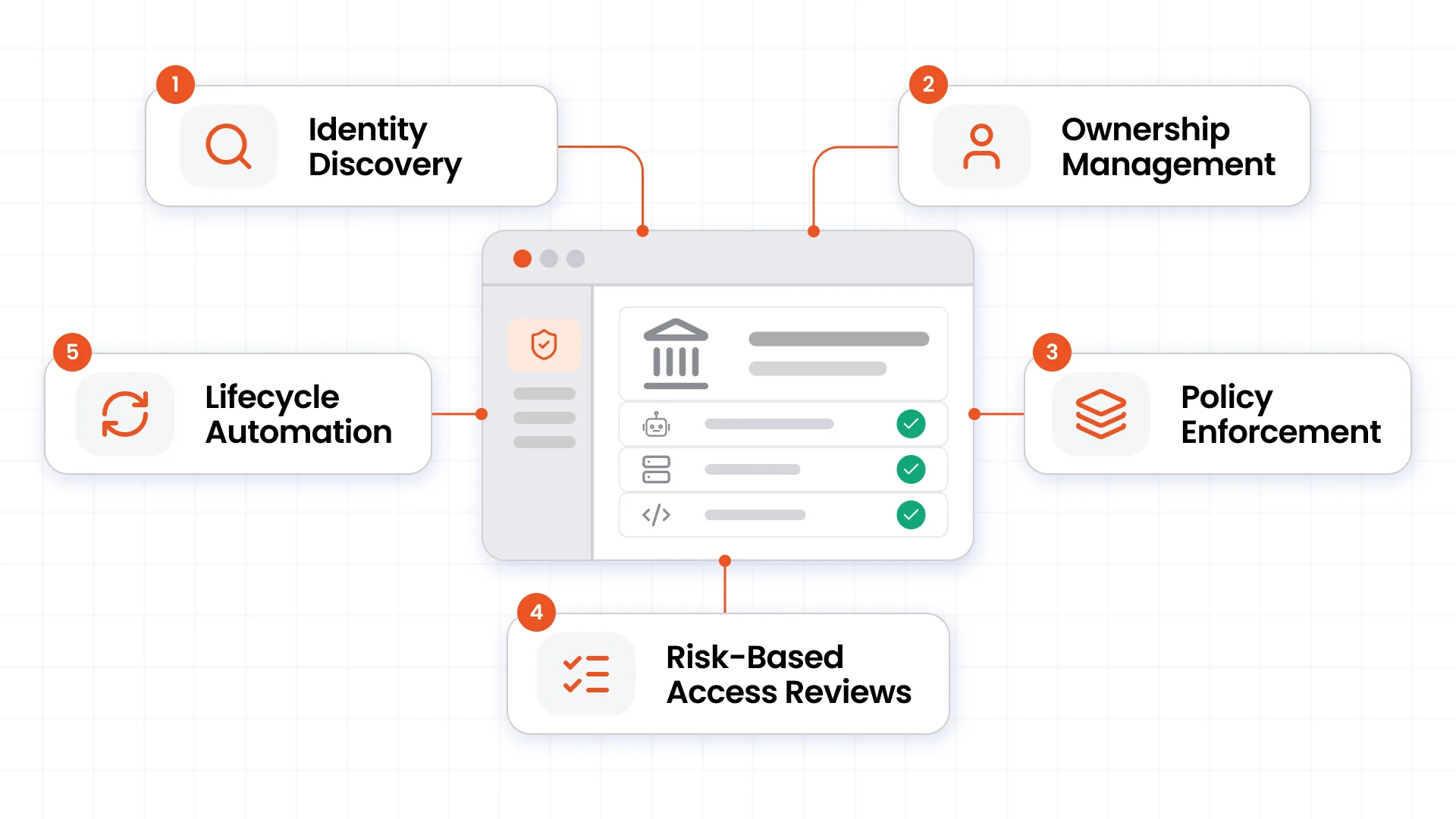
Closing these five gaps takes more than new rules on an employee-focused IGA solution. Modern IGA treats AI agents, service accounts, and workloads as full identities, and it connects identity records, permissions, lifecycle events, and review decisions in one place.
| Capability | What It Does | Gap It Closes |
|---|---|---|
| Identity Discovery | Finds service accounts, API keys, and AI agents across connected systems. | Discovery |
| Ownership Management | Assigns a named owner and records why each identity exists. | Ownership |
| Lifecycle Automation | Ties creation, expiry, and retirement to automatic provisioning and removal. | Lifecycle Management |
| Risk-Based Access Reviews | Sends reviewers to the riskiest access first. | Access Reviews |
| Policy Enforcement | Limits each agent to the systems and data its task needs. | Authorization |
These five capabilities work like a relay. Discovery finds the identity, ownership names a person, lifecycle automation removes access when the work ends, reviews catch drift, and policy limits what an agent does in between.
Runtime authorization adds a final check when an agent attempts a specific action. Teams should confirm whether their IGA platform supports that check directly or needs a companion tool such as authentication and authorization for AI agents.
Extend Identity Governance to AI Agents and NHIs With miniOrange
New AI agents, integrations, and automations bring new identities into your business. Each needs clear ownership, the right access, and proper oversight.
miniOrange IGA platform helps you bring human and non-human identities under the same roof. Your team can discover identities across connected apps, manage access throughout their lifecycle, and review permissions through one platform.
As AI adoption grows, your identity governance needs to keep pace. miniOrange helps you extend governance beyond employee accounts without building a separate process for every new type of identity.
Ready to bring AI agents into your identity governance strategy? Talk to a miniOrange IGA expert and book a demo.
FAQs
Why does traditional IGA struggle with AI agents?
Traditional IGA relies on employee records, fixed roles, and scheduled access reviews. AI agents work independently, change their access needs, and delegate tasks, which creates gaps in ownership, lifecycle management, authorization, and discovery.
How are non-human identities different from human identities?
Human identities represent people. Non-human identities represent software, services, workloads, bots, and automated processes. They often rely on API keys, OAuth tokens, or certificates, and they do not follow employee lifecycle events.
Do AI agents need identity governance?
Yes, AI agents access applications, process data, and act for users or organizations. Clear ownership, appropriate permissions, and regular access reviews reduce unauthorized access.
What is the biggest gap when managing service accounts and AI agents?
Missing ownership and incomplete discovery create the largest blind spots. Without knowing who owns an identity, why it exists, and what it reaches, organizations struggle to validate permissions and remove unnecessary access.
Does managing AI agents require replacing an existing IGA platform?
Replacement is not automatic. Organizations should assess how the current platform handles non-human identities, lifecycle automation, discovery, and access reviews, then close gaps with integrations or added controls.
What is MCP governance, and why does it matter?
MCP governance controls how AI agents reach tools, applications, and data through the Model Context Protocol. It covers connected servers, tool access, authorization rules, and monitoring of agent interactions.
Leave a Comment