Hello there!
Need Help? We are right here!

Need Help? We are right here!
Search Results:
×
Unlike a human user, who logs in, completes a task, and logs out, AI agents run continuously. They operate autonomously, access multiple systems simultaneously, and execute actions without ongoing human oversight. This introduces security risks such as:
Traditional IAM solutions are not designed to manage autonomous Non-Human Identities (NHIs) operating at machine speed. AI agents require an identity management system purpose-built for authentication, fine-grained authorization, and lifecycle governance.

Secure using OAuth/OIDC, JWT validation, and mTLS, so every agent presents a verifiable identity at every access request. Eliminate static keys with short-lived, scoped credentials that expire automatically, and enforce secret rotation.

Enforce RBAC, ABAC, least privilege, and policy-based access controls to limit AI agents to exactly the systems, APIs, and data scopes they need for their defined function.

Extend centralized IAM governance to AI agents, service accounts, workload identities, and machine identities. Assign ownership, maintain inventories, and enforce review cycles.

Register agents at deployment, provision scoped access, rotate credentials, modify permissions as workflows change, and decommission identities when agents are retired.

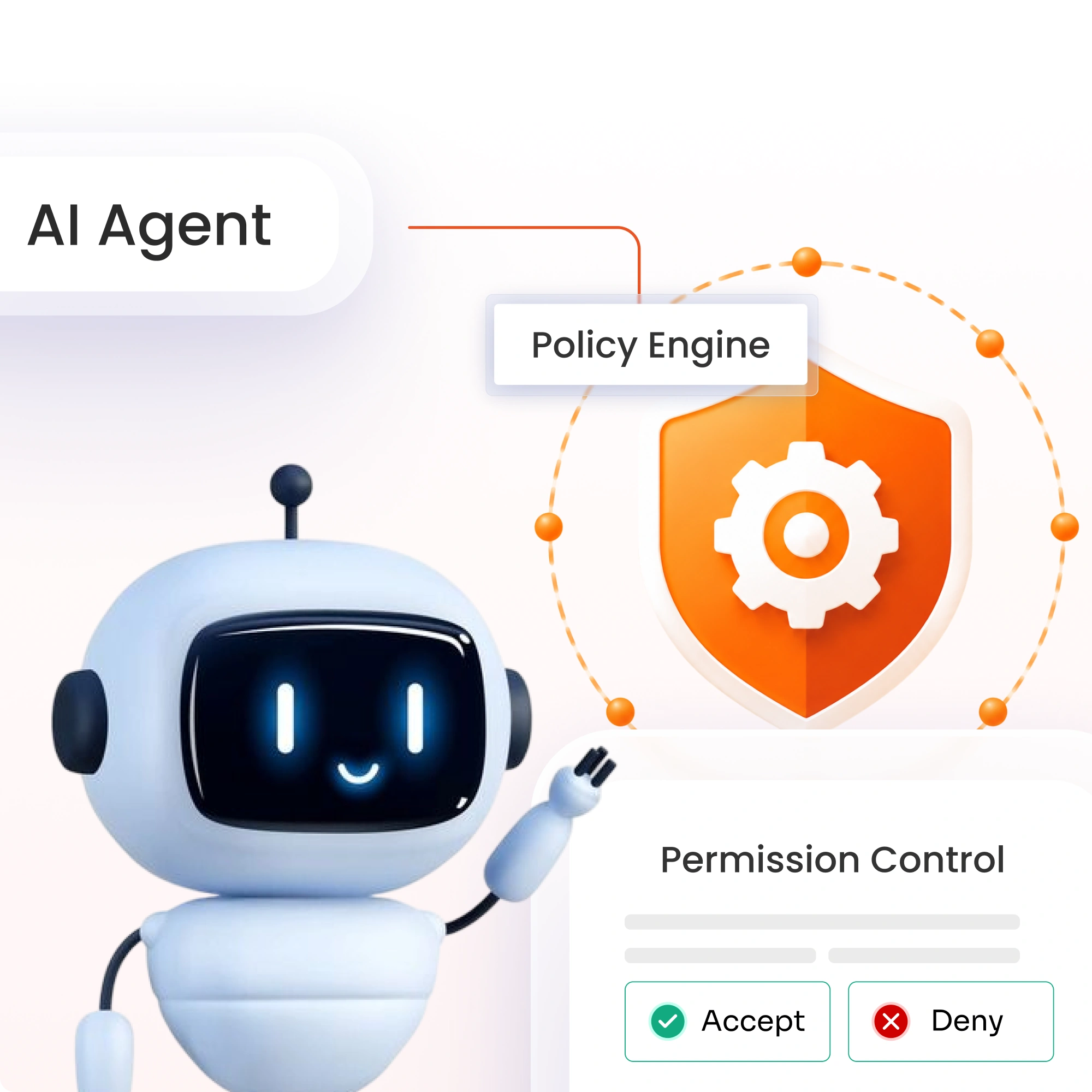
Validate AI agent actions before execution. Every API call, tool invocation, and inter-agent request is checked against policies, preventing privilege abuse and unauthorized behavior.

Maintain timestamped audit logs for all AI agent activity, including data access, API calls, tool interactions, and authorization decisions. Support compliance reporting for SOC 2, ISO 27001, and NIST AI RMF.

Enforce identity-aware authorization with agents using Model Context Protocols (MCPs) and external tools. Govern which agents can access which tools, under what conditions, and with what data scope.
Ensure every action of your AI agent is authenticated, authorized, and governed with AI Agent Identity Management.
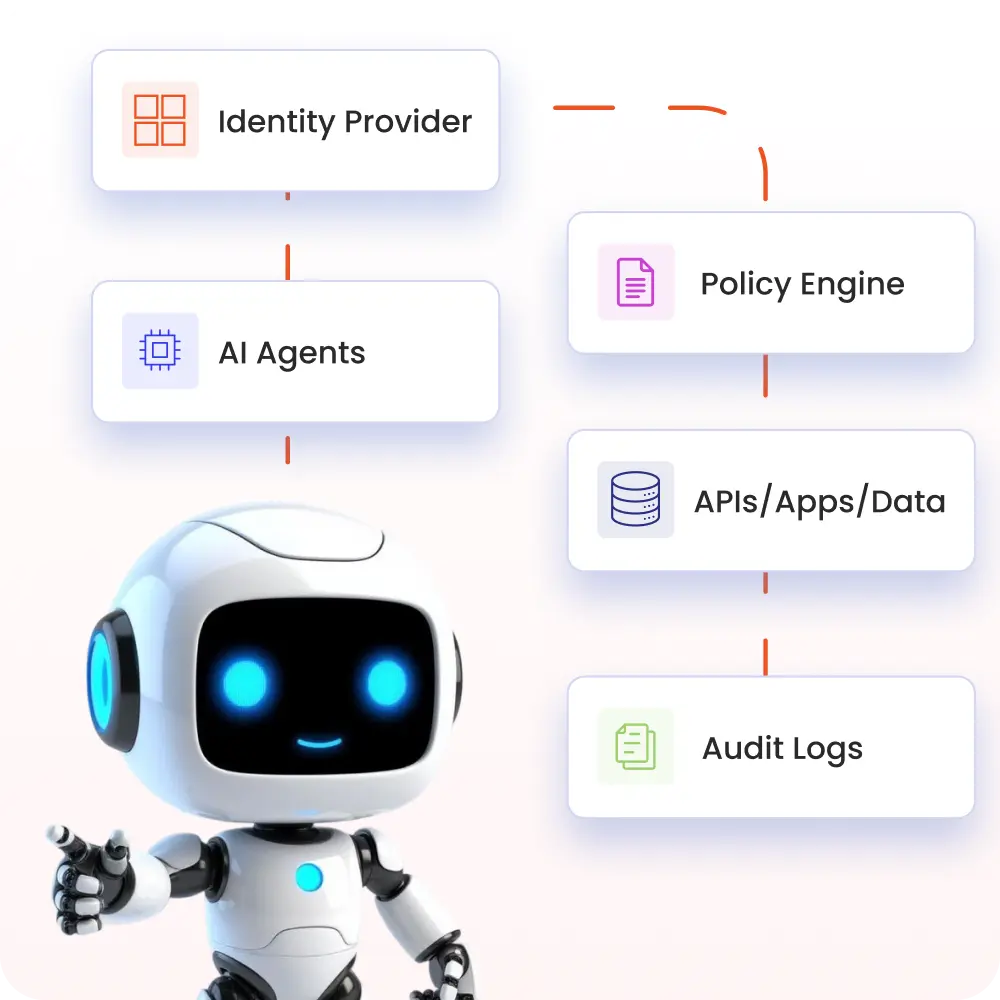
1. Register AI Agent Identity: Every AI agent is enrolled as a unique, governed non-human identity with a defined owner, purpose, environment scope, and baseline access profile.
2. Authenticate the AI Agent: Use OAuth 2.0 / OIDC, JWT validation, mTLS, or API key–based authentication to verify the agent’s identity before granting access.
3. Apply Access Policies: Enforce RBAC, ABAC, and least-privilege to define which resources, APIs, and data an AI agent is allowed to access.
4. Validate Runtime Actions: Evaluate each API call, tool invocation, and system interaction in real-time against authorization policies to prevent unauthorized or out-of-scope actions.
5. Monitor and Govern Activity: Log audits continuously, ensure access reviews, and lifecycle governance for visibility, traceability, and compliance across all AI agent activities.

Enterprise AI assistants like Microsoft Copilot, RAG-based tools, and custom LLM deployments access CRMs, knowledge bases, and communication systems. Secure and govern their identities to prevent exposure to sensitive information.

Agentic workflows connecting CRMs, ERPs, ticketing systems, and data pipelines need scoped, auditable access. Apply per-agent authorization policies for controlled AI-driven workflows. Ensure every automated action is securely governed and aligned with organizational access policies.
AI agents are the highest-volume API consumers in enterprises, operating across dozens of endpoints simultaneously. Enable identity-aware API access, scoped permissions, and policy-based controls to verify every API call.
Organizations deploy multiple agents to handle tasks, and managing trust and governance between the agents is critical. Enforce unique identities, policy-based authorization, and authentication for every inter-agent communication.

AI agents routinely access internal tools, SaaS platforms, and apps, often with broader permissions than necessary. Apply centralized IAM policies and fine-grained authorization to control which tools agents can access, under what conditions, and for how long.

Agents access customer data, financial records, or regulated information, and unrestricted access creates serious compliance and breach risks. Apply RBAC/ABAC policies, least privilege, and runtime authorization checks, so agents access only what their function requires.
Manage users, AI agents, service accounts, and machine identities from a single, centralized IAM platform.
Enforce granular, dynamic authorization across APIs, enterprise applications, and AI workflows.
miniOrange brings deep IAM implementation experience across hundreds of enterprise environments.
Supports autonomous AI adoption without sacrificing identity governance and visibility. Deploy agents confidently, knowing every identity is authenticated.