


Application onboarding is the process of integrating an application with your identity governance and administration platform so its accounts, roles, and entitlements can be governed.
Once an application is onboarded, you can:
- See every account in the application and who owns it.
- Review access during access certification campaigns.
- Grant and remove access through access requests.
- Apply policies such as least privilege and segregation of duties.
- Remove access automatically when someone changes roles or leaves.
Without onboarding, an application stays outside your controls, and any access inside it is invisible to your security and audit teams.
Why Application Onboarding Is Harder Than It Looks
IGA industry leaders describe it simply as connecting your governance system to a company's applications and databases in a secure way. The platform reads identity and access data from each application, then keeps that data consistent through a step called reconciliation. It is a core part of identity governance and administration.
Connecting one application sounds simple. Governing a full estate of them is where the difficulty starts. A few things make it hard:
- Every Application Is Different. Applications vary in business importance, data sensitivity, access complexity, user population, and how they expose their data. A modern SaaS tool may offer a clean interface, while a legacy system may only produce a flat file.
- Custom Work Piles Up. When every new application needs its own connector, script, or integration, onboarding turns into a software project instead of a routine task. Analysts call this application onboarding debt. The more custom code you build, the more you have to test and maintain every time something changes.
- Accounts Do Not Always Match People. Every application account has to be linked to a real identity before it can be governed. This step is called account correlation. When accounts cannot be matched, they sit unresolved and weaken your reviews.
- Non-Human Identities are Easy to Miss. Non-human identities such as service accounts, bots, and API tokens often hold access inside applications with no clear human owner. They need to be onboarded and governed too.
The practical fix is to make onboarding configuration-driven. When lifecycle rules and integration patterns are reusable, adding a new application becomes policy work rather than a fresh engineering effort.
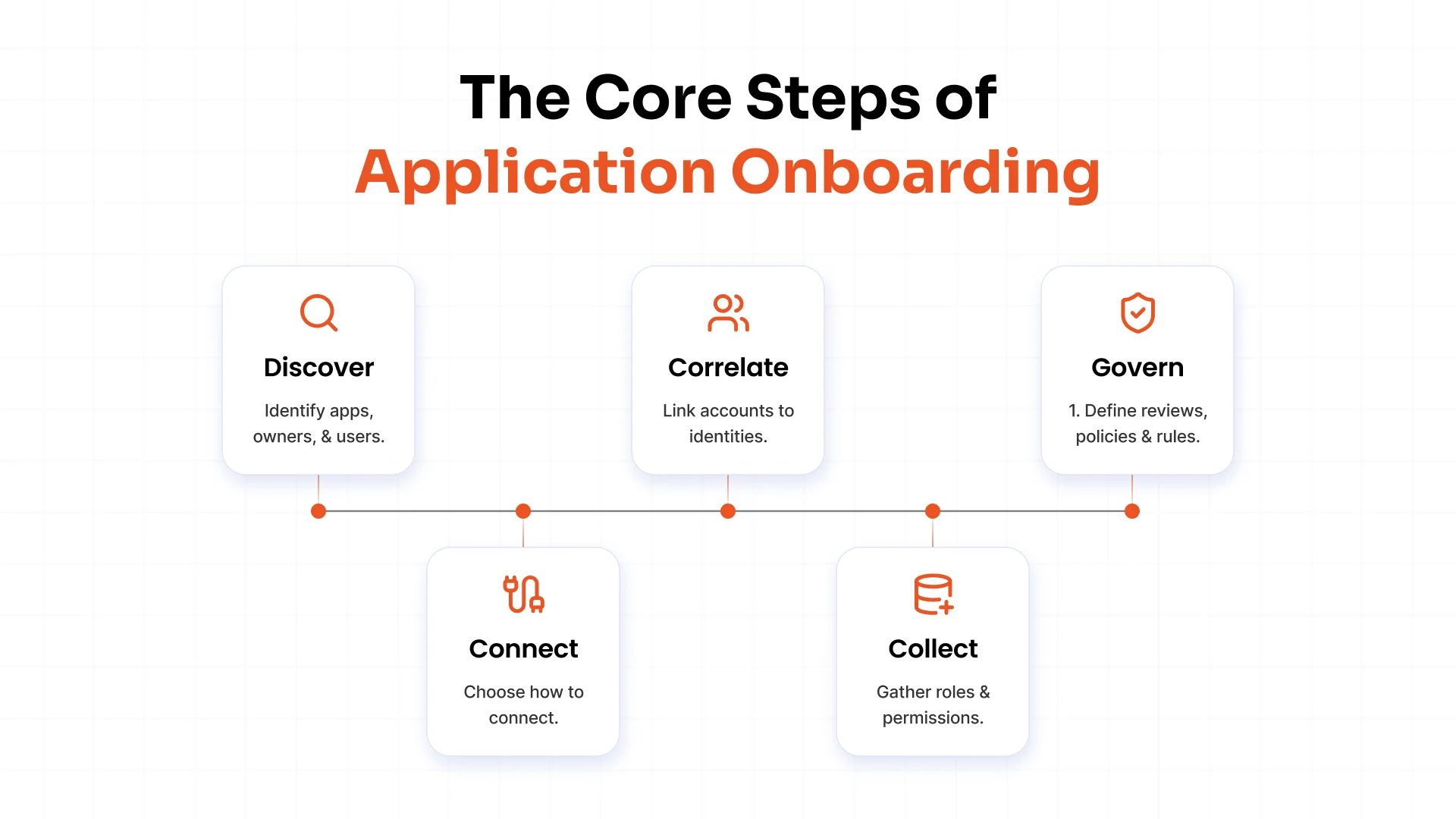
The Core Steps of Application Onboarding
Every platform is a little different, but most application onboarding follows the same sequence.
Step 1: Discover and Inventory the Application
Identify the application, its owner, its user population, and the type of data it holds. Automated identity discovery and visibility tools help you find applications that are already in use but not yet governed.
Step 2: Choose a Connection Method
Select the application you want to onboard, for example, Microsoft Entra ID, Active Directory, or Okta, and more. The system automatically uses the appropriate connector to establish the connection in the background. For applications without a prebuilt connector, use a flexible connector or file-based import.
Step 3: Correlate Accounts to Identities
- Pull accounts from the application. Automatically correlate accounts to the right person or managed non-human identity.
- Test the correlation to identify unmatched or incorrectly matched accounts before going live.
Step 4: Collect Roles and Entitlements
Pull in the roles and permissions the application uses, at a level of detail your reviewers can actually understand. Vague entitlements lead to rubber-stamp reviews.
Step 5: Set Up Governance
Define who reviews access, how access is requested and approved, which policies apply, and how access is removed. Building Segregation of Duties rules at this point stops risky access combinations before they are granted. This is where onboarding becomes real governance.
Bring Every Application Under Governance
miniOrange Identity Governance helps you connect applications, correlate accounts, and govern access from one place through identity lifecycle management.
How to Prioritize Applications for Onboarding
Most organizations cannot onboard every application at once, so the order you choose matters.
A common mistake is starting with the easiest applications. A tool with a ready connector and clean data is quick to connect, but it may carry very little risk. Meanwhile, the systems that hold your biggest risks, such as finance or cloud administration, stay ungoverned.
miniOrange recommends sequencing by risk and readiness rather than by convenience. Two questions guide the decision:
- Where does access create the greatest business or compliance risk?
- Which applications are ready enough to be governed successfully?
Score each application on factors like access risk, sensitive or regulated data, privilege level, audit importance, user population, and known access problems. Prioritized risk scoring helps you rank them. Then score readiness separately: is there a confirmed owner, can accounts be matched, can access data be extracted, and is there a way to remove access?
Putting risk and readiness side by side gives you four clear groups:
| High Readiness | Low Readiness | |
|---|---|---|
| High Priority | Onboard first. These prove the process while cutting real risk. | Prepare first, then onboard soon. Do not defer them permanently. |
| Low Priority | Onboard selectively to validate repeatable patterns. | Defer until business needs change. |
High-risk applications that are ready to govern go first. High-risk applications that are not ready need preparation, not permanent delay.
Onboard in Waves, Not All at Once
Rather than one giant backlog, break onboarding into manageable waves:
- Foundation. Connect your authoritative identity sources first, such as your HR system and directory, so the platform knows who everyone is.
- First Wave. A small set of high-risk, ready applications where you can prove the full governance process from end to end.
- Later Waves. High-risk applications that need preparation, followed by broader business applications.
- Continuous Backlog. New applications, acquisitions, and changing risks keep the roadmap moving.
Treat your roadmap as a living document. An application can move up the list after a security incident, a new audit finding, or a merger. A structured IGA implementation checklist keeps each wave consistent.
When Is an Application Actually Onboarded?
It is tempting to measure progress by counting connected applications. But “40 applications connected” tells your leadership very little about risk.
A better measure is whether each application passes a governance gate. Before you call an application onboarded, confirm that it has:
- An assigned application owner.
- A known user population with accounts correlated, and unmatched accounts investigated.
- Roles and entitlements collected at a usable level of detail.
- A tested access review process and a defined way to remove access.
- The ability to produce audit evidence.
Connectivity is the start of onboarding. Governance is the finish line.
The Role of Automation and AI
Manual onboarding is slow and full of trial and error, especially when matching accounts to identities. This is why modern platforms lean on automation.
Newer tools use AI to recommend the best connection method, suggest how accounts map to identities, and flag applications that are in use but not yet governed. SailPoint, for example, reports that this approach can shorten onboarding from weeks to hours while keeping the identity team in control of final approval. Some platforms also let application owners handle parts of the setup, which spreads the work without giving up oversight.
Automation should cover the full lifecycle, not just day one. Onboarding that only automates account creation leaves offboarding as a weak point, which is how stale access and orphaned accounts build up over time.
Best Practices for Application Onboarding
- Prioritize Risk Over Convenience. Do not let an easy connector decide your first wave.
- Fix Your Identity Foundation Early. Poor account matching affects every process built on top of it.
- Assign an Owner Before You Onboard. Access without an owner leads to weak review decisions.
- Score Readiness Separately from Risk. High-risk applications may need preparation first.
- Keep the First Wave Small. Prove the full process before you scale.
- Define “Onboarded” Carefully. Connectivity alone is not governance.
- Include Non-Human Identities. Service accounts and bots need governance too.
- Reassess Regularly. Audits, incidents, and new applications should update your access governance roadmap.
Onboard Applications the Governed Way
miniOrange IGA solution combines discovery, account correlation, lifecycle management, and access reviews so every application you onboard is actually governed, not just connected. Explore miniOrange Identity Governance or schedule a personalized demo to plan your rollout.
Frequently Asked Questions
Why should you prioritize applications before onboarding them?
Because you usually cannot onboard everything at once. Starting with the easiest applications can leave your highest-risk systems ungoverned. Prioritizing by risk and readiness makes sure the applications that matter most are governed first.
What is account correlation in application onboarding?
Account correlation is the step that links an application account to a real identity, whether a person or a managed non-human identity. Without correlation, accounts cannot be governed and can weaken access reviews. It should be tested before it goes live.
What is the difference between an authoritative source and a target application?
An authoritative source, usually an HR system or directory, is trusted to define who a person is. A target application receives and shares access data and is matched back to those identities. Both are onboarded, but they play different roles.
When is an application considered fully onboarded?
An application is fully onboarded when it has an owner, correlated accounts, collected entitlements, a tested review process, a way to remove access, and the ability to produce audit evidence. Connectivity alone is not the finish line.
Can non-human identities be onboarded in IGA?
Yes. Service accounts, bots, and API tokens hold access inside applications and should be onboarded and governed like human accounts. Leaving them out creates blind spots and unmonitored access.
Leave a Comment