
The notification of the Digital Personal Data Protection (DPDP) Rules, 2025, marks a major turning point in how businesses in India collect, use, and safeguard personal data in the digital ecosystem. Together with the Digital Personal Data Protection (DPDP) Act, 2023, these Rules create a rights-based, consent-driven framework that places citizens at the centre of data processing while still enabling responsible innovation and growth in the digital economy.
In this article, we’ll break down what the DPDP Rules, 2025, mean for organizations, the new compliance obligations they introduce, and practical steps you can take to get ready.
Introduction to DPDP Act 2023
The Digital Personal Data Protection Act, 2023 (DPDP Act), is India’s landmark legislation designed to regulate how organizations collect, process, and protect personal data in the digital age. The Act responds to the exponential growth of online services, raising the need to safeguard individual privacy while supporting technology-driven innovation.
It establishes stringent requirements for consent, data minimization, purpose limitation, and the rights of individuals, such as accessing, correcting, and erasing personal data. Entities processing data (data fiduciaries) must ensure data accuracy, build robust safeguards against breaches, notify regulators and affected individuals of data incidents, and erase data that no longer serves its lawful purpose unless required by law.
What is Digital Personal Data?
Digital personal data refers to any information in digital form that can directly or indirectly identify an individual. This includes names, contact details, online identifiers, device data, and any other attribute that can single out a person, whether collected online or digitized from offline sources.
The Act does not apply to data used for purely personal or domestic purposes, nor data made public by the individual or under legal obligation. The DPDP Act aims to build trust between citizens and organizations that handle personal data, improving transparency and accountability throughout India’s digital ecosystem by centering on individual rights and responsibilities.
Government Exemptions Under DPDP Act
Exclusion from Right to Erasure: Individuals ordinarily have the right to request deletion (erasure) of their personal data from data fiduciaries. However, government agencies may be exempt from complying with such requests if the data is needed for lawful purposes such as national security, law enforcement, or public interest.
Consent Not Always Required: The DPDP Act generally requires organizations to obtain explicit consent for processing personal data. Government departments, however, may process personal data without consent in specific situations, such as for carrying out official functions, responding to emergencies, or fulfilling legal obligations.
National Security and Public Order: When data processing is necessary for national security, public order, or investigation of offences, the government may override standard privacy rights and obligations prescribed in the Act.
Why the DPDP Rules, 2025 Matter?
Empowerment of Data Principals
The DPDP Rules, 2025, prioritize the rights of data principals by granting them control over their personal data. Individuals can access, correct, and erase their data, ensuring transparency and autonomy. This empowerment is fundamental to building trust in India’s digital ecosystem and protecting citizen privacy effectively. It places personal data rights firmly in the hands of individuals.
Clear Compliance Framework for Businesses
The Rules give organizations a detailed and phased compliance roadmap spanning 18 months. This framework enables businesses to implement responsible data practices by establishing clear consent requirements, data handling standards, and breach reporting protocols. It reduces uncertainty and enhances accountability for all data fiduciaries. The phased approach allows companies a gradual adjustment to new obligations.
Strengthened Security Safeguards
They mandate robust security controls such as encryption, data masking, continuous monitoring, and strict access controls. Data fiduciaries must report breaches promptly to affected individuals and the Data Protection Board. These measures strengthen protection against data breaches and unauthorized use. Security requirements also include regular audits and contractual obligations with processors.
Promotion of Trust and Accountability
The DPDP Rules foster public trust in digital services by emphasizing transparency and accountability. The establishment of the Data Protection Board ensures oversight and enforcement. Organizations that adhere to these rules signal commitment to responsible data handling, enhancing consumer confidence. This trust foundation encourages wider digital adoption and innovation.
Alignment with Global Best Practices
The Rules align India’s data protection laws with international standards while accommodating national priorities like data localization. This positions India favorably in the global digital economy and supports cross-border data flows under safeguarded protocols, facilitating innovation and cooperation. The framework bridges global compliance with specific domestic concerns.
Understanding the Fundamental Pillars of the DPDP Act
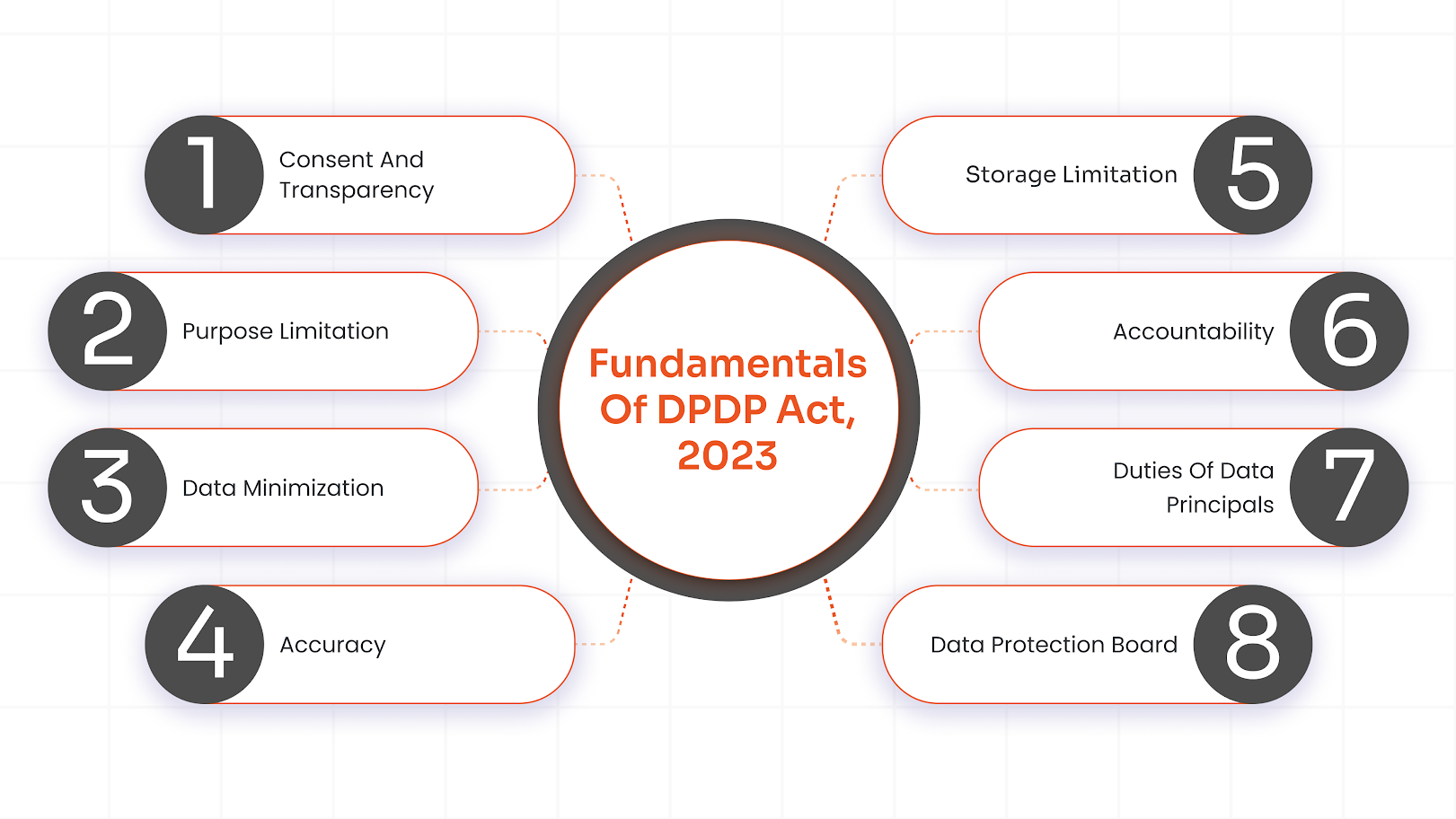
The Digital Personal Data Protection Act, 2023 (DPDP Act) is structured around several fundamental pillars that establish a comprehensive legal framework for data protection in India.
Consent and Transparency
The Digital Personal Data Protection Act, 2023 requires data fiduciaries to obtain free, informed, explicit consent from data principals before processing personal data, as stated in Section 4. Clear communication about how data is collected, the purpose, and the rights of principal must be ensured, promoting trust and autonomy in data handling practices under the Act.
Purpose Limitation
Section 5 mandates that personal data must only be processed for explicit, lawful purposes communicated at the point of collection. This restricts data use strictly to specific objectives, ensuring no secondary or unauthorized processing occurs, protecting individuals from misuse, and fostering responsible data governance.
Data Minimization
According to Section 6, data fiduciaries are obligated to collect only the minimum necessary personal data required for the stated purpose. This limitation reduces exposure to breaches and unnecessary risks while encouraging ethical data handling that respects privacy and avoids superfluous data collection.
Accuracy
Section 7 stresses the importance of maintaining accurate, complete, and up-to-date data. Data fiduciaries must take reasonable steps to correct or erase inaccurate information, ensuring decisions based on data are fair and reliable. Accuracy safeguards individuals from harm caused by faulty data.
Storage Limitation
As per Section 8, personal data should only be retained as long as necessary to fulfill the original purpose or until consent withdrawal, whichever comes first. Upon completion, data must be securely deleted or irreversibly anonymized, mitigating risks associated with data hoarding and unauthorized access.
Security Safeguards and Accountability
Sections 9 and 10 require fiduciaries to enforce robust security measures like encryption, access controls, and timely breach notifications. Accountability involves maintaining compliance records and undergoing audits, reducing vulnerabilities, and building organizational trustworthiness in protecting personal data.
Rights and Duties of Data Principals
Sections 11 to 15 provide data principals' rights such as access, correction, erasure, and grievance redressal, while also imposing duties to provide authentic data and avoid misuse. This balanced approach empowers individuals and ensures system integrity.
Data Protection Board and Enforcement
Under Sections 18 to 26 and 33 to 34, an independent Data Protection Board of India oversees enforcement, investigates complaints, and imposes penalties for violations. This institutional oversight ensures compliance and protection of privacy rights across India’s digital ecosystem.
5-Step DPDP Compliance Readiness Roadmap
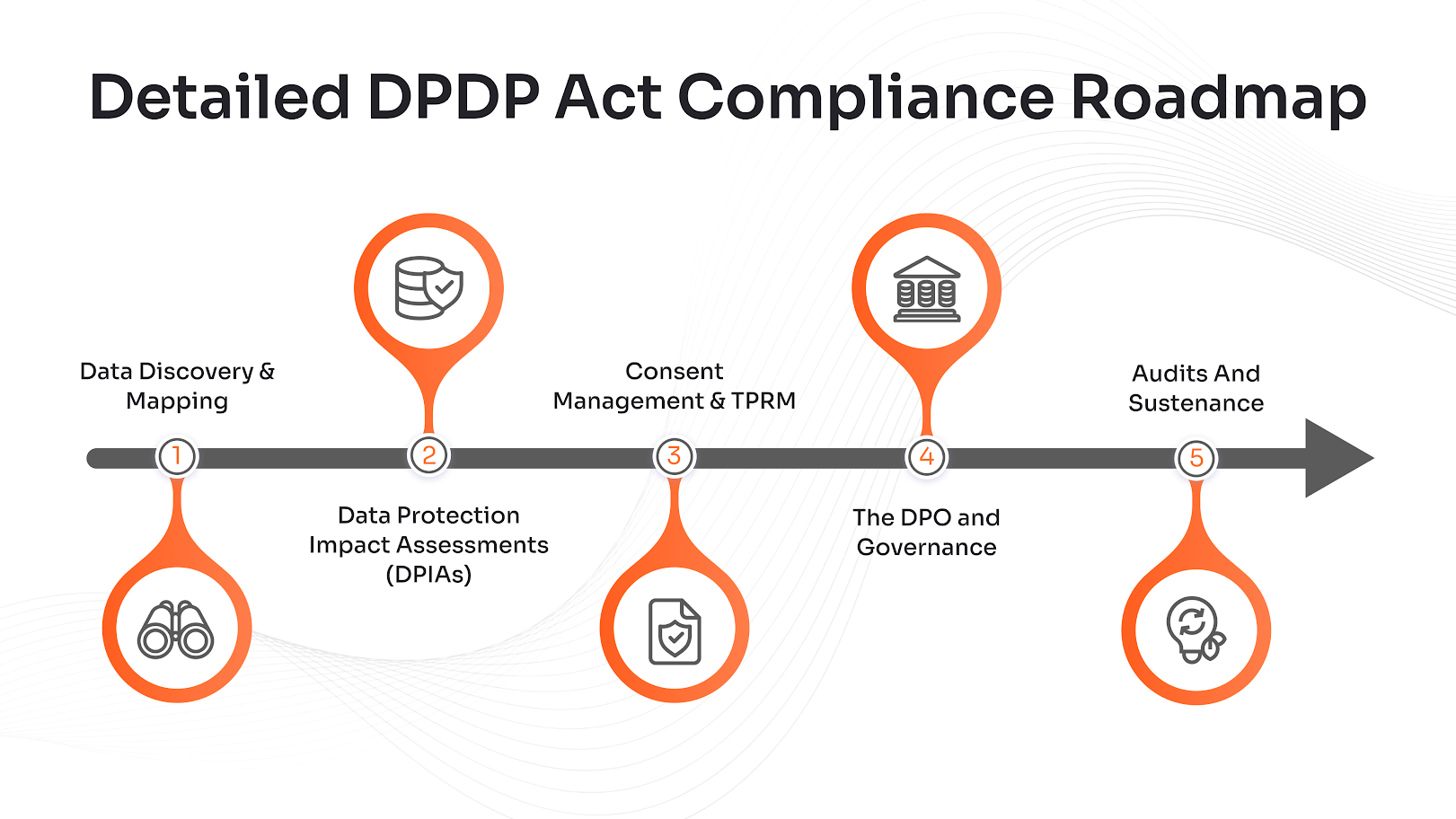
Step 1: Data Discovery, Mapping, and RoPA Documentation
Start with comprehensive data discovery, mapping all personal data processed and stored. Create and maintain a Record of Processing Activities (RoPA) to capture data lifecycle and flows. This supports the identification of sensitive data and compliance gaps. RoPA is foundational for risk assessments and a legal compliance requirement under the DPDP framework. It guides all subsequent compliance actions.
Step 2: Conducting Data Protection Impact Assessments (DPIAs)
Perform Data Protection Impact Assessments to evaluate privacy risks associated with processing. DPIAs help identify vulnerabilities and compliance gaps in systems handling high-risk or large-scale data. Mitigation plans must address identified risks. DPIAs are mandatory for Significant Data Fiduciaries under DPDP, proving proactive privacy management and regulatory compliance. They protect both organizations and data principals.
Step 3: Consent Management, TPRM, and Vendor Due Diligence
Implement effective consent management systems, ensuring consent is informed, specific, and revocable. Simultaneously, conduct due diligence on third-party vendors with access to personal data, checking their DPDP compliance. Proper Third-Party Risk Management (TPRM) reduces risks from external partners and ensures data protection standards are metropolitan. Coordinated oversight of data processors supports organizational accountability and compliance.
Step 4: Structuring the DPO and Governance
Designate a qualified Data Protection Officer (DPO) to lead privacy governance efforts. Establish clear responsibilities for data protection policies, staff training, and regulatory reporting. Effective governance frameworks ensure adherence to DPDP requirements. This organizational structure encourages ongoing risk management, employee awareness, and swift responses to compliance issues, reinforcing trust and legal conformity.
Step 5: Audits and Sustenance for Ongoing Compliance
Develop frameworks for continuous monitoring of data processing activities and security controls. Conduct periodic independent audits and reviews for compliance verification. Regular updates and policy refinements are necessary due to evolving risks and regulatory changes. Sustained compliance reduces breach incidence and demonstrates organizational commitment to data protection under DPDP norms.
High Stakes: Penalties, Extraterritoriality, and Unaddressed Ambiguities
The Digital Personal Data Protection Act, 2023, imposes significant financial penalties up to ₹250 crores for non-compliance, bringing focus to the greater risks posed for organizations and enterprises. The Act’s extraterritorial scope extends its jurisdiction to foreign entities processing the personal data of Indians, regardless of their location, to offer goods or services in India.
This broad global reach means companies worldwide must comply or risk substantial fines and market access restrictions. However, enforcement mechanisms for foreign companies remain unclear, raising concerns about cross-border regulatory cooperation. This ambiguity highlights the need for international frameworks to support effective enforcement and data protection globally.
The Critical Role of Cybersecurity in DPDP Compliance
Mandatory Technical Safeguards
Under the DPDP Rules, 2025, encryption is mandatory for protecting personal data both at rest and in transit. Access controls restrict unauthorized data access, ensuring only designated personnel handle sensitive information. These safeguards minimize the risk of data breaches and unauthorized use. Organizations must also implement logging and monitoring to detect suspicious activity, fulfilling compliance requirements while enhancing data confidentiality and integrity.
72-Hour Data Breach Reporting
The DPDP framework mandates reporting data breaches to the Data Protection Board within 72 hours of discovery. Organizations must have defined incident response protocols to quickly assess, contain, and mitigate breaches. Prompt notification includes informing affected individuals to reduce harm. This strict timeline enforces accountability, encourages a proactive security posture, and ensures transparency under India’s digital data protection regime.
The CISO's Responsibility in the New Framework
The Chief Information Security Officer (CISO) now bears expanded responsibilities under DPDP to ensure technical and organizational measures align with regulatory mandates. The role includes overseeing encryption, access controls, breach detection, and staff training. CISOs must collaborate with legal and compliance teams to manage risk, respond to incidents swiftly, and embed data protection into organizational culture, strengthening overall privacy governance.
miniOrange as Your Cybersecurity Ally
Data Discovery and Classification
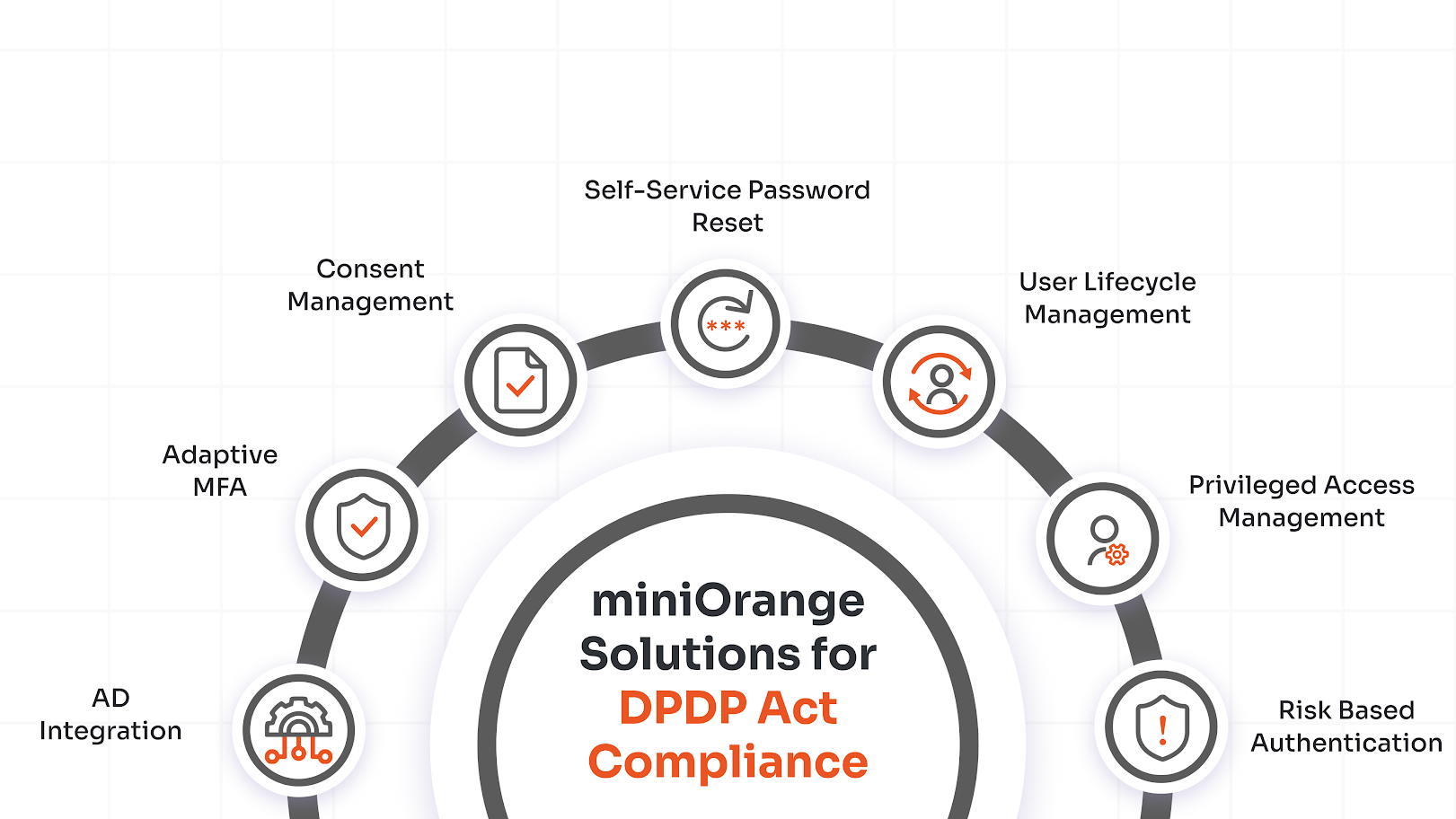
miniOrange integrates with external directories like AD, LDAP, and AWS Cognito to discover and classify user data accurately. Its SCIM Provisioning Gateway automates user onboarding and offboarding, helping maintain precise data records. This ensures organizations know what data they have, where it resides, and who can access it, supporting compliance with DPDP’s data inventory requirements.
Adaptive Access and Data Minimization
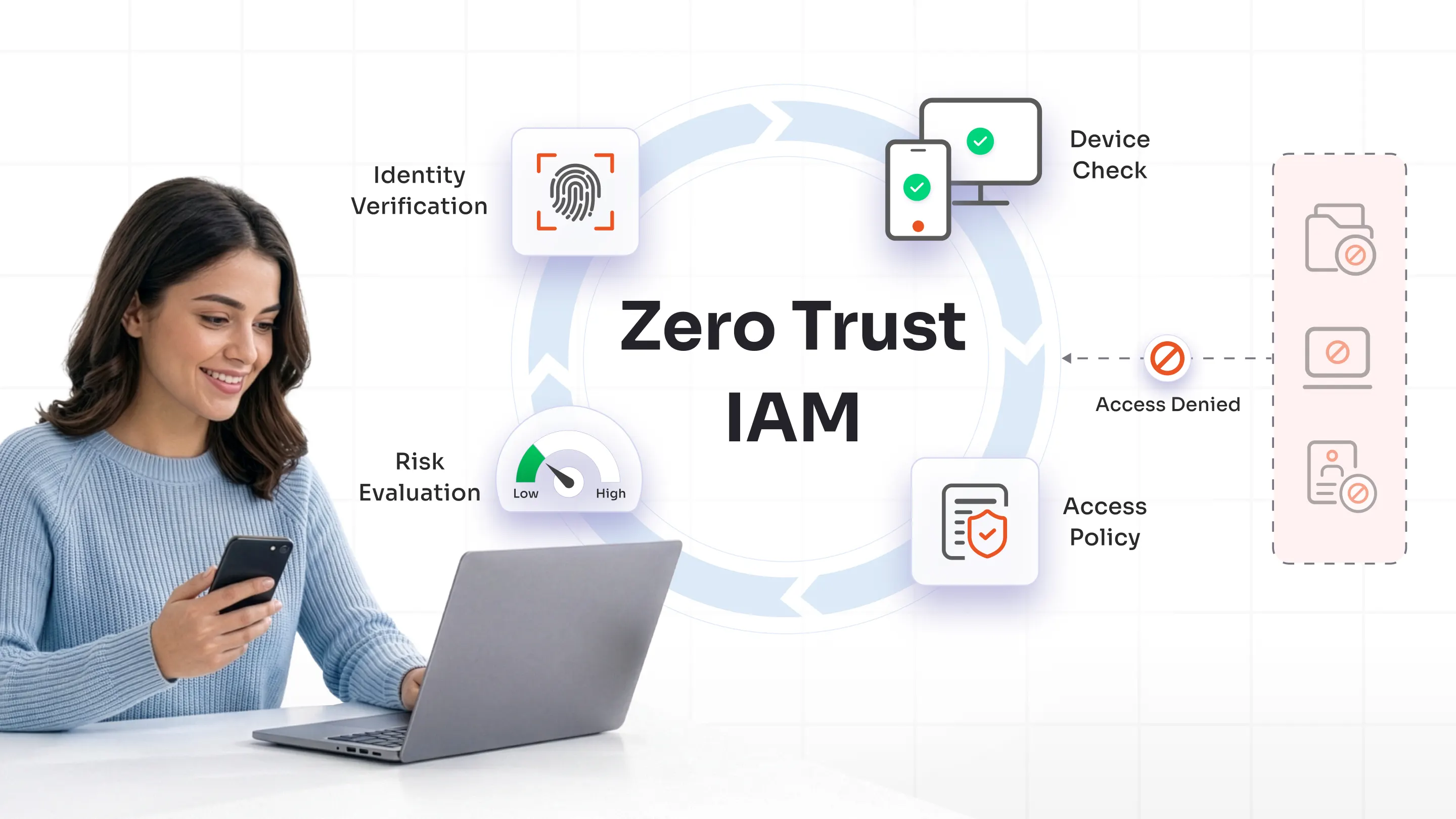
With adaptive access policies, miniOrange restricts data access based on factors like IP, device, location, and time, ensuring minimum necessary data exposure. Lifecycle management governs user data through onboarding to offboarding, preventing excessive retention. These controls enforce data minimization principles vital under DPDP, reducing risk and ensuring only required data is accessible.
Consent Management and Secure Authentication
miniOrange facilitates consent-driven flows via OAuth 2.0 Server and Identity Brokering, ensuring users provide informed consent. Digital ID verification and social login features include embedded consent prompts, enhancing transparency. Single Sign-On (SSO) and Multi-Factor Authentication (MFA) provide secure, seamless processing, elevating data security and trust in user authentication.
Automated Retention and Erasure
You get complete data lifecycle controls like self-service password reset and automated provisioning/deprovisioning, enabling timely data removal per DPDP. Automated workflows reduce manual errors, enforce compliance with data retention limits, and contribute to robust data governance policies, helping organizations stay aligned with regulatory timelines.
Enhanced Access Control and Breach Response
Privileged Access Management protects critical accounts, while secure remote access monitors and restricts internal resource usage. Adaptive MFA and risk-based authentication detect anomalies early. Audit logs and reporting tools assist breach investigations, supporting regulatory obligations. While grievance redressal isn’t direct, miniOrange’s system logs greatly aid in complaint investigations.
Support for Cross-Border Data Handling
miniOrange utilizes OAuth and SAML protocols for secure data exchange across borders, supporting federated identity systems and global applications. This capability aligns with the extraterritorial scope of DPDP, helping organizations comply with international data transfer regulations securely and efficiently.
Conclusion
The DPDP Act mandates strict regulatory compliance focused on protecting personal data through transparency, consent, security, and accountability. Organizations must adapt by implementing robust identity, consent management, and breach response systems. miniOrange’s advanced solutions empower enterprises with essential solutions for seamless DPDP compliance, fostering trust and resilience in a growing digital ecosystem while addressing India’s strict data protection scenario.
FAQs
What are the major obligations under DPDP?
Organizations must obtain informed consent, implement security safeguards, ensure data minimization, maintain data accuracy, provide grievance redressal, and report breaches under DPDP.
What are the consent requirements?
Consent must be free, specific, informed, unconditional, unambiguous, and given through clear affirmative action before processing personal data.
What is the Role of the Data Protection Board of India?
The Board oversees enforcement, investigates breaches, adjudicates complaints, issues penalties, and registers consent managers and data fiduciaries.
What are the 8 rules of Data Protection?
Key rules include consent, purpose limitation, data minimization, accuracy, storage limitation, security safeguards, accountability, and grievance redressal.
Is DPO mandatory in India?
Yes, organizations designated as significant data fiduciaries must appoint a Data Protection Officer to oversee compliance and data governance.
What rights do individuals have under DPDP?
Individuals have rights to access, correction, erasure, grievance redressal, and the ability to withdraw consent, empowering them with control over personal data.
Leave a Comment