
We are always on the lookout for different solutions to safeguard our digital assets and accounts from potential cybercriminals. One such solution is the Multi-Factor Authentication (MFA).
This authentication solution adds an extra layer of security on top of credential-based login, making the accounts more secure. It comprises several key methods—OTP over SMS/email, security questions, biometric authentication, push notification, and more.
Out of the lot, the grid pattern matching method, also known as grid card authentication, has emerged as one of the most secure, user-friendly, and effective methods. It works offline and without any mobile dependencies, making it an ideal choice for critical infrastructures.
In this blog, we will look at what this authentication method is, how it works, its popular use cases, and how it is different from other MFA methods.
What is Grid Pattern Matching?
Grid pattern matching is an MFA method where users authenticate themselves by remembering a secret pattern on the grid.
So, this method offers a 4×4 or 5×5 grid with numbered tiles during the login process (the numbers are randomized at every attempt).
The only thing that the user needs to do is remember their secret pattern, chosen during enrollment/registration of the user. During authentication, the user enters only those numbers/values shown on the tiles corresponding to their secret pattern, in the correct order.
If the entered sequence is correct against what the system expects, then the user is granted access or else the access is denied.
Unlike OTPs or hardware tokens that rely on devices, the grid pattern method works on the spatial memory. This makes it a valuable method to evade replay and visual tracking attacks. It is a go-to method for quick authentication, and it is the most preferred phishing-resistant MFA solution.
How Grid Pattern Authentication Works?
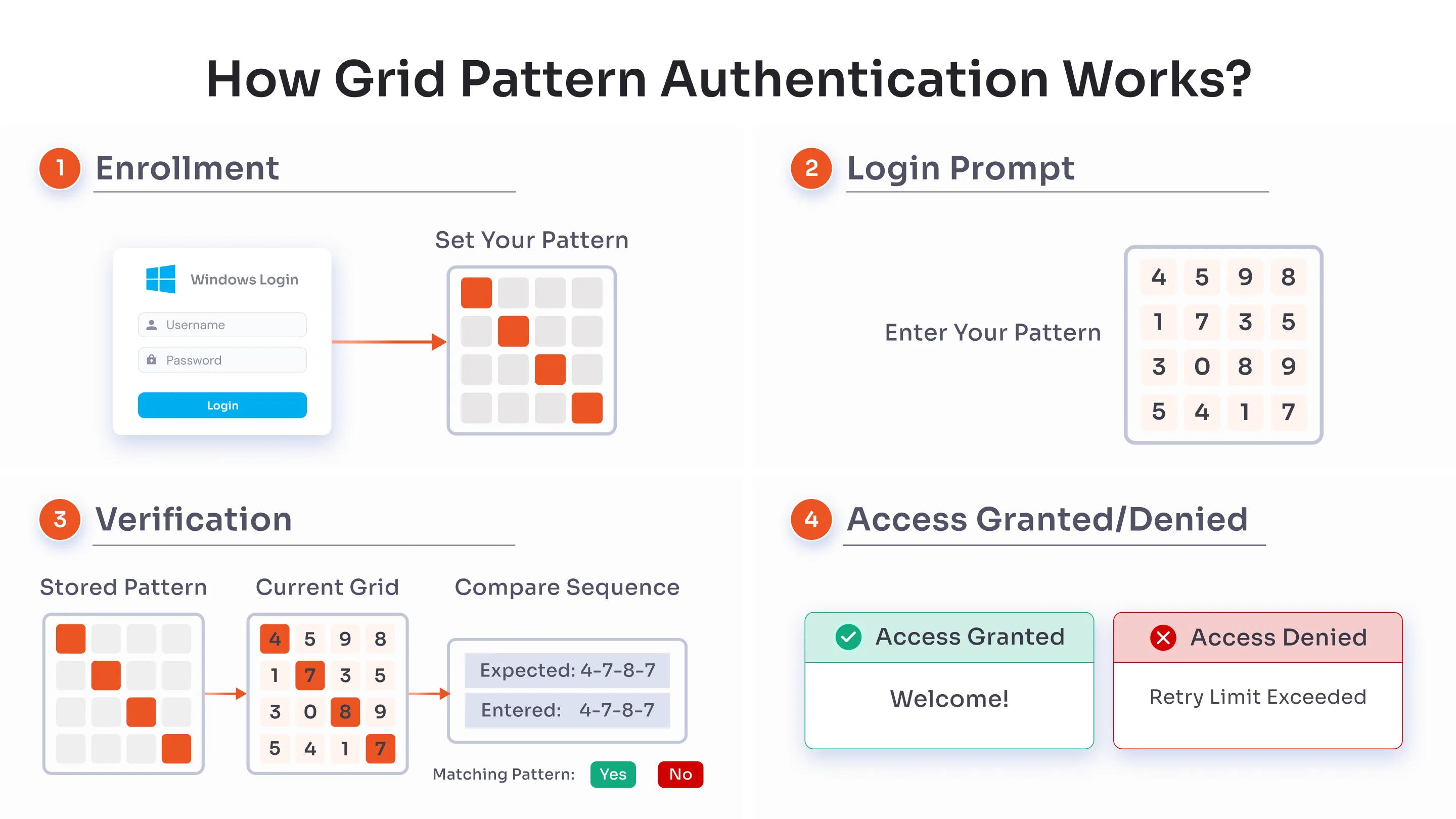
The typical flow of the grid pattern matching authentication method looks like this:
1. Enrollment Phase
The user signs in once with their regular credentials over Windows and is prompted to set up the grid pattern matching.
The user sees a grid (e.g., 4×4 or 5×5) and chooses a secret pattern by selecting a sequence of tiles. The system securely stores the pattern's position and not the numbers shown on the grid.
2. Login Prompt
During future logins, after entering the credentials, the user is shown the grid again. This grid is populated with a random set of numbers, which keeps changing for every login attempt.
The user recalls the secret pattern and locates those tiles on the current grid.
3. Verification
The user enters the numbers currently displayed on the tiles that match their secret pattern, in the correct order. The system uses the stored pattern positions and the current random grid to calculate the expected numeric sequence, then compares it with what the user entered.
4. Access Granted/Denied
If the entered sequence exactly matches the expected sequence, the second factor is approved, and access to the system is granted. If it does not match (or exceeds the retry limits), the authentication fails, and access is denied.
Read in-depth about how to set up the grid pattern matching method.
What are the Benefits of Using Grid Pattern Matching MFA Method?
The grid pattern method has distinct advantages that make it well-suited for enterprises balancing security and flexibility.
1. Independence from Devices or Networks
Unlike OTPs sent via SMS or push notifications, grid-based authentication doesn’t depend on mobile phones, networks, or apps. It is a Windows-focused MFA solution.
This is critical for users in remote areas or sectors where personal devices are not allowed in secure zones, such as manufacturing floors or defense facilities.
Check out this latest grid pattern matching use case for no-phone zones.
2. Strong Security Posture
Since grid card authentication uses spatial memory and humans find it easy to remember a shape, this leads to fewer users writing down their secret patterns. This, in turn, reduces the physical risk of credential theft.
Further, this method also prevents MFA bombing, as attackers can no longer spam push notifications to trick users into clicking “approve.”
3. Easy to Implement and Scale
The solution doesn’t require complex setup, expensive hardware, or heavy integration. For example, grid pattern matching can be rolled out quickly because it only needs a user’s unique grid configuration and basic setup on the authentication server.
Furthermore, this MFA method is designed to accommodate new employees, clients, or partners without major changes or costs, making it a scalable feature.
4. User-Friendly Method
Grid pattern matching MFA is intuitive. Employees or users only need to recognize their secret pattern and enter the numbers displayed on the corresponding tiles. There are no extra passwords to remember for the second factor, tokens to carry, or waiting for OTPs to appear on phones/emails.
Grid Pattern vs. Other MFA Methods
No single MFA method fits every organization. Each has strengths and limitations depending on the use case, user environment, and security goals. The grid pattern matching MFA method stands out for its simplicity, offline capability, and cost-effectiveness compared to more complex or device-dependent options.
Let’s see how it compares with other popular multi-factor authentication techniques used today:
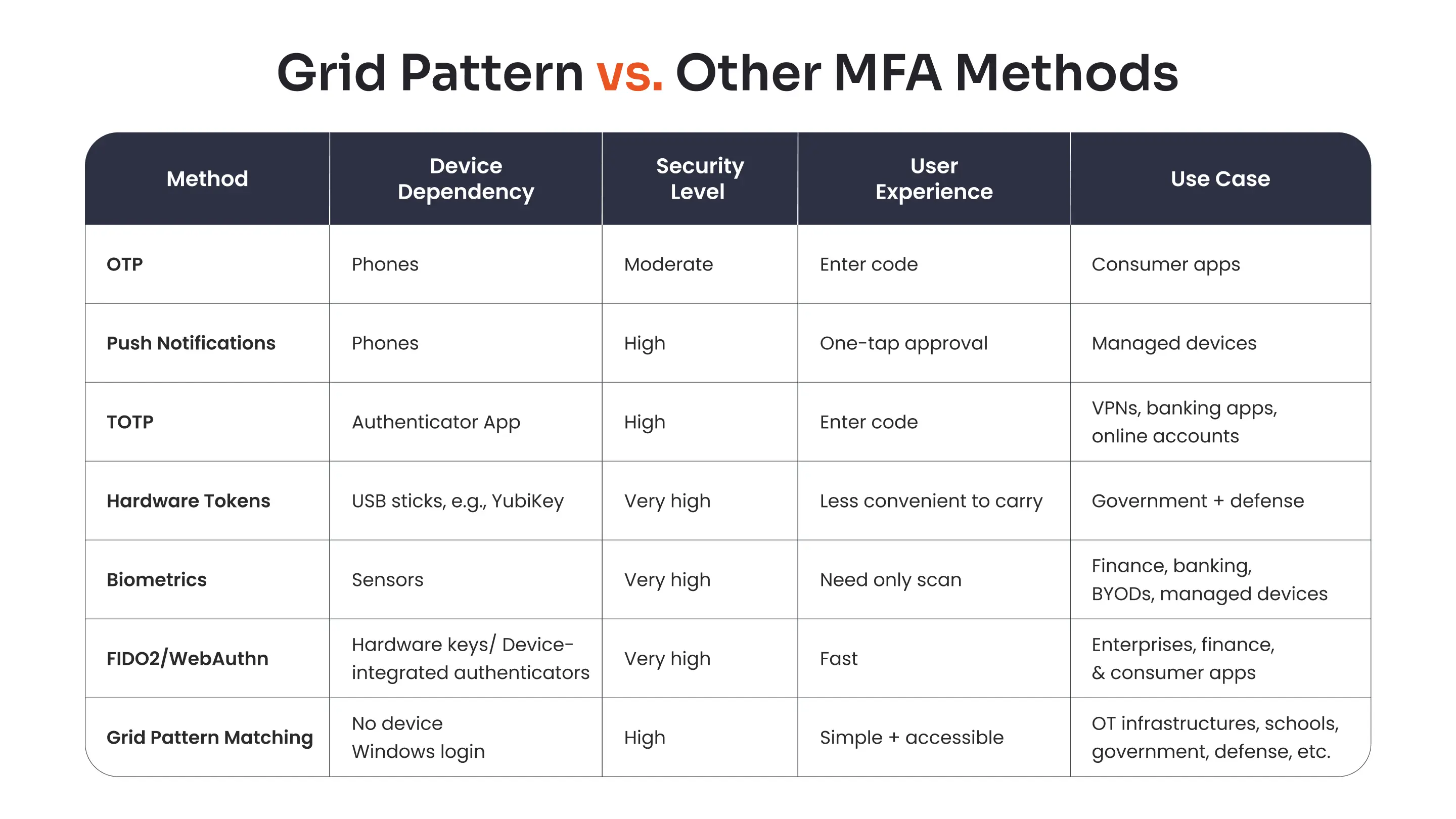
In essence, while modern MFA methods like FIDO2 or biometric authentication cater to digital-first enterprises, grid card authentication remains a reliable, cost-effective solution for ensuring secure access in offline, compliance-focused, or hybrid environments.
Use Cases of Grid Pattern Matching Method
Grid-based authentication is not a one-size-fits-all solution, but it excels in certain industries and scenarios:
- Financial institutions and banking: These use grid card authentication to secure customer portals and staff systems. This reduces SIM swap or phishing-based OTP interception while keeping the user experience straightforward.
- Government and defense: These sectors often restrict the use of mobile devices inside the premises. A grid pattern can be used on desktops present inside the premises and in offline environments.
- OT infrastructures: In manufacturing plants, utilities, or energy facilities, network connectivity is often limited, and phones are not allowed. Grid authentication lets engineers and administrators verify locally without depending on mobile networks.
- Schools and educational facilities: In labs, exam halls, and shared PCs where phones are banned or discouraged, student and staff logins can still be secured. Staff and students log in via Windows using grid pattern authentication.
Ultimately, grid pattern matching MFA remains a strong contender for use cases where device-free, Windows login, and offline authentication are critical.
Discover miniOrange MFA Solutions
miniOrange provides enterprises with a comprehensive suite of MFA methods, including grid pattern matching, push notifications, biometrics, and adaptive MFA that cater to diverse operational environments.
The grid authentication available in miniOrange’s platform is designed for high usability, offline reliability, and Windows-only login.
To know more about modern MFA solutions, connect with our experts for a demo!
FAQs
Is the grid pattern MFA method a secure, mobile-independent method?
Yes, the grid pattern MFA method is entirely mobile-independent. It doesn’t rely on SIM cards, mobile networks, or apps for authentication.
Which industries can use the grid pattern method?
Industries such as banking, government, education, and manufacturing frequently use the grid pattern method. It’s especially suited for organizations that restrict personal device usage or operate in areas with limited internet connectivity.
Why should enterprises still consider grid card authentication in 2026?
Even as modern MFA evolves, grid card authentication remains a reliable fallback method. It ensures secure access in offline or high-security environments, provides inclusivity for all user types, and serves as a cost-effective component within a layered security model.

Leave a Comment