

Your passwords, login tokens, and personal information need protection when you use an online service. Two technologies that help protect this information are hashing and encryption.
Identity and Access Management (IAM) incorporates both, but they solve different security problems. Hashing helps verify passwords and detect changes to data. Encryption protects sensitive information that authorized users or systems need to retrieve.
Understanding hashing vs. encryption in IAM helps you choose the right method for protecting user identities, authentication credentials, and sensitive identity data.
What Is Encryption?
Encryption is the process of converting readable data into an unreadable form using an encryption algorithm and a key. Here, we call readable data plaintext, and we call unreadable data ciphertext.
The ciphertext looks like meaningless characters to someone who doesn't have the required key. An authorized user or system can decrypt the ciphertext using the appropriate key and recover the original data.
For example, imagine an identity management system storing a user's phone number. If the phone number is encrypted, the system can later decrypt it when an authorized application needs to display the number.
Encryption protects data from unauthorized access while preserving the ability to retrieve the original information.
How Does Encryption Work?
Encryption uses an algorithm and a key to transform plaintext into ciphertext. Decryption reverses the process when the appropriate key is available.
Encryption flows like this:
This is a conceptual flow, not an implementation.
Modern encryption algorithms use mathematical operations, add key schedules, initiate vectors, block modes, and often authenticate tags on top. This architecture makes it difficult for unauthorized parties to recover the original data without the required key.
The 2 common types of encryption are:
1. Symmetric encryption
Symmetric encryption uses one key for both encryption and decryption. Advanced Encryption Standard (AES) is the standard here. It's fast, which is why it's used for encrypting large volumes of data, like a database column full of user records.
2. Asymmetric encryption
Asymmetric encryption uses a key pair: a public key to encrypt and a private key to decrypt. Rivest-Shamir-Adleman (RSA) and Elliptic Curve Cryptography (ECC) are the common algorithms. This is what makes Transport Layer Security (TLS) work when a browser connects to your login page, and it's the foundation of how ID tokens and SAML assertions get signed and verified.
What Is Encryption Used For?
Encryption is useful whenever data must remain confidential but still be available to authorized users or systems.
Common uses include:
- Protecting sensitive identity data: Encrypting personally identifiable information (PII), such as phone numbers, addresses, and other sensitive user details.
- Securing communication: Protecting information exchanged between a user's browser and an application through protocols such as HTTPS.
- Protecting data that must be retrieved: Encrypting API credentials, configuration secrets, and other information that an authorized system needs to read later.
Encryption protects confidentiality. It doesn't automatically prove that data hasn't been changed, so secure systems often use authenticated encryption or separate integrity checks.
What Is Hashing?
Hashing is the process of converting input data into a fixed-length value called a hash, hash value, or digest.
A cryptographic hash function takes an input of any supported length and produces an output of a fixed length. Even a small change in the input should produce a different hash value.
Also known as a digest, a cryptographic hash function is designed to make it computationally difficult to recover the original input from its hash. Hashing is therefore generally treated as a one-way process.
How Does Hashing Work?
Hashing follows a simple flow:
Input → Hashing algorithm → Hash value
The hash value is based on the input. If the input changes, the resulting hash should also change. Change one character in the input and the hash changes completely. That property (a tiny change producing a wildly different output) is called the avalanche effect, and it's what makes hashing useful for spotting tampering.
Not all hash algorithms are built for the same job, though. General-purpose hash functions like SHA-256 are designed to run fast, which is great for checksums and terrible for passwords. A fast hash, for instance, means an attacker with a stolen password database can try billions of guesses a second. Password hashing needs the opposite: algorithms built to be slow and resource-hungry on purpose.
What Is Hashing Used For?
Hashing is commonly used for:
- Password verification: Store the hash, never the password. Compare hashes at login, not plaintext.
- Data integrity verification: Hash a file before you send it, hash it again after it arrives, and compare the two. If they match, nothing has changed in transit.
- Detecting changes to data: Software updates, downloaded packages, configuration files. Publish the hash alongside the file so anyone can verify it hasn't been tampered with.
Hashing helps verify data, but it doesn't automatically provide confidentiality or prove who created the data.
Hashing vs. Encryption: What Is the Difference?
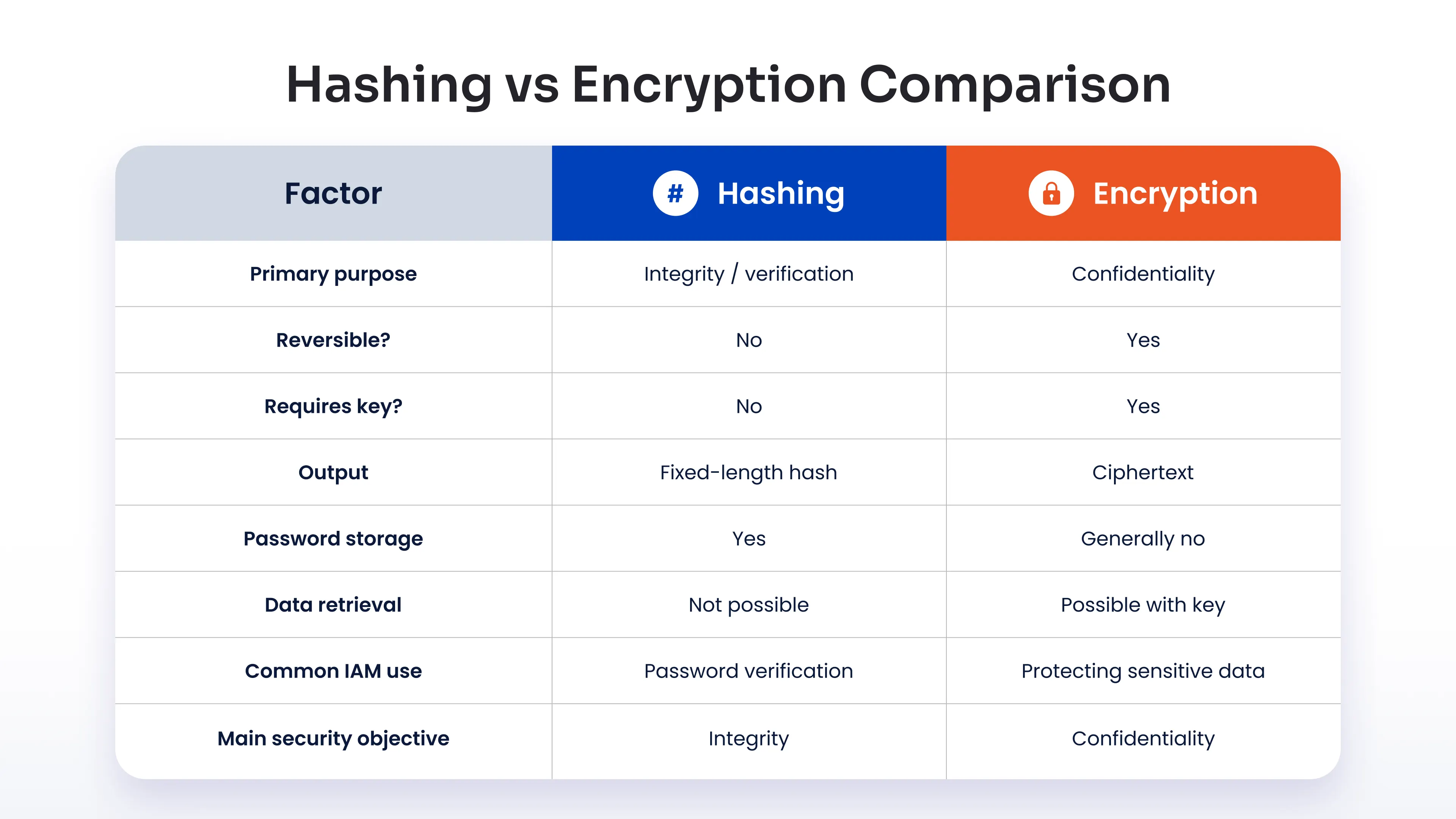
The main difference between hashing and encryption is whether the original data needs to be recovered.
Hashing is designed for one-way verification. Encryption is designed for reversible protection of data.
Hashing vs. Encryption Comparison Table:
Hashing and Encryption in IAM: How Are They Used?
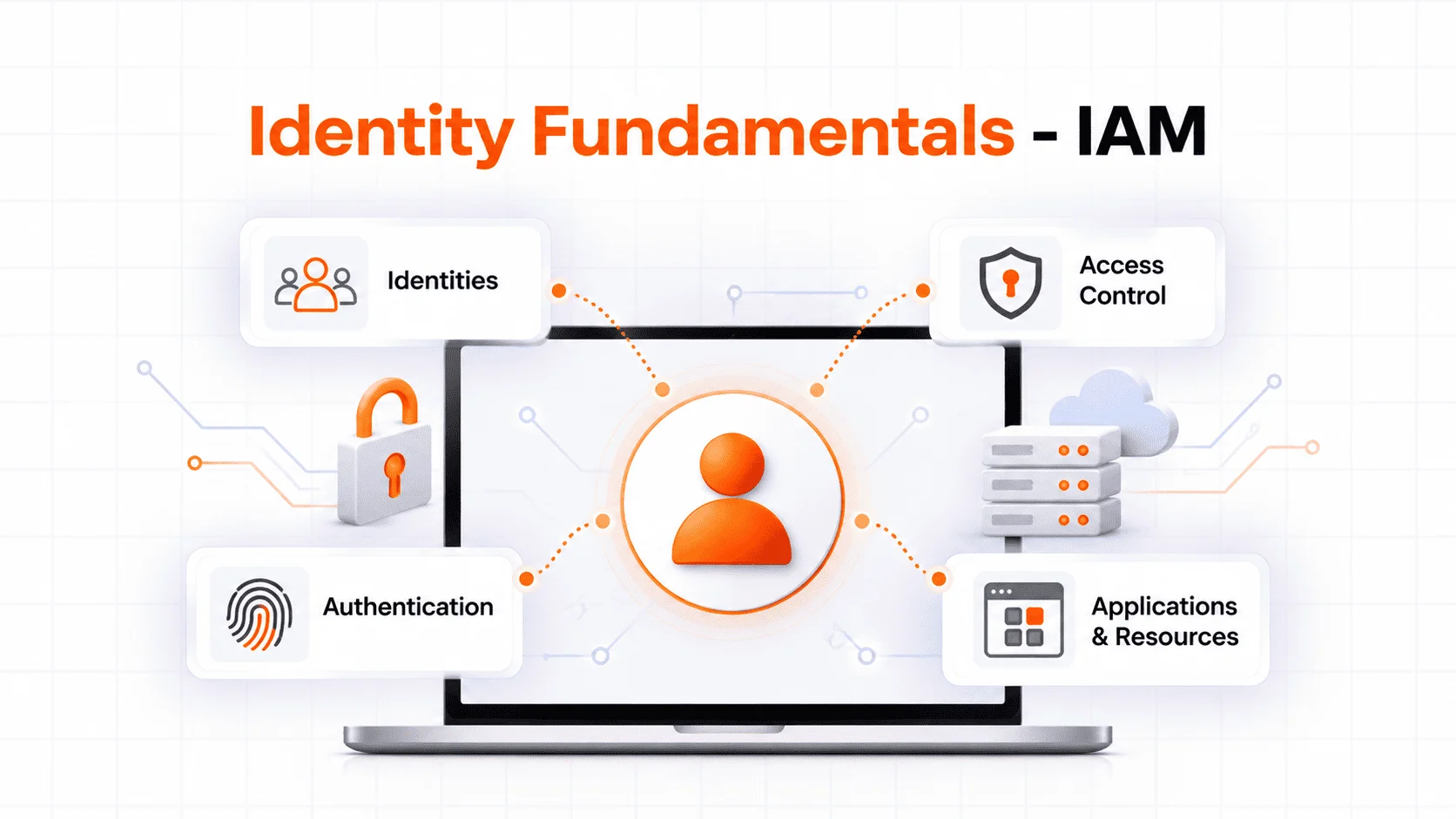
Identity and access management (IAM) controls who users are, how they authenticate, and which resources they can access. Hashing is commonly used to verify passwords. Encryption helps protect sensitive identity data, credentials, and communication.
Hashing in IAM Authentication
Authentication is the process of verifying that a user is who they claim to be.
Password authentication is one common example. A user enters a password, and the identity system checks whether it matches the password associated with the account. Password hashing helps protect stored passwords.
Password storage and verification
A secure password storage process typically works like this:
- The user creates a password.
- The identity system generates a unique salt.
- The system hashes the password using a password-hashing algorithm and the salt.
- The system stores the resulting password hash and the salt.
- During login, the system applies the same process to the entered password.
- The system compares the result with the stored password hash.
A salt is a unique random value added to a password before hashing. It helps prevent attackers from using precomputed hash lists, such as rainbow tables, to identify passwords.
The salt doesn't need to be kept secret. It is stored with the password hash.
Password hashing doesn't make weak passwords safe. An attacker who obtains password hashes may still guess passwords offline. A strong password-hashing algorithm, unique salts, suitable work factors, and strong passwords help reduce this risk.
Encryption in IAM Authentication
IAM systems handle sensitive information, including user attributes, authentication credentials, and tokens.
Encryption helps protect this information from unauthorized access.
Protecting identity data
Identity systems may store sensitive user information such as:
- Email addresses and phone numbers.
- Employee identifiers.
- User profile information.
- Sensitive identity attributes.
- API credentials and other secrets.
Encryption can protect this data at rest, meaning while it is stored in a database, file, or backup.
For example, an identity management platform may encrypt a user's phone number in its database. When an authorized application needs to display the number, the system can decrypt it.
Securing tokens, credentials, and communication
Encryption can also protect sensitive data exchanged between users, applications, and identity providers.
For example, HTTPS uses TLS to protect communication between a browser and a web application. This helps prevent attackers from reading sensitive information transmitted over the connection.
Identity systems may also use encryption to protect secrets and credentials stored in configuration files or databases. Encryption keys must be protected carefully. If an attacker obtains the keys, encrypted data may be exposed.
Hashing vs Encryption for Authentication: Which Should You Use?
Authentication involves more than checking passwords. It can also involve protecting communication, identity data, and the integrity of authentication messages.
The appropriate security method depends on what the system needs to do.
Password authentication
For password-based authentication, use a dedicated password-hashing algorithm with a unique salt for each password. Common options:
- Argon2id
- scrypt
- bcrypt
- PBKDF2
These algorithms are built to make guessing expensive, unlike fast general-purpose hashes. At login, the system verifies the entered password against the stored hash. Never store passwords in plaintext, and never encrypt them as a substitute for hashing.
Secure authentication communication
Encryption protects communication between the user and the identity provider. A login request often carries sensitive information, and HTTPS (TLS under the hood) encrypts that connection between browser and server. This cuts the risk of an attacker intercepting credentials or other authentication data in transit.
Identity data that must be retrieved
Some identity data has to be retrieved after authentication, like an email address, department, or phone number an app needs to display. Encryption fits here because the authorized application can decrypt the value when needed. Hashing can't do this: it gives you no way back to the original data.
Integrity verification
Hashing shows whether data changed. A system hashes a file before sending it, hashes it again on arrival, and compares the two. A mismatch means the data changed in transit.
A plain hash alone doesn't prove the data came from a trusted source, though. An attacker who can alter both the data and its hash can slip past a simple comparison. Where integrity and authenticity both matter, use authenticated encryption, message authentication codes (MACs), or digital signatures instead.
Benefits and Limitations of Hashing and Encryption
Hashing and encryption each provide different security benefits. They also have limitations that IAM teams need to consider.
Benefits and Limitations of Hashing
| Benefits | Limitations |
|---|---|
| ✓ Irreversible by design. A database breach doesn't hand over usable passwords. | ✗ Can't recover the original value, ever. Wrong tool anytime you need the data back. |
| ✓ Fast to compute for integrity checks, using general-purpose algorithms like SHA-256. | ✗ Fast hash algorithms are actively dangerous for passwords. |
| ✓ No key management overhead. There's no key to lose, rotate, or leak. | ✗ Weak salting (reused salts, no salting) reopens the door to rainbow table attacks. |
Benefits and Limitations of Encryption
| Benefits | Limitations |
|---|---|
| ✓ Reversible. Works for anything that needs to be read again. | ✗ Lose the key, lose the data, permanently. |
| ✓ Strong, well-audited algorithms (AES, RSA, ECC) are available and battle-tested. | ✗ Key management (generation, rotation, storage, access control) is its own attack surface. |
| ✓ Supports both data in transit and data at rest. | ✗ Slower than hashing for high-volume operations, which matters at scale. |
Conclusion
Hashing and encryption are both important for identity security, but they solve different problems.
Hashing helps verify passwords and detect data changes. Encryption protects sensitive data that authorized users or systems need to retrieve.
In IAM, password hashing is used for password storage and verification, while encryption helps protect identity data, credentials, and communication.
Understanding hashing vs. encryption helps you choose the right protection for each type of data and build authentication systems that protect user identities more effectively.
FAQs
Is hashing more secure than encryption?
Neither is "more secure" on its own. They solve different problems: hashing for passwords and integrity, encryption for anything that needs to be read again. Using the wrong one for the job is the real risk, not a gap between the two.
Can you decrypt a hash?
No. A hash has no key and no reverse function, by design. What looks like "decrypting" a hash is usually an attacker guessing inputs, hashing each guess, and checking for a match, not reversing the hash itself.
Can encrypted data be hashed?
Yes. The two are independent operations. You can hash a file to generate a checksum, then encrypt that same file for storage. Neither operation interferes with the other.
Why is hashing preferred for passwords?
The system never needs the original password, only confirmation it was entered correctly. Hashing verifies this without storing recoverable plaintext. If the database leaks, properly salted hashes stay useless to an attacker. Encrypted passwords, if the key also leaks, don't.
What's the difference between hashing, encryption, and encoding?
Encoding (Base64, URL encoding) isn't security. It makes data transportable, and anyone can decode it instantly. Encryption hides data reversibly with a key. Hashing transforms data irreversibly with no key.
What is salting, and why does it strengthen hashing?
A salt is a random, unique value added to a password before hashing, then stored alongside the hash. Without it, identical passwords produce identical hashes, crackable with one precomputed table. Unique salts force an attacker to brute-force every hash separately.

Leave a Comment