
Every second, millions of conversations happen inside your enterprise network. APIs exchange data, IoT sensors report telemetry. However, none of these interactions involves a human. Yet, every interaction requires a rigorous verification, “Is this machine who it claims to be?”
As per a news article published on the CDO Trends, the ratio of Non-Human Identities (NHIs) to human identities is 82 to 1, and is increasing quickly.
So, there’s a need to manage them the right way. That is where Machine Identity Management (MIM) steps in — not as a visible checkpoint, but as the foundational layer enabling automated communication and security.
This blog breaks down MIM for security practitioners: what it entails, how to implement it effectively, and why it is non-negotiable for enterprises.
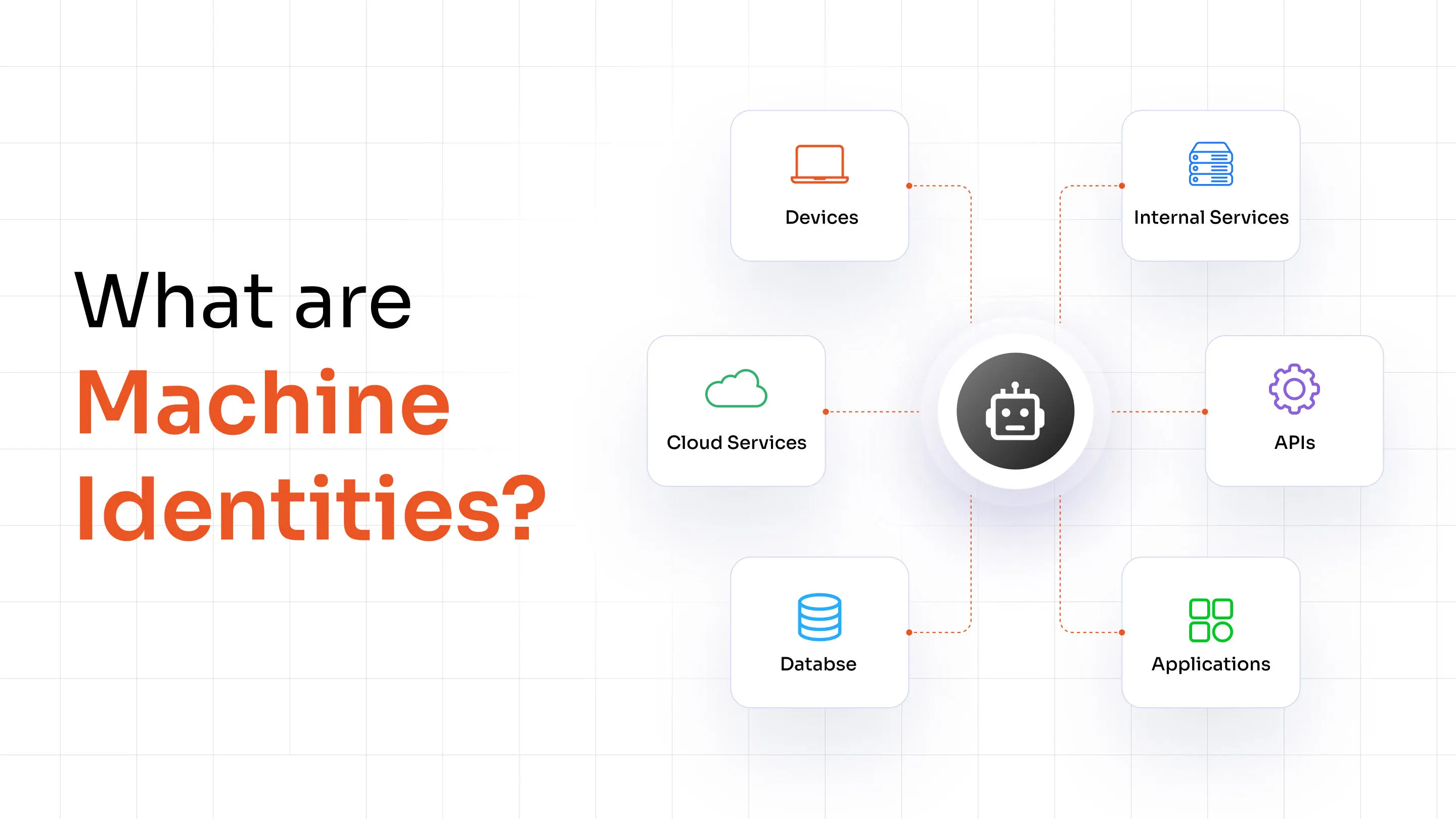
What are Machine Identities?
Machine identities are the cryptographic credentials that establish trust between non-human entities in a network. Unlike human users who authenticate with usernames, passwords, or biometrics, machines rely on mathematical proof:
- Service accounts, like cloud or OS accounts for automated tasks.
- Digital certificates
- Cryptographic keys like Secure Shell (SSH) keys
- Secrets and tokens, which include OAuth, JWTs, and API keys
Consider a Kubernetes pod needing to pull images from a private container registry. It doesn’t log in with a username; it presents a service account token signed by its cluster’s certificate authority. The registry checks this token against its trusted authorities to allow the pull. This token is the machine identity.
Without proper management of these credentials, trust between systems breaks down. Machines fail to verify each other, automation stops working, and security gaps emerge.
Examples of machine identities are automation tools, DevOps tools, cloud identities, CI/CD pipelines, and SaaS integrations.
What is Machine Identity Management (MIM)?
MIM includes technologies, policies, and processes that govern the entire lifecycle of machine credentials: secure decommissioning, rotation, usage monitoring, distribution, and issuance.
Think of it as Identity and Access Management (IAM) for the non-human world, but with distinct operational realities:
- Risk Profile: A compromised machine identity often grants broader, quieter access than phished human credentials.
- Scale: Enterprises handle hundreds of thousands of machine identities compared to thousands of human IDs.
- Authentication Methods: Machines verify themselves via cryptography, not knowledge-based factors.
- Dynamism: Containers and serverless perform a specific task and then shut down after a few minutes/seconds. But human user accounts have existed for years, often tied to employment tenure.
Effective MIM automates repetitive tasks (like certificate renewals) while enforcing strict controls: no machine gets more privilege than necessary, every credential is tracked, and anomalous usage triggers alerts.
Top Examples of Machine Identity Management in Practice
Strong MIM moves beyond passive storage to active orchestration. Here’s how it manifests in enterprise environments:
- Certificate Issuance: Getting digital certificates for machines so they can prove their identity when joining a network or starting a new workload, like issuing a digital ID badge.
- Machine Identity Audit: A thorough check of your machine identity records and processes to spot gaps, like expired certificates, missing details, or weak security settings that could cause problems.
- Revocation and Disposal: Removing a machine’s digital certificates and keys when they expire, are no longer needed, or when the machine itself is retired, like deactivating an old ID badge.
- System Documentation: Keeping an up-to-date record of all machine identities, including what they are, what certificates or keys they use, where they run, and who or what relies on them.
- MIM Automation Configuration: Setting up tools to handle machine identity tasks automatically, such as issuing, renewing, tracking, and removing certificates, so teams don’t have to do it manually.
- Certificate and Encryption Key Rotation: Regularly replacing SSL/TLS certificates and SSH encryption keys with new ones to limit how long any single key can be misused and keep access secure.
Why is Machine Identity Management Important?
The stakes of having poor MIM are pretty high; here’s why it is important for your enterprise:
- Zero Trust: You cannot enforce “never trust, always verify” for machines without knowing which machines exist and what they’re authorized to do. MIM offers this visibility and control.
- Operational Continuity: One expired TLS certificate on a load balancer can drop all HTTPS traffic and cause revenue loss and brand damage. A strong MIM program continuously tracks certificate expiry dates and automatically rotates them before they lapse, preventing this situation.
- Compliance: Regulations such as HIPAA, PCI DSS, SAMA, and more require strong key management. Automated MIM offers auditors the evidence they need without scrambling for spreadsheets.
- Breach Containment: In case an attacker steals a service account key, tight MIM limits its blast radius via strict scoping and rapid revocation, turning a breach into a contained incident.
- Cloud-Native Enablement: In multi-cloud or hybrid setups, manual certificate management becomes impossible at scale. MIM is the enabler for secure, portable workloads.
Types of Machine Identities You’ll Encounter
Here are some of the varieties of machine identities that will help you tailor controls:
- TLS/SSL Certificates: Secure HTTP, SMTP, LDAP, and internal service-to-service traffic. The most visible machine identity type.
- SSH Keys: Enable administrative access to Linux/Unix systems. Often overlooked in rotation schedules despite high privilege.
- API Keys: Gatekeepers to SaaS platforms, payment gateways, or internal microservices. Frequently hard-coded in source code, a major leakage vector.
- Service Accounts: Represent automated processes (e.g., backup jobs, CI/CD runners) in AD, Azure AD, or IAM systems. Commonly over-privileged.
- Tokens and Secrets: Short-lived credentials like OAuth access tokens or Kubernetes service account tokens used in ephemeral workloads. Require just-in-time issuance and rapid expiration.
The Machine Identity Lifecycle: 5 Critical Phases
Managing machine identities isn’t a one-time setup; it’s a continuous cycle demanding attention at every stage:
1. Creation and Discovery
The goal is to know exactly what exists.
Make use of cloud asset inventories, network scanners, and certificate transparency logs to identify all machine identities, including orphaned cloud keys and forgotten dev/test certificates.
2. Deployment and Management
Here, the goal is to provision securely. Generate certificates or keys through Certificate Authorities (CAs) using hardened workflows. Furthermore, store private keys in a cloud Key Management System (KMS) or Hardware Security Modules (HSMs), but never in plaintext or application configurations. You can also enforce policy-based approvals for high-risk requests.
3. Monitoring and Tracking
The goal of this step is to detect anomalies early. For this to be a success, track usage patterns — “Is a web server certificate suddenly being used by a batch job? Is an SSH key authenticating from an unknown location?”
Correlate identity usage with SIEM feeds to spot compromised machines before data exfiltration occurs.
4. Rotation and Renewal
The focus is to prevent expiry and limit exposure. For this, automate rotation before expiry. For short-lived tokens, use Just-in-Time (JIT) issuance. Rotation makes sure to limit the window for attackers to exploit a stolen key.
5. Revocation and Decommissioning
The objective of this is to eliminate the machines. So, when a Virtual Machine (VM) is retired, immediately revoke its credentials and prevent loopholes for breaches.
Threats Looming Over Machine Identity Management
Weak MIM practices create exploitable gaps. Watch for these recurring threat patterns:
- Over-privileged Access: A machine identity with rights to read or edit a configuration file is an invitation for privilege escalation if compromised.
- Lack of Observability: If the enterprises cannot fully inventory their machine identities, then they are left flying blind during incidents.
- Machine Identity Threat: Cybercriminals steal machine credentials via compromised build servers, only to move laterally, often undetected for months.
- Shadow Machine Identities: Self-signed certificates for API keys or internal tools tucked in Dockerfiles function outside security controls, creating unknown risks.
- Certificate Mismanagement: This can happen if there are loopholes during renewal automation gaps, causing outages.
- Weak Cryptographic Keys: RSA 1024-bit keys or SHA-1 signatures still linger in legacy systems, vulnerable to modern cracking techniques.
- Unauthorized Machine Access: Rogue devices or spoofed workloads presenting valid-but-stolen certificates to bypass network segmentation.
Core Elements of MIM
Build your MIM program around these foundational pillars:
- Identity Verification: Verify every machine identity request against a trusted source, for example, cloud tagging, before issuance. There should be no self-service for high-trust credentials.
- Access Management: Enable strict least privileges on the machine identities to keep the data safe.
- Public Key Infrastructure (PKI): This is the bedrock for certificate-based trust. Whether using a private PKI or cloud-managed service, ensure strong CA security, CRL/OCSP availability, and proper hierarchy design.
- Role-Based Access Control (RBAC): RBAC defines roles such as PKI administrator or certificate requester; make sure to never give broad access to machine identities.
- Certificate Lifecycle Management (CLM): Proactively automate the full cycle: discovery → request → issuance → deployment → monitoring → renewal → revocation.
- Regular Audits and Compliance Checks: Schedule automated scans for expired keys, over-privileged service accounts, and weak algorithms, along with remediation workflows tied to ticketing systems.
Challenges in Machine Identity Management
Even with awareness, implementation hurdles remain:
- Visibility Gaps: Dynamic environments, such as Kubernetes or serverless, create identities faster than manual processes can track. Agentless discovery is essential but complex to deploy comprehensively.
- Automation Debt: Legacy apps often lack APIs for automated certificate injection, requiring awkward workarounds like sidecar proxies or manual reloads.
- Secret Sprawl: Developers still commit API keys to GitHub; scanning helps, but preventing it requires IDE pre-commit hooks and rigorous training.
- Hybrid Complexity: On-premises PKI doesn’t naturally extend to AWS Private CA or Azure Key Vault, requiring careful federation design or workload-specific solutions.
- Skills Shortage: Finding staff who understand both PKI cryptography and modern DevOps pipelines is difficult, driving reliance on managed services or specialized platforms.
Addressing these requires investment in discovery automation, developer self-service guardrails, and clear ownership between security, platform, and application teams.
Machine Identity Management vs. Human Identity Management
While both fall under IAM, managing machine identities demands different approaches:
| Aspect | Human Identity Management | Machine Identity Management |
|---|---|---|
| Authentication Method | Biometrics, passwords, OTPs, etc. | Tokens, cryptographic keys, certificates, etc. |
| Scale | Tens to hundreds of thousands | Hundreds of thousands to millions |
| Typical Lifespan | Years | Minutes to years |
| Growth Driver | Hiring, M&A | Autoscaling, deployments, and IoT proliferation |
| Risks if Compromised | Limited to the user’s permissions | Broad access, like service accounts or keys |
| Audit Focus | Password policies and access reviews | Key strength, usage logs, and expiry tracking |
Treating them as identical leads to over-provisioned service accounts or expired web certificates, which is a common pitfall.
Best Practices for Resilient Machine Identity Management
- Centralized Access Control: Keep all the identity rules and permissions in one place instead of having inconsistent or scattered controls across siloed systems.
- Automate Credential Rotation: Set up systems to renew and replace machine identities before they expire, so there are no outages.
- Limit Machine Identity Privileges: Give machines the exact access they need to do their job and no more.
- Track and Audit Machine Identity Activities: Constantly monitor how machine identities are used and regularly review logs to spot suspicious activity.
- Automate Machine Identity Discovery and Inventory: Use tools to auto-scan your cloud systems and networks to locate every machine identity, including hidden or forgotten ones. Always have an up-to-date list.
Summing Up
Effective Machine Identity Management is the invisible foundation that keeps enterprises running securely. By automating the lifecycle of machine credentials from issuance to retirement, it prevents costly outages caused by expired certificates and closes gaps that attackers exploit.
Centralized control, strict privilege limits, and continuous monitoring transform machine identities from a hidden risk into a trusted, auditable asset.
FAQs
Is machine identity management only relevant for large organizations?
No, even small and medium enterprises face the risks from expired certificates or leaked API keys.
Can we manage machine identities without a full PKI?
For SSH keys and API keys, yes, use a secrets manager with rotation automation. For TLS-based service mesh or zero-trust networking, a PKI (private or cloud-managed) is strongly recommended for operational integrity at scale.
About the Author

Content Writer
With a background in Journalism and extensive experience in SaaS and cybersecurity content writing, Chaitali Avadhani has contributed to creating various forms of impactful content pieces across multiple verticals. At miniOrange, her role is to craft SEO-friendly and lead-generating content around Identity and Access Management (IAM) products and cybersecurity as a whole.
Leave a Comment