

Every application you run needs a way to prove it's allowed to talk to another system. That proof is a secret: a password, an API key, a certificate, a token.
Multiply that across a modern stack, and you get thousands of them, spread across repos, config files, Slack messages, and CI/CD pipelines that mostly nobody's tracking.
That's secret sprawl. And it's quietly become one of the easiest ways into an organization's most sensitive systems, no phishing email or zero-day required.
What is Secret Sprawl in Modern Applications?
Before you can fix secret sprawl, it helps to know what a "secret" actually is.
A secret is any credential that lets a user, application, script, or service prove its identity to another system. Every time software connects to a database, calls an API, decrypts data, or authenticates with another service, it's usually using some kind of secret behind the scenes.
Secret sprawl happens when those credentials spread across your environment faster than anyone can track them. For instance, somewhere in your organization's Slack history, there's a database password nobody's rotated in two years. Secret sprawl is one reason organizations invest in privileged password management solution to centralize sensitive credentials, control access, and automate password rotation.
Every system you run depends on some credential to prove it belongs there, and those credentials multiply faster than anyone can track them. GitGuardian found 28.65 million new hardcoded secrets exposed on public GitHub in 2025 alone. That's a 34% jump from the year before, the biggest single-year increase the company has recorded in five years of running this report.
And that's just what's visible on public repos. Internal systems are worse. So is the AI tooling most teams adopted in the last 12 months without updating how they handle credentials.
Types of Secrets
Secrets come in a few recognizable forms:
- Passwords and usernames for databases, servers, and admin panels
- API keys and tokens that let apps and services call each other
- SSH keys for remote server access
- TLS/SSL certificates that encrypt traffic between systems
- Encryption keys that protect data at rest
Each type carries a different blast radius. A leaked API key might expose one integration. A leaked database credential, on the other hand, can expose everything behind it.
Secrets vs. Credentials: What's The Difference
People use "secrets" and "credentials" interchangeably, and honestly, the line's blurry.
Credentials usually mean something a human uses to log in: a username and password tied to one’s personal identity. They’re accountable to that person.
Secrets is the broader term. It includes credentials, but also covers the machine-to-machine layer: API keys, tokens, certificates, and encryption keys that no human ever types in. This difference matters because machines don’t remember to rotate passwords or delete old tokens. If a secret gets copied into source code, shared in a document, or left behind after a project ends, it’ll probably stay there until someone actively finds and removes it.
Read more: What is Credential Management
Why Secret Sprawl Is Considered a Security Risk
Every place a secret sits is another door into your systems. As secrets spread across repositories, cloud platforms, developer devices, and collaboration tools, your attack surface grows with them.
The real problem starts after a secret is exposed. Security teams suddenly need answers they often don’t have. Where else does this credential exist? Which systems depend on it? Can it be rotated immediately, or will that bring production to a halt?
Here’s what unmanaged secret sprawl typically leads to:
| Risk | Why it matters |
|---|---|
| More attack paths | Every copy of a secret creates another opportunity for an attacker to find and misuse it. |
| Slow incident response | Teams struggle to locate every instance of a compromised credential before it can be abused again. |
| Long-lived credentials | Forgotten secrets often remain active for months or even years after they should have been rotated. |
| Compliance issues | Poor visibility into secrets makes it difficult to meet audit requirements under frameworks like HIPAA, PCI DSS, SOC 2, and the EU Cyber Resilience Act. |
As per GitGuardian's State of Secrets Sprawl 2026 report, internal repositories turned out to be 6 times more likely to contain hardcoded credentials than public ones. Teams often treat internal code as safe, even though those repositories usually contain production credentials.
The report also found that 64% of secrets that were valid in 2022 are still active today. Rotating credentials sounds simple until the same key is buried across dozens of applications, scripts, and deployment pipelines. Many organizations end up postponing the work because tracing every dependency takes time.
How Does Secret Sprawl Start in an Organization?
So how does secret sprawl start in an organization that's otherwise doing everything right? Usually, one shortcut at a time.
Common Causes of Secret Sprawl
Distributed Nature Of Modern Applications
A single product might touch a dozen microservices, 3 cloud providers, a handful of SaaS tools, and a CI/CD pipeline that deploys 10 times a day. Each connection needs its own credential.
Developers Optimizing For Speed
Hardcoding a key to test something locally beats setting up a vault integration. So it goes into the code "just for now." And it rarely comes back out.
This is what it usually looks like in practice: someone adds a new environment variable in development to unblock a feature, then forgets to tell the rest of the team. Staging gets updated a week later. Production doesn't, until a deploy breaks and someone spends an afternoon tracing a missing credential back through 3 environments.
AI-Assisted Coding
GitGuardian found that AI-assisted development commits leak secrets at roughly 2 times the rate of the average commit. The tools are fast. They're not naturally cautious about what they read, reuse, or repeat back to you.
Ungoverned Collaboration Platforms
A password pasted into Slack to unblock a teammate, a token dropped in a support ticket, a connection string in a shared doc: none of that lives anywhere a security team can see it.
Where Secret Sprawl Commonly Exists
If you went looking, secret sprawl would probably turn up in:
- Git repositories, public and internal
- CI/CD pipelines, where build variables often stick around long after the job that needed them
- Kubernetes manifests and secrets objects that were never properly externalized
- Cloud platforms, in IAM roles, storage buckets, and serverless function configs
- Developer workstations, in shell history, cached tokens, and local .env files
- Infrastructure as code templates, where a "just this once" hardcoded value becomes permanent
- SaaS and collaboration tools: chat threads, tickets, shared docs
None of these places are unusual. That's exactly why secret sprawl or credential theft is difficult to spot. Credentials become scattered across everyday tools until nobody knows how many copies exist or which one is still in use.
How Can You Detect Secret Sprawl?
You can't fix what you can't find. Detection is the unglamorous first step that you don’t want to underinvest in.
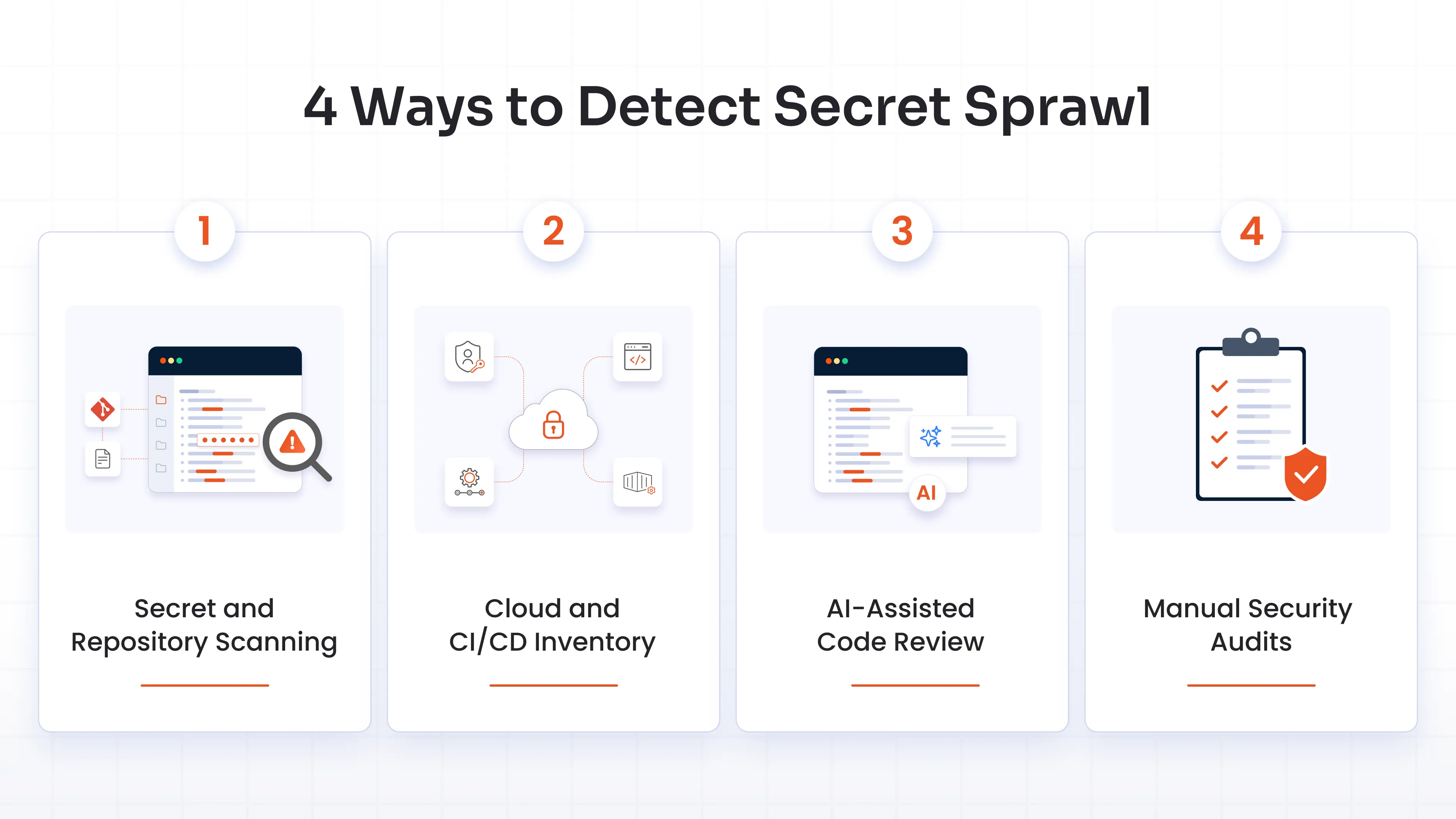
Secret and Repository Scanning
Automated scanners crawl your commit history and flag patterns that look like credentials: long random strings, known API key formats, private key headers.
Run this on every commit, not just occasionally. A secret sitting in your git history for 6 months is still exposed even after you delete it from the current branch, since the old commit still holds it.
Cloud And CI/CD Inventory
Beyond code, you need visibility into what's actually deployed: IAM roles, environment variables in your build pipeline, secrets baked into container images.
Most cloud platforms offer native tools for this. Few teams have something that ties the findings together across all of them, which is exactly the gap attackers count on when they pivot from one compromised service to the next.
AI-Assisted Code Review
Newer tools use AI to review pull requests for exposed credentials before they merge, catching sprawl at the point of creation instead of after the fact.
Worth pairing with traditional scanning, not replacing it. AI review tools miss things, same as human reviewers do.
Manual Security Audits
Automated tools catch patterns. They don't catch the token someone shared in a video call or a spreadsheet on a shared drive.
Periodic manual audits, even quarterly ones, catch what scanners structurally can't see.
Best Practices to Avoid Secret Sprawl
Detection tells you where the problem is. These are the practices that actually shrink it.
- Centralize secrets management: One vault, one source of truth. Every credential should have a home instead of a dozen copies scattered across systems.
- Eliminate hardcoded secrets: If it's sitting in your source code, it's not a secret anymore. Pull credentials from a vault at runtime instead.
- Automate rotation: Manual rotation doesn't scale past a handful of credentials. Set a schedule to automatic password rotation and let the system handle it.
- Use short-lived credentials where you can: A token that expires in an hour does far less damage if it leaks than one that's valid for a year.
- Adopt workload identity for machine-to-machine access: Instead of static API keys, let services authenticate using identity tied to the platform they're running on.
- Scan on every commit, not just periodically: Sprawl accumulates between audits.
- Enforce least privilege: A credential should only grant access to what its owner actually needs, nothing more.
- Train developers on the real cost of shortcuts: Most sprawl comes from convenience, not malice. A 5-minute explanation of why hardcoding a key creates months of cleanup work goes a long way.
These password management best practices significantly reduce secret sprawl across traditional applications. But modern environments introduce another challenge: AI systems and the growing number of non-human identities that rely on secrets just as heavily.
Secret Sprawl in AI Systems and Non-Human Identities
Everything we discussed above gets harder once you factor in machines that aren't human and don't clock out at 6 pm.
Every AI agent, coding assistant, or automated workflow needs credentials to function. These are non-human identities (NHIs), and they're multiplying faster than most security teams can inventory manually. Common examples:
- API keys that let an agent call a model provider
- Tokens that grant an automation access to internal data
- Service accounts that trigger downstream actions without a human in the loop
- MCP server credentials connecting AI tools to internal systems
GitGuardian, in the same report we discussed earlier, found 24,008 unique secrets exposed in MCP-related configuration files on public GitHub, including 2,117 valid, usable credentials. That's a category of exposure that barely existed two years ago, and it grew fast enough to earn its own line item in this year's report.
The underlying driver is the same one that's always fueled secret sprawl: more systems, more automation, more credentials, less visibility per credential. AI just moves faster than the review processes most organizations built for human-driven development.
Treating NHI secrets as a separate problem from everyday credential management misses the point. It's the same sprawl. There's just a machine on the other end instead of a person, and machines don't ask for help when something looks wrong.
How miniOrange PAM Helps
Most of the fixes above point toward the same conclusion: centralize, automate, and control access to whatever's protecting your systems.
That's exactly what privileged password management is built to do. It handles secrets as part of a broader privileged access management platform. In practice, that looks like:
- A centralized, encrypted vault instead of credentials sitting exposed in code, configuration files, or chat logs
- Password checkout workflows, so nobody holds standing access. Access gets requested, approved, and used for a bounded session that closes automatically
- Scheduled, automatic rotation instead of rotation depending on someone's memory
- Full audit logs for every checkout and session for compliance like PCI-DSS, HIPAA, & SOX. So the "who touched what, when" answer already exists when an auditor or responder needs it
- Application-to-application password management, so scripts and services retrieve credentials at runtime instead of pulling a static, hardcoded key
Application-to-application management is the piece most standalone secrets tools handle separately from privileged access, if they handle it at all. Because it sits on the same platform as miniOrange's IAM and MFA products, access governance extends across human and non-human identities together, instead of stopping at the edge of one point solution. That distinction matters more each quarter, as service accounts and AI agents start outnumbering human logins in most enterprise environments.
If secret sprawl already has a foothold in your organization, it's worth seeing how this fits your specific environment. Schedule a demo and walk through it with the team.
Final Thoughts
Secret sprawl builds by default, quietly, whenever systems multiply faster than governance does.
The organizations that get ahead of it don't try to eliminate every secret. That's impossible: every system needs a way to authenticate. They centralize the ones they have and rotate them automatically, making sure every credential, human or machine, has an owner and an expiration date.
FAQs
Where are secrets commonly exposed?
Most commonly in git repositories (public and internal), CI/CD pipelines, Kubernetes configs, cloud IAM roles, developer workstations, and collaboration tools like Slack or shared docs. Internal repos are actually more likely to leak secrets than public ones, since teams assume "internal" means "safe."
How often should organizations rotate secrets?
It depends on the credential's exposure, but a common baseline is every 30 to 90 days for privileged accounts, and immediately after any suspected exposure. High-risk credentials should rotate more often, ideally on an automated schedule.
Can secret sprawl affect compliance requirements?
Yes. Frameworks like HIPAA, PCI-DSS, SOC 2, ISO 27001, and the EU Cyber Resilience Act all expect organizations to maintain visibility and control over the credentials protecting sensitive systems.
What should you look for in a secrets management solution?
Centralized storage with strong encryption, automated rotation, granular access controls, detailed audit logging, and integration with the cloud platforms and vaults you already use. For privileged accounts, look for session monitoring and approval workflows on top of basic storage.
Is secret sprawl the same as credential sprawl?
Mostly, yes, though "credential sprawl" sometimes refers more narrowly to human login credentials, while "secret sprawl" covers the broader set: API keys, tokens, certificates, and encryption keys included. In practice, most teams use the terms interchangeably.
How does secret sprawl lead to a data breach?
It usually starts with one exposed credential that gives the attacker a foothold. From there, secrets tend to lead to other secrets. Because the attacker is using valid credentials rather than exploiting a software flaw, their activity often looks like normal traffic, which is why sprawl-driven breaches take months to detect on average.
Leave a Comment