

Secure Shell (SSH) gives you direct access to critical servers, databases, and cloud infrastructure. Once a privileged user connects through SSH, they hold extensive control over that system. They can alter core configurations, run terminal scripts, move files, or delete production databases in seconds.
If you lack visibility into privileged actions, it can be risky. If a credential gets stolen or an insider goes rogue, traditional firewalls won’t be enough.
Here, SSH session monitoring can provide continuous visibility into all activity inside an SSH session. To build a resilient security posture, you need to deploy central privileged session management to govern every high-risk shell connection.
SSH monitoring can also mean checking the availability and health of the SSH service. However, this guide focuses on the activity tracking part.
In this comprehensive guide, you will learn how SSH session monitoring works, how to use native Linux tools and system logs, how to record command execution, and how enterprise solutions simplify SSH monitoring across hybrid infrastructure.
What Is SSH Session Monitoring?
SSH session monitoring is the practice of capturing, tracking, and auditing user activity during an active Secure Shell (SSH) connection. Instead of treating SSH access as a black box, monitoring gives your security team real-time visibility and detailed historical logs for every administrative terminal connection.
Why Is SSH Session Monitoring Important?
Granting direct, unmonitored access to production environments is risky. This is where SSH session monitoring can help to:
- Detect suspicious or unauthorized behavior.
- Investigate security incidents with a detailed audit trail.
- Meet audit and compliance requirements with detailed activity records.
- Monitor third-party and remote administrator access.
- Reduce insider threat risk through greater visibility into privileged activity.
- Establish accountability for privileged actions.
What Should You Monitor in an SSH Session?
Effective monitoring requires tracking key details throughout the session. At a minimum, you should consider monitoring the following:
| Activity Category | What to Monitor |
|---|---|
| User Identity | The verified username, human identity, and requested account role |
| Connection Source | Client IP address, hostname, location, and device status |
| Target System | Destination server IP, hostname, database instance, or container |
| Session Duration | Exact session start time, end time, total active duration, and idle time |
| Executed Commands | Raw terminal commands, scripts run, arguments passed, and system outputs |
| File Activity | Files created, modified, viewed, transferred (SFTP/SCP), or deleted |
| Authentication Details | Login method, public key used, MFA verification status, and password attempts |
| Session Behavior | Out-of-baseline actions, unexpected directory jumps, or high-risk tools executed |
| Privilege Changes | Usage of sudo, su, or execution of binaries with elevated permissions |
How to Monitor SSH Sessions
You can check active connections and user logins directly from the Linux command line. Native tools give you basic, point-in-time visibility into active sessions.
Check Active SSH Sessions Using who
The who command lists all users currently logged into the server. It displays usernames, terminal line identifiers, login times, and remote IP addresses.
Monitor Active Sessions With w
The w command provides more information about logged-in users, including login time, idle time, and their current process.
Check SSH Login History With last
To view past connections and inspect historical SSH logins, use the last command. It reads from the /var/log/wtmp file to display past sessions, logout times, and reboots.
Check Active SSH Connections With ss
The ss (socket statistics) tool inspects active network connections directly at the socket level. You can isolate active inbound SSH connections by filtering for port 22.
What These Commands Don't Tell You
CLI utilities like who, w, last, and ss provide useful visibility into session state and socket connections. However, they do not provide complete session recording or centralized privileged activity monitoring. They cannot capture executed command payloads, log keystrokes, or stream active sessions back to a central security hub.
If you need to know what a privileged user actually did, you need better monitoring and auditing capabilities.
How to View SSH Logs
Linux and Windows environments log SSH authentication attempts and connection metadata by default. Reviewing these log files helps you spot brute-force attacks and track login history.
SSH Logs on Linux
The location of SSH-related logs depends on your Linux distribution.
On Ubuntu and Debian systems, you will commonly find authentication-related SSH events in:
/var/log/auth.log
On RHEL, CentOS, and Fedora systems, authentication events are commonly found in:
/var/log/secure
If your system uses systemd, you can also use journalctl to query logs.
For example:
journalctl -u ssh
Depending on the distribution and service configuration, the SSH service may use a different unit name.
SSH Logs on Windows
If you run OpenSSH Server on Windows Server, authentication events appear in the Windows Event Viewer.
- Navigate to: Applications and Services Logs > OpenSSH > Operational.
- Event ID
4624indicates a successful account logon, while Event ID4625signals a failed login attempt.
How to Record an SSH Session
To record an SSH session activity natively, you can deploy terminal recorders and kernel audit tools.
Record SSH Sessions With tlog
tlog is an open-source terminal recorder that integrates with System Security Services Daemon (SSSD). Unlike script, tlog formats ssh session recording output into structured JSON messages.
You can forward tlog JSON streams directly to centralized logging engines like Elasticsearch or Graylog for indexing.
Record Terminal Sessions With script
The native Linux script utility captures everything displayed in a terminal window, saving raw session output to a text file. This approach can work for specific administrative use cases, but it requires you to manage the recording process and resulting files.
Audit SSH Commands With auditd
The Linux Audit Daemon (auditd) works at the kernel level to track system calls, file access, and process execution. You can set rules to log executed commands across user sessions.
Limitations of Native Recording Tools
Native tools like script, tlog, and auditd record terminal activity on individual systems. However, managing local log files, securing session files against tampering, and configuring custom rules across hundreds of Linux servers quickly becomes unmanageable. That is where an SSH monitoring tool can make sense.
SSH Session Monitoring With Privileged Access Management (PAM)
Native tools may be sufficient for a handful of standalone servers. But not when your environment scales across cloud, hybrid, on-premises, and third-party networks.
miniOrange Privileged Access Management (PAM) solves this challenge by acting as an agentless gateway between your users and target machines.
Instead of logging in directly, users connect through a centralized PAM gateway. The gateway brokers privileged access while enforcing authentication and access controls and keeping privileged credentials protected.
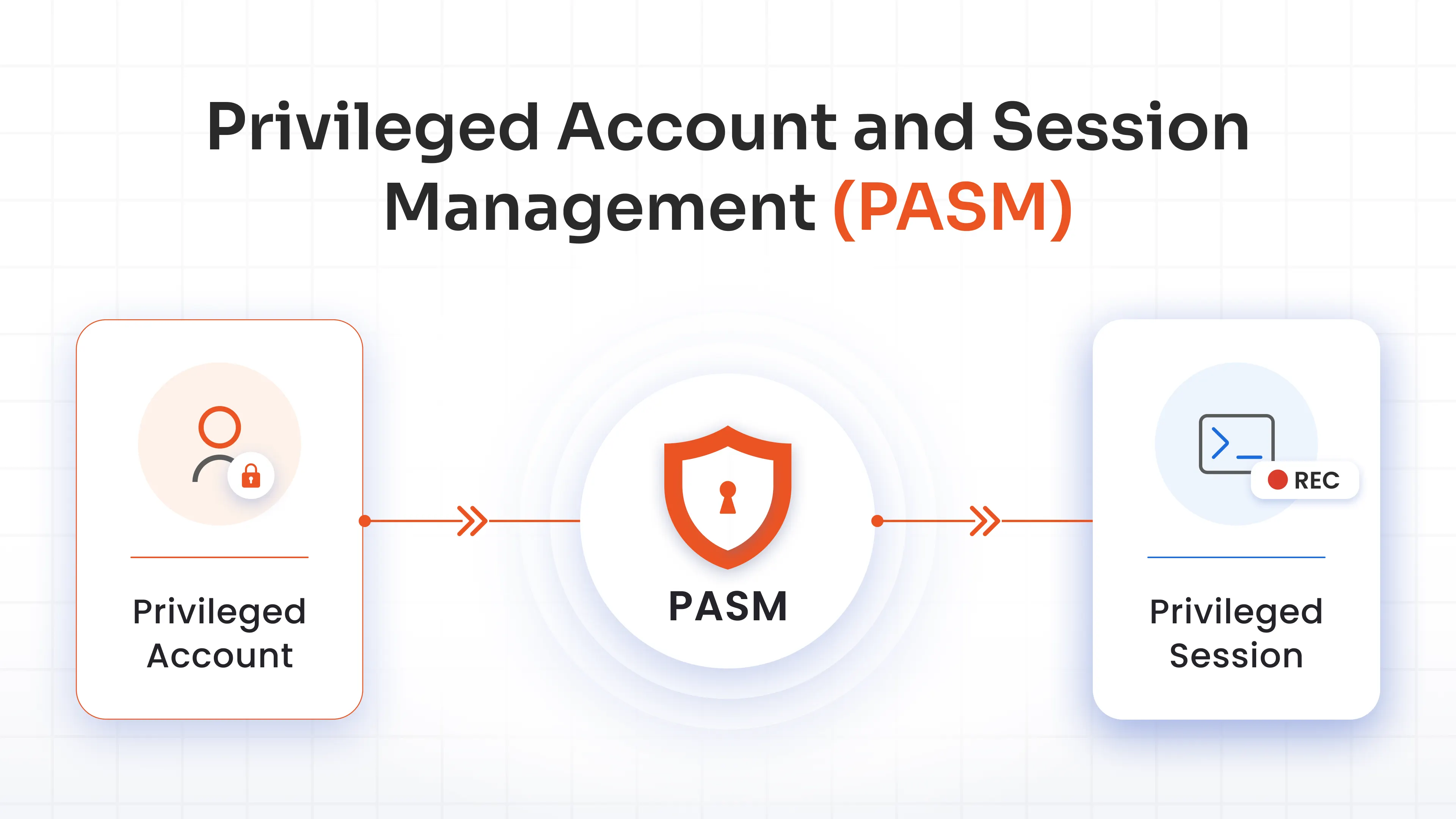
By pairing PAM with privileged account and session management, you get a fully audited, zero-trust connection framework.
Key Capabilities of PAM-Based SSH Session Monitoring
Centralized SSH Session Monitoring
View every active terminal session across your network from a single control dashboard. If your infrastructure spans multiple environments, you do not have to rely only on separate server logs.
SSH Session Recording and Playback
Automatically record video playbacks for every SSH connection, complete with precise timestamps.
Real-Time Session Monitoring
Watch active admin sessions live and collaborate with engineers using built-in session collaboration capabilities. This matters during high-risk administrative work.
Command-Level Monitoring and Control
miniOrange PAM's session recording experience provides command-level tracking and lets administrators navigate recorded sessions through commands and timestamps.
Privileged Session Termination
Instantly terminate suspicious SSH sessions with a single click. Act before a session becomes risky. Flag out-of-character logins and commands with privileged user behavior analytics.
Role-Based SSH Access
Role-based controls can help you define who should be able to access specific privileged resources and what they are allowed to do. This supports the principle of least privilege.
Just-In-Time (JIT) SSH Access
Instead of giving an administrator permanent access to a critical server, you can grant access for the required period and monitor the resulting session. This reduces permanent standing privileges.
Session Audit Trails
miniOrange PAM provides privileged session audit capabilities that track session activity with timestamps and event information. These records can support investigations and audit requirements.
Monitor and Record SSH Sessions With miniOrange PAM
If you need a reliable SSH monitoring tool built for hybrid infrastructure, miniOrange PAM offers a lightweight, identity-centric platform. It simplifies SSH access, vaulting, and auditing without adding unnecessary operational overhead.
You get access controls, session recording, audit trails, JIT access, credential management, and anomaly detection within a unified PAM platform.
FAQs
How do I check an active SSH session?
You can use commands such as who and w to view logged-in users. You can also use ss to inspect active network connections to the SSH service. These commands provide useful session and connection visibility, but they do not provide complete session recording.
What is an SSH monitoring tool?
An SSH monitoring tool helps you track SSH connections and activity. Depending on the tool, it may provide visibility into users, source IPs, target systems, commands, session duration, session recordings, and suspicious activity. A PAM solution can provide centralized privileged session monitoring, recording, control, and auditing across a larger environment.
How do I record an SSH session?
You can use native tools such as tlog or script to record terminal activity. For centralized privileged access, a PAM solution can provide session recording and playback. miniOrange PAM supports recording privileged sessions and reviewing them through its recorded-session interface.
Leave a Comment